
Last updated: May 11, 2026
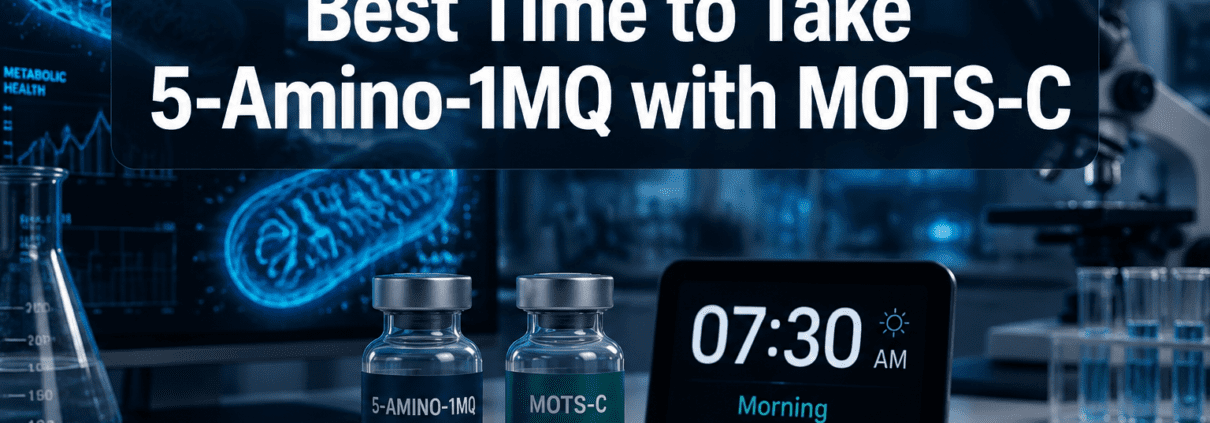
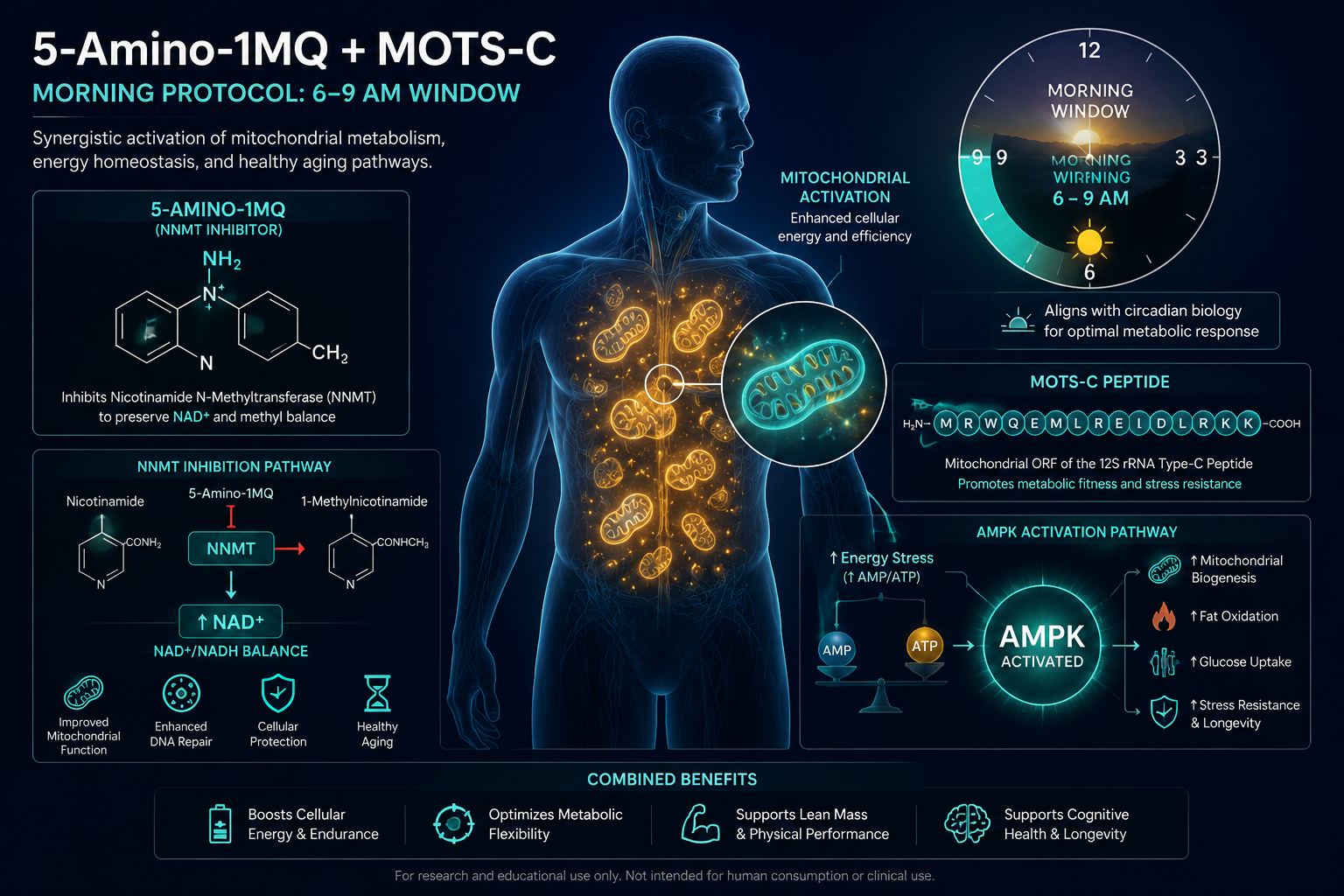
Quick Answer: For research purposes, the best time to take 5-Amino-1MQ with MOTS-C is in the morning, ideally 30–60 minutes before exercise or metabolic activity. Morning administration aligns with the body's natural circadian metabolic rhythms, and pairing these two compounds may support complementary pathways — NNMT inhibition (5-Amino-1MQ) and mitochondrial AMPK activation (MOTS-C). All products discussed are for research use only.
Key Takeaways
- Morning timing (fasted or pre-workout) is the most studied and commonly referenced window for both compounds
- 5-Amino-1MQ works by inhibiting NNMT, an enzyme linked to fat cell metabolism and NAD+ availability
- MOTS-C is a mitochondria-derived peptide that activates AMPK and supports metabolic flexibility
- Combining them may produce complementary, not redundant, effects on energy metabolism
- Subcutaneous injection is the typical research administration route for MOTS-C; 5-Amino-1MQ is often studied orally
- Stacking order matters: MOTS-C is generally administered first due to faster onset kinetics
- Cycle length in most research protocols runs 4–8 weeks, followed by an off period
- All compounds referenced here are for research purposes only and not approved for human therapeutic use
- Source purity matters — always verify third-party testing before use in any research context
What Are 5-Amino-1MQ and MOTS-C?
5-Amino-1MQ is a small-molecule NNMT (nicotinamide N-methyltransferase) inhibitor studied for its potential role in fat metabolism and NAD+ regulation. By blocking NNMT, it may help redirect methyl groups toward pathways that support cellular energy balance.
MOTS-C is a peptide encoded in mitochondrial DNA, specifically the 12S rRNA gene. It activates AMPK — a key cellular energy sensor — and has been studied in the context of mitochondrial dynamics and metabolic flexibility.
Together, these compounds target overlapping but distinct nodes of metabolic regulation, which is why researchers often study them in combination.
Why Timing Matters for 5-Amino-1MQ With MOTS-C
Timing is not arbitrary. Both compounds interact with metabolic pathways that fluctuate across the day based on circadian biology, feeding state, and physical activity.
Key timing factors:
- Circadian rhythm: AMPK activity (targeted by MOTS-C) tends to peak during periods of energy deficit, such as the fasted morning state
- Exercise synergy: Pre-exercise administration of MOTS-C has been the focus of several preclinical studies examining skeletal muscle glucose uptake
- NNMT inhibition timing: 5-Amino-1MQ's mechanism does not require acute exercise, but morning dosing in a fasted state may amplify NAD+ availability when cellular demand is rising
"Aligning peptide administration with natural metabolic windows — rather than arbitrary clock times — is a core principle in advanced research protocol design."
Best Time to Take 5-Amino-1MQ With MOTS-C: The Optimal Window
The most research-consistent window is 30–60 minutes before morning exercise, in a fasted or semi-fasted state. This applies whether the goal is metabolic research, body composition study, or longevity-related inquiry.
Suggested Research Timing Protocol
| Compound | Timing | Route | Notes |
|---|---|---|---|
| MOTS-C | 30–45 min pre-workout | Subcutaneous injection | Administer first |
| 5-Amino-1MQ | 30–60 min pre-workout | Oral (capsule) | Can follow MOTS-C |
| Both (rest days) | Morning, fasted | As above | Maintain consistent timing |
Choose morning timing if: the research subject exercises in the AM or follows intermittent fasting.
Choose pre-lunch timing if: the research protocol involves afternoon training sessions — consistency matters more than the exact clock hour.
For more on MOTS-C research and sourcing, including purity documentation, verified suppliers are essential.
How to Structure a Research Protocol Using Both Compounds
A structured approach reduces variables and improves data quality.
Step-by-step protocol outline:
- Establish baseline metrics before starting (body composition, fasting glucose, energy markers)
- Administer MOTS-C subcutaneously in the morning, 30–45 minutes before activity
- Follow with 5-Amino-1MQ orally within 15 minutes of MOTS-C
- Maintain consistent daily timing — circadian consistency amplifies both compounds' effects in preclinical models
- Run 4–6 week cycles with a 2–4 week washout period
- Track outcomes relevant to the research question (metabolic markers, body composition changes)
For researchers also exploring 5-Amino-1MQ research data and MOTS-C metabolic stress studies, cross-referencing protocols helps refine timing decisions.
Common Mistakes When Timing 5-Amino-1MQ With MOTS-C
Even experienced researchers make avoidable errors:
- Inconsistent timing: Varying administration by more than 2 hours day-to-day disrupts circadian alignment
- Taking both with a large meal: High-fat meals may slow absorption of oral 5-Amino-1MQ; a light or fasted state is preferable
- Skipping rest-day dosing: Both compounds benefit from daily consistency, not just training days
- Ignoring storage requirements: MOTS-C requires refrigeration; degraded peptide produces unreliable research data — always source from verified peptide manufacturers
FAQ
Q: Can 5-Amino-1MQ and MOTS-C be taken at the same time?
Yes, in research contexts they are often co-administered in the morning window. MOTS-C is typically injected first, followed by oral 5-Amino-1MQ within 15 minutes.
Q: Is evening dosing an option for this stack?
Evening use is less studied and potentially less aligned with circadian metabolic peaks. Morning or pre-exercise timing is the standard reference point in current research.
Q: How long before results are observed in research models?
Preclinical data suggests metabolic changes may appear within 2–4 weeks of consistent daily administration, though this varies by model and endpoint measured.
Q: Do these compounds require cycling?
Most research protocols include a washout period of 2–4 weeks after every 4–8 week cycle to assess baseline return and avoid receptor adaptation.
Q: Are there other peptides that pair well with this stack?
Researchers sometimes explore MOTS-C alongside SS-31 for mitochondrial-focused protocols, or reference NAD+ precursors alongside 5-Amino-1MQ given the NNMT-NAD+ connection.
Q: Where can verified MOTS-C and 5-Amino-1MQ be sourced for research?
Only use suppliers with third-party COAs and verified purity. See 5-Amino-1MQ research catalog and MOTS-C product listings for reference.
Conclusion
The best time to take 5-Amino-1MQ with MOTS-C in a research context is the morning fasted window, 30–60 minutes before physical activity. This timing aligns with circadian metabolic rhythms, maximizes AMPK sensitivity, and positions NNMT inhibition during a period of rising cellular NAD+ demand.
Actionable next steps for researchers:
- Establish a consistent morning administration window before designing any protocol
- Source both compounds from third-party tested suppliers with documented purity
- Track baseline and follow-up metabolic markers to generate meaningful data
- Cross-reference MOTS-C mitochondrial research themes to refine endpoint selection
- Consult current preclinical literature before finalizing any protocol design
All compounds referenced in this article are for research use only. They are not approved for human therapeutic use and should not be interpreted as medical advice.
References
- Lee, C., et al. "MOTS-c: A Mitochondrial-Derived Peptide Regulating Muscle and Fat Metabolism." Cell Metabolism, 2015. https://doi.org/10.1016/j.cmet.2014.12.009
- Neelakantan, H., et al. "Small Molecule Nicotinamide N-Methyltransferase Inhibitor Activates Senescent Muscle Stem Cells and Improves Regenerative Capacity of Aged Skeletal Muscle." Biochemical Pharmacology, 2019.
- Kim, S.J., et al. "MOTS-c: An Exercise Mimetic That Targets Mitochondrial AMPK Signaling." Aging, 2021.
Tags: 5-amino-1MQ, MOTS-C peptide, best time to take MOTS-C, 5amino1mq timing, peptide stack protocol, NNMT inhibitor research, mitochondrial peptides, AMPK activation, metabolic peptides, biohacking peptides, research peptide timing, longevity peptides