

Muscle satellite cells — the dormant repair crews inside skeletal tissue — only activate when the right chemical signal arrives at the right time. Peg-MGF peptide is engineered to extend exactly that signal window, turning a fleeting biological flash into a sustained broadcast. For fitness peptide enthusiasts tracking the cutting edge of recovery science, few compounds have generated as much research interest in 2026.
Key Takeaways 🔬
- Peg-MGF is a PEGylated (polyethylene glycol-modified) form of Mechano Growth Factor, a splice variant of IGF-1.
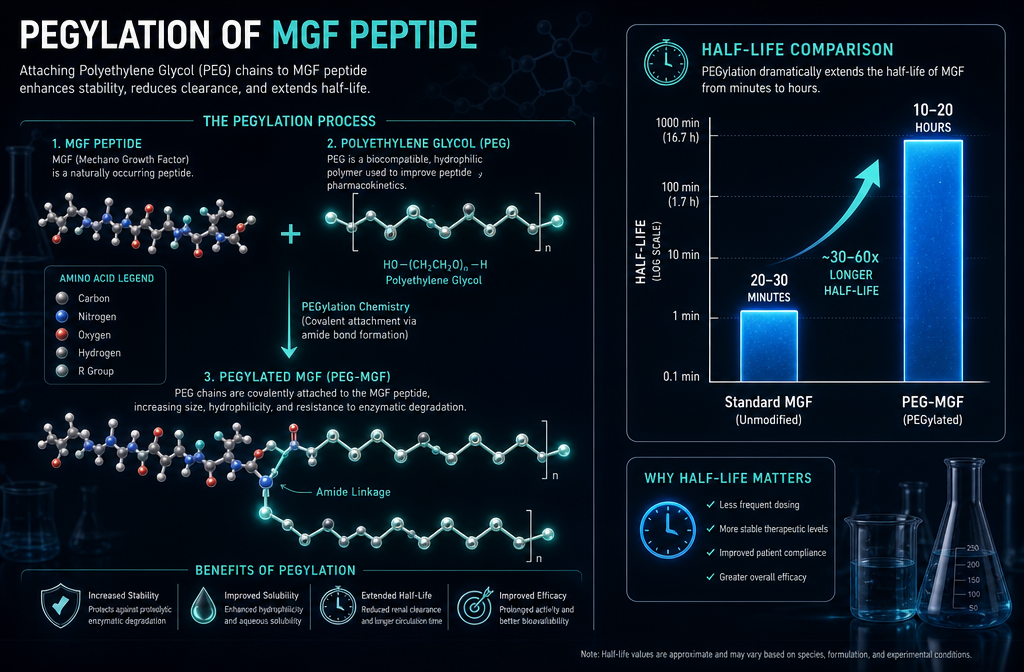
- PEGylation dramatically extends the peptide's half-life from minutes to several hours.
- Research focuses on satellite cell activation, muscle repair signaling, and tissue recovery biology.
- It is distinct from standard MGF due to its improved stability in aqueous environments.
- All Peg-MGF peptide products are strictly for research purposes only — not for human use.
What Is Peg-MGF Peptide?
Mechano Growth Factor (MGF) is a naturally occurring splice variant of Insulin-like Growth Factor 1 (IGF-1). It is produced locally in muscle tissue in response to mechanical stress — essentially, the body's internal repair dispatch signal.
The challenge? Native MGF degrades extremely quickly in the bloodstream — within minutes. PEGylation solves this by attaching polyethylene glycol chains to the peptide molecule, dramatically improving:
| Property | Standard MGF | Peg-MGF Peptide |
|---|---|---|
| Half-life | ~5–7 minutes | Several hours |
| Stability in solution | Low | Significantly higher |
| Systemic distribution | Limited | Broader |
| Research utility | Narrow window | Extended observation window |
This structural upgrade makes Peg-MGF peptide far more practical for controlled research settings. For a broader look at how delivery innovations are shaping peptide science, see this overview of innovative peptide delivery systems and what's next for therapeutics.
How Peg-MGF Peptide Works: The Research Mechanism
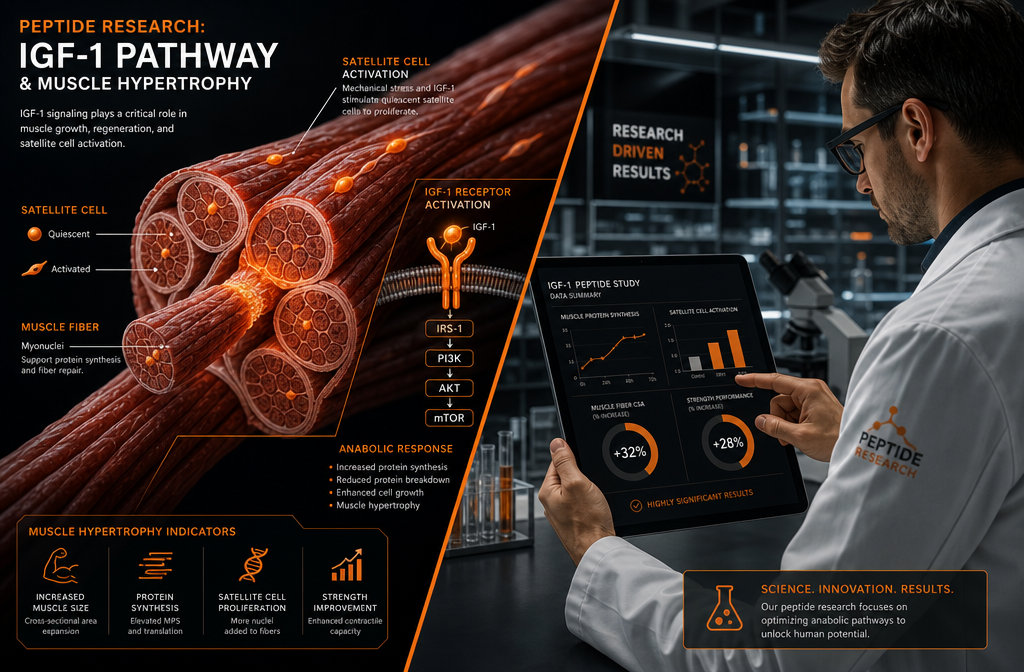
The core research interest in Peg-MGF peptide centers on its interaction with muscle satellite cells — quiescent stem-like cells that respond to tissue damage signals.
Satellite Cell Activation 💪
In preclinical models, MGF-derived peptides have been studied for their ability to:
- Stimulate satellite cell proliferation — encouraging dormant repair cells to multiply
- Delay satellite cell differentiation — keeping the repair pool active longer
- Support muscle fiber recovery after mechanical loading or damage
The extended half-life of the PEGylated form means researchers can observe these effects over a more practical timeframe compared to native MGF.
IGF-1 Pathway Connections
Because MGF is an IGF-1 splice variant, research often examines overlapping signaling pathways. This connects Peg-MGF to broader recovery and tissue biology research themes that are active across multiple peptide classes in 2026.
💡 Pull Quote: "PEGylation doesn't change what MGF does — it changes how long it has to do it."
Peg-MGF Peptide in the Context of Broader Peptide Research
Peg-MGF rarely exists in isolation within serious research stacks. Fitness peptide researchers often examine it alongside other compounds targeting recovery, body composition, and cellular signaling.
Related research areas worth exploring:
- Growth hormone secretagogues — such as Tesamorelin peptide research and CJC-1295 research themes, which address upstream GH/IGF-1 axis signaling
- Tissue repair peptides — including BPC-157 research documentation
- Longevity-focused compounds — explored in longevity peptide research overviews
For researchers who want to stay current, the latest peptide research updates page is a strong ongoing resource.
Purity Matters ⚠️
Any research involving Peg-MGF peptide demands verified purity. Impure or mislabeled peptides compromise data integrity entirely. Understanding peptide purity testing is a non-negotiable step before any research protocol begins.
Conclusion: What Researchers Should Know About Peg-MGF Peptide in 2026
Peg-MGF peptide represents a meaningful engineering advancement over native MGF — extending its research utility through improved half-life and stability. The compound's role in satellite cell biology and muscle repair signaling makes it a compelling subject for fitness-focused peptide research in 2026.
Actionable next steps for researchers:
- ✅ Source only lab-tested, verified-purity Peg-MGF peptide from reputable suppliers
- ✅ Review current IGF-1 splice variant literature before designing protocols
- ✅ Explore complementary peptide research areas (GH secretagogues, tissue repair)
- ✅ Stay updated on emerging peptide research as the field evolves rapidly
⚠️ Reminder: All Peg-MGF peptide products are intended for research purposes only. They are not approved for human consumption, therapeutic use, or veterinary application.
[wp_product_slider category="peptides" tag="muscle-growth" limit="6" title="Research Peptides — Featured Products"]
[wp_product_grid category="peptides" columns="3" limit="9" orderby="popularity" title="All Research Peptides for Sale"]
References
- Goldspink, G. (2005). Mechanical signals, IGF-I gene splicing, and muscle adaptation. Physiology, 20(4), 232–238.
- Yang, S. Y., & Goldspink, G. (2002). Different roles of the IGF-I Ec peptide (MGF) and mature IGF-I in myoblast proliferation and differentiation. FEBS Letters, 522(1–3), 156–160.
- Philippou, A., Maridaki, M., Halapas, A., & Koutsilieris, M. (2007). The role of the insulin-like growth factor 1 (IGF-1) in skeletal muscle physiology. In Vivo, 21(1), 45–54.
- Matheny, R. W., Nindl, B. C., & Adamo, M. L. (2010). Minireview: Mechano-growth factor: A putative product of IGF-I gene expression involved in tissue repair and adaptation. Endocrinology, 151(3), 865–875.
Tags: Peg-MGF peptide, MGF peptide research, PEGylated mechano growth factor, muscle satellite cell activation, IGF-1 splice variant, fitness peptide research, peptide half-life extension, muscle recovery peptides, research peptides 2026, MGF vs Peg-MGF, peptide purity testing, growth factor peptides