

Last updated: May 11, 2026
Quick Answer: Epithalon and MOTS-C synergy refers to the combined use of two research peptides — Epithalon (a telomerase-activating tetrapeptide) and MOTS-C (a mitochondria-derived peptide) — that target distinct but complementary aging pathways. Epithalon works primarily at the epigenetic and telomere level, while MOTS-C acts on mitochondrial energy regulation and metabolic stress response. Together, they represent a dual-pathway approach to cellular longevity research.
Key Takeaways
- Epithalon is a synthetic tetrapeptide studied for its role in telomere maintenance and pineal gland regulation.
- MOTS-C is encoded in mitochondrial DNA and is linked to metabolic flexibility, AMPK activation, and stress resilience.
- The two peptides target different cellular compartments — nucleus/epigenome vs. mitochondria — making their combined study scientifically logical.
- Neither peptide is approved for human therapeutic use; both are for research purposes only.
- Epithalon and MOTS-C synergy is of particular interest to longevity researchers studying the intersection of epigenetic aging and mitochondrial decline.
- Early preclinical research suggests each peptide has distinct mechanisms with minimal pathway overlap, reducing the risk of redundancy in combined protocols.
- Sourcing purity-tested peptides matters significantly in research settings.
What Is Epithalon and MOTS-C Synergy?
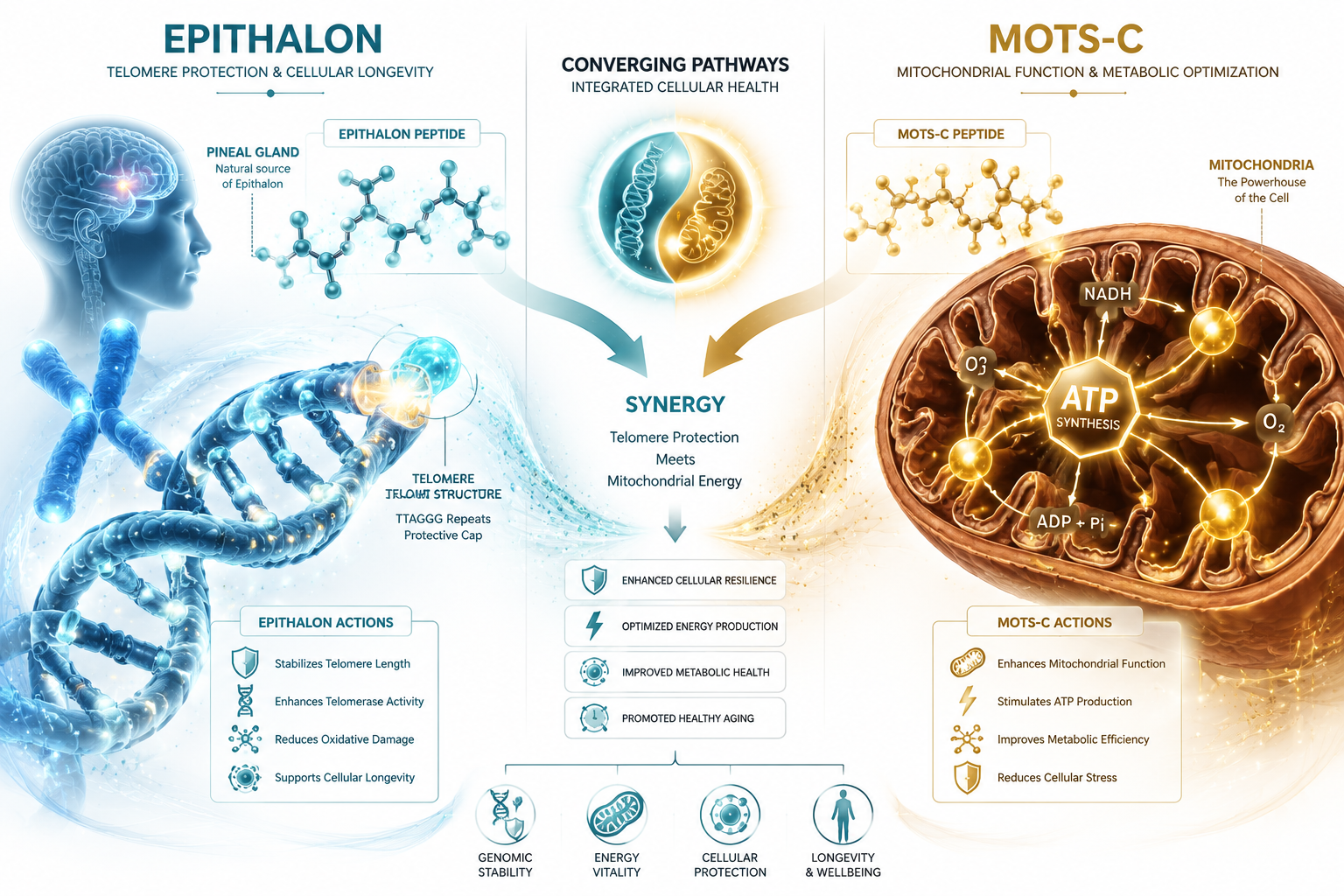
Epithalon and MOTS-C synergy describes the hypothesis — and emerging research interest — that these two peptides may complement each other by addressing aging from two separate biological angles simultaneously. Epithalon targets the telomere-epigenetic axis; MOTS-C targets the mitochondrial-metabolic axis.
Why this matters: Cellular aging is not a single-pathway event. Telomere shortening and mitochondrial dysfunction are two of the most well-documented hallmarks of aging (López-Otín et al., Cell, 2013). A protocol addressing both simultaneously is more mechanistically complete than one addressing either alone.
- Epithalon (Ala-Glu-Asp-Gly): Studied for telomerase activation, melatonin regulation, and antioxidant effects in preclinical models.
- MOTS-C (Mitochondrial Open Reading Frame of the 12S rRNA-c): A 16-amino acid peptide that activates AMPK, supports insulin sensitivity, and modulates cellular stress responses.
For a deeper look at each peptide individually, see the MOTS-C mechanism and research overview and the Epithalon longevity signals research page.
How Do the Two Pathways Differ?
| Feature | Epithalon | MOTS-C |
|---|---|---|
| Origin | Synthetic tetrapeptide | Mitochondrial-encoded peptide |
| Primary target | Telomeres, pineal gland | Mitochondria, AMPK pathway |
| Key mechanism | Telomerase activation | Metabolic stress regulation |
| Research model focus | Aging, immune, neuroendocrine | Metabolic flexibility, exercise response |
| Overlap risk | Low | Low |
Because the pathways are largely non-overlapping, researchers studying epithalon and MOTS-C synergy generally expect additive rather than redundant effects. This is a core reason the combination draws interest in longevity-focused research circles.
What Does the Research Say About Epithalon and MOTS-C Synergy?
Direct head-to-head studies on the combined use of epithalon and MOTS-C are limited as of 2026. Most available data comes from independent preclinical studies on each peptide.
Epithalon research highlights:
- Preclinical studies in rodent models have shown associations with extended lifespan markers and telomerase activity (Khavinson et al., Bulletin of Experimental Biology and Medicine, 2003).
- Antioxidant and melatonin-regulatory effects have been documented in animal models.
MOTS-C research highlights:
- Lee et al. (Cell Metabolism, 2015) identified MOTS-C as a mitochondrial-derived peptide that regulates metabolic homeostasis and extends lifespan in mouse models.
- MOTS-C levels naturally decline with age, suggesting a potential role in age-related metabolic decline.
For more on MOTS-C's mitochondrial research themes, visit the MOTS-C mitochondrial research overview.

Who Is This Research Combination Relevant For?
Epithalon and MOTS-C synergy research is most relevant for:
- Longevity researchers studying multi-pathway interventions in aging models.
- Biohackers tracking the preclinical peptide literature for emerging dual-peptide protocols.
- Fitness-focused researchers interested in MOTS-C's documented effects on exercise metabolism and muscle insulin sensitivity.
Not relevant for: Anyone seeking approved therapeutic treatments. These are research compounds only, not approved drugs or supplements.
⚠️ All peptides referenced in this article are for research use only and are not intended for human therapeutic use, diagnosis, or treatment.
How Does This Compare to Other Peptide Synergy Combinations?
The epithalon and MOTS-C pairing is one of several dual-peptide research frameworks gaining attention. For comparison:
- LL-37 and MOTS-C synergy focuses on immune-metabolic interaction.
- MOTS-C and SLU-PP-332 targets exercise mimetic pathways.
- SS-31 and MOTS-C combines two mitochondria-focused compounds for overlapping but distinct effects.
The epithalon/MOTS-C combination is unique because it pairs a nuclear/epigenetic agent with a mitochondrial one — a broader mechanistic reach than most same-organelle pairings.
Conclusion
Epithalon and MOTS-C synergy sits at the intersection of two of the most studied hallmarks of aging: telomere biology and mitochondrial function. While direct combination studies remain limited, the mechanistic logic is sound — these peptides work on distinct cellular systems with minimal redundancy.
Actionable next steps for researchers:
- Review independent preclinical literature on each peptide before designing combination protocols.
- Source purity-verified peptides from tested suppliers — see Epithalon peptides for research and MOTS-C peptides for research.
- Track emerging combination studies through PubMed and preprint servers, as this area is evolving rapidly in 2026.
- Cross-reference with related longevity peptide research at longevity peptide research overview.
All compounds are for research use only.
FAQ
Q: What is epithalon and MOTS-C synergy?
A: It refers to the combined research use of Epithalon (a telomere-targeting tetrapeptide) and MOTS-C (a mitochondrial-derived peptide) to address two distinct aging pathways simultaneously.
Q: Are Epithalon and MOTS-C approved for human use?
A: No. Both are research peptides only, not approved for therapeutic use in humans.
Q: Do Epithalon and MOTS-C have overlapping mechanisms?
A: No. Epithalon primarily targets telomeres and the pineal gland; MOTS-C targets mitochondrial metabolism via AMPK. The pathways are largely distinct.
Q: Where can researchers source these peptides?
A: Purity-tested research peptides are available through verified suppliers. See Epithalon for sale and MOTS-C for sale.
Q: Is there direct clinical evidence for combining these two peptides?
A: As of 2026, direct combination studies are limited. Evidence comes primarily from independent preclinical research on each peptide.
Q: How does MOTS-C relate to mitochondrial aging?
A: MOTS-C is encoded in mitochondrial DNA and declines with age. Preclinical research links it to metabolic flexibility and stress resilience. See the MOTS-C mitochondrial dynamics research.
Q: What makes this combination different from other peptide pairings?
A: Most dual-peptide combinations target similar organelles or pathways. Epithalon and MOTS-C target the nucleus/epigenome and mitochondria respectively — a broader mechanistic spread.
References
- Khavinson, V.K., et al. (2003). "Epithalon peptide induces telomerase activity and telomere elongation in human somatic cells." Bulletin of Experimental Biology and Medicine, 135(6), 590–592.
- Lee, C., et al. (2015). "The mitochondrial-derived peptide MOTS-c promotes metabolic homeostasis and reduces obesity and insulin resistance." Cell Metabolism, 21(3), 443–454.
- López-Otín, C., et al. (2013). "The hallmarks of aging." Cell, 153(6), 1194–1217.
Tags: epithalon and MOTS-C synergy, epithalon peptide research, MOTS-C mitochondrial peptide, longevity peptides, telomere research, mitochondrial aging, biohacking peptides, peptide synergy, AMPK activation, cellular aging research, research peptides 2026, dual peptide protocol