

Roughly 43 million musculoskeletal injuries are recorded annually in the United States alone — yet the peptide science community continues to focus significant attention on a fragment derived from thymosin beta-4, known as TB-500, as a subject of serious tissue repair research. TB-500 for healing and tissue repair has become one of the most discussed peptide topics among researchers studying recovery biology, largely because of its proposed role in cellular migration, actin regulation, and inflammatory modulation.
Key Takeaways
- TB-500 is a synthetic version of a naturally occurring peptide fragment derived from thymosin beta-4, a protein found in nearly all human and animal cells.
- Research interest centers on TB-500's proposed ability to support actin regulation, which plays a direct role in cell movement and tissue repair processes.
- TB-500 has been studied in the context of muscle, tendon, ligament, and cardiac tissue recovery.
- It is currently a research compound and is not approved for human therapeutic use.
- Understanding the mechanism behind TB-500 helps researchers contextualize it within the broader landscape of healing peptides.
What Is TB-500 and How Does It Work
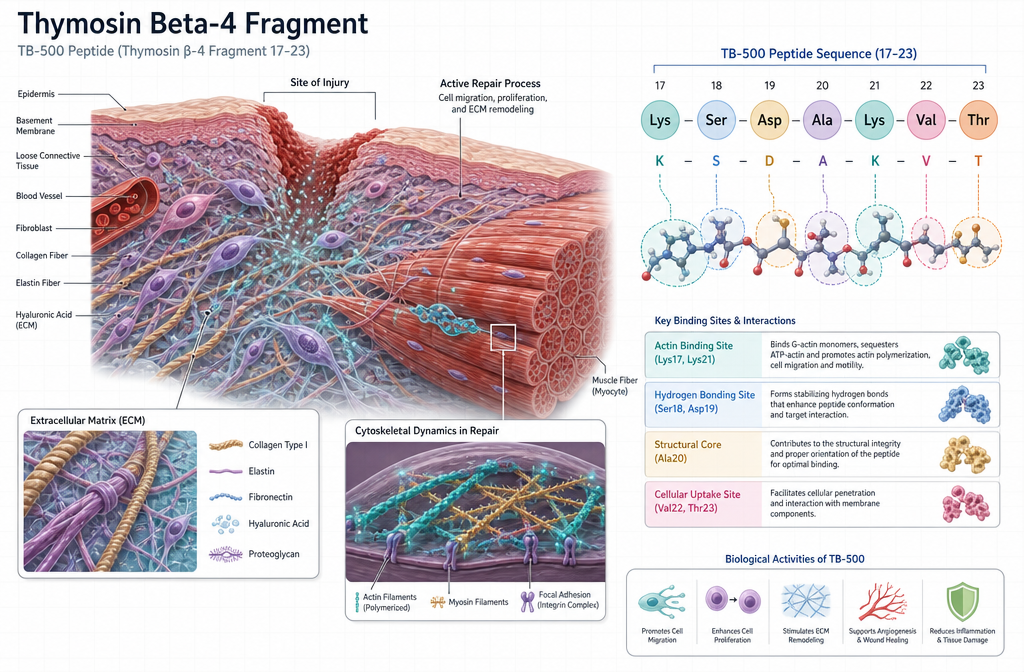
TB-500 is a synthetic peptide corresponding to amino acids 17–23 of thymosin beta-4 (TB4), a 43-amino acid protein that occurs naturally in virtually every nucleated cell in the body. The active sequence — Ac-LKKTETQ — is considered the functional core responsible for TB4's interaction with G-actin, the monomeric form of the structural protein actin.
Actin regulation is central to understanding TB-500's proposed mechanism. By sequestering G-actin, TB-500 may:
- Promote cell migration and proliferation
- Support angiogenesis (new blood vessel formation)
- Modulate local inflammatory responses
- Encourage extracellular matrix remodeling
This mechanism distinguishes TB-500 from growth hormone secretagogues or metabolic peptides. For a broader view of how peptides interact with tissue biology, the recovery and tissue biology overview provides useful foundational context.
"The actin-sequestering function of thymosin beta-4 fragments positions TB-500 as a unique candidate in cellular repair research."
TB-500 for Healing and Tissue Repair: Research Applications
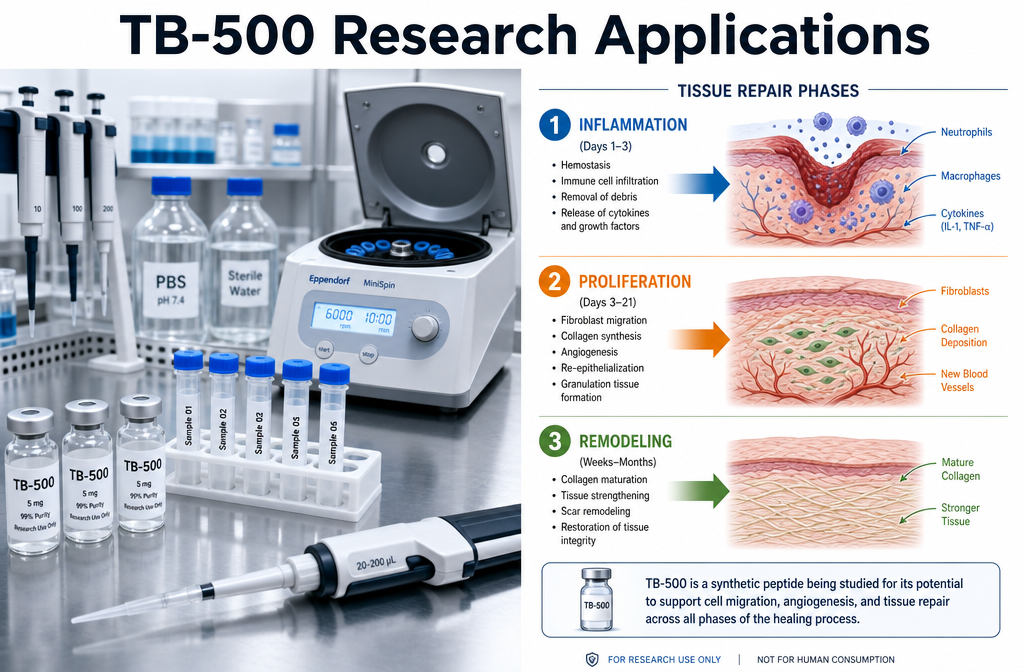
Research into TB-500 for healing and tissue repair has explored several tissue types, each with distinct repair challenges.
Muscle and Connective Tissue
Preclinical studies have examined TB-500's effect on skeletal muscle recovery following injury. The peptide's proposed role in satellite cell activation and fibroblast migration makes it relevant to both acute and chronic tissue damage models.
| Tissue Type | Research Focus | Proposed Mechanism |
|---|---|---|
| Skeletal Muscle | Recovery from strain | Satellite cell support |
| Tendons/Ligaments | Repair after overuse | Fibroblast migration |
| Cardiac Tissue | Post-ischemic remodeling | Angiogenesis support |
| Corneal Tissue | Wound closure speed | Epithelial cell migration |
Cardiac and Vascular Research
Some of the most compelling preclinical data involves cardiac tissue. TB-500 has been studied for its potential to support angiogenesis and reduce scar formation following ischemic events in animal models. This overlaps with research into other peptides targeting cellular energy and vascular health, such as those explored in MOTS-c mitochondrial research.
Skin and Wound Healing
TB-500's influence on keratinocyte and endothelial cell migration has made it a subject of wound-healing research. Researchers studying skin repair compounds may also find value in reviewing GHK-Cu peptide research, another peptide with documented interest in skin tissue biology.
TB-500 vs. BPC-157: Key Differences
Both TB-500 and BPC-157 appear frequently in recovery peptide discussions. They are structurally unrelated and proposed to work through different pathways.
- BPC-157 primarily targets growth hormone receptor pathways and gut-brain axis signaling.
- TB-500 targets actin dynamics and cell motility directly.
Some researchers study them together. For more on BPC-157 research, see the BPC-157 nasal spray and capsules evidence overview.
Important Research Considerations
TB-500 remains a research compound only. It is not approved by any regulatory body for human therapeutic use. Researchers sourcing peptides for study should prioritize purity verification. Reviewing certificate of analysis standards helps ensure compound integrity before any research begins.
Those building broader recovery-focused research protocols may also benefit from exploring peptide blends for research to understand how TB-500 fits within multi-peptide frameworks.
Conclusion
TB-500 for healing and tissue repair represents one of the more mechanistically grounded areas of current peptide research. Its proposed role in actin regulation, angiogenesis, and cellular migration gives researchers a clear biological rationale for continued investigation across muscle, tendon, cardiac, and skin tissue models.
Actionable next steps for researchers:
- Review available preclinical literature on thymosin beta-4 fragments before designing protocols.
- Source TB-500 only from suppliers who provide third-party certificates of analysis.
- Consider how TB-500 complements other recovery-focused peptides in a structured research design.
- Stay updated on regulatory status in your jurisdiction before initiating any study.
Tags: TB-500, thymosin beta-4, peptide research, tissue repair, healing peptides, actin regulation, BPC-157, recovery biology, connective tissue, angiogenesis, research peptides, wound healing