

Growth hormone (GH) secretion declines by roughly 14% per decade after age 30 — a biological shift that has driven significant research interest in peptides that can stimulate the pituitary gland naturally. Among these compounds, CJC-1295 for growth hormone release has become one of the most studied GHRH analogs in preclinical and early clinical research settings.
Key Takeaways
- CJC-1295 is a synthetic analog of growth hormone-releasing hormone (GHRH) designed to extend the half-life of natural GHRH signaling.
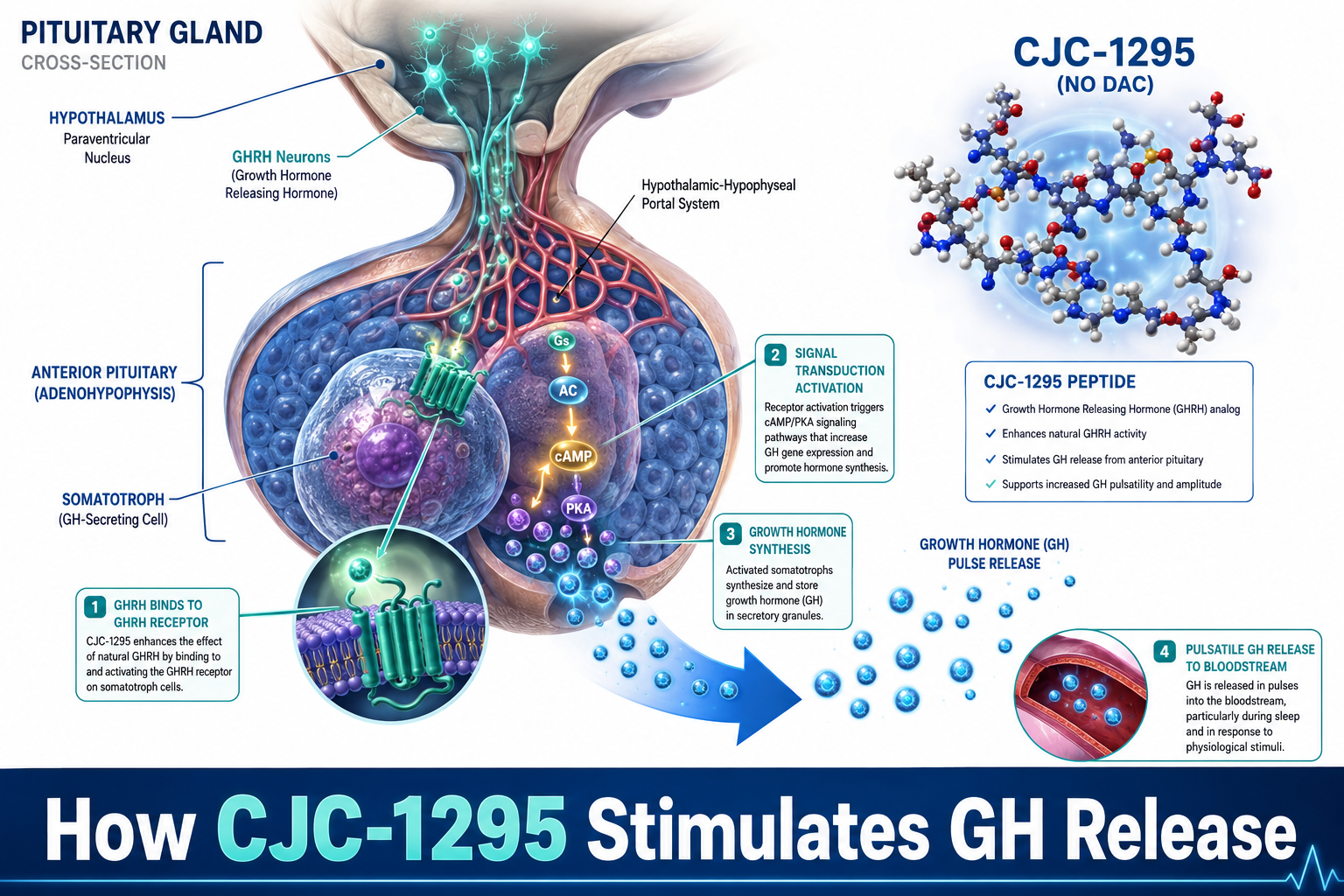
- It works by binding to GHRH receptors on the pituitary gland, prompting pulsatile GH secretion.
- Two primary forms exist: CJC-1295 with DAC and CJC-1295 without DAC, each with distinct pharmacokinetic profiles.
- Research frequently examines CJC-1295 in combination with ghrelin mimetics like Ipamorelin for synergistic GH stimulation.
- Purity and sourcing quality are critical factors when evaluating CJC-1295 for any research application.
What Is CJC-1295 and How Does It Work
CJC-1295 is a 30-amino acid synthetic peptide engineered to mimic the action of endogenous GHRH. Natural GHRH has a very short half-life — measured in minutes — because plasma enzymes rapidly degrade it. CJC-1295 was designed to resist this enzymatic breakdown, extending its active window considerably.
The peptide binds to GHRH receptors on somatotroph cells in the anterior pituitary. This binding triggers a cascade that results in increased GH pulse amplitude and frequency. Importantly, CJC-1295 for growth hormone release works within the body's existing feedback systems rather than bypassing them, which is a key distinction from exogenous GH administration.
CJC-1295 With DAC vs. Without DAC
| Feature | With DAC | Without DAC |
|---|---|---|
| Half-life | 6-8 days | 30 minutes |
| GH release pattern | Sustained baseline elevation | Pulsatile, mimics natural rhythm |
| Research use | Long-acting studies | Pulse-mimicking protocols |
The Drug Affinity Complex (DAC) modification allows the peptide to bind to albumin in the bloodstream, dramatically extending its half-life. Researchers exploring the CJC-1295 with DAC research findings have noted this distinction matters significantly for study design.
For a deeper look at the DAC mechanism, the CJC-1295 with DAC deeper dive resource provides useful background on pharmacokinetic comparisons.
CJC-1295 for Growth Hormone Release: Research Combinations and Protocols
One of the most studied approaches in GH secretagogue research involves pairing CJC-1295 with a ghrelin receptor agonist. Ghrelin mimetics like Ipamorelin act on a completely separate receptor pathway (the GHS-R1a receptor), and when combined with a GHRH analog, the two signals work synergistically to amplify GH output beyond what either compound achieves alone.
"Combining a GHRH analog with a ghrelin mimetic targets two independent receptor pathways simultaneously, producing a more robust GH pulse than either agent alone."
This synergistic approach is explored in detail within the CJC-1295 plus Ipamorelin research overview, which outlines how these two peptide classes complement each other in research models.
Multi-peptide blend research has also expanded. Formulations that include Tesamorelin, CJC-1295, and Ipamorelin represent a growing area of interest for researchers studying combined GH axis stimulation. Similarly, researchers reviewing Sermorelin, Ipamorelin, and CJC-1295 combinations have examined how stacking multiple GHRH-related peptides affects overall GH axis response.
Key Research Themes in 2026
Ongoing research into CJC-1295 for growth hormone release centers on several areas:
- Body composition — GH's role in lean mass preservation and fat metabolism
- Sleep quality — GH is predominantly released during slow-wave sleep; GHRH analogs may influence this pattern
- Recovery markers — Tissue repair processes linked to IGF-1 downstream signaling
- Metabolic parameters — Insulin sensitivity and lipid profiles in GH-deficient models
Researchers looking at CJC-1295 no-DAC research themes and CJC-1295 DAC muscle research themes will find these areas well-documented in the available literature.
Sourcing and Purity Considerations
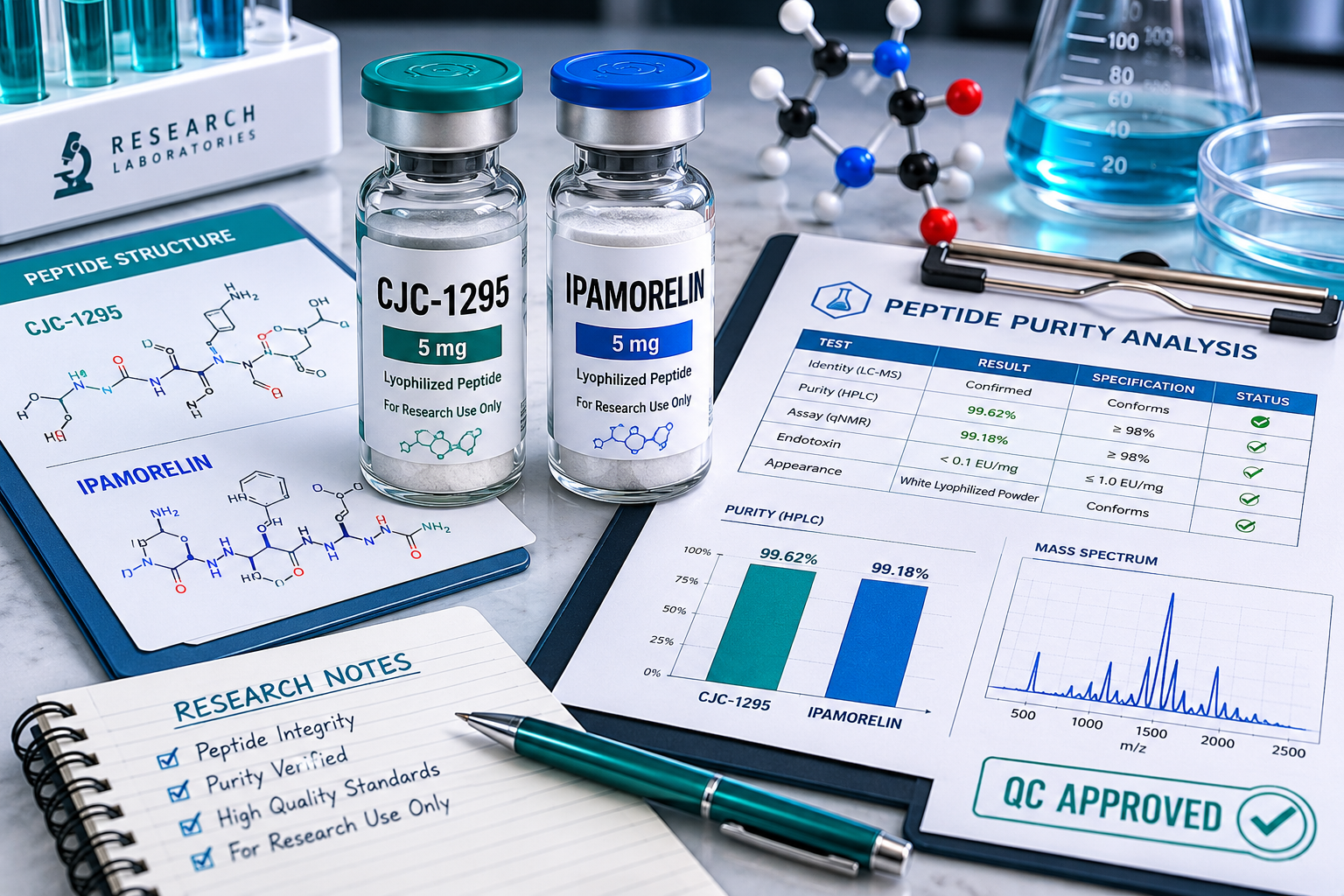
For any research application, peptide purity is non-negotiable. A compound with low assay values or unknown impurities produces unreliable data. Researchers should consult a thorough CJC-1295 and Ipamorelin assay planning and sourcing checklist before beginning any protocol. Third-party HPLC and mass spectrometry verification are considered the gold standard for confirming peptide identity and purity.
Conclusion
CJC-1295 for growth hormone release remains one of the most actively researched GHRH analogs available to the scientific community in 2026. Its ability to extend the half-life of GHRH signaling, combined with a well-characterized receptor mechanism, makes it a valuable tool in GH axis research. Researchers should prioritize sourcing verified, high-purity material, carefully select between DAC and no-DAC formulations based on study design, and consider synergistic peptide combinations where relevant. Consulting updated research themes and assay planning resources before initiating any study will help ensure reproducible, meaningful results.
Tags: CJC-1295, growth hormone release, GHRH analog, CJC-1295 with DAC, CJC-1295 without DAC, Ipamorelin, peptide research, GH secretagogue, pituitary peptides, GHRH receptor, peptide purity, growth hormone research