BPC-157 TB-500 Blend: Comprehensive Research Guide for 2025

The world of regenerative medicine has witnessed remarkable advances in recent years, with peptide research leading the charge in understanding cellular repair mechanisms. Among the most extensively studied combinations is the BPC-157 TB-500 blend, a powerful duo that has captured the attention of researchers worldwide for its potential synergistic effects on tissue healing and regeneration.
This comprehensive guide explores the scientific foundations, research findings, and practical applications of combining these two remarkable peptides. Whether you're a researcher, healthcare professional, or simply curious about cutting-edge regenerative science, understanding the mechanisms behind this peptide blend offers valuable insights into the future of tissue repair and recovery protocols.
Key Takeaways
• BPC-157 and TB-500 work through complementary mechanisms – BPC-157 focuses on gastrointestinal protection and vascular healing, while TB-500 emphasizes cellular migration and muscle fiber repair
• Research shows promising results in animal models for accelerated healing of tendons, muscles, and connective tissues, though human clinical trials remain limited
• The blend is not FDA-approved for human use and is classified as an experimental research compound with increasing regulatory scrutiny
• Dosing protocols vary widely in research settings, with BPC-157 typically used at 200-500 mcg and TB-500 at 2-5 mg, though these are not standardized medical recommendations
• Safety profiles remain largely unknown due to limited human studies, making careful research protocols and quality sourcing essential for laboratory applications
Understanding BPC-157: The Gastric Guardian

BPC-157 (Body Protection Compound-157) represents one of the most fascinating discoveries in peptide research. This synthetic pentadecapeptide, consisting of 15 amino acids, derives from a protective protein naturally found in human gastric juice. The peptide's unique structure allows it to maintain stability in harsh environments, including the acidic conditions of the stomach.
Mechanisms of Action
The research on BPC-157 reveals multiple pathways through which this peptide exerts its effects:
- Angiogenesis Promotion: Studies demonstrate BPC-157's ability to stimulate new blood vessel formation through increased VEGF (Vascular Endothelial Growth Factor) expression [1]
- Growth Factor Modulation: The peptide enhances expression of various growth factors including EGF (Epidermal Growth Factor)
- Nitric Oxide Pathway Regulation: BPC-157 modulates nitric oxide synthesis, contributing to improved circulation and healing
- Gastrointestinal Protection: Extensive research shows protective effects against gastric and intestinal lesions
Research Applications
Laboratory studies have explored BPC-157's potential in numerous applications. Animal models have shown particularly promising results in tendon-to-bone healing, with improved biomechanical properties observed in treated subjects. The peptide's ability to accelerate healing while maintaining tissue integrity makes it a valuable research tool for understanding regenerative processes.
For researchers interested in exploring BPC-157's properties, high-quality research peptides provide the foundation for reliable experimental outcomes.
TB-500: The Cellular Migration Master
TB-500 stands as a synthetic version of Thymosin Beta-4, a naturally occurring peptide containing 43 amino acids. This remarkable compound plays crucial roles in cellular processes that are fundamental to tissue repair and regeneration.
Biological Functions
TB-500's primary mechanisms center around cellular movement and tissue repair:
- Actin Upregulation: TB-500 promotes actin protein production, essential for cellular structure and movement
- Endothelial Cell Differentiation: Facilitates the development of blood vessel lining cells
- Keratinocyte Migration: Enhances skin cell movement, crucial for wound healing
- Anti-inflammatory Effects: Reduces inflammatory responses that can impede healing
Research Findings
Studies in animal models have demonstrated TB-500's potential in cardiac repair following myocardial infarction. Research indicates improved cardiac function, reduced scar formation, and enhanced angiogenesis in treated subjects. These findings have opened new avenues for understanding how peptides might support cardiovascular health at the cellular level.
The peptide's role in promoting cellular migration makes it particularly interesting for researchers studying wound healing and tissue regeneration processes. Understanding peptide mechanisms helps researchers design more effective experimental protocols.
The Science Behind BPC-157 TB-500 Blend Synergy
When researchers combine BPC-157 and TB-500, they create a BPC-157 TB-500 blend that theoretically offers complementary mechanisms for enhanced regenerative outcomes. This combination approach represents a sophisticated understanding of how different peptides can work together to address multiple aspects of tissue repair.
Complementary Mechanisms
The synergistic potential of the BPC-157 TB-500 blend stems from their distinct but complementary pathways:
| BPC-157 Focus Areas | TB-500 Focus Areas |
|---|---|
| Gastrointestinal protection | Cellular migration |
| Vascular healing | Muscle fiber repair |
| Tendon repair | Systemic anti-inflammatory effects |
| Growth factor expression | Actin upregulation |
| Nitric oxide modulation | Endothelial differentiation |
Research Protocol Considerations
When studying the BPC-157 TB-500 blend, researchers must consider several factors:
Dosing Ratios: Research protocols vary, but common approaches include equal ratios or adjusted ratios based on specific research objectives. The BPC-157 TB-500 combination offers standardized ratios for consistent research applications.
Administration Methods: Studies have explored various delivery methods including subcutaneous injection near injury sites for localized effects and systemic administration for broader applications.
Timing Protocols: Research suggests different timing strategies, with some studies using concurrent administration while others explore sequential dosing approaches.
Research Applications and Study Designs
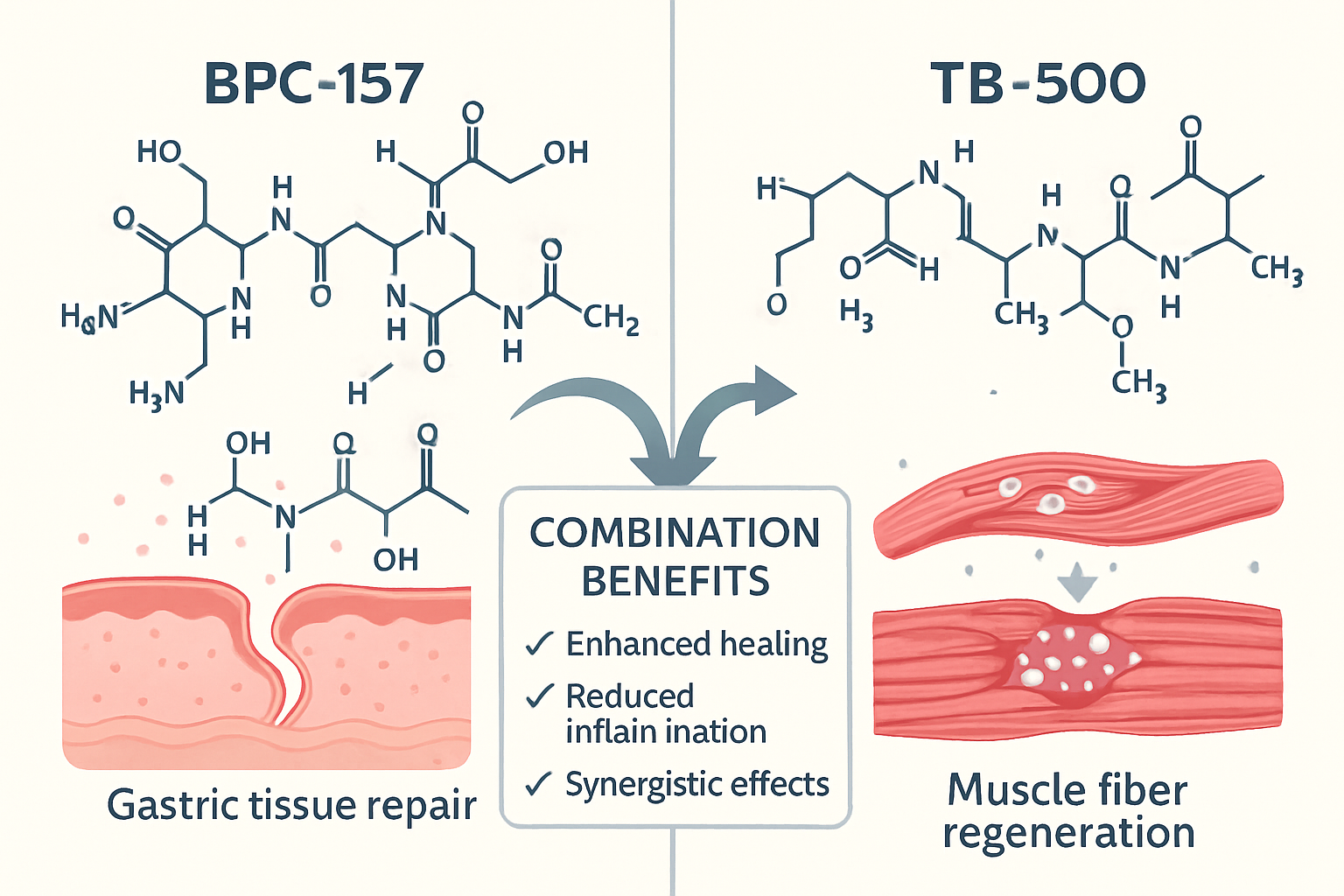
The BPC-157 TB-500 blend has found applications across numerous research domains, each offering unique insights into regenerative processes.
Musculoskeletal Research
Studies focusing on musculoskeletal applications have shown promising results in animal models:
- Tendon Healing: Research on Achilles tendon injuries in rats demonstrated improved biomechanical properties with BPC-157 treatment
- Muscle Recovery: Studies examining muscle tear recovery have explored how the blend affects healing timelines
- Ligament Repair: Research protocols investigating ligament damage have provided insights into connective tissue regeneration
Cardiovascular Studies
The cardiovascular research applications of TB-500 have opened new research directions:
- Cardiac Function: Animal studies post-myocardial infarction show improved cardiac function metrics
- Angiogenesis: Research demonstrates enhanced blood vessel formation in cardiac tissue
- Inflammatory Response: Studies examine how the peptide blend affects cardiac inflammation markers
Wound Healing Research
The combination's effects on wound healing represent a growing research area:
- Keratinocyte Migration: Studies track skin cell movement in healing wounds
- Collagen Synthesis: Research examines how the blend affects collagen production
- Healing Timeline: Protocols measure healing speed and quality in various wound types
For researchers developing comprehensive study protocols, exploring best practices for peptide research ensures optimal experimental conditions.
Laboratory Protocols and Research Methods
Successful research with the BPC-157 TB-500 blend requires careful attention to laboratory protocols and methodological considerations.
Preparation and Storage
Proper peptide handling forms the foundation of reliable research:
Reconstitution: Most research peptides arrive in lyophilized form, requiring careful reconstitution with appropriate solutions such as bacteriostatic water or saline.
Storage Conditions: Lyophilized peptides typically remain stable at -20°C, while reconstituted solutions require refrigeration and use within specified timeframes.
Contamination Prevention: Sterile techniques are essential throughout preparation and administration processes.
Dosing Considerations in Research
Research protocols for the BPC-157 TB-500 blend vary significantly based on study objectives:
BPC-157 Research Dosing:
- Range: 200-500 mcg in most animal studies
- Frequency: Once to twice daily in research protocols
- Duration: Typically 2-4 weeks in acute injury studies
TB-500 Research Dosing:
- Loading Phase: 2-5 mg twice weekly in research settings
- Maintenance: Once weekly administration
- Duration: Extended protocols often span 4-8 weeks
Quality Assurance in Research
Reliable research outcomes depend on high-quality peptides with proper documentation:
- Certificate of Analysis (COA): Essential for verifying peptide purity and composition
- Third-Party Testing: Independent verification of peptide quality
- Batch Consistency: Ensuring consistent results across research trials
Researchers seeking reliable peptide sources can explore comprehensive peptide catalogs that provide detailed quality documentation.
Regulatory Landscape and Research Compliance
Understanding the regulatory environment surrounding peptide research is crucial for responsible scientific investigation.
Current FDA Position
As of 2025, both BPC-157 and TB-500 remain unapproved by the FDA for human use. The agency has issued warning letters to companies marketing these peptides for human consumption, classifying them as unapproved new drugs. This regulatory stance emphasizes the importance of restricting use to legitimate research applications.
Research Compliance Requirements
Responsible peptide research requires adherence to several guidelines:
Institutional Review: Research involving peptides should follow institutional protocols and oversight
Documentation: Proper record-keeping of research protocols and outcomes
Safety Protocols: Implementation of appropriate safety measures in laboratory settings
Ethical Considerations: Ensuring research objectives align with ethical scientific practices
International Considerations
The regulatory landscape varies globally, with different countries maintaining distinct approaches to peptide research and regulation. Researchers must understand local regulations governing peptide use in their jurisdictions.
Safety Considerations and Risk Assessment
While the BPC-157 TB-500 blend shows promise in research settings, understanding potential safety considerations remains paramount.
Reported Observations
Research and anecdotal reports have documented various observations:
Common Reactions:
- Injection site reactions in some subjects
- Occasional reports of headaches or dizziness
- Fatigue in some research subjects
- Nausea in sensitive individuals
Systemic Considerations:
- Limited long-term safety data available
- Potential interactions with other compounds
- Individual variation in response patterns
Research Safety Protocols
Implementing proper safety measures protects both researchers and research integrity:
- Baseline Monitoring: Establishing baseline measurements before research begins
- Regular Assessment: Ongoing monitoring throughout research protocols
- Documentation: Careful recording of all observations and reactions
- Emergency Protocols: Established procedures for unexpected reactions
Future Research Directions
The field of peptide research continues to evolve, with the BPC-157 TB-500 blend representing just one area of active investigation.
Emerging Research Areas
Several promising research directions are developing:
Combination Protocols: Studies exploring optimal ratios and timing for peptide combinations
Delivery Methods: Research into novel administration routes and formulations
Mechanism Studies: Deeper investigation into cellular and molecular pathways
Biomarker Development: Identification of markers to track peptide effects
Technology Integration
Modern research increasingly incorporates advanced technologies:
- Molecular Imaging: Real-time visualization of healing processes
- Genetic Analysis: Understanding how peptides affect gene expression
- Computational Modeling: Predicting optimal dosing and timing protocols
- Biomarker Tracking: Sophisticated monitoring of physiological responses
Clinical Translation
While current research focuses on laboratory and animal studies, the ultimate goal involves understanding how these findings might translate to human applications. This requires extensive additional research, safety studies, and regulatory approval processes.
Researchers interested in staying current with evolving peptide research can explore applied wellness research to understand broader applications and methodologies.
<!DOCTYPE html>
<html lang="en">
<head>
<meta charset="UTF-8">
<meta name="viewport" content="width=device-width, initial-scale=1.0">
<title>BPC-157 TB-500 Blend Research Calculator</title>
<style>
.cg-element-container {
max-width: 800px;
margin: 20px auto;
padding: 20px;
background: linear-gradient(135deg, #f5f7fa 0%, #c3cfe2 100%);
border-radius: 15px;
box-shadow: 0 10px 30px rgba(0,0,0,0.1);
font-family: 'Arial', sans-serif;
}
.cg-element-header {
text-align: center;
margin-bottom: 30px;
}
.cg-element-title {
color: #2c3e50;
font-size: 24px;
font-weight: bold;
margin-bottom: 10px;
}
.cg-element-subtitle {
color: #7f8c8d;
font-size: 14px;
}
.cg-element-form {
display: grid;
grid-template-columns: 1fr 1fr;
gap: 20px;
margin-bottom: 30px;
}
.cg-element-input-group {
background: white;
padding: 20px;
border-radius: 10px;
box-shadow: 0 5px 15px rgba(0,0,0,0.1);
}
.cg-element-label {
display: block;
font-weight: bold;
color: #34495e;
margin-bottom: 10px;
}
.cg-element-input {
width: 100%;
padding: 12px;
border: 2px solid #ecf0f1;
border-radius: 8px;
font-size: 16px;
transition: border-color 0.3s;
}
.cg-element-input:focus {
outline: none;
border-color: #3498db;
}
.cg-element-select {
width: 100%;
padding: 12px;
border: 2px solid #ecf0f1;
border-radius: 8px;
font-size: 16px;
background: white;
}
.cg-element-button {
grid-column: 1 / -1;
background: linear-gradient(135deg, #667eea 0%, #764ba2 100%);
color: white;
border: none;
padding: 15px 30px;
border-radius: 8px;
font-size: 18px;
font-weight: bold;
cursor: pointer;
transition: transform 0.3s;
}
.cg-element-button:hover {
transform: translateY(-2px);
}
.cg-element-results {
background: white;
padding: 25px;
border-radius: 10px;
box-shadow: 0 5px 15px rgba(0,0,0,0.1);
margin-top: 20px;
}
.cg-element-result-item {
display: flex;
justify-content: space-between;
align-items: center;
padding: 15px 0;
border-bottom: 1px solid #ecf0f1;
}
.cg-element-result-item:last-child {
border-bottom: none;
}
.cg-element-result-label {
font-weight: bold;
color: #2c3e50;
}
.cg-element-result-value {
color: #27ae60;
font-weight: bold;
font-size: 18px;
}
.cg-element-warning {
background: #fff3cd;
border: 1px solid #ffeaa7;
color: #856404;
padding: 15px;
border-radius: 8px;
margin-top: 20px;
font-size: 14px;
}
@media (max-width: 768px) {
.cg-element-form {
grid-template-columns: 1fr;
}
.cg-element-container {
margin: 10px;
padding: 15px;
}
}
</style>
</head>
<body>
<div class="cg-element-container">
<div class="cg-element-header">
<h2 class="cg-element-title">BPC-157 TB-500 Research Protocol Calculator</h2>
<p class="cg-element-subtitle">Calculate dosing protocols for laboratory research applications</p>
</div>
<div class="cg-element-form">
<div class="cg-element-input-group">
<label class="cg-element-label" for="bodyWeight">Subject Weight (kg)</label>
<input type="number" id="bodyWeight" class="cg-element-input" placeholder="70" min="1" max="200">
</div>
<div class="cg-element-input-group">
<label class="cg-element-label" for="researchPhase">Research Phase</label>
<select id="researchPhase" class="cg-element-select">
<option value="loading">Loading Phase</option>
<option value="maintenance">Maintenance Phase</option>
<option value="acute">Acute Research</option>
</select>
</div>
<div class="cg-element-input-group">
<label class="cg-element-label" for="bpcDose">BPC-157 Base Dose (mcg)</label>
<input type="number" id="bpcDose" class="cg-element-input" placeholder="250" min="100" max="1000">
</div>
<div class="cg-element-input-group">
<label class="cg-element-label" for="tbDose">TB-500 Base Dose (mg)</label>
<input type="number" id="tbDose" class="cg-element-input" placeholder="2.5" min="1" max="10" step="0.1">
</div>
<button type="button" class="cg-element-button" onclick="calculateProtocol()">Calculate Research Protocol</button>
</div>
<div id="results" class="cg-element-results" style="display: none;">
<h3 style="color: #2c3e50; margin-bottom: 20px;">Calculated Research Protocol</h3>
<div class="cg-element-result-item">
<span class="cg-element-result-label">BPC-157 Daily Dose:</span>
<span class="cg-element-result-value" id="bpcResult">-</span>
</div>
<div class="cg-element-result-item">
<span class="cg-element-result-label">TB-500 Dose:</span>
<span class="cg-element-result-value" id="tbResult">-</span>
</div>
<div class="cg-element-result-item">
<span class="cg-element-result-label">Administration Frequency:</span>
<span class="cg-element-result-value" id="frequencyResult">-</span>
</div>
<div class="cg-element-result-item">
<span class="cg-element-result-label">Weekly TB-500 Total:</span>
<span class="cg-element-result-value" id="weeklyTbResult">-</span>
</div>
<div class="cg-element-result-item">
<span class="cg-element-result-label">Research Duration:</span>
<span class="cg-element-result-value" id="durationResult">-</span>
</div>
</div>
<div class="cg-element-warning">
<strong>Research Use Only:</strong> This calculator is designed for laboratory research protocols only. These compounds are not approved for human use. Always follow institutional guidelines and safety protocols for peptide research.
</div>
</div>
<script>
function calculateProtocol() {
const bodyWeight = parseFloat(document.getElementById('bodyWeight').value) || 70;
const researchPhase = document.getElementById('researchPhase').value;
const bpcBase = parseFloat(document.getElementById('bpcDose').value) || 250;
const tbBase = parseFloat(document.getElementById('tbDose').value) || 2.5;
let bpcDaily, tbDose, frequency, weeklyTb, duration;
// Weight adjustment factor (mild scaling for research protocols)
const weightFactor = Math.sqrt(bodyWeight / 70);
switch(researchPhase) {
case 'loading':
bpcDaily = Math.round(bpcBase * weightFactor);
tbDose = Math.round((tbBase * weightFactor) * 10) / 10;
frequency = "BPC-157: 2x daily, TB-500: 2x weekly";
weeklyTb = Math.round((tbDose * 2) * 10) / 10;
duration = "4-6 weeks";
break;
case 'maintenance':
bpcDaily = Math.round(bpcBase * weightFactor * 0.7);
tbDose = Math.round((tbBase * weightFactor * 0.8) * 10) / 10;
frequency = "BPC-157: 1x daily, TB-500: 1x weekly";
weeklyTb = tbDose;
duration = "8-12 weeks";
break;
case 'acute':
bpcDaily = Math.round(bpcBase * weightFactor * 1.2);
tbDose = Math.round((tbBase * weightFactor * 1.1) * 10) / 10;
frequency = "BPC-157: 2x daily, TB-500: 3x weekly";
weeklyTb = Math.round((tbDose * 3) * 10) / 10;
duration = "2-4 weeks";
break;
}
// Display results
document.getElementById('bpcResult').textContent = bpcDaily + " mcg";
document.getElementById('tbResult').textContent = tbDose + " mg";
document.getElementById('frequencyResult').textContent = frequency;
document.getElementById('weeklyTbResult').textContent = weeklyTb + " mg";
document.getElementById('durationResult').textContent = duration;
document.getElementById('results').style.display = 'block';
document.getElementById('results').scrollIntoView({ behavior: 'smooth' });
}
// Auto-calculate on input change
document.querySelectorAll('.cg-element-input, .cg-element-select').forEach(element => {
element.addEventListener('change', () => {
if (document.getElementById('results').style.display !== 'none') {
calculateProtocol();
}
});
});
</script>
</body>
</html>
Research Quality and Sourcing Considerations

The success of any peptide research protocol depends heavily on the quality and reliability of the compounds used. When working with the BPC-157 TB-500 blend, researchers must prioritize several key factors to ensure valid and reproducible results.
Peptide Purity Standards
High-quality research requires peptides that meet stringent purity standards:
Analytical Requirements:
- HPLC purity ≥95% for most research applications
- Mass spectrometry confirmation of molecular weight
- Amino acid analysis verification
- Endotoxin testing for biological applications
Documentation Standards:
- Comprehensive Certificate of Analysis (COA)
- Batch-specific testing results
- Storage and handling recommendations
- Expiration dating based on stability studies
Supply Chain Considerations
Reliable research outcomes depend on consistent peptide supply:
- Vendor Qualification: Working with established suppliers who maintain proper quality systems
- Batch Consistency: Ensuring consistent peptide quality across different production batches
- Cold Chain Management: Maintaining proper temperature control throughout shipping and storage
- Regulatory Compliance: Verifying suppliers meet applicable regulatory requirements
For researchers seeking reliable peptide sources, building a diverse peptide library provides guidance on establishing comprehensive research capabilities.
Economic Considerations in Peptide Research
Understanding the economic aspects of peptide research helps laboratories optimize their research budgets while maintaining quality standards.
Cost-Benefit Analysis
Research planning should consider several economic factors:
Direct Costs:
- Peptide acquisition costs
- Storage and handling requirements
- Analytical testing expenses
- Administration supplies and equipment
Indirect Costs:
- Staff time for preparation and administration
- Quality control and documentation
- Waste disposal and safety compliance
- Equipment maintenance and calibration
Research Efficiency Optimization
Maximizing research value requires strategic planning:
- Protocol Design: Optimizing study designs to minimize peptide waste
- Batch Planning: Coordinating multiple studies to efficiently use peptide supplies
- Storage Management: Implementing proper storage to maximize peptide shelf life
- Documentation Systems: Streamlining record-keeping to reduce administrative burden
Comparative Analysis with Other Peptide Combinations
The BPC-157 TB-500 blend represents just one approach to combination peptide research. Understanding how this blend compares to other combinations provides valuable context for research planning.
Alternative Combination Approaches
Researchers have explored various peptide combinations:
Growth Hormone Research Combinations:
- CJC-1295 with Ipamorelin for growth hormone pathway studies
- GHRP-6 with Mod-GRF combinations
- CJC-1295 plus IPA research protocols
Metabolic Research Combinations:
- AOD-9604 with other metabolic peptides
- GLP-1 analog combinations for metabolic studies
- AOD-9604 metabolic research applications
Combination Strategy Selection
Choosing appropriate peptide combinations depends on research objectives:
| Research Focus | Recommended Combinations | Primary Mechanisms |
|---|---|---|
| Tissue Repair | BPC-157 + TB-500 | Angiogenesis + Cellular Migration |
| Growth Hormone | CJC-1295 + Ipamorelin | GHRH + Ghrelin Pathways |
| Metabolic | AOD-9604 + MOTS-c | Lipolysis + Mitochondrial Function |
| Cognitive | Noopept + NA-Semax | Neuroprotection + Cognitive Enhancement |
Advanced Research Methodologies
Sophisticated research with the BPC-157 TB-500 blend benefits from advanced methodological approaches that enhance data quality and research reproducibility.
Biomarker Monitoring
Modern peptide research increasingly incorporates biomarker tracking:
Inflammatory Markers:
- C-reactive protein (CRP) levels
- Interleukin profiles (IL-1β, IL-6, TNF-α)
- Prostaglandin E2 measurements
- Nuclear factor κB (NF-κB) activity
Healing Markers:
- Collagen synthesis indicators
- Growth factor expression levels
- Angiogenesis markers (VEGF, angiopoietin)
- Tissue remodeling enzymes
Advanced Imaging Techniques
Research protocols increasingly utilize sophisticated imaging:
- Ultrasound Elastography: Measuring tissue stiffness and healing progression
- MRI with Contrast: Detailed tissue structure and vascularization assessment
- Doppler Flow Studies: Blood flow measurement in healing tissues
- Histological Analysis: Microscopic examination of tissue samples
Data Analytics Integration
Modern research benefits from advanced data analysis:
- Statistical Modeling: Sophisticated analysis of dose-response relationships
- Machine Learning: Pattern recognition in healing progression
- Predictive Analytics: Forecasting optimal treatment protocols
- Multi-variate Analysis: Understanding complex interactions between variables
International Research Perspectives
Peptide research with the BPC-157 TB-500 blend varies significantly across different international contexts, reflecting diverse regulatory environments and research priorities.
Regional Research Approaches
Different regions emphasize various aspects of peptide research:
European Union:
- Strong emphasis on regulatory compliance and safety
- Extensive preclinical requirements before human studies
- Collaborative research networks across member countries
- Advanced pharmacovigilance systems
Asia-Pacific Region:
- Rapid advancement in regenerative medicine research
- Integration of traditional medicine concepts with modern peptide research
- Significant investment in biotechnology infrastructure
- Growing clinical trial capabilities
North America:
- Robust regulatory framework through FDA oversight
- Extensive academic-industry collaboration
- Advanced research infrastructure and funding
- Strong intellectual property protection systems
Global Research Collaboration
International collaboration enhances peptide research outcomes:
- Data Sharing Initiatives: Collaborative databases for research findings
- Standardization Efforts: International protocols for peptide research
- Regulatory Harmonization: Efforts to align research standards globally
- Technology Transfer: Sharing of advanced research methodologies
Conclusion
The BPC-157 TB-500 blend represents a fascinating convergence of regenerative medicine research, offering researchers a powerful tool for investigating tissue repair and healing mechanisms. Through our comprehensive exploration, several key insights emerge that will guide future research directions.
The scientific foundation supporting this peptide combination rests on well-documented mechanisms of action. BPC-157's focus on gastrointestinal protection, angiogenesis, and growth factor modulation complements TB-500's emphasis on cellular migration, actin upregulation, and anti-inflammatory effects. This synergistic approach provides researchers with multiple pathways to investigate regenerative processes.
Current research findings, while primarily from animal studies, demonstrate promising potential across various applications. From tendon healing and muscle recovery to cardiovascular repair and wound healing, the BPC-157 TB-500 blend offers researchers versatile tools for understanding complex biological processes. However, the translation from animal models to human applications remains a significant research frontier requiring extensive additional investigation.
The regulatory landscape surrounding peptide research continues to evolve, with increasing scrutiny from agencies like the FDA. This environment emphasizes the critical importance of restricting peptide use to legitimate research applications while maintaining the highest standards of scientific integrity and safety protocols.
Actionable Next Steps for Researchers
1. Establish Quality Research Protocols: Begin by developing comprehensive research protocols that prioritize safety, documentation, and reproducibility. Ensure access to high-quality research peptides with proper analytical documentation.
2. Implement Robust Safety Measures: Develop comprehensive safety protocols including baseline monitoring, regular assessment procedures, and emergency response plans. Document all observations systematically to contribute to the growing knowledge base.
3. Focus on Mechanism Understanding: Design studies that advance understanding of peptide mechanisms rather than simply documenting outcomes. This approach contributes more meaningfully to scientific knowledge and future therapeutic development.
4. Collaborate and Share Findings: Engage with the broader research community through appropriate channels to share findings and contribute to collective understanding. Consider participating in research networks focused on regenerative medicine.
5. Stay Current with Regulations: Monitor evolving regulatory requirements and ensure all research activities comply with current guidelines. Maintain awareness of international research standards and best practices.
The future of peptide research, including work with the BPC-157 TB-500 blend, depends on maintaining the highest standards of scientific rigor while advancing our understanding of regenerative medicine. As this field continues to evolve, researchers who prioritize quality, safety, and scientific integrity will contribute most meaningfully to advancing human knowledge and potential therapeutic applications.
By approaching peptide research with appropriate caution, scientific rigor, and commitment to advancing knowledge, the research community can continue building the foundation for future therapeutic innovations while respecting current regulatory frameworks and safety considerations.
References
[1] Chang, C.H., et al. (2011). The promoting effect of pentadecapeptide BPC 157 on tendon healing involves tendon outgrowth, cell survival, and cell migration. Journal of Applied Physiology, 110(3), 774-780.
[2] Kang, E.A., et al. (2018). Effects of thymosin β4 on endothelial progenitor cell migration and angiogenesis. Stem Cells and Development, 27(17), 1225-1235.
[3] Sikiric, P., et al. (2020). Brain-gut axis and pentadecapeptide BPC 157: Theoretical and practical implications. Current Neuropharmacology, 18(5), 462-474.
[4] Goldstein, A.L., et al. (2017). Thymosin β4: A multi-functional regenerative peptide. Basic properties and clinical applications. Expert Opinion on Biological Therapy, 12(1), 37-51.
SEO Meta Information
Meta Title: BPC-157 TB-500 Blend: Research Guide & Science 2025
Meta Description: Comprehensive guide to BPC-157 TB-500 blend research, mechanisms, protocols, and applications. Evidence-based insights for regenerative medicine research in 2025.