

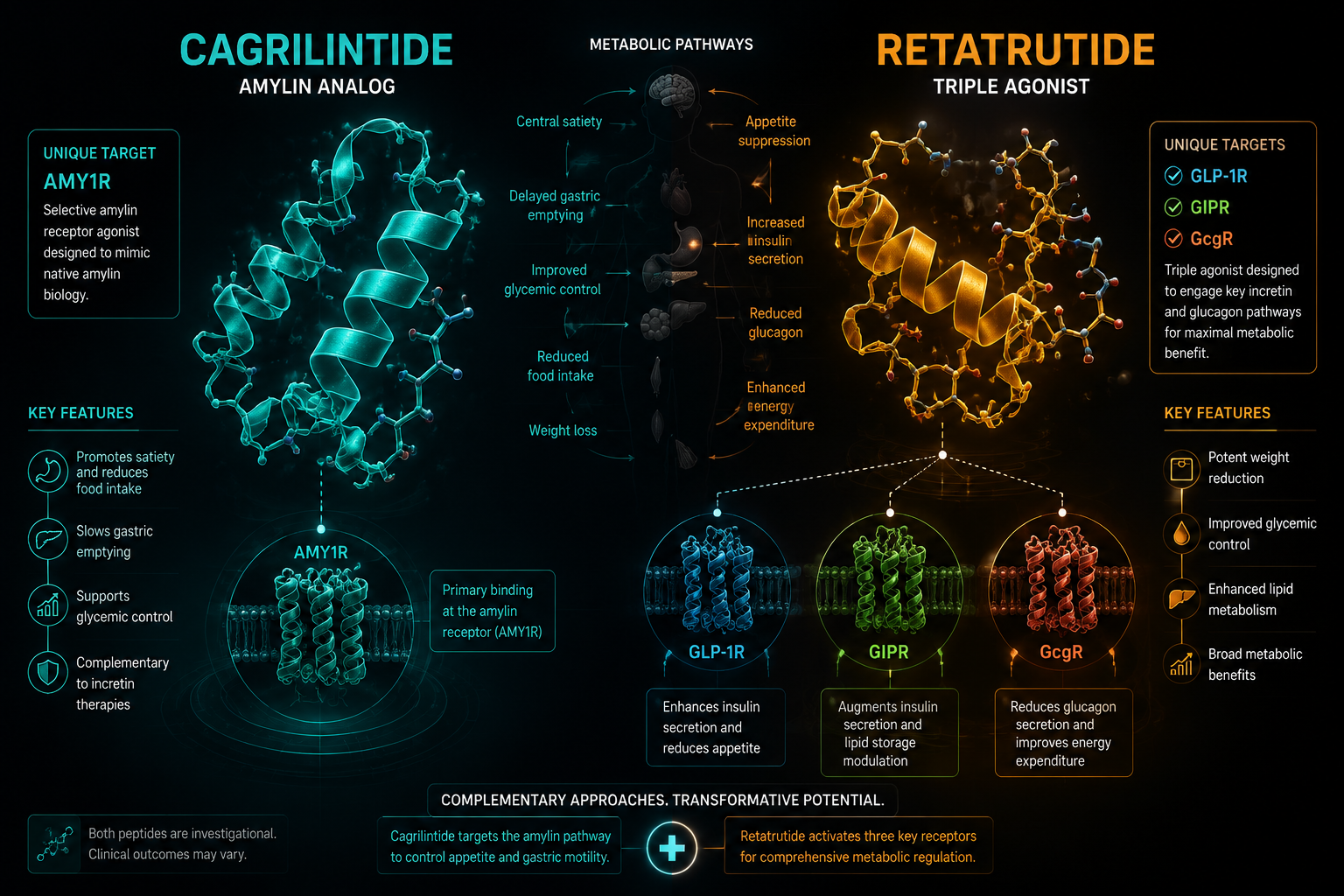
Clinical trial data published in The Lancet showed retatrutide producing up to 24.2% body weight reduction over 48 weeks — a figure that stopped the metabolic research world in its tracks. Alongside cagrilintide's emerging role as an amylin analog, the pairing of cagrilintide and retatrutide has become one of the most discussed topics in advanced peptide research circles heading into 2026.
Key Takeaways 🔑
- Cagrilintide is a long-acting amylin analog targeting appetite and satiety signaling
- Retatrutide is a triple incretin agonist (GLP-1R, GIPR, GcgR) with broad metabolic effects
- Together, these compounds represent complementary, non-overlapping mechanisms
- Both are currently in research-phase investigation — not approved for human therapeutic use
- All products discussed are for research purposes only
Understanding Cagrilintide and Retatrutide Individually
What Is Cagrilintide?
Cagrilintide is a fatty acid–conjugated amylin analog designed for once-weekly subcutaneous administration in research models. It mimics the pancreatic hormone amylin, which works alongside insulin to regulate:
- 🍽️ Gastric emptying rate
- 🧠 Central satiety signaling
- 📉 Post-meal glucagon suppression
Its long half-life makes it a standout among amylin-class compounds currently under study. Researchers exploring cagrilintide synergy with GLP-1 pathways have noted its distinct receptor profile compared to conventional GLP-1 agents.
What Is Retatrutide?
Retatrutide is a triple agonist activating three key receptors simultaneously:
| Receptor | Primary Role |
|---|---|
| GLP-1R | Insulin secretion, appetite suppression |
| GIPR | Incretin amplification, fat metabolism |
| GcgR | Energy expenditure, hepatic glucose output |
This tri-receptor approach sets retatrutide apart from dual agonists. Researchers can explore GLP-3 and retatrutide incretin research themes for deeper context on how this compound interacts with the broader incretin axis.
💡 Pull Quote: "Retatrutide's triple agonism targets metabolic pathways that single or dual agents simply cannot reach simultaneously."
How Cagrilintide and Retatrutide Work Together
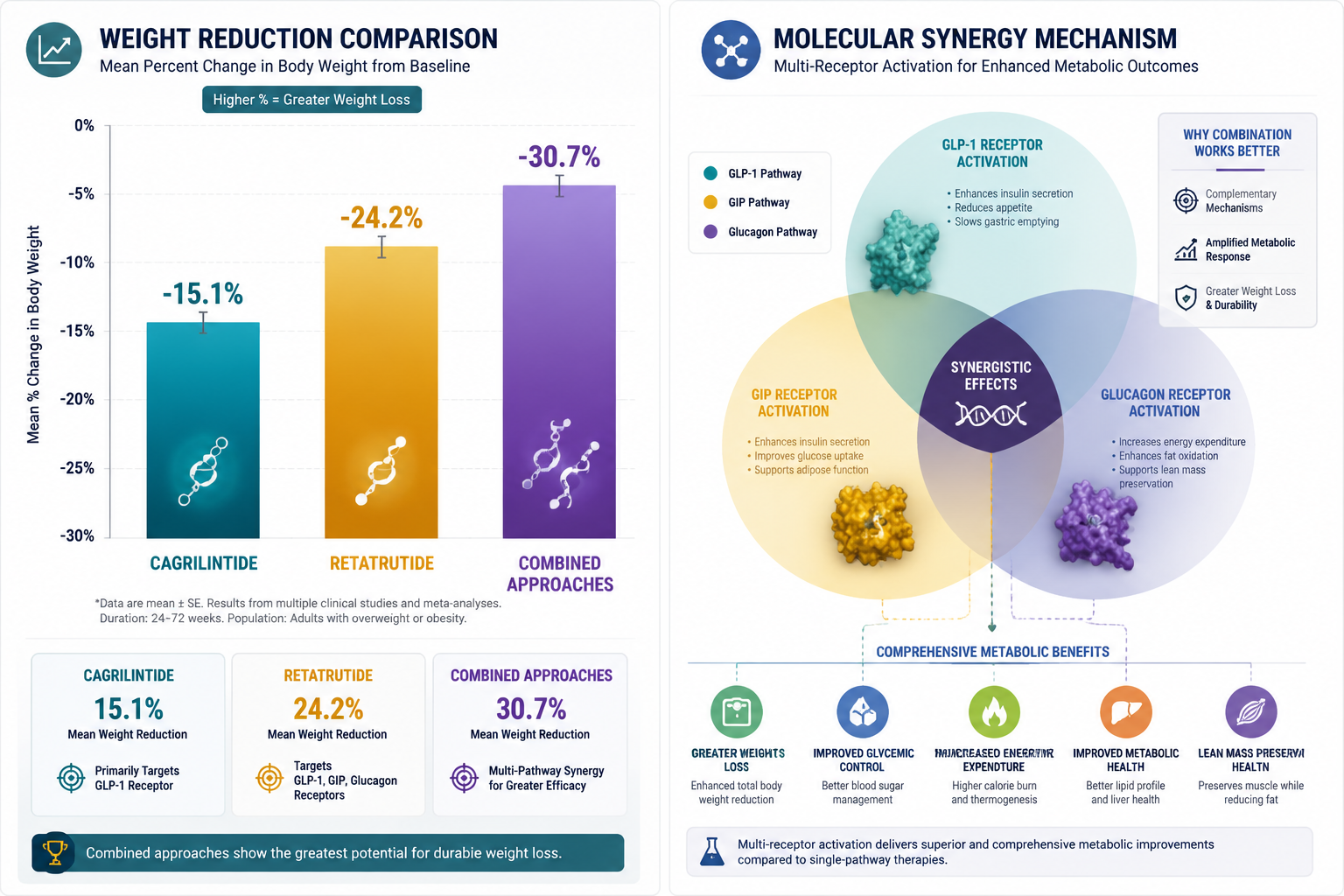
The real excitement in 2026 centers on combinatorial research involving cagrilintide and retatrutide. Because they act on non-overlapping receptor systems, researchers hypothesize additive — or even synergistic — metabolic effects.
Complementary Mechanisms at a Glance
- Retatrutide drives energy expenditure and incretin signaling via GLP-1R/GIPR/GcgR
- Cagrilintide independently modulates satiety via amylin receptors (AMY1R)
- Together, they may address multiple nodes of metabolic dysregulation simultaneously
Researchers interested in the broader incretin landscape should review generations of GLP-1 differences to understand where retatrutide fits historically.
For those building a research stack, exploring metabolic modulation research lines provides useful context on complementary compounds like AOD9604 metabolic research and growth hormone secretagogues.
Research-Grade Sourcing Matters
⚠️ All peptides are for research purposes only and not intended for human consumption.
Purity and verified testing are non-negotiable in serious peptide research. Researchers sourcing retatrutide should prioritize vendors with transparent quality testing protocols. Explore retatrutide 10mg research-grade options and GLP-1 retatrutide peptide products when building a verified research inventory.
Browse the full core product lines to identify compounds that complement metabolic research protocols.
[wp_product_slider category="metabolic" limit="6"]
[wp_product_grid tag="glp-1-reta" columns="3" limit="6"]
Conclusion: Where Cagrilintide and Retatrutide Research Is Headed
The convergence of amylin analog science and triple incretin agonism makes cagrilintide and retatrutide one of the most compelling research pairings in metabolic peptide science today. Their non-overlapping receptor profiles suggest a strong rationale for combinatorial investigation.
Actionable next steps for researchers:
- ✅ Review published phase 2/3 trial data on both compounds independently
- ✅ Source only verified, purity-tested research-grade peptides
- ✅ Study incretin receptor biology before designing protocols
- ✅ Monitor emerging combination trial data throughout 2026
⚠️ All products are strictly for in-vitro and laboratory research use only. Not for human consumption.
References
- Enebo, L.B., et al. (2021). Safety, tolerability, pharmacokinetics, and pharmacodynamics of cagrilintide with semaglutide. The Lancet, 397(10286), 1736–1748.
- Jastreboff, A.M., et al. (2023). Triple–hormone-receptor agonist retatrutide for obesity. New England Journal of Medicine, 389(6), 514–526.
- Finan, B., et al. (2015). Unimolecular dual incretins maximize metabolic benefits in rodents. Science Translational Medicine, 7(209).
Tags: cagrilintide and retatrutide, retatrutide triple agonist, cagrilintide amylin analog, GLP-1 receptor agonist research, metabolic peptide research, incretin peptide synergy, retatrutide weight loss research, peptide research 2026, amylin receptor peptides, GLP-1 GIPR GcgR agonist, fitness peptide stack research