
Legal Peptides for Sale Online: The Complete 2026 Compliance Guide
The peptide industry stands at a critical crossroads in 2026. While the promise of enhanced performance, accelerated recovery, and optimized wellness continues to attract fitness enthusiasts, martial artists, and weightlifters, the regulatory landscape has transformed dramatically. The FDA's aggressive enforcement actions in late 2024 sent shockwaves through the industry, and legal peptides for sale online are now subject to unprecedented scrutiny. Understanding what makes a peptide purchase legal versus illegal could mean the difference between achieving your research goals safely and facing serious health risks or legal consequences.
This comprehensive guide cuts through the confusion surrounding peptide legality, helping you navigate the complex regulatory environment while making informed decisions about your peptide research needs.
Key Takeaways
- Only FDA-approved peptides from licensed pharmacies are legal for human use – research peptides labeled "not for human consumption" remain illegal for personal use regardless of online availability
- FDA enforcement escalated significantly in 2024-2026 with warning letters, seizures, and coordinated multi-agency investigations targeting non-compliant suppliers and practitioners
- Marketing claims trigger regulatory action – products advertised for anti-aging, weight loss, healing, or disease treatment face heightened scrutiny from FDA, FTC, and state boards
- Peptide legality depends on multiple factors including the specific compound, sourcing method, compounding authorization, prescribing authority, and administration route
- Research-grade peptides require proper documentation and should only be purchased from verified suppliers who provide certificates of analysis and comply with research-only distribution requirements
Understanding the Legal Framework for Peptides in 2026
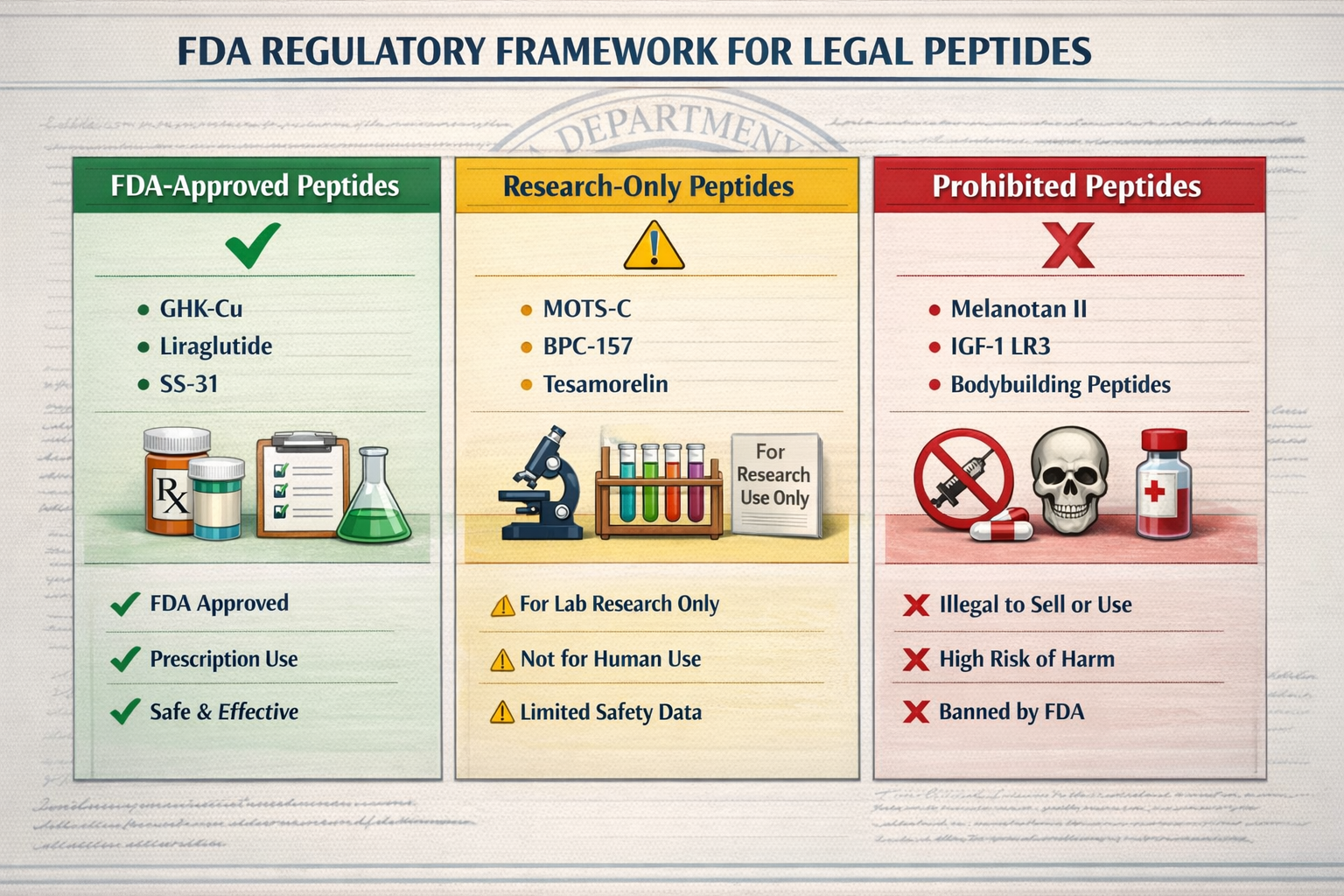
The legal status of peptides sold online depends on a complex web of federal and state regulations that have tightened considerably over the past two years. The Federal Food, Drug, and Cosmetic Act (FD&C Act) serves as the foundation for peptide regulation, establishing that any substance intended for human use must receive FDA approval through rigorous clinical trials demonstrating safety and efficacy.[6]
What Makes a Peptide Legal?
FDA-approved peptides represent the only category of compounds that can be legally marketed and sold for human consumption. These peptides have undergone extensive clinical trials, received formal approval, and can only be dispensed through licensed pharmacies with valid prescriptions.[1] Examples include medications like semaglutide (Ozempic, Wegovy) and tesa, which have specific approved indications.
The challenge for those seeking legal peptides for sale online lies in distinguishing between legitimately approved products and the vast marketplace of research-grade compounds. Most peptides available through online suppliers fall into the research category, clearly labeled "not for human consumption" or "for research use only."[1]
The Research Peptide Category
Research peptides occupy a legally ambiguous space that has attracted significant regulatory attention. While these compounds can be legally manufactured, sold, and purchased for legitimate scientific research, they cannot legally be used for human consumption, regardless of labeling or supplier claims.[1]
Common research peptides include:
- BPC-157 – studied for tissue repair mechanisms
- TB-500 – investigated for cellular regeneration
- MOTS-C – researched for metabolic optimization
- SS-31 – examined for mitochondrial support
- GHK-Cu – studied for skin matrix biology
The critical legal distinction: purchasing these compounds for laboratory research remains permissible under specific conditions, but marketing or using them for human enhancement, wellness, or therapeutic purposes violates federal law.[3]
The 2024-2026 FDA Enforcement Wave
The regulatory landscape shifted dramatically when the FDA issued a series of warning letters in late 2024 to entities marketing peptides online for human use. These enforcement actions alleged violations of the Federal Food, Drug, and Cosmetic Act and warned of potential escalation to product seizures or legal injunctions if violations continued.[2]
Why Enforcement Intensified
Several factors contributed to the regulatory crackdown:
Safety concerns topped the list, with reports of adverse events from contaminated or improperly formulated peptides reaching alarming levels. Unregulated peptide products lacked quality control, proper sterility testing, and consistent dosing – creating significant health risks for consumers.
Aggressive marketing practices by some suppliers blurred the lines between research compounds and therapeutic products. Claims about anti-aging benefits, muscle growth, fat loss, and disease treatment attracted regulatory attention, particularly when directed at consumers rather than legitimate research institutions.[3]
Rapid industry growth in the aesthetics and wellness sectors created a proliferation of clinics, medical spas, and online retailers offering peptide therapies without proper authorization. The FDA viewed this expansion as threatening public health and undermining the drug approval process.
Lack of FDA approval for most peptides being marketed meant these products were technically unapproved new drugs under federal law, regardless of their research potential or anecdotal benefits.[1]
Multi-Agency Coordination
The 2026 enforcement environment involves unprecedented coordination among multiple regulatory bodies:
- FDA – Oversees drug approval, manufacturing standards, and interstate commerce
- FTC – Monitors advertising claims and consumer protection
- State Pharmacy Boards – Regulate compounding practices and pharmacy licensing
- State Medical Boards – Discipline healthcare providers for improper prescribing
- State Departments of Health – Investigate unlicensed medical practices
This multi-pronged approach means violations can trigger simultaneous investigations from several agencies, dramatically increasing legal and financial risks for non-compliant entities.[3]
Compounding Pharmacies and Peptide Legality
Compounding represents another complex area in the peptide legal landscape. While licensed compounding pharmacies can create customized medications under specific circumstances, most peptides are not on the FDA's list of bulk drug substances permitted for compounding.[1]
The 503A and 503B Framework
The Drug Quality and Security Act created two categories of compounding facilities:
503A pharmacies can compound medications for individual patients based on valid prescriptions, but must comply with state pharmacy laws and federal restrictions on bulk substances. They cannot compound peptides not on the approved bulks list unless they have specific authorization.[3]
503B outsourcing facilities operate under more stringent FDA oversight, including regular inspections and adherence to current Good Manufacturing Practices (cGMP). These facilities can produce larger quantities but face even stricter limitations on which peptides they can legally compound.
The critical point: just because a compounding pharmacy offers a peptide doesn't automatically make it legal. The pharmacy must have proper authorization, the peptide must be on approved lists or have specific exemptions, and the patient must have a legitimate prescription from a licensed healthcare provider.[3]
State-Level Variations
Compounding regulations vary significantly by state, creating additional complexity for those seeking peptides for research purposes. Some states maintain more permissive compounding laws, while others have implemented restrictions that exceed federal requirements.
This patchwork of regulations means a peptide that might be legally compounded in one state could be prohibited in another, even if both states have licensed compounding pharmacies attempting to follow applicable laws.[5]
Identifying Legal Peptide Sources Online
For researchers and institutions seeking legal peptides for sale online, due diligence is essential. The following criteria help distinguish legitimate suppliers from problematic sources:
Verification Checklist for Peptide Suppliers
✅ Clear Research-Only Labeling – Legitimate research peptide suppliers prominently display "Not for Human Consumption" and "For Research Use Only" on all products and documentation.
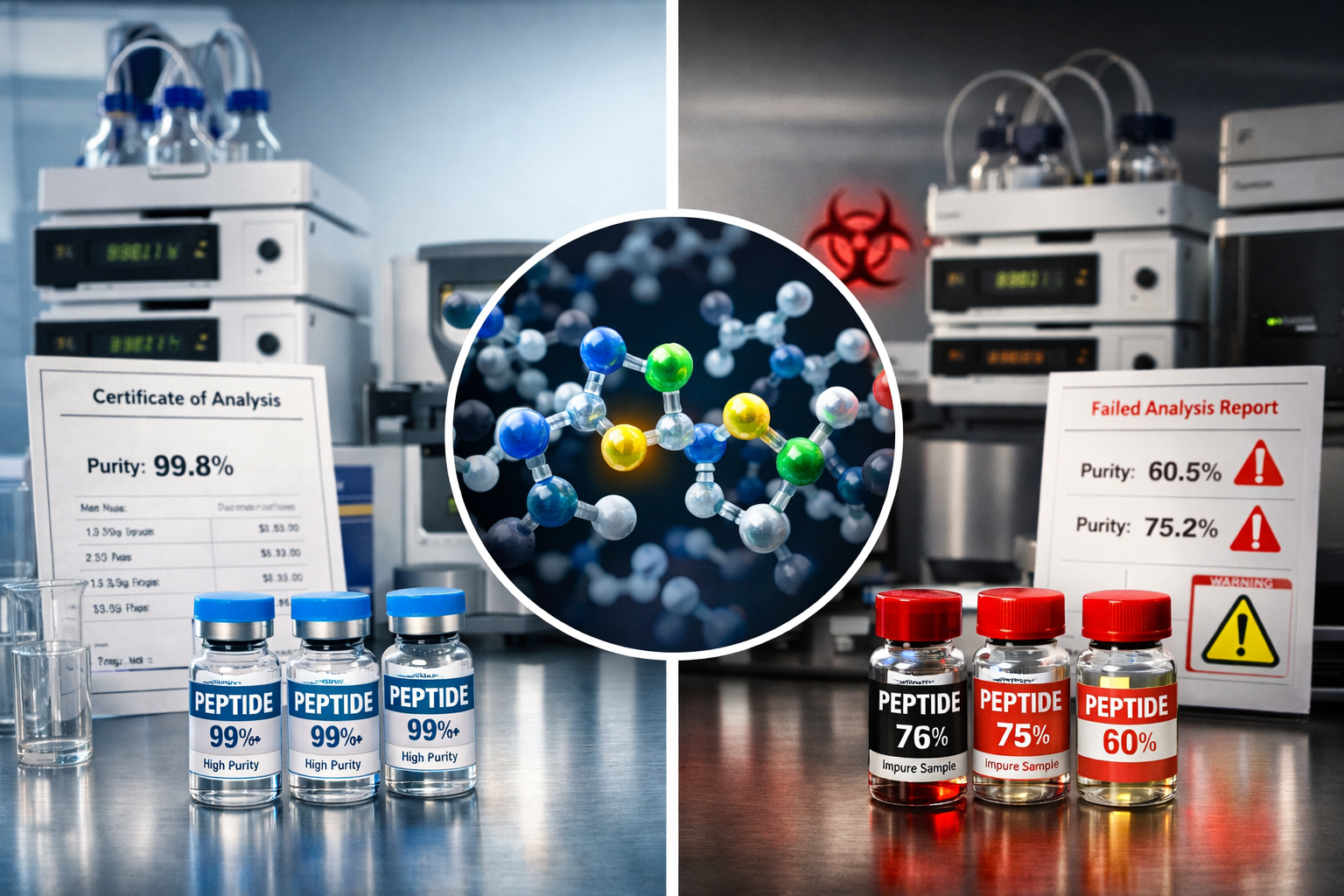
✅ Certificates of Analysis (COA) – Reputable suppliers provide third-party testing results showing purity, composition, and quality verification for each batch. These COAs should come from independent laboratories using methods like HPLC and mass spectrometry.
✅ No Therapeutic Claims – Legal research suppliers avoid marketing language suggesting human health benefits, disease treatment, or wellness applications. Product descriptions focus on research applications and molecular properties.
✅ Proper Business Licensing – Legitimate suppliers maintain appropriate business licenses, comply with chemical handling regulations, and operate transparently with verifiable business addresses and contact information.
✅ Research Verification – Some suppliers require institutional affiliation or research credentials before selling peptides, demonstrating commitment to legitimate research use rather than consumer sales.
✅ Quality Manufacturing Standards – While not required to meet pharmaceutical cGMP standards, reputable research suppliers often voluntarily implement quality control measures and maintain clean manufacturing environments.
Red Flags to Avoid
🚩 Human use suggestions – Any supplier implying, suggesting, or explicitly stating that research peptides can be used for human consumption violates federal law.[1]
🚩 Therapeutic promises – Claims about muscle growth, fat loss, anti-aging, healing, or disease treatment indicate non-compliance with FDA regulations.[3]
🚩 No testing documentation – Absence of COAs or refusal to provide purity testing results suggests questionable quality control and potential contamination risks.
🚩 Suspiciously low prices – Significantly cheaper peptides often indicate inferior quality, contamination, or underdosing compared to legitimate products.
🚩 Prescription-free "therapeutic" peptides – Any site offering FDA-approved peptides without requiring valid prescriptions operates illegally.[1]
When exploring options for research peptides online, these verification steps protect both legal compliance and research integrity.
Popular Legal Research Peptides in 2026
While the regulatory environment has tightened, legitimate research into peptide mechanisms continues. Understanding which peptides remain available for research purposes helps researchers plan compliant studies.
Mitochondrial and Longevity Research Peptides
SS-31 (Elamipretide) represents one of the most studied mitochondrial-targeting peptides. Research examines its potential mechanisms in cellular energy optimization and mitochondrial membrane stabilization. Scientific literature documents extensive preclinical investigations into SS-31's molecular interactions.[32]
MOTS-C has attracted significant research interest for its mitochondrial-derived properties. Studies explore how this peptide interacts with metabolic pathways and cellular stress responses. Researchers investigating longevity mechanisms often include MOTS-C in their experimental protocols.
Epithalon continues to be studied for its relationship to telomere biology and cellular aging processes. While research remains preliminary, scientific interest in this peptide's mechanisms persists across multiple research institutions.
Tissue Repair and Recovery Research
BPC-157 remains one of the most researched peptides for tissue repair mechanisms, despite increased regulatory scrutiny. Laboratory studies examine its potential effects on angiogenesis, collagen synthesis, and cellular regeneration pathways. Researchers must ensure proper documentation and research protocols when working with this compound.
TB-500 (Thymosin Beta-4) appears frequently in research examining cellular migration, differentiation, and tissue remodeling. Scientific investigations focus on understanding the molecular mechanisms underlying these processes rather than therapeutic applications.
Metabolic Research Peptides
Tesamorelin holds FDA approval for specific indications, making it one of the few peptides with established legal pathways for human use under medical supervision. Research continues into additional mechanisms and potential applications beyond approved uses.
AOD-9604 has been studied for its relationship to metabolic processes and fat oxidation pathways. While not FDA-approved for human use, it remains available for legitimate research purposes with proper documentation.
SLU-PP-332 represents newer research into metabolic modulation, with scientific interest in its mechanisms related to energy expenditure and metabolic regulation.
Skin Biology and Matrix Research
GHK-Cu continues to be extensively researched for its interactions with skin matrix biology, collagen synthesis, and cellular signaling pathways. Studies examine both systemic and topical applications in research contexts.
Research into peptides in skincare has expanded significantly, with multiple compounds being investigated for their molecular mechanisms in dermal biology.
Peptide Combinations and Blends
Some research protocols investigate peptide synergies, examining how different compounds might interact at molecular levels. Examples include studies on LL-37 and MOTS-C combinations or LL-37 and SS-31 interactions.
Legal Risks of Non-Compliant Peptide Use
Understanding the potential consequences of purchasing or using non-approved peptides helps researchers and consumers make informed decisions about compliance.
Health Risks
Unapproved peptides from unverified sources carry significant health risks:
Contamination – Without pharmaceutical-grade manufacturing and quality control, peptides may contain bacterial endotoxins, heavy metals, or other contaminants that can cause serious adverse reactions.
Incorrect composition – Testing by independent laboratories has revealed that some online peptides contain different compounds than labeled, wrong concentrations, or no active ingredient at all.
Sterility issues – Injectable peptides require proper sterile manufacturing. Non-compliant products may lack adequate sterility, leading to infections or systemic complications.
Unknown interactions – Without proper clinical trials, interactions between peptides and medications, supplements, or medical conditions remain poorly understood, creating unpredictable risks.
Legal Consequences for Consumers
Individuals who purchase or use non-approved peptides for human consumption face several legal risks:
Regulatory violations – Possessing or using unapproved drugs violates federal law, potentially resulting in product seizure, fines, or in extreme cases, criminal charges.[1]
Professional disqualification – Athletes subject to drug testing may face suspensions or lifetime bans for using prohibited peptides. Many peptides appear on WADA's prohibited substances list.
Employment consequences – Individuals in regulated sectors (healthcare, law enforcement, military) may face disciplinary action or termination if found using non-approved substances.
Insurance implications – Health complications from unapproved peptides may not be covered by insurance, leaving individuals responsible for significant medical costs.
Risks for Healthcare Providers
Healthcare providers who prescribe, recommend, or administer non-approved peptides face even more serious consequences:
Medical board discipline – State medical boards have increased enforcement against providers offering unapproved peptide therapies, with penalties ranging from reprimands to license suspension or revocation.[3]
Malpractice liability – Adverse events from non-approved peptides create significant malpractice exposure, with potential for substantial damages if patients suffer harm.
FDA enforcement – Providers involved in marketing or distributing unapproved peptides may receive warning letters, face product seizures, or encounter legal injunctions.[2]
Criminal prosecution – In cases involving fraud, interstate commerce violations, or serious patient harm, criminal charges may be filed against providers and clinic operators.
Professional reputation damage – Regulatory actions become public record, potentially destroying careers and professional standing even if formal penalties are minimal.
How to Purchase Peptides Legally in 2026
For those committed to legal compliance, several pathways exist for obtaining peptides depending on intended use.
For Legitimate Research Purposes
Researchers affiliated with institutions, laboratories, or companies conducting legitimate scientific studies can legally purchase research-grade peptides by:
- Establishing institutional credentials – Providing documentation of research affiliation, laboratory facilities, and scientific objectives
- Selecting verified suppliers – Choosing suppliers who require research verification and provide comprehensive testing documentation
- Maintaining proper documentation – Keeping records of purchases, research protocols, and handling procedures
- Following chemical handling regulations – Complying with local, state, and federal regulations for chemical storage and use
- Avoiding human administration – Ensuring research protocols do not involve human subjects unless approved through proper IRB channels with FDA oversight
Reputable suppliers of research peptides implement verification processes to ensure compliance with these requirements.
For FDA-Approved Therapeutic Use
Individuals seeking peptides for personal health optimization should:
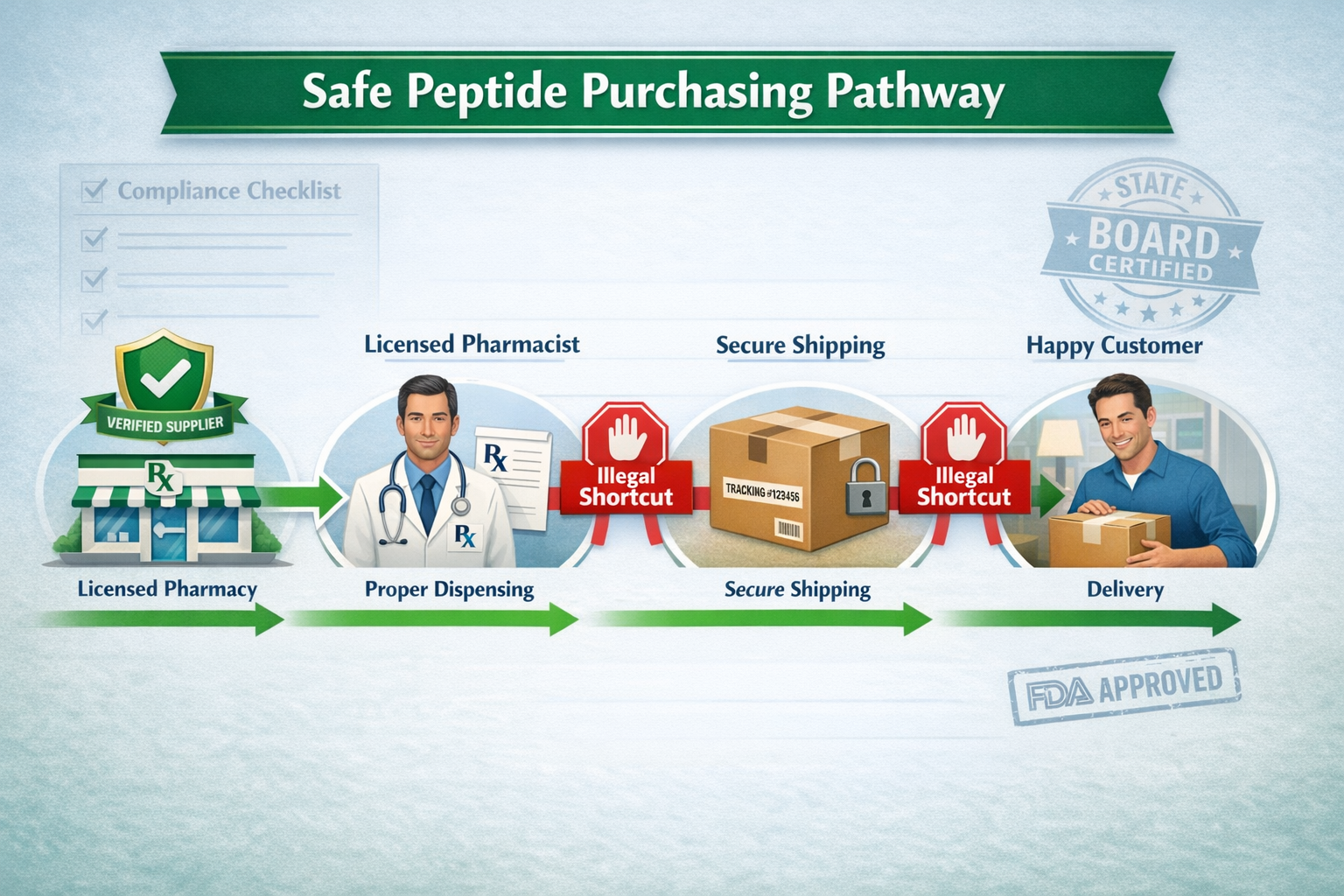
- Consult licensed healthcare providers – Work with physicians who can evaluate whether FDA-approved peptide therapies are appropriate for specific medical conditions
- Obtain valid prescriptions – Ensure prescriptions are written for legitimate medical purposes, not wellness or enhancement
- Use licensed pharmacies – Fill prescriptions only through licensed pharmacies, whether traditional retail or legitimate compounding facilities
- Verify compounding authorization – If using a compounding pharmacy, confirm they have legal authority to compound the specific peptide
- Avoid online "prescription mills" – Be wary of telehealth services that prescribe peptides after minimal consultation or without proper medical evaluation
The pathway to legally buying peptides online for personal use requires navigating these regulatory requirements carefully.
Understanding Prescription Requirements
Valid prescriptions for peptides must meet several criteria:
- Legitimate medical purpose – The prescription must address a diagnosed medical condition, not general wellness or enhancement
- Licensed prescriber – The healthcare provider must be licensed in the patient's state and authorized to prescribe the specific medication
- Proper patient relationship – A valid doctor-patient relationship must exist, typically requiring in-person examination (though telemedicine rules have evolved)
- Appropriate documentation – Medical records should support the medical necessity of the prescribed peptide
Prescriptions that fail to meet these criteria may be considered invalid, making the resulting peptide purchase illegal regardless of the pharmacy's licensing status.[1]
Quality Verification and Testing Standards
Whether purchasing peptides for research or therapeutic use, quality verification remains critical for safety and efficacy.
Understanding Certificates of Analysis
A Certificate of Analysis (COA) provides essential information about peptide quality:
Purity percentage – High-quality research peptides typically show purity levels of 98% or higher. Lower purity indicates potential contamination or degradation.
Testing methodology – Reputable COAs specify testing methods used, typically including:
- High-Performance Liquid Chromatography (HPLC)
- Mass Spectrometry (MS)
- Amino Acid Analysis (AAA)
Batch-specific results – Each peptide batch should have its own COA, not generic results applied to multiple batches.
Independent laboratory verification – The most reliable COAs come from third-party laboratories with no financial interest in the supplier's business.
Molecular weight confirmation – Testing should verify the peptide's molecular weight matches expected values for the specified compound.
Red Flags in Testing Documentation
🚩 Generic or template COAs – Documents that appear to be templates with filled-in blanks rather than actual laboratory reports
🚩 Missing batch numbers – COAs without specific batch identifiers that match product labels
🚩 Suspiciously perfect results – Purity claims of exactly 100% or results that seem too consistent across multiple batches
🚩 Unverifiable laboratories – Testing labs that cannot be independently verified or contacted
🚩 Outdated testing – COAs dated months or years before product sale, suggesting testing wasn't performed on current inventory
Innovative Testing and Delivery Systems
The peptide industry continues to evolve with innovative delivery systems that may improve stability, bioavailability, and ease of administration. Research into nasal spray formulations and other alternative delivery methods represents an active area of scientific investigation.
However, regardless of delivery system innovation, the fundamental legal requirements remain unchanged – peptides must either be FDA-approved for human use or clearly designated and used for research purposes only.
Staying Compliant: Best Practices for 2026
As regulatory enforcement continues to intensify, following best practices helps ensure legal compliance and safety.
For Research Institutions and Laboratories
✅ Maintain comprehensive documentation – Keep detailed records of peptide purchases, research protocols, handling procedures, and disposal methods
✅ Implement proper storage protocols – Follow manufacturer guidelines for temperature control, light exposure, and shelf life
✅ Verify supplier credentials regularly – Periodically re-verify that suppliers maintain appropriate licensing and quality standards
✅ Train personnel thoroughly – Ensure all staff handling peptides understand legal requirements, safety protocols, and proper procedures
✅ Establish clear research boundaries – Create and enforce policies prohibiting personal use or human administration outside approved research protocols
✅ Review regulatory updates – Stay informed about evolving FDA guidance, state regulations, and enforcement priorities
For Healthcare Providers
✅ Prescribe only FDA-approved peptides – Limit prescribing to peptides with established approval for specific medical indications
✅ Document medical necessity thoroughly – Maintain detailed records supporting the medical rationale for peptide prescriptions
✅ Verify pharmacy compliance – Ensure compounding pharmacies have proper authorization before sending prescriptions
✅ Avoid marketing therapeutic claims – Refrain from advertising peptide therapies for unapproved uses, even if scientific literature suggests potential benefits
✅ Obtain informed consent – When prescribing peptides, ensure patients understand the approved uses, potential risks, and regulatory status
✅ Consult healthcare attorneys – For providers considering peptide therapies, legal consultation helps navigate complex compliance requirements[5][6]
For Individual Researchers and Consumers
✅ Verify legal status before purchasing – Research the specific peptide's regulatory status and ensure intended use complies with applicable laws
✅ Choose established suppliers – Select suppliers with track records, transparent business practices, and comprehensive testing documentation
✅ Avoid human consumption of research peptides – Never use research-grade peptides for personal health purposes, regardless of online claims or anecdotal reports
✅ Seek medical guidance for therapeutic needs – Work with licensed healthcare providers if interested in FDA-approved peptide therapies
✅ Stay informed about regulatory changes – Monitor FDA announcements, industry news, and legal developments affecting peptide availability
The Future of Peptide Regulation
The regulatory landscape for peptides will likely continue evolving throughout 2026 and beyond. Several trends appear likely:
Increased Enforcement Activity
Regulatory agencies have signaled their commitment to continued enforcement against non-compliant peptide marketing and distribution. Expect:
- More warning letters to online suppliers
- Increased coordination between federal and state agencies
- Higher profile enforcement actions against large-scale operations
- Greater scrutiny of healthcare providers offering peptide therapies
Potential Regulatory Clarification
Industry advocates continue pushing for clearer regulatory frameworks that distinguish between legitimate research, appropriate compounding, and problematic marketing. Possible developments include:
- Expanded lists of peptides permitted for compounding under specific conditions
- Clearer guidance on research peptide distribution requirements
- Streamlined pathways for peptide drug approval
- More defined standards for compounding pharmacy authorization
Technological Advances
Scientific progress in peptide research may lead to:
- New FDA approvals for peptides currently in clinical trials
- Improved delivery systems that enhance safety and efficacy
- Better testing methodologies for quality verification
- Advanced manufacturing techniques that reduce costs while maintaining quality
Industry Consolidation
Regulatory pressure may drive industry changes:
- Smaller, non-compliant suppliers exiting the market
- Consolidation among legitimate research suppliers
- Increased professionalization of compounding pharmacies
- Greater investment in compliance infrastructure
Frequently Asked Questions About Legal Peptides
Can I legally buy peptides online without a prescription?
Research peptides can be purchased without a prescription if clearly labeled "not for human consumption" and used only for legitimate research purposes. FDA-approved therapeutic peptides require valid prescriptions from licensed healthcare providers.[1]
Are research peptides legal to possess?
Possessing research peptides is legal when they're used for legitimate scientific research. Using them for human consumption violates federal law, regardless of how they're labeled or marketed.[1]
How can I tell if a peptide supplier is legitimate?
Legitimate suppliers provide certificates of analysis from independent laboratories, clearly label products as research-only, avoid therapeutic marketing claims, maintain transparent business practices, and often require research credentials before selling.[3]
What peptides are FDA-approved for human use?
Very few peptides have FDA approval. Examples include insulin, semaglutide (Ozempic, Wegovy), tesa, and several others for specific medical conditions. The vast majority of peptides discussed in fitness and wellness contexts lack FDA approval.[1]
Can compounding pharmacies legally make any peptide?
No. Compounding pharmacies can only compound peptides that appear on the FDA's approved bulk substances list or have specific authorization. Most popular peptides are not on this list, making their compounding legally questionable.[1][3]
What are the penalties for using illegal peptides?
Penalties vary but may include product seizure, fines, professional disqualification (for athletes), employment consequences, and in serious cases, criminal charges. Healthcare providers face additional risks including license suspension and malpractice liability.[1][3]
Are peptides from overseas suppliers legal?
Importing peptides from overseas suppliers faces additional regulatory scrutiny from customs enforcement. Many shipments are seized, and importing unapproved drugs for personal use generally violates federal law.[1]
How has peptide regulation changed in 2026?
Enforcement has intensified significantly, with more warning letters, increased multi-agency coordination, greater scrutiny of compounding practices, and higher penalties for violations compared to previous years.[2][3]
Conclusion: Navigating Legal Peptides for Sale Online in 2026
The landscape of legal peptides for sale online has fundamentally transformed in 2026. What once represented a largely unregulated market has become a heavily scrutinized industry where compliance determines the difference between legitimate research and serious legal violations.
For researchers, the pathway remains clear: work with verified suppliers who provide comprehensive testing documentation, maintain proper research protocols, and never cross the line into human administration without appropriate FDA oversight and IRB approval. The availability of research-grade compounds like SS-31, MOTS-C, and GHK-Cu continues for legitimate scientific investigation.
For individuals seeking therapeutic benefits, the only legal path involves working with licensed healthcare providers who can prescribe FDA-approved peptides for appropriate medical conditions. The temptation to purchase research peptides for personal use carries significant health risks and legal consequences that far outweigh any potential benefits.
Action Steps for Legal Compliance
If you're a researcher:
- Verify your supplier's credentials and testing documentation
- Maintain comprehensive records of all peptide purchases and uses
- Ensure research protocols comply with institutional and regulatory requirements
- Stay updated on regulatory changes affecting peptide research
- Explore the full catalog of research peptides available through compliant suppliers
If you're seeking therapeutic benefits:
- Consult with licensed healthcare providers about FDA-approved options
- Obtain valid prescriptions for any peptide therapy
- Use only licensed pharmacies with verified compounding authorization
- Avoid online suppliers making therapeutic claims about research peptides
- Report suspected illegal peptide marketing to appropriate regulatory authorities
If you're a healthcare provider:
- Limit prescribing to FDA-approved peptides for approved indications
- Consult with healthcare attorneys about compliance requirements
- Verify compounding pharmacy credentials before sending prescriptions
- Document medical necessity thoroughly for all peptide prescriptions
- Avoid marketing peptide therapies for unapproved uses
The regulatory environment will continue evolving, but the fundamental principle remains constant: peptides must either receive FDA approval for human use or remain strictly within the research context. No amount of anecdotal evidence, online marketing, or wellness industry promotion changes these legal requirements.
By prioritizing compliance, quality verification, and informed decision-making, researchers and consumers can navigate the complex world of legal peptides while protecting both their health and legal standing. The science of peptides holds tremendous promise, but realizing that promise requires working within established regulatory frameworks that protect public safety while enabling legitimate scientific advancement.
References
[1] Are Peptides Legal – https://floridahealthcarelawfirm.com/are-peptides-legal/
[2] Injectable Peptides Fda State Enforcement Compounding – https://www.frierlevitt.com/articles/injectable-peptides-fda-state-enforcement-compounding/
[3] Peptides Law And Compliance – https://lengealaw.com/peptides-law-and-compliance/
[4] Fdas Overreach On Compounded Peptides Legal Battles And How Clinics Can Push Back – https://www.safehg.com/fdas-overreach-on-compounded-peptides-legal-battles-and-how-clinics-can-push-back/
[5] Navigating Peptide Regulations Compliance – https://byrdadatto.com/podcast/navigating-peptide-regulations-compliance/
[6] Peptide Law A Healthcare Attorneys Guide To The Fdc Act And Unapproved Drugs – https://djholtlaw.com/peptide-law-a-healthcare-attorneys-guide-to-the-fdc-act-and-unapproved-drugs/
[7] New Fda Rules Are Reshaping The Peptide Industry – https://www.peptide-drug-summit.com/news/new-fda-rules-are-reshaping-the-peptide-industry
[8] Peptide Legal Frequently Asked Questions – https://djholtlaw.com/peptide-legal-frequently-asked-questions/
SEO Meta Title and Description
Meta Title: Legal Peptides for Sale Online: 2026 Compliance Guide
Meta Description: Discover which peptides are legal to buy online in 2026. Complete guide to FDA regulations, research peptides, quality verification, and compliance requirements.