

The global Melanotan peptide market was valued at USD 603 million in 2025 — a figure that signals just how seriously the research and wellness communities are taking this synthetic analog of alpha-melanocyte-stimulating hormone (α-MSH).
Key Takeaways 🔬
- Melanotan peptide activates melanocortin receptors, stimulating melanin production and skin pigmentation
- Two variants exist: Melanotan I and the shorter, more potent Melanotan II
- The FDA has signaled a major regulatory shift, with a PCAC review scheduled for July 2026
- The compound is not FDA-approved for any medical condition as of 2026
- Research interest spans tanning, vitiligo, sexual function, and appetite regulation
What Is the Melanotan Peptide and How Does It Work?
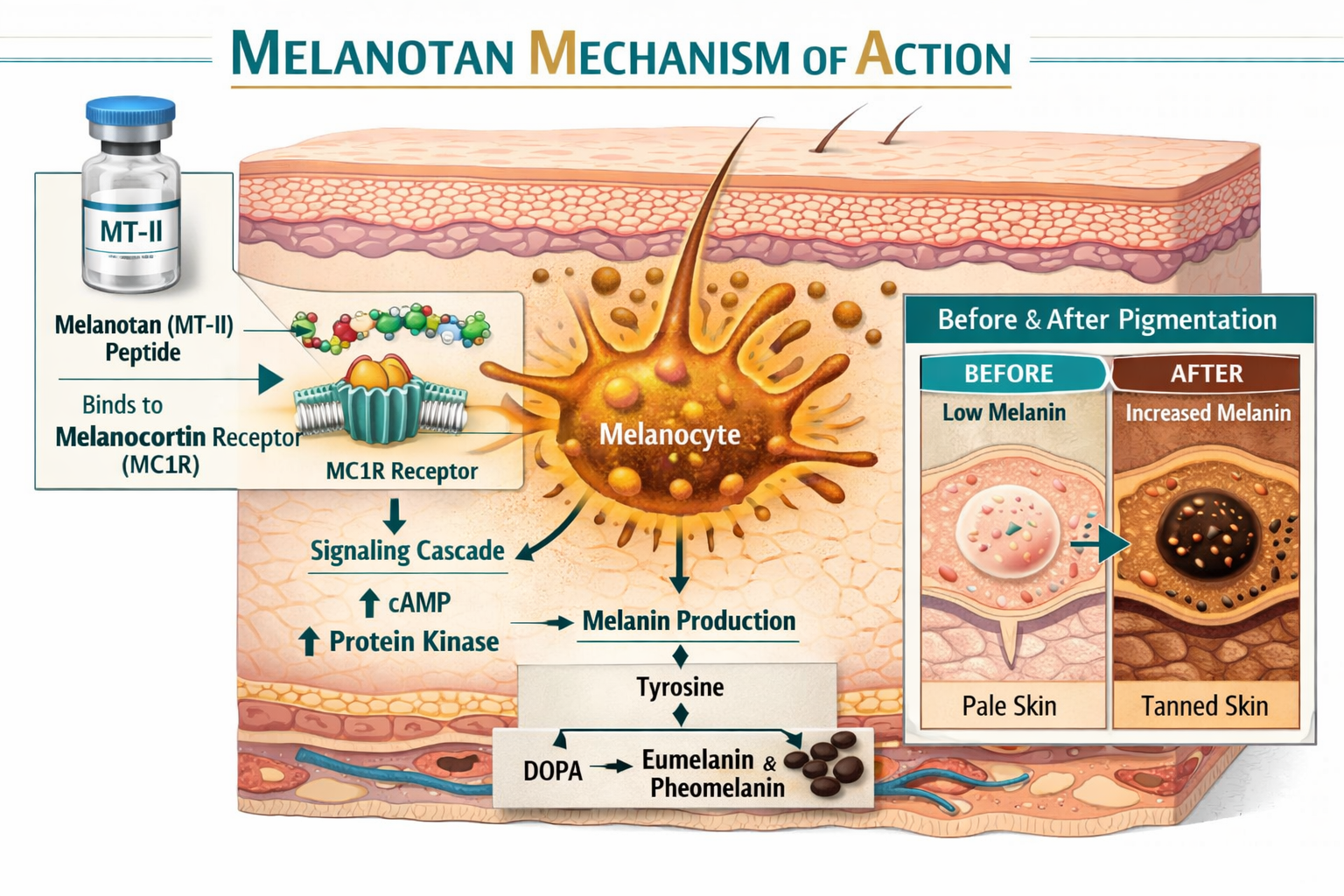
Melanotan peptide refers to a class of synthetic analogs modeled after α-MSH, a naturally occurring hormone. Melanotan II (MT-II) is the shorter, cyclic variant developed in the 1990s, engineered to produce stronger pigmentation effects at lower cumulative doses than its predecessor, Melanotan I.
The mechanism is straightforward: MT-II binds to and activates melanocortin receptors in the skin, triggering melanin synthesis. It also interacts with receptors in the central nervous system, which explains its studied effects on sexual arousal and appetite suppression.
💡 "A 1996 Phase I pilot study confirmed that just 5 low-dose subcutaneous injections administered every other day produced measurable tanning activity in human subjects — with pigmentation still visible one week after dosing ended."
Administration is typically subcutaneous injection, starting with a daily loading phase, then tapering to 2–3 times per week for maintenance.
7 Key Facts About the Melanotan Peptide
1. 🧬 Two Variants, One Family
Melanotan I and Melanotan II are related but distinct. MT-II is cyclic, more potent, and requires lower doses.
2. 📈 A Fast-Growing Market
Projected CAGR of 6.3% from 2025–2033, driven largely by growing awareness of its potential in vitiligo research.
3. ⚖️ Regulatory Shift in 2026
The FDA is moving Melanotan peptide off its Category 2 restricted list. The Pharmacy Compounding Advisory Committee (PCAC) is scheduled to review MT-II in July 2026 for potential inclusion on the 503A bulks list.
4. 🚫 Not FDA-Approved
Despite market growth, the Melanotan peptide remains unapproved for any medical condition, which continues to limit mainstream adoption.
5. 🔬 Off-Label Research Areas
| Research Area | Status |
|---|---|
| Skin tanning | Most studied |
| Vitiligo | Emerging interest |
| Erectile dysfunction | Off-label study |
| Rosacea | Preliminary |
| Appetite regulation | CNS-mediated research |
6. ⚠️ Notable Side Effects
Researchers document painful erections, drowsiness, and compulsive yawning. More seriously, case reports link melanotropic peptide use to eruptive nevi and atypical moles — underscoring the need for careful monitoring.
7. 🏭 Major Industry Players
Leading producers include Bachem, PolyPeptide Labs, AmbioPharm, and Phoenix Pharmaceuticals. For lab-tested peptides from verified sources, purity documentation is essential.
[product_slider]
Melanotan Peptide in Context: Related Research Compounds
The Melanotan peptide shares receptor pathways with PT-141 (Bremelanotide), another melanocortin-based compound studied for sexual dysfunction. Researchers exploring this space may also find value in reviewing PT-141 research documentation and broader longevity peptide research for comparative context.
For those interested in skin-focused peptide science, resources on peptides in skincare and glow peptide blends provide useful adjacent reading.
Conclusion: What Researchers Should Do Next
The Melanotan peptide sits at a genuine regulatory inflection point in 2026. With the PCAC review approaching and the FDA signaling reduced restrictions, this is a critical time to stay informed.
Actionable next steps:
- ✅ Monitor the July 2026 PCAC review outcome for compounding implications
- ✅ Source only from suppliers providing full purity and testing documentation
- ✅ Review what's new in peptide research regularly for regulatory updates
- ✅ Cross-reference side effect profiles before including MT-II in any research protocol
- ✅ Explore related melanocortin compounds like PT-141 for comparative receptor studies
Tags: Melanotan peptide, Melanotan II, melanocortin receptor, synthetic peptide, skin tanning peptide, peptide research 2026, FDA peptide regulation, alpha-MSH analog, vitiligo research, PT-141, peptide compounding, melanotropic peptide