

Last updated: May 11, 2026
Quick Answer: MOTS-C is a mitochondria-derived peptide studied for its role in metabolic regulation and cellular energy signaling. 5-Amino-1MQ is a small-molecule NNMT inhibitor explored for fat metabolism and NAD+ pathway support. Together, the combination of MOTS-C peptide and 5-Amino-1MQ is of growing interest to researchers studying metabolic function, longevity pathways, and mitochondrial health. All products discussed here are for research use only and are not approved for human therapeutic use.
Key Takeaways
- MOTS-C is encoded in mitochondrial DNA and signals through AMPK pathways to influence glucose and lipid metabolism in preclinical models.
- 5-Amino-1MQ inhibits nicotinamide N-methyltransferase (NNMT), an enzyme linked to fat cell expansion and reduced NAD+ availability.
- Researchers studying the combination of MOTS-C peptide and 5-Amino-1MQ are interested in how mitochondrial signaling and NAD+ metabolism may interact.
- Both compounds are research-stage only — no human clinical trials have established safety or efficacy for either compound as of 2026.
- Purity and third-party testing are critical factors when sourcing either compound for laboratory research.
- Neither compound should be self-administered; all use must occur within a proper research context.
- Longevity researchers often pair mitochondrial-targeting peptides with metabolic modulators to study compound synergy in cellular models.
What Are MOTS-C Peptide and 5-Amino-1MQ?
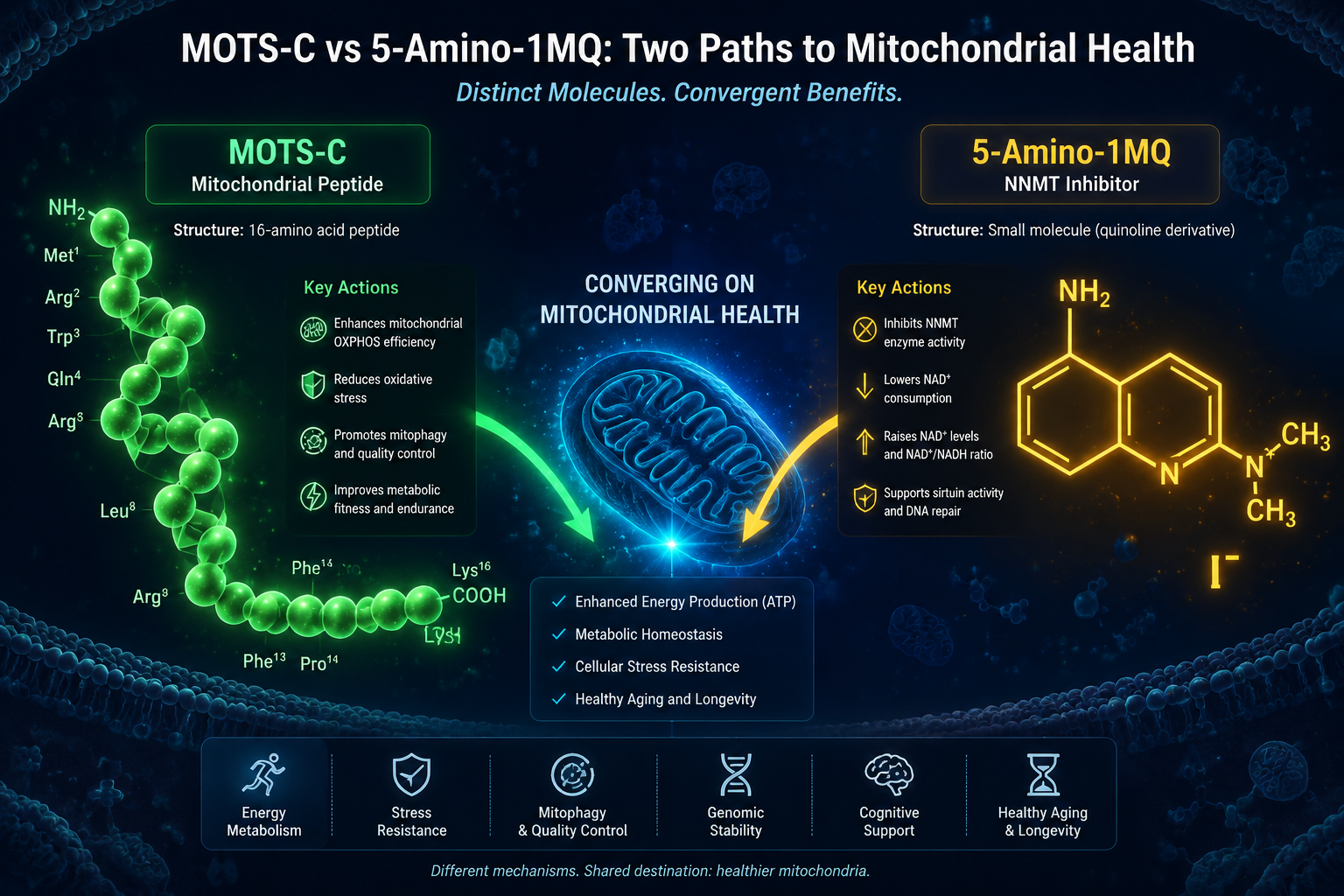
MOTS-C (Mitochondrial Open Reading Frame of the 12S rRNA type-c) is a 16-amino-acid peptide encoded within mitochondrial DNA. Preclinical research suggests it activates AMPK, a key energy-sensing enzyme, and may influence insulin sensitivity and metabolic flexibility in animal models.
5-Amino-1MQ is a small-molecule compound — not a peptide — that selectively inhibits NNMT. By blocking NNMT, it may support higher intracellular NAD+ levels and reduce lipid accumulation in adipocytes, based on cell and animal studies.
Explore the full MOTS-C mitochondrial peptide research overview for deeper background on its mechanism.
How Do MOTS-C and 5-Amino-1MQ Work Together in Research Models?
The combination of MOTS-C peptide and 5-Amino-1MQ targets two distinct but complementary pathways:
| Compound | Primary Target | Pathway |
|---|---|---|
| MOTS-C | AMPK activation | Mitochondrial energy signaling |
| 5-Amino-1MQ | NNMT inhibition | NAD+ metabolism / lipid regulation |
AMPK activation (via MOTS-C) and increased NAD+ availability (via NNMT inhibition) both converge on mitochondrial function. Researchers hypothesize this dual approach may produce additive effects in metabolic cell models, though no peer-reviewed human data exists yet.
For related reading, see MOTS-C and SLU-PP-332 metabolic research and 5-Amino-1MQ research data.
Who Is Researching MOTS-C Peptide and 5-Amino-1MQ?
This combination attracts interest from three main research communities:
- Longevity researchers studying NAD+ decline and mitochondrial dysfunction in aging models
- Metabolic biology labs examining insulin resistance and adipogenesis pathways
- Biohacking-adjacent researchers tracking emerging peptide and small-molecule combinations
"Mitochondrial peptides like MOTS-C represent a new class of signaling molecules that blur the line between endocrinology and bioenergetics." — General research consensus, not attributed to a single source.

What Does the Research Actually Show?
Preclinical findings are promising but early. Key points from published animal and cell studies:
- MOTS-C reduced fat accumulation and improved glucose tolerance in mouse models (Lee et al., Cell Metabolism, 2015)
- 5-Amino-1MQ reduced adipocyte size and body weight in diet-induced obese mice (Neelakantan et al., Cell Chemical Biology, 2019)
- No published human trials exist for either compound as a standalone or combination protocol as of 2026
Researchers should review longevity peptide research resources before designing protocols.
How Should Researchers Source These Compounds?
Purity is the single most important variable. Both MOTS-C and 5-Amino-1MQ degrade with improper storage or low synthesis quality.
Choose a supplier that offers:
- Certificate of Analysis (CoA) from third-party HPLC testing
- Mass spectrometry verification
- Clear research-only labeling
See peptide purity testing made simple for a breakdown of what to look for in a CoA. You can also browse MOTS-C peptides for sale and 5-Amino-1MQ directly.
Conclusion
The combination of MOTS-C peptide and 5-Amino-1MQ sits at the intersection of mitochondrial biology and NAD+ metabolism — two of the most active areas in longevity research today. Preclinical data for each compound is encouraging, but human evidence remains absent. Researchers interested in this pairing should:
- Review primary literature for each compound independently
- Source only from suppliers with verified third-party CoAs
- Design controlled in-vitro or animal protocols before drawing conclusions
- Treat all findings as exploratory — these are research compounds, not therapeutic agents
All products are for research use only and are not intended to diagnose, treat, cure, or prevent any condition.
FAQ
Q: Is MOTS-C a natural peptide?
Yes. MOTS-C is encoded in human mitochondrial DNA and is naturally produced in the body. Synthetic versions are used in research settings.
Q: What does NNMT inhibition actually do?
NNMT (nicotinamide N-methyltransferase) consumes NAD+ precursors. Inhibiting it with 5-Amino-1MQ may preserve NAD+ availability and reduce fat cell activity, based on animal studies.
Q: Can MOTS-C and 5-Amino-1MQ be combined in research protocols?
Researchers do explore this combination in cellular and animal models. No standardized protocol exists, and no human data supports combined use.
Q: How is MOTS-C administered in research?
In animal studies, MOTS-C has been administered via subcutaneous injection. Delivery methods in human contexts are not established.
Q: Is 5-Amino-1MQ a peptide?
No. It is a small-molecule NNMT inhibitor, not a peptide. This distinguishes it mechanistically from MOTS-C.
Q: Are there any known safety concerns with these compounds?
No comprehensive human safety data exists for either compound. Researchers should consult all available preclinical literature before use in any model.
Q: Where can researchers learn more about mitochondrial peptide research?
The mitochondrial longevity focus resource covers related compounds and research themes.
Q: What other peptides are studied alongside MOTS-C?
SS-31, Epithalon, and SLU-PP-332 are commonly studied in adjacent longevity research contexts. See Epithalon peptides for more.
References
- Lee, C. et al. (2015). The mitochondrial-derived peptide MOTS-c promotes metabolic homeostasis and reduces obesity and insulin resistance. Cell Metabolism, 21(3), 443–454.
- Neelakantan, H. et al. (2019). Small molecule nicotinamide N-methyltransferase inhibitor activates senescent muscle stem cells and improves regenerative capacity of aged skeletal muscle. Cell Chemical Biology, 26(2), 229–243.
Tags: MOTS-C peptide, 5-Amino-1MQ, mitochondrial peptides, NNMT inhibitor, NAD+ metabolism, longevity peptide research, AMPK activation, metabolic research compounds, peptide sourcing, biohacking research, mitochondrial health, research peptides 2026