
Roughly 80% of serious resistance-training athletes report using some form of performance-support compound — yet peptides remain one of the least understood categories in that space. As interest in muscle growth and bodybuilding peptides accelerates through 2026, researchers and fitness enthusiasts alike are paying closer attention to how these short-chain amino acid sequences interact with the body's own signaling systems.
Key Takeaways
- Bodybuilding peptides work by signaling the body's natural hormonal pathways rather than introducing synthetic hormones directly.
- Growth hormone-releasing peptides (GHRPs) and growth hormone-releasing hormones (GHRHs) are the two primary categories studied for muscle and body composition research.
- Peptide combinations — such as CJC-1295 with Ipamorelin — are frequently investigated for synergistic effects.
- Purity and sourcing quality are critical variables that affect research outcomes.
- Peptides are research compounds; their use in humans requires proper regulatory and medical oversight.
How Muscle Growth and Bodybuilding Peptides Work
Peptides are short chains of amino acids — the same building blocks that form proteins. Unlike anabolic steroids, muscle growth and bodybuilding peptides typically act upstream in the hormonal cascade. They stimulate the pituitary gland or hypothalamus to release growth hormone (GH) naturally, rather than flooding the body with exogenous hormones.
This distinction matters for two reasons:
- Physiological signaling — The body retains feedback control, which may reduce the risk of hormonal dysregulation.
- Specificity — Different peptides target different receptors, allowing researchers to study isolated effects on muscle protein synthesis, fat metabolism, and recovery.
"Peptides do not force a biological outcome — they invite a conversation between molecules."
The most studied categories include:
| Category | Example Peptides | Primary Research Focus |
|---|---|---|
| GHRH Analogues | CJC-1295, Tesamorelin | GH pulse amplification, body composition |
| GHRPs | Ipamorelin, GHRP-6 | GH secretion, appetite, muscle repair |
| Repair Peptides | BPC-157, TB-500 | Tissue healing, cytoskeletal remodeling |
Research into CJC-1295 and muscle research themes highlights how GHRH analogues can extend the GH release window, a property of particular interest in body composition studies.
Key Peptides Studied for Muscle and Body Composition
Ipamorelin and CJC-1295
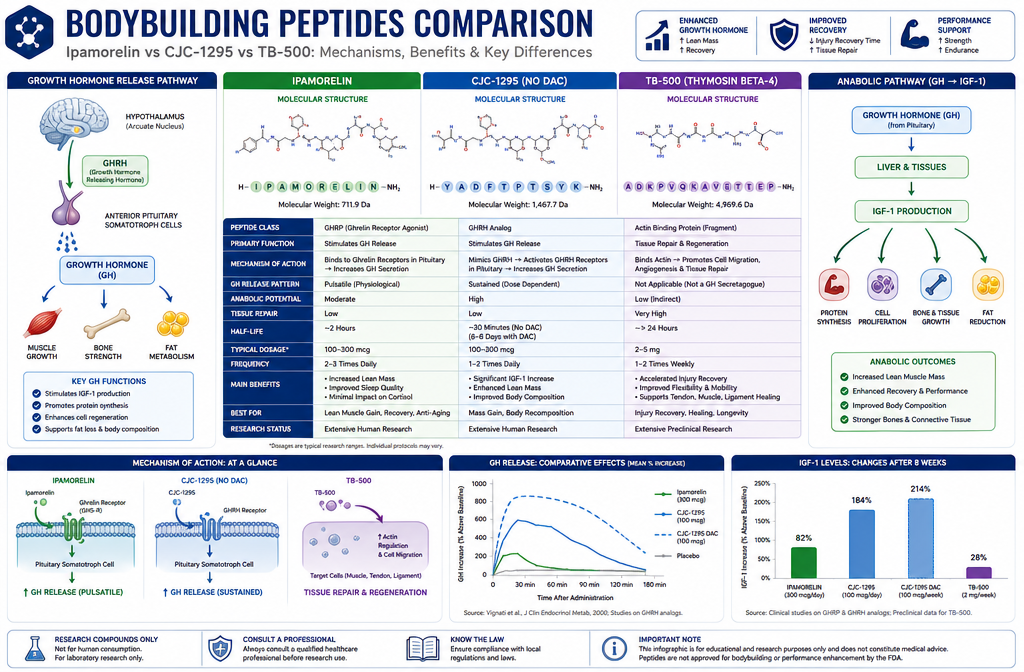
Ipamorelin is a selective GHRP known for producing a clean GH pulse with minimal effect on cortisol or prolactin — two hormones that can counteract muscle-building efforts. When paired with CJC-1295, the combination is thought to create a synergistic GH release pattern. Detailed research context on this pairing is available through CJC and Ipamorelin synergy research.
For researchers exploring Ipamorelin muscle and fat research themes, the peptide's selectivity makes it a frequently referenced compound in body composition literature.
Tesamorelin
Tesamorelin is a stabilized GHRH analogue with a strong research profile, particularly around visceral fat reduction and lean mass preservation. A thorough overview of Tesamorelin peptide benefits outlines why it remains a benchmark compound in GH-axis research.
BPC-157 and TB-500
These repair-focused peptides are studied for their roles in tissue regeneration and muscle recovery rather than direct anabolism. TB-500 muscle recovery research documents its influence on actin regulation and cellular repair — processes directly relevant to post-training recovery.
Sourcing and Purity: A Non-Negotiable Variable
The quality of any peptide research depends entirely on compound purity. Contaminated or mislabeled peptides produce unreliable data and potential safety concerns. Researchers should prioritize suppliers that provide third-party testing documentation.
Understanding peptide purity testing and referencing established Bachem and reference standards are practical starting points for evaluating supplier credibility.
Conclusion
Muscle growth and bodybuilding peptides represent a rapidly evolving area of research with genuine scientific depth. The actionable steps for anyone engaging with this field are clear: understand the mechanism of each peptide class, prioritize verified purity sources, and stay current with emerging comparative data such as Ipamorelin vs. Tesamorelin. Research compounds should always be handled within appropriate regulatory frameworks.
Tags: muscle growth peptides, bodybuilding peptides, Ipamorelin, CJC-1295, Tesamorelin, BPC-157, TB-500, GHRP research, peptide purity, growth hormone peptides, body composition research, peptide sourcing