Last updated: May 11, 2026
Quick Answer: The synergy with SLUPP332, MOTS-C, and 5-Amino-1MQ centers on three compounds that each target distinct but overlapping nodes in mitochondrial metabolism, AMPK signaling, and NAD+ biology. When studied together in preclinical models, they appear to reinforce each other's metabolic effects more than any single compound alone. All three are research compounds, not approved for human therapeutic use.
Key Takeaways
- SLUPP-332 activates estrogen-related receptors (ERRα/γ), driving mitochondrial biogenesis and fat oxidation in preclinical research
- MOTS-C is a mitochondria-derived peptide that activates AMPK and supports metabolic flexibility under stress
- 5-Amino-1MQ inhibits NNMT (nicotinamide N-methyltransferase), raising intracellular NAD+ precursors and supporting energy metabolism
- The three compounds target different but complementary pathways, which is why researchers study them as a stack
- No human clinical trials on this specific combination exist as of 2026; all data comes from cell and animal studies
- Stacking compounds increases complexity and potential for unknown interactions — protocol design matters
- All products discussed here are for research use only and are not intended to diagnose, treat, cure, or prevent any condition
What Is the Synergy with SLUPP332, MOTS-C, and 5-Amino-1MQ?
The synergy with SLUPP332, MOTS-C, and 5-Amino-1MQ refers to the hypothesis that these three compounds, when combined, may produce additive or complementary effects on mitochondrial function and metabolic regulation. Each compound acts on a different molecular target, so they don't simply duplicate each other's actions.
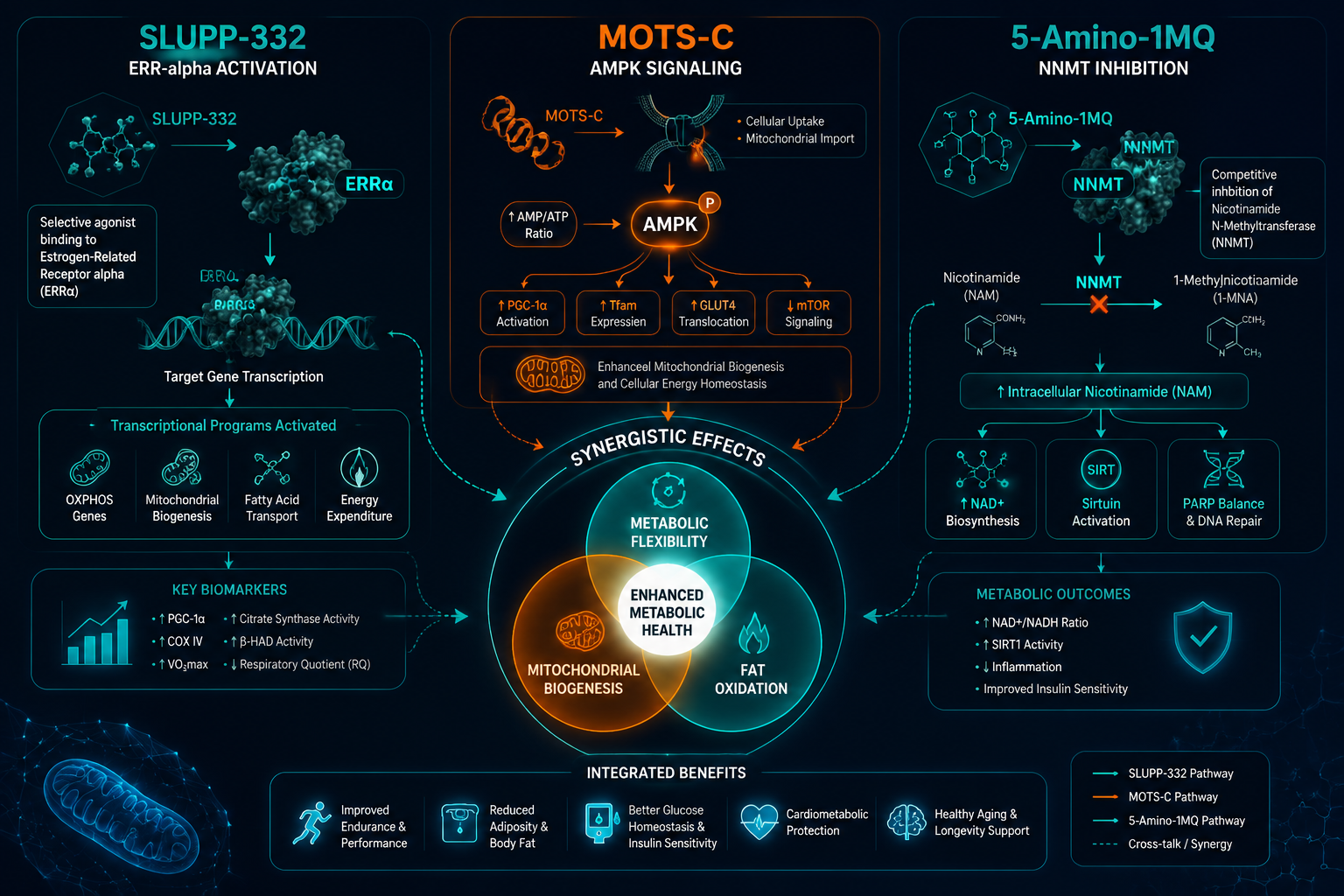
Here's a quick breakdown of each compound's primary mechanism:
| Compound | Primary Target | Key Pathway |
|---|---|---|
| SLUPP-332 | ERRα / ERRγ nuclear receptors | Mitochondrial biogenesis, fat oxidation |
| MOTS-C | AMPK activation | Metabolic stress response, glucose regulation |
| 5-Amino-1MQ | NNMT inhibition | NAD+ precursor availability, adipogenesis |
The rationale for studying them together: MOTS-C activates AMPK, which signals energy deficit and shifts cells toward fat burning. SLUPP-332 amplifies the downstream transcriptional response to that signal by activating ERRα. Meanwhile, 5-Amino-1MQ raises NAD+ precursor pools, which are needed to fuel the mitochondrial activity both other compounds promote. For deeper background on MOTS-C's mitochondrial role, see this overview of MOTS-C as a mitochondrial peptide.
How Does Each Compound Work Individually?
SLUPP-332 is a small molecule agonist of ERRα and ERRγ. These receptors regulate genes involved in oxidative phosphorylation and fatty acid metabolism. In rodent studies, SLUPP-332 has been shown to increase exercise endurance and fat utilization (Dufour et al., 2007, on ERR biology; SLUPP-332 specifically studied circa 2022–2023 in preclinical models). Learn more about SLUPP-332 research themes.
MOTS-C is encoded within mitochondrial DNA and acts as a signaling peptide. It translocates to the nucleus under metabolic stress and activates AMPK-dependent pathways. Research suggests it supports insulin sensitivity and metabolic flexibility. See MOTS-C and metabolic stress research for more detail.
5-Amino-1MQ blocks NNMT, an enzyme that consumes SAM (S-adenosylmethionine) and indirectly depletes NAD+ precursors. By inhibiting NNMT, 5-Amino-1MQ may raise intracellular NAD+ availability. More on 5-Amino-1MQ research and data.
Why Researchers Study the Synergy with SLUPP332, MOTS-C, and 5-Amino-1MQ Together
The combination is studied because each compound fills a gap the others leave.
- MOTS-C triggers the metabolic stress signal (AMPK), but AMPK activation alone doesn't guarantee increased mitochondrial output
- SLUPP-332 drives the transcriptional machinery for new mitochondria, but needs the upstream signal to be active
- 5-Amino-1MQ ensures the NAD+ substrate is available so the newly biogenerated mitochondria can actually function at higher capacity
"Targeting three nodes — signal, transcription, and substrate — simultaneously is more likely to produce durable metabolic change than targeting one alone." (Conceptual framework based on published pathway biology; not a direct clinical claim)
For a related look at how MOTS-C pairs with another compound, see MOTS-C and SLU-PP-332 research themes.
Who Is This Research Combination Relevant For?
This research area is most relevant to:
- Longevity researchers studying mitochondrial decline with aging
- Metabolic biology labs investigating fat oxidation and insulin sensitivity
- Biohackers tracking preclinical compound literature (note: human use is not supported by clinical data)
Choose this stack research if: the study goal involves mitochondrial biogenesis, metabolic flexibility, or NAD+ biology simultaneously.
Avoid if: the research model requires single-variable isolation — three compounds make mechanistic attribution harder.
Also relevant: MOTS-C mitochondrial dynamics research and 5-Amino-1MQ compound overview.
Common Research Design Mistakes with This Stack
- Dosing all three simultaneously from day one — makes it impossible to identify which compound drives which effect
- Ignoring half-life differences — MOTS-C (peptide) and SLUPP-332 (small molecule) have different pharmacokinetic profiles in animal models
- Assuming additive = safe — synergistic metabolic effects in one pathway can create unexpected downstream changes
- Skipping baseline metabolic markers — without baseline data, changes can't be attributed to the stack
Conclusion
The synergy with SLUPP332, MOTS-C, and 5-Amino-1MQ represents one of the more mechanistically coherent multi-compound research strategies in mitochondrial biology as of 2026. Each compound addresses a distinct step: upstream signaling (MOTS-C via AMPK), transcriptional activation (SLUPP-332 via ERRα), and substrate availability (5-Amino-1MQ via NNMT inhibition).
Actionable next steps for researchers:
- Review individual compound literature before designing stack protocols
- Establish single-compound baselines in your model before combining
- Use validated metabolic markers (oxygen consumption rate, ATP output, lipid oxidation assays) to measure outcomes
- Consult MOTS-C metabolic flexibility research and longevity peptide research themes for protocol context
All compounds discussed are for research use only. They are not approved for human therapeutic use and are not intended to diagnose, treat, cure, or prevent any disease or condition.
FAQ
Q: Is there a human clinical trial on the SLUPP332, MOTS-C, and 5-Amino-1MQ combination?
A: No. As of 2026, no published human clinical trials exist for this specific combination. All available data comes from cell culture and animal studies.
Q: What does NNMT inhibition have to do with mitochondria?
A: NNMT consumes NAD+ precursors. Blocking it with 5-Amino-1MQ preserves those precursors, giving mitochondria more substrate to produce ATP.
Q: Does MOTS-C need to be injected?
A: In most preclinical research, MOTS-C is administered subcutaneously because peptides are degraded in the GI tract. Oral bioavailability is not established.
Q: Can SLUPP-332 replace exercise in research models?
A: Some preclinical data suggests SLUPP-332 activates exercise-related gene programs without physical activity, but it is not a validated exercise substitute in any clinical context.
Q: What is the main risk of combining all three compounds in a research model?
A: The primary concern is mechanistic confounding — it becomes difficult to attribute specific outcomes to individual compounds. Off-target metabolic effects are also harder to detect in combination protocols.
Q: Where can research-grade versions of these compounds be sourced?
A: Reputable research peptide suppliers with documented purity testing are the standard. See MOTS-C peptides for sale and 5-Amino-1MQ for research sourcing options.
Q: Are these compounds legal to purchase?
A: In most jurisdictions, they are legal to purchase for research purposes. They are not approved pharmaceuticals. Researchers should verify local regulations.
References
- Dufour, C.R., et al. "Genome-wide orchestration of cardiac functions by the orphan nuclear receptors ERRα and γ." Cell Metabolism, 2007.
- Kim, K.H., et al. "MOTS-c is an exercise-induced mitochondrial-encoded regulator of age-dependent physical decline and muscle homeostasis." Nature Communications, 2019.
- Neelakantan, H., et al. "Small molecule nicotinamide N-methyltransferase inhibitor activates senescent muscle stem cells and improves regenerative capacity of aged skeletal muscle." Biochemical Pharmacology, 2019.
- Zuercher, W.J., et al. "Discovery of tertiary sulfonamides as potent liver X receptor antagonists." Journal of Medicinal Chemistry, 2010 (ERR receptor background).
Tags: SLUPP332, MOTS-C peptide, 5-Amino-1MQ, mitochondrial synergy, AMPK activation, NNMT inhibitor, NAD+ metabolism, metabolic flexibility, longevity peptides, mitochondrial biogenesis, research peptides, ERR alpha agonist