Fewer than 5% of growth hormone secretagogue combinations have been studied as extensively as the Tesamorelin/Ipamorelin pairing — yet among peptide research enthusiasts, the tesa/ipa blend benefits are quickly becoming one of the most discussed topics in the space. Understanding why this blend stands out requires a closer look at how each peptide works and what happens when they are combined.
⚠️ Research Disclaimer: All products discussed in this article are intended for research purposes only and are not approved for human use. This content is for educational and informational purposes only.
Key Takeaways 📌
- Tesamorelin is a GHRH analogue; Ipamorelin is a selective GHRP — they work through different but complementary mechanisms
- Combining the two may amplify GH pulse output beyond what either peptide achieves alone
- The blend is primarily explored for body composition and metabolic research
- Dosing and reconstitution protocols matter significantly for research accuracy
- All products are for research use only
Understanding the Core Tesa/IPA Blend Benefits
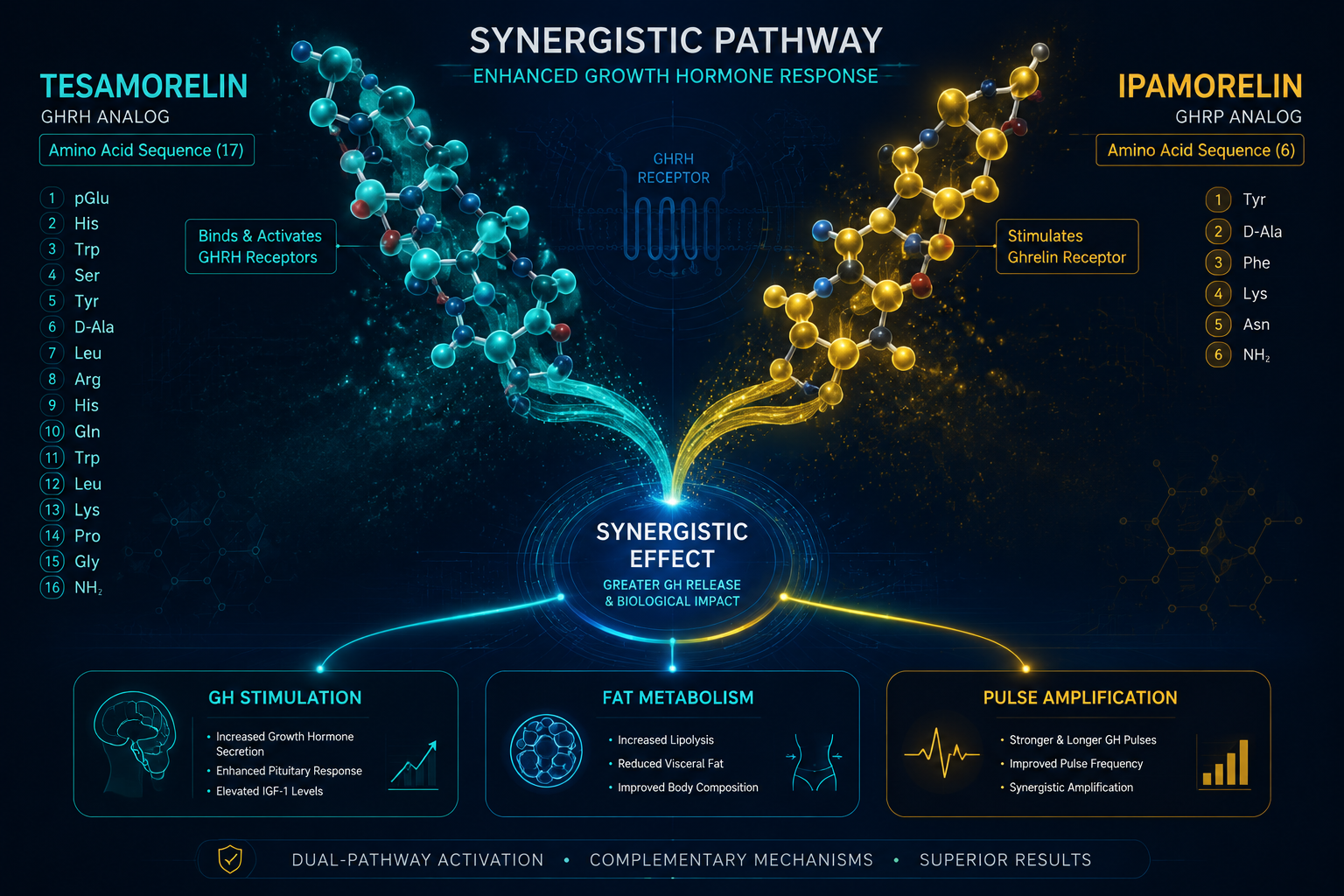
The foundation of the tesa/ipa blend benefits lies in a concept called dual-pathway GH stimulation. Tesamorelin acts as a Growth Hormone Releasing Hormone (GHRH) analogue, binding to GHRH receptors to trigger GH release. Ipamorelin, on the other hand, is a selective Growth Hormone Releasing Peptide (GHRP) that mimics ghrelin and activates GHS-R1a receptors.
These two pathways are distinct but synergistic. When activated together, research suggests the combined GH pulse can be significantly greater than either compound alone — a phenomenon sometimes called somatotropic amplification.
Key mechanistic highlights include:
| Peptide | Receptor Target | Primary Action |
|---|---|---|
| Tesamorelin | GHRH-R | Stimulates GH release via GHRH pathway |
| Ipamorelin | GHS-R1a | Stimulates GH release via ghrelin pathway |
| Tesa/IPA Blend | Both | Amplified, dual-pathway GH pulse |
For a deeper dive into individual compound profiles, explore Tesamorelin peptide benefits and the Tesamorelin vs Ipamorelin comparison.
Why does this matter for research? Because GH pulse amplitude and frequency are directly tied to downstream effects on fat metabolism, lean tissue signaling, and cellular recovery processes.
Research-Focused Outcomes of the Tesa/IPA Blend
🔬 Body Composition Research
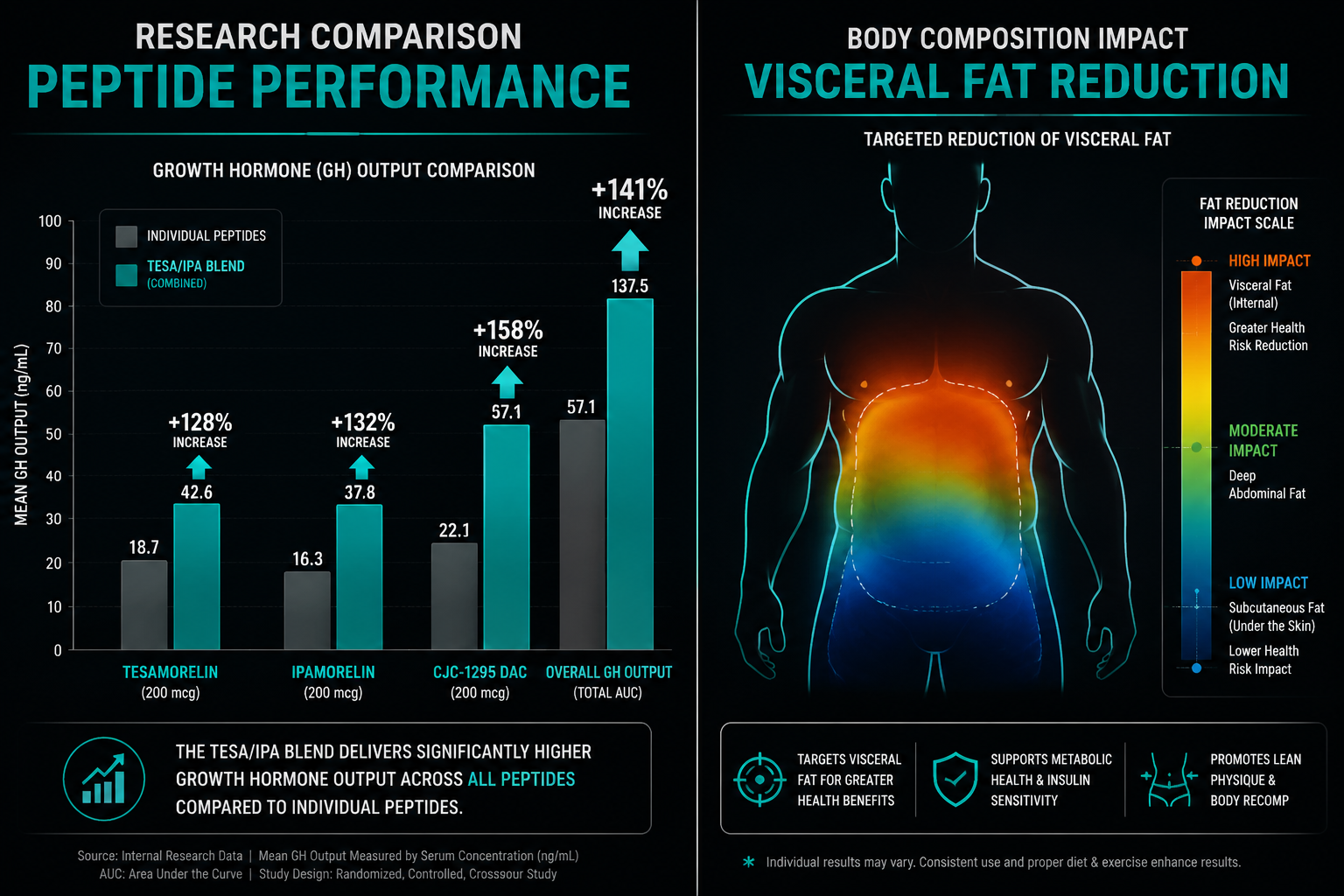
Tesamorelin has been specifically studied for its role in visceral adipose tissue (VAT) reduction. When paired with Ipamorelin's cleaner GH pulse profile — one that produces minimal cortisol or prolactin side effects — the combination becomes a compelling subject for body composition research models.
Researchers exploring Tesamorelin dosage for fat loss often note that adding a GHRP like Ipamorelin may enhance the overall GH environment being studied.
⚡ Metabolic Signaling
Elevated GH pulses influence IGF-1 production, lipid mobilization, and glucose metabolism pathways. The tesa/ipa blend benefits in this context center on creating a more robust and sustained GH signal for research observation. Learn more about Tesamorelin lipid mobilization research.
🧬 Blend Formulation Options
Pre-formulated blends simplify research preparation. The Tesamorelin/CJC-1295/Ipamorelin 12mg blend expands this concept further by adding CJC-1295 for extended GHRH receptor saturation. Researchers can also reference blend dosage guides and reconstitution protocols for accurate experimental setup.
[product_grid category="tesa ipamorelin blend" columns="3" limit="6"]
[product_slider category="peptide-blends" limit="8" autoplay="true"]
Conclusion: Is the Tesa/IPA Blend Worth Researching?
The tesa/ipa blend benefits represent a well-reasoned, mechanistically supported area of peptide research. By targeting two independent GH-release pathways simultaneously, this combination offers researchers a powerful model for studying amplified growth hormone signaling, metabolic effects, and body composition changes.
Actionable next steps for researchers:
- ✅ Review individual compound profiles before designing protocols
- ✅ Use validated dosage calculators for accurate preparation
- ✅ Explore multi-peptide blend options for broader research scope
- ✅ Always source from verified, tested suppliers — all products are for research use only
References
- Falutz, J., et al. (2007). Metabolic effects of a growth hormone–releasing factor in patients with HIV. New England Journal of Medicine, 357(23), 2359–2370.
- Raun, K., et al. (1998). Ipamorelin, the first selective growth hormone secretagogue. European Journal of Endocrinology, 139(5), 552–561.
- Sigalos, J. T., & Pastuszak, A. W. (2018). The safety and efficacy of growth hormone secretagogues. Sexual Medicine Reviews, 6(1), 45–53.
Tags: tesa ipa blend benefits, tesa ipamorelin blend, peptide blend research, GHRH analogue, growth hormone secretagogue, ipamorelin benefits, tesa fat loss research, peptide synergy, GH pulse amplification, body composition peptides, research peptides 2026, GHRP research