

Only two amino acids. That is all it takes to make Thymogen peptide one of the most studied short-chain immune modulators in modern peptide research. This synthetic dipeptide — built from L-glutamic acid and L-tryptophan — has attracted serious scientific attention for its role in T-cell regulation, bone marrow recovery, and immune signaling. As researchers continue to explore the full peptide landscape in 2026, Thymogen stands out for its elegant simplicity and surprisingly broad biological activity.
Key Takeaways 🔑
- Thymogen peptide is a synthetic two-amino-acid compound modeled on thymic protein fragments
- It modulates immune signaling through the cAMP/cGMP second messenger pathway
- Research shows strong T-lymphocyte stimulation and bone marrow restoration effects
- A newer oral variant (AWE18) addresses the original compound's limited oral bioavailability
- Long-term safety data remains incomplete — ongoing research is essential
What Is Thymogen Peptide? Structure and Origin
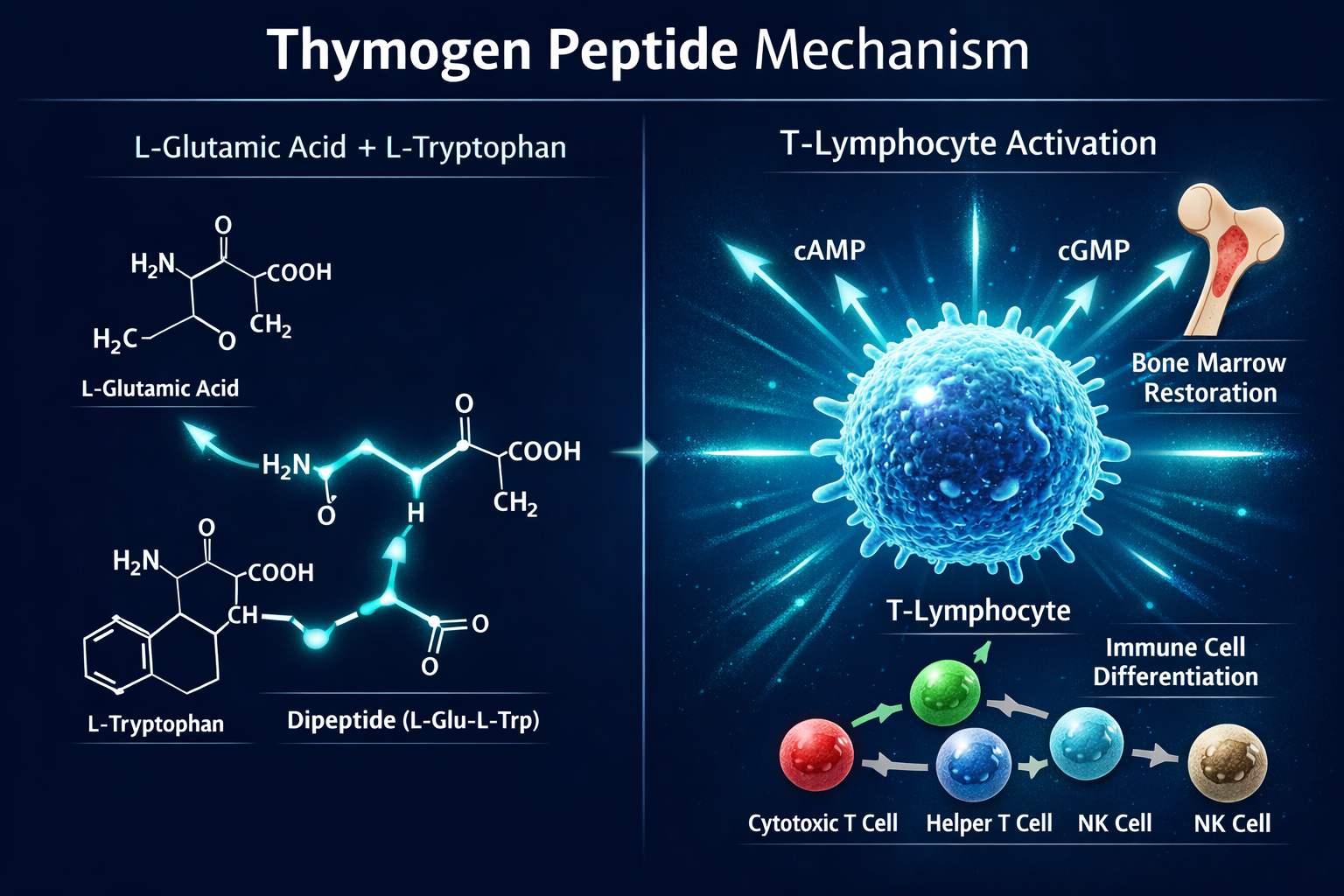
Thymogen peptide is a synthetic dipeptide composed of L-glutamic acid bonded to L-tryptophan. It was originally designed to mimic bioactive fragments found in natural thymic proteins — the same proteins the thymus gland uses to train immune cells.
Unlike larger peptides such as Thymosin Alpha-1, Thymogen's minimal structure makes it easier to synthesize and study. Its small size does not limit its activity — research suggests it punches well above its molecular weight.
How Thymogen Peptide Works: The Mechanism 🔬
Thymogen peptide influences immune function primarily through phosphodiesterase inhibition, which preserves elevated levels of cAMP and cGMP inside immune cells. These cyclic nucleotides act as critical second messengers, controlling how cells respond to external signals.
| Mechanism | Effect Observed |
|---|---|
| cAMP/cGMP modulation | Enhanced intracellular immune signaling |
| T-lymphocyte stimulation | Increased differentiation and proliferation |
| Neutrophil/monocyte activation | Broader innate immune support |
| Bone marrow restoration | Recovery after irradiation at 1Gy and 4Gy |
This multi-pathway activity is why researchers exploring longevity peptide research have taken notice of this compound.
7 Key Research Findings on Thymogen Peptide
1. 🛡️ T-Cell Differentiation Support
Parenteral administration of Thymogen peptide consistently stimulates T-lymphocyte differentiation and proliferation in experimental models.
2. 🦴 Bone Marrow Restoration
Research demonstrates measurable bone marrow recovery following radiation exposure, a finding relevant to immunosuppression research.
3. 🎯 Tumor Incidence Reduction
Experimental models showed a 12% decrease in tumor incidence and a 1.7x reduction in tumor multiplicity — notable findings for cancer-adjacent immune research.
4. ✅ Autoimmune Model Success Rate
Positive immune outcomes were recorded in 94.4% of autoimmune models, with 83.3% showing improved laboratory immune markers.
5. 🩹 Wound Healing and Cellular Synthesis
Research links Thymogen peptide to accelerated DNA and protein synthesis, supporting tissue repair processes — similar to findings seen with GHK-Cu peptide research.
6. 💊 New Oral Variant AWE18
The original Thymogen showed limited oral bioavailability. A peptidomimetic variant called AWE18 was developed to improve both systemic and oral activity — a major step forward for delivery flexibility. Researchers interested in innovative peptide delivery systems will find this development significant.
7. ⚠️ Safety Data Gaps Remain
Long-term safety beyond seasonal or annual research cycles has not been fully established. Combination effects with other immune therapies also remain understudied.
[product_slider]
Thymogen Peptide vs. Other Immune Peptides
When compared to related compounds like Selank or MOTS-c, Thymogen peptide occupies a unique niche focused specifically on thymic immune axis modulation. Some researchers suggest it may outperform Thymosin Alpha-1 in targeted immune support applications when backed by metabolomics data — though direct head-to-head clinical trials remain limited.
💬 "Thymogen's two-amino-acid structure challenges the assumption that complexity equals potency in peptide research."
Conclusion: What Researchers Should Do Next
Thymogen peptide represents a compelling area of immune peptide research in 2026. Its well-documented mechanisms — from cAMP/cGMP modulation to T-cell stimulation — make it a strong candidate for continued study. Researchers should:
- ✅ Prioritize purity-verified sources — review quality testing protocols before sourcing
- ✅ Explore the AWE18 oral variant for delivery flexibility studies
- ✅ Track emerging long-term safety data as the research base grows
- ✅ Consider Thymogen immune research resources for updated protocols
The science is promising — and the research journey for this small but powerful dipeptide is far from over.
Tags: Thymogen peptide, immune peptide research, thymic peptides, T-lymphocyte stimulation, peptide immune modulation, Thymosin Alpha-1, AWE18 peptidomimetic, synthetic dipeptide, bone marrow restoration, cAMP cGMP signaling, longevity peptides, peptide research 2026