

Fewer than 1 in 10 fitness peptide enthusiasts can name a neuropeptide that simultaneously influences inflammation, gut motility, immune regulation, and circadian rhythm — yet VIP peptide has been doing exactly that since researchers first isolated it in 1970. As interest in advanced peptide research accelerates in 2026, vasoactive intestinal peptide is earning a second look from the scientific community.
"VIP peptide sits at a rare intersection of neuroscience, immunology, and metabolic research — making it one of the most multifaceted signaling molecules under study today."
Key Takeaways 🔬
- VIP peptide (Vasoactive Intestinal Peptide) is a 28-amino-acid neuropeptide found throughout the nervous and immune systems.
- It signals primarily through VPAC1 and VPAC2 receptors, triggering broad downstream effects.
- Research interest focuses on its anti-inflammatory, neuroprotective, and circadian-regulating properties.
- VIP is studied alongside other longevity-focused peptide research compounds for its potential systemic benefits.
- All VIP peptide products are for research purposes only and are not intended for human therapeutic use.
What Is VIP Peptide?
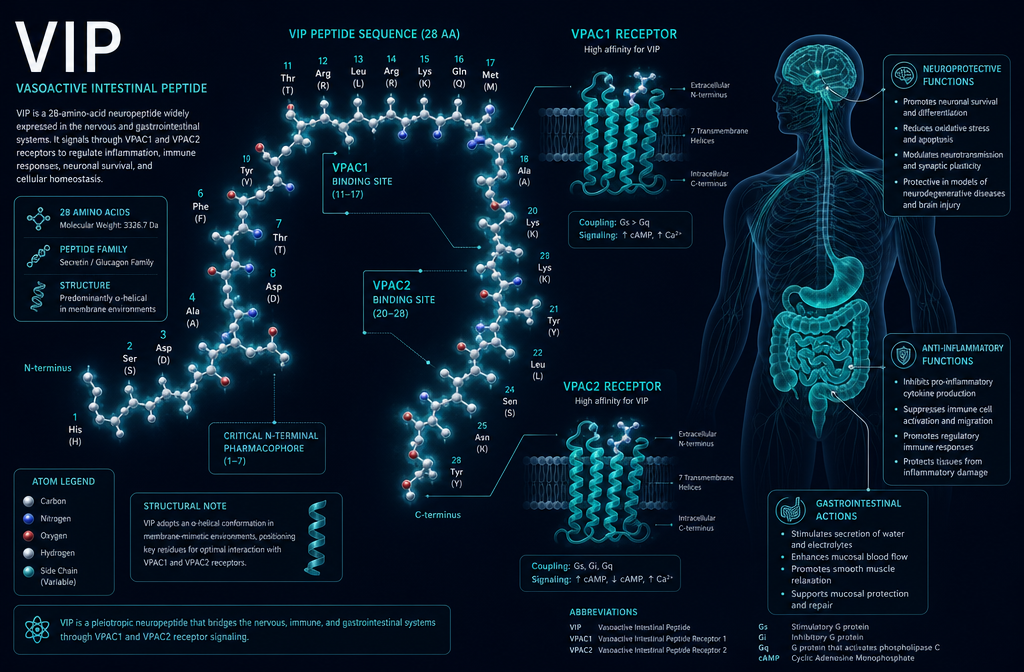
Vasoactive Intestinal Peptide is a 28-amino-acid signaling molecule belonging to the secretin/glucagon superfamily. It is produced naturally in the gut, brain, and peripheral nervous system. Despite its name, VIP's influence extends far beyond vascular tone.
Structure and Receptor Binding
VIP binds to two primary G-protein-coupled receptors:
| Receptor | Primary Location | Key Function |
|---|---|---|
| VPAC1 | Lung, liver, gut | Immune modulation, smooth muscle relaxation |
| VPAC2 | Brain, pancreas, heart | Circadian rhythm, neuroprotection |
This dual-receptor system gives VIP peptide its remarkably wide range of biological influence. Researchers studying innovative peptide delivery systems note that VIP's short half-life presents unique formulation challenges worth exploring.
VIP Peptide Research: Key Areas of Interest
Anti-Inflammatory Properties 🛡️
One of the most studied aspects of VIP peptide is its role in immune regulation. Research models suggest VIP may:
- Suppress pro-inflammatory cytokines such as TNF-α and IL-6
- Promote regulatory T-cell activity
- Reduce neuroinflammatory markers in preclinical models
These properties place VIP in a similar research conversation as other anti-inflammatory compounds like SS-31 peptide, which is studied for mitochondrial protection and oxidative stress reduction.
Circadian and Sleep Research ⏰
VIP is heavily concentrated in the suprachiasmatic nucleus (SCN) — the brain's master clock. Research models indicate it plays a direct role in synchronizing circadian rhythms across tissues. This makes VIP peptide a point of interest for researchers exploring sleep architecture and metabolic timing.
Neuroprotective Potential 🧠
Preclinical data suggests VIP may support neuronal survival under stress conditions. This aligns with broader longevity peptide research themes that examine neuroprotection as a key pillar of healthy aging models.
Metabolic and GI Research
VIP was originally identified for its effects on intestinal smooth muscle. Current research also explores its interaction with metabolic signaling, drawing comparisons to GLP-1 peptide research in terms of gut-brain axis communication.
VIP Peptide vs. Related Research Compounds
For researchers building a broader peptide research library, VIP is often studied alongside:
- MOTS-c peptide — mitochondrial and metabolic signaling
- GHK-Cu peptide — tissue repair and anti-inflammatory models
- Tesamorelin peptide — growth hormone axis research
View all research peptides available for purchase

[product_carousel tag="research-peptides" limit="6"]
Sourcing and Quality Considerations
Peptide purity is non-negotiable in legitimate research. When sourcing VIP peptide, researchers should prioritize vendors who provide:
- Third-party HPLC and mass spectrometry testing
- Certificates of Analysis (CoA) for every batch
- Transparent manufacturing standards
Learn more about peptide purity testing protocols before making sourcing decisions.
⚠️ Research Use Only: All VIP peptide products are strictly for laboratory and research purposes. They are not approved for human consumption or therapeutic use.
Conclusion: Is VIP Peptide Worth Researching in 2026?
For fitness peptide enthusiasts and researchers tracking the cutting edge of peptide science, VIP peptide represents a compelling area of study. Its multi-system influence — spanning inflammation, circadian biology, neuroprotection, and gut-brain signaling — makes it a uniquely versatile molecule.
Actionable next steps for researchers:
- ✅ Review published preclinical literature on VPAC1/VPAC2 receptor pathways
- ✅ Compare VIP's mechanisms alongside related compounds in your research stack
- ✅ Source only from vendors with verified lab-tested peptide quality standards
- ✅ Document all experimental protocols carefully for reproducibility
References
- Said, S. I., & Mutt, V. (1970). Polypeptide with broad biological activity: isolation from small intestine. Science, 169(3951), 1217–1218.
- Delgado, M., & Ganea, D. (2013). Vasoactive intestinal peptide: a neuropeptide with pleiotropic immune functions. Amino Acids, 45(1), 25–39.
- Abad, C., & Bhatt, D. L. (2021). VIP and PACAP in neuroinflammation. Frontiers in Cellular Neuroscience, 15, 635476.
- Harmar, A. J., et al. (2002). The VPAC2 receptor is essential for circadian function in the mouse suprachiasmatic nuclei. Cell, 109(4), 497–508.
Tags: VIP peptide, vasoactive intestinal peptide research, neuropeptide anti-inflammatory, VPAC1 VPAC2 receptor peptide, circadian rhythm peptide research, peptide research 2026, neuroprotective peptides, fitness peptide research, peptide sourcing quality, longevity peptide compounds, gut brain axis peptides, research peptides for sale