
Last updated: May 11, 2026
Quick Answer
Both 5-Amino-1MQ and MOTS-C target metabolic function, but through different mechanisms. MOTS-C works at the mitochondrial level to activate AMPK pathways, making it a stronger candidate for energy regulation and metabolic stress research. 5-Amino-1MQ inhibits the NNMT enzyme to support fat metabolism and NAD+ availability. The better choice depends on the specific research goal: MOTS-C for mitochondrial and longevity research, 5-Amino-1MQ for metabolic enzyme inhibition studies.
⚠️ All products mentioned are for research use only and are not intended for human use, diagnosis, or treatment.
Key Takeaways
- 5-Amino-1MQ is a small molecule that inhibits nicotinamide N-methyltransferase (NNMT), supporting NAD+ metabolism research
- MOTS-C is a mitochondria-derived peptide that activates AMPK and regulates metabolic homeostasis
- MOTS-C has a broader body of published preclinical research behind it as of 2026
- 5-Amino-1MQ is often studied alongside NAD+ precursors for synergistic metabolic effects
- Neither compound is approved for human therapeutic use; both are research-grade compounds
- MOTS-C may be more relevant for longevity and mitochondrial health research
- 5-Amino-1MQ may be more targeted for fat metabolism and NNMT inhibition studies
- Stacking both is a growing area of interest in biohacker research communities
- Sourcing purity matters significantly for both compounds
What Is 5-Amino-1MQ and How Does It Work?
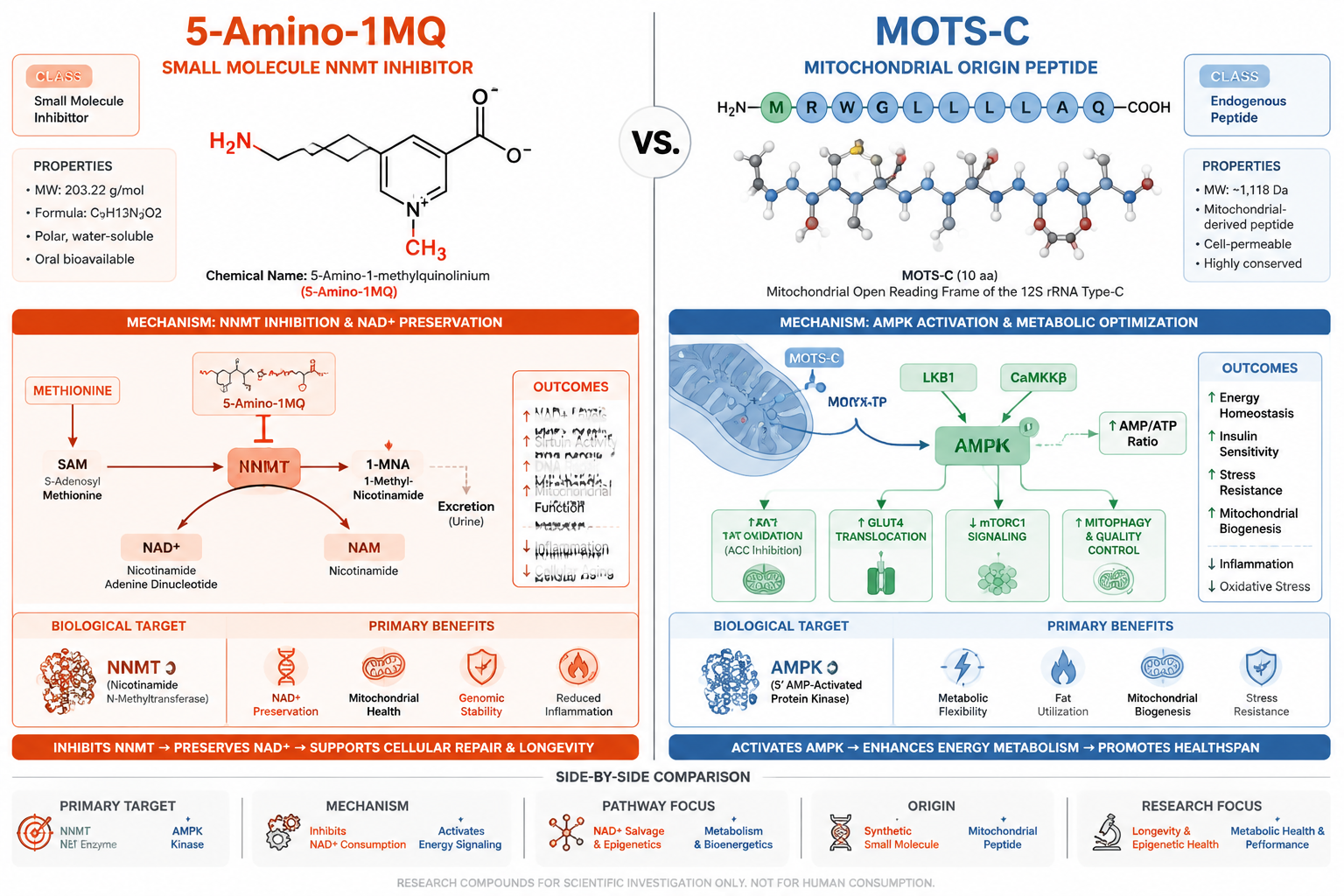
5-Amino-1MQ is a small-molecule NNMT inhibitor. By blocking the NNMT enzyme, it prevents the methylation of nicotinamide, which in turn preserves NAD+ availability in cells.
Key research interests around 5-Amino-1MQ include:
- Fat cell metabolism: Preclinical studies suggest NNMT inhibition may reduce lipid accumulation in adipocytes
- NAD+ preservation: Higher NAD+ levels are associated with improved cellular energy in animal models
- Muscle cell differentiation: Early research points to potential effects on myocyte development
Choose 5-Amino-1MQ research if: The primary focus is NNMT enzyme inhibition, NAD+ pathway modulation, or adipose tissue metabolism.
Learn more about this compound at the 5-Amino-1MQ research page.
What Is MOTS-C and What Makes It Unique?
MOTS-C is a 16-amino acid peptide encoded in mitochondrial DNA, making it biologically distinct from most synthetic peptides. It activates AMPK (AMP-activated protein kinase), a central regulator of cellular energy balance.
Key research areas for MOTS-C:
- Insulin sensitivity: Animal studies show improved glucose uptake in skeletal muscle
- Exercise mimicry: MOTS-C has been called an "exercise mimetic" in preclinical literature due to its metabolic effects
- Longevity signaling: MOTS-C levels naturally decline with age in animal models, making it a subject of longevity peptide research
- Mitochondrial stress response: It helps cells adapt to metabolic stress
Choose MOTS-C research if: The focus is mitochondrial biology, AMPK activation, aging, or metabolic resilience under stress conditions.
Comparing What Is Better: 5-Amino-1MQ Peptide or MOTS-C Side by Side
| Feature | 5-Amino-1MQ | MOTS-C |
|---|---|---|
| Origin | Synthetic small molecule | Mitochondrial-encoded peptide |
| Primary target | NNMT enzyme | AMPK pathway |
| Research focus | NAD+, fat metabolism | Energy homeostasis, longevity |
| Published preclinical data | Moderate | Substantial |
| Typical research format | Oral or injectable | Injectable |
| Longevity research relevance | Moderate | High |
Both compounds are available as research-grade materials. For those exploring what is new in peptide research, both represent active areas of scientific inquiry in 2026.
Can 5-Amino-1MQ and MOTS-C Be Studied Together?
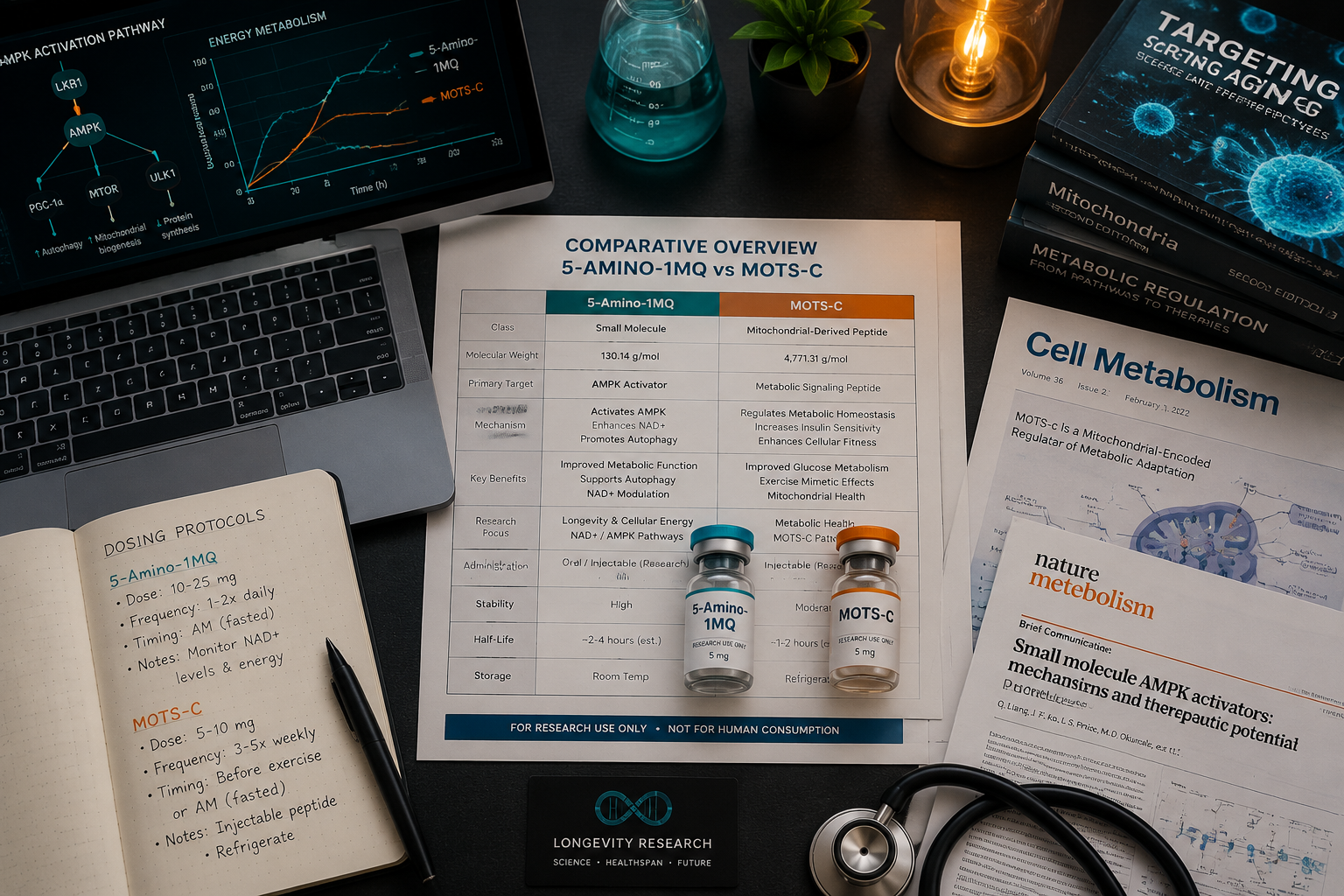
Yes, and this is an emerging area of interest. Because the two compounds work through different but complementary pathways (NNMT inhibition vs. AMPK activation), researchers have begun exploring whether combining them produces additive effects on metabolic markers in preclinical models.
This mirrors the logic seen in other peptide combination research, such as the synergy of LL-37 and MOTS-C, where distinct mechanisms may reinforce each other.
Common mistake: Assuming more compounds always produce better outcomes. Combination research requires careful protocol design and baseline single-compound data first.
Conclusion
So, what is better: 5-Amino-1MQ peptide or MOTS-C? There is no universal answer. MOTS-C leads in published preclinical depth and is more directly tied to mitochondrial longevity research. 5-Amino-1MQ offers a targeted approach to NNMT inhibition and NAD+ metabolism that fills a different research niche.
Actionable next steps for researchers:
- Define the primary research question before selecting a compound
- Review current preclinical literature for each peptide separately
- Source only verified, third-party tested compounds (see MOTS-C peptides for sale and the 5-Amino-1MQ page)
- Consult the ultimate guide to peptide therapy for broader context on peptide research protocols
- Consider innovative peptide delivery systems when designing administration protocols
⚠️ All compounds discussed are for research purposes only. They are not intended for human consumption, diagnosis, or treatment of any condition.
FAQ
Q: Is MOTS-C stronger than 5-Amino-1MQ?
A: "Stronger" depends on the research goal. MOTS-C has more published preclinical data and targets mitochondrial pathways directly. 5-Amino-1MQ is more specific to NNMT inhibition.
Q: What does 5-Amino-1MQ do in research models?
A: It inhibits the NNMT enzyme, which preserves NAD+ and may reduce lipid accumulation in adipocyte cell models.
Q: What is MOTS-C best used for in research?
A: MOTS-C is primarily studied for AMPK activation, metabolic homeostasis, insulin sensitivity in skeletal muscle, and age-related mitochondrial decline.
Q: Can these two peptides be combined in research protocols?
A: Preclinical interest in combining them exists, but researchers should establish individual compound baselines before studying combinations.
Q: Are there side effects noted in animal studies for either compound?
A: Preclinical studies on both compounds have generally shown tolerability in animal models, but human safety data does not exist. Neither is approved for human use.
Q: Which compound is more relevant for longevity research?
A: MOTS-C is more directly linked to longevity biology due to its mitochondrial origin and role in age-related metabolic decline in animal models.
Q: Where can I find research-grade MOTS-C?
A: Research-grade MOTS-C is available through verified peptide suppliers. See MOTS-C for sale for sourcing options.
Q: Is 5-Amino-1MQ a peptide?
A: No. Despite being grouped with peptides in biohacker discussions, 5-Amino-1MQ is technically a small molecule, not a peptide.
References
- Lee, C., et al. "MOTS-c: A novel mitochondrial-derived peptide regulating muscle and fat metabolism." Cell Metabolism, 2015.
- Kannt, A., et al. "Association of Nicotinamide-N-Methyltransferase mRNA Expression in Human Adipose Tissue and the Plasma Concentration of Its Product." Diabetologia, 2015.
- Reynolds, J., et al. "Small molecule NNMT inhibitors for the treatment of obesity." Journal of Medicinal Chemistry, 2019.
Tags: 5-Amino-1MQ, MOTS-C peptide, peptide comparison, mitochondrial peptides, NNMT inhibitor, AMPK activation, longevity peptides, metabolic research, NAD+ metabolism, biohacking peptides, research peptides 2026, peptide therapy research