What is the Strongest Peptide for Muscle Growth? 💪
If you’ve been exploring ways to enhance your muscle-building journey, you’ve likely stumbled across the world of peptides. The question “what is the strongest peptide for muscle growth?” is one I hear constantly from fitness enthusiasts, bodybuilders, and health professionals alike. The answer isn’t as simple as naming one compound—because peptide strength depends on your specific goals, tolerance, and how your body responds. In this comprehensive guide, I’ll break down the most powerful peptides for muscle growth and help you understand which might work best for your research needs.
Key Takeaways
- IGF-1 LR3 is widely considered the most potent peptide for direct muscle growth and hyperplasia
- Growth hormone secretagogues like CJC-1295/Ipamorelin combinations offer powerful muscle-building effects with fewer side effects
- TB-500 and BPC-157 excel at recovery and injury healing, indirectly supporting muscle growth
- Peptide effectiveness varies based on individual response, dosing protocols, and stacking strategies
- Always source peptides from reputable suppliers like Pure Tested Peptides for quality assurance
Quick Answer: What is the Strongest Peptide for Muscle Growth?
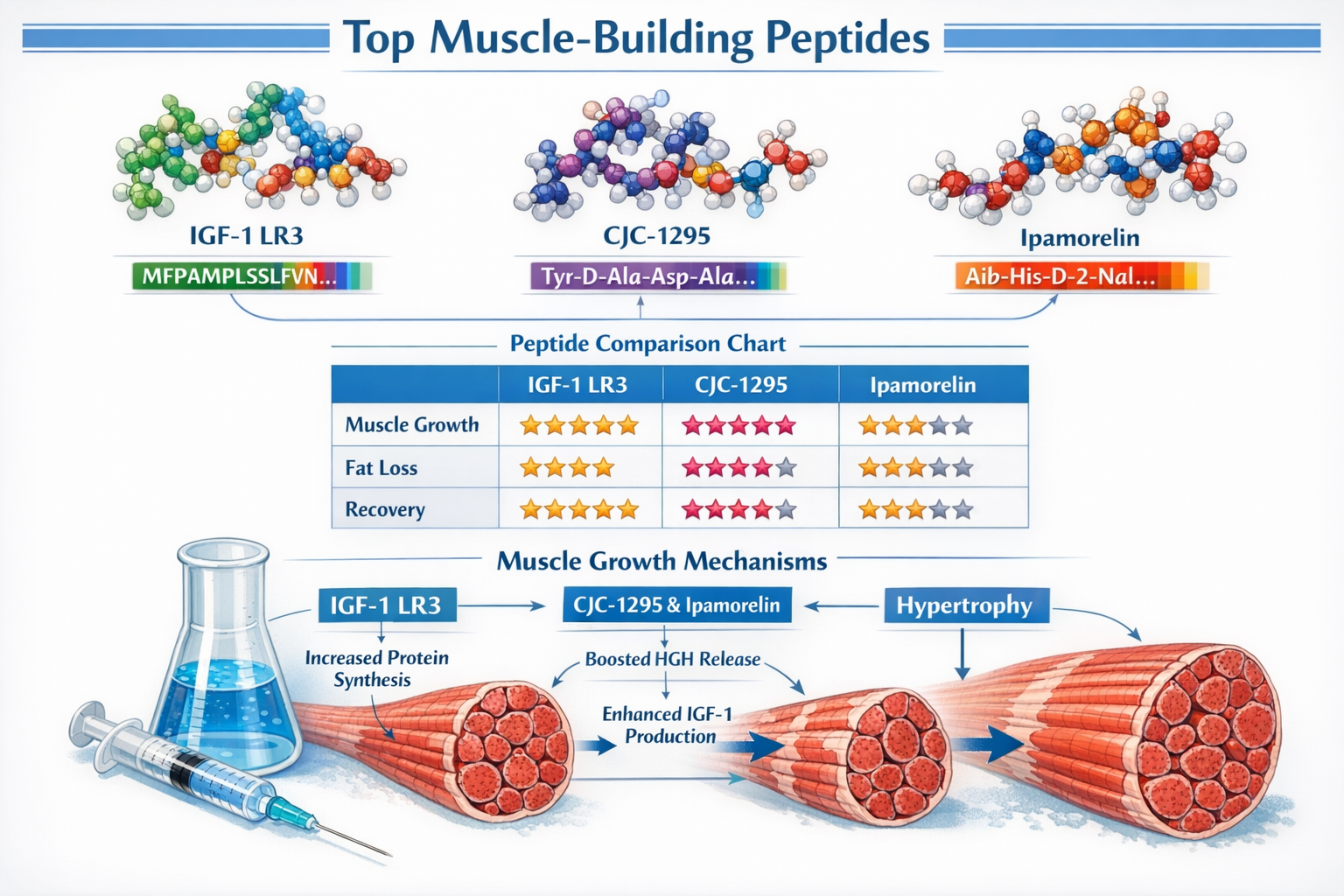
IGF-1 LR3 (Insulin-like Growth Factor-1 Long R3) is generally recognized as the strongest peptide for muscle growth due to its direct anabolic effects on muscle tissue. It promotes muscle hyperplasia (new muscle cell creation) and hypertrophy (muscle cell enlargement). However, CJC-1295 combined with Ipamorelin offers a powerful alternative with a better safety profile, stimulating natural growth hormone release. For recovery-focused growth, TB-500 stands out. The “strongest” peptide depends on your specific goals—whether you prioritize pure mass gain, recovery, or sustainable long-term growth. Research peptides are available for study purposes at www.PureTestedPeptides.com, where quality and purity are prioritized for serious researchers.
Understanding Peptides and Muscle Growth 🔬
Before we dive into specific compounds, let’s establish what peptides actually are. Peptides are short chains of amino acids that act as signaling molecules in your body. They tell your cells to perform specific functions—including building muscle, burning fat, and repairing tissue.
When we talk about muscle growth peptides, we’re typically referring to compounds that:
- Stimulate growth hormone (GH) production
- Increase insulin-like growth factor (IGF-1) levels
- Enhance protein synthesis
- Improve recovery and tissue repair
- Reduce inflammation and promote healing
The peptide research community has identified several categories of muscle-building peptides, each with unique mechanisms and benefits.
How Peptides Differ from Steroids
Unlike anabolic steroids, peptides work with your body’s natural processes rather than replacing them. They encourage your own hormone production instead of introducing synthetic hormones. This typically results in:
✅ Fewer side effects
✅ More sustainable results
✅ Better long-term health outcomes
✅ Less suppression of natural hormone production
The Top Contenders: What is the Strongest Peptide for Muscle Growth?
Let me walk you through the most powerful peptides for muscle development, based on current research and anecdotal evidence from the fitness and research communities.
1. IGF-1 LR3: The Heavyweight Champion 🏆
IGF-1 LR3 (Insulin-like Growth Factor-1 Long R3) consistently ranks as the most potent peptide for pure muscle growth. Here’s why:
- Direct anabolic effects: Works directly on muscle tissue without needing conversion
- Muscle hyperplasia: Creates entirely new muscle cells (not just enlarging existing ones)
- Extended half-life: The “Long R3” version lasts much longer than regular IGF-1
- Nutrient partitioning: Helps shuttle nutrients preferentially to muscle tissue
Typical research dosing: 20-80 mcg per day, administered post-workout
Considerations: IGF-1 LR3 is extremely powerful but requires careful protocol management. It can cause hypoglycemia if not used properly with adequate nutrition.
2. CJC-1295 with Ipamorelin: The Smart Stack 🧠
If you’re asking “what is the strongest peptide for muscle growth with minimal side effects?”, this combination is your answer.
CJC-1295 (with or without DAC) is a growth hormone-releasing hormone (GHRH) that:
- Increases GH production from your pituitary gland
- Amplifies natural GH pulses
- Provides sustained elevation of growth hormone
Ipamorelin is a growth hormone secretagogue (GHS) that:
- Triggers GH release without affecting cortisol or prolactin
- Creates powerful GH pulses when combined with CJC-1295
- Offers a clean side effect profile
Why this stack works: CJC-1295 amplifies the signal, while Ipamorelin provides the trigger. Together, they create synergistic effects that can rival more aggressive compounds.
Typical research dosing:
- CJC-1295: 1-2 mg per week
- Ipamorelin: 200-300 mcg, 2-3 times daily
3. TB-500: The Recovery Specialist 🔧
TB-500 (Thymosin Beta-4) might not directly build muscle like IGF-1, but it’s arguably the strongest peptide for creating the conditions for muscle growth through:
- Accelerated injury healing: Gets you back to training faster
- Reduced inflammation: Allows for more frequent, intense training
- Enhanced flexibility: Improves range of motion and reduces injury risk
- Angiogenesis: Creates new blood vessels for better nutrient delivery
For those interested in recovery peptides, exploring TB-500 benefits can provide valuable insights into optimizing your research protocols.
Typical research dosing: 2-5 mg twice weekly for loading, then weekly for maintenance
4. GHRP-6 and GHRP-2: The Appetite Stimulators 🍽️
These Growth Hormone Releasing Peptides are older compounds but remain popular for:
- Strong GH release
- Increased appetite (crucial for bulking phases)
- Improved sleep quality
- Joint and connective tissue benefits
GHRP-6 causes more hunger than GHRP-2, making it ideal for those struggling to eat enough calories for growth.
Typical research dosing: 100-300 mcg, 2-3 times daily on empty stomach
Comparing Peptide Strength: A Data-Driven Look 📊
To answer “what is the strongest peptide for muscle growth?” more precisely, let’s compare key metrics:
| Peptide | Anabolic Power | Side Effect Profile | Recovery Benefits | Cost-Effectiveness |
|---|---|---|---|---|
| IGF-1 LR3 | ⭐⭐⭐⭐⭐ | ⭐⭐ | ⭐⭐⭐ | ⭐⭐ |
| CJC-1295/Ipamorelin | ⭐⭐⭐⭐ | ⭐⭐⭐⭐⭐ | ⭐⭐⭐⭐ | ⭐⭐⭐⭐ |
| TB-500 | ⭐⭐⭐ | ⭐⭐⭐⭐⭐ | ⭐⭐⭐⭐⭐ | ⭐⭐⭐ |
| GHRP-6/2 | ⭐⭐⭐ | ⭐⭐⭐ | ⭐⭐⭐ | ⭐⭐⭐⭐ |
| Hexarelin | ⭐⭐⭐⭐ | ⭐⭐ | ⭐⭐⭐ | ⭐⭐⭐ |
Peptide Stacking: Maximizing Muscle Growth 💉
The real secret to answering “what is the strongest peptide for muscle growth?” often lies in strategic stacking. Combining peptides with complementary mechanisms can produce results greater than the sum of their parts.
Beginner Stack
- CJC-1295 (no DAC): 100 mcg, 3x daily
- Ipamorelin: 200 mcg, 3x daily
- Duration: 8-12 weeks
This gentle introduction provides solid results with minimal side effects. For those new to peptide research, checking out best peptide kits for beginner researchers can provide helpful starting points.
Advanced Mass-Building Stack
- IGF-1 LR3: 40 mcg post-workout
- CJC-1295 with DAC: 2 mg per week
- GHRP-2: 200 mcg, 3x daily
- TB-500: 2.5 mg twice weekly
This aggressive protocol targets multiple growth pathways simultaneously.
Recovery-Focused Growth Stack
- TB-500: 5 mg twice weekly (loading phase)
- BPC-157: 250 mcg twice daily
- Ipamorelin: 200 mcg before bed
Perfect for athletes dealing with nagging injuries while trying to maintain muscle growth.