

The Difference Between GLP-3 and GLP-1 Peptides: A Complete Guide for Fitness Enthusiasts
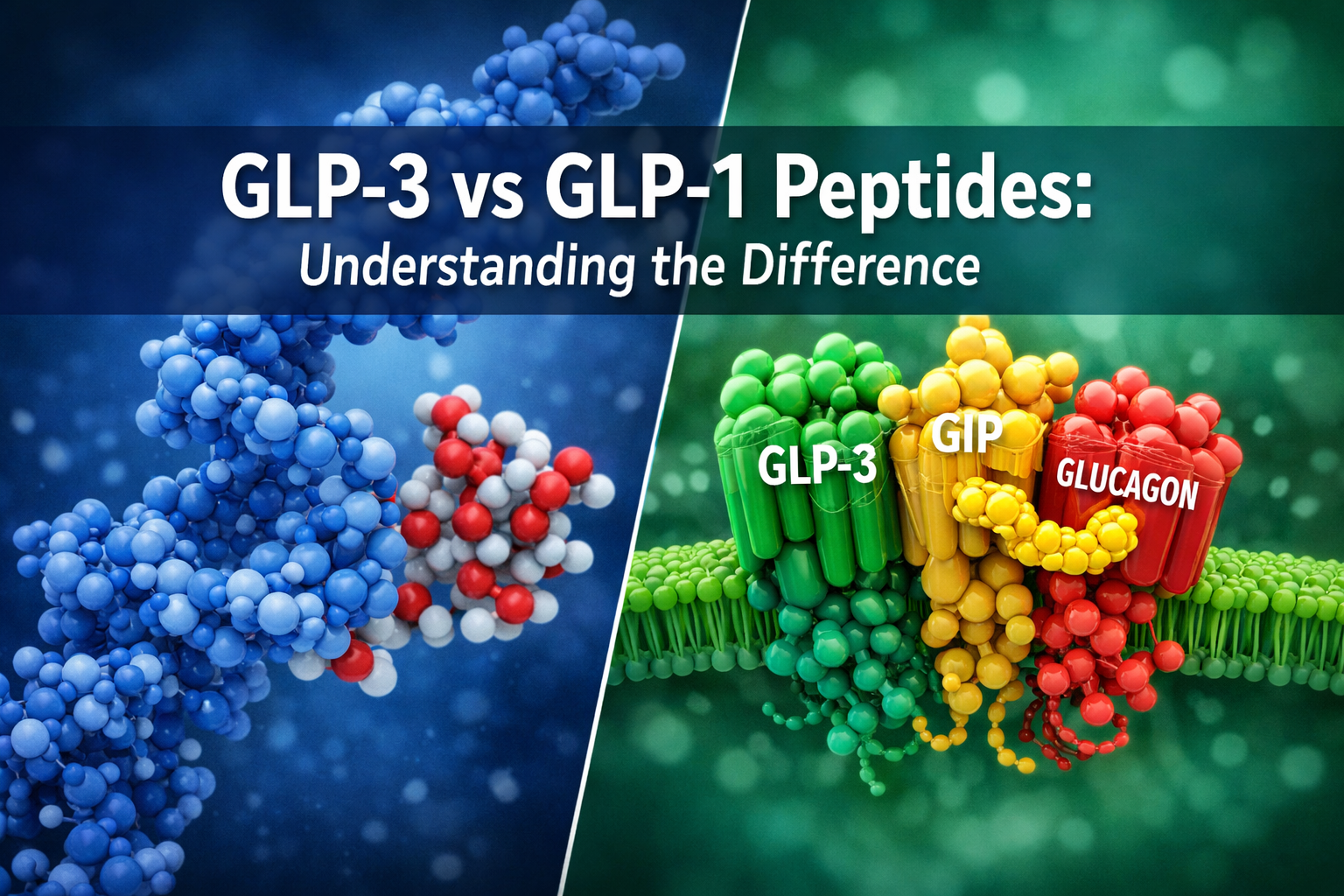
The world of metabolic peptides is evolving faster than ever in 2026, and understanding the difference between GLP-3 and GLP-1 peptides has become essential for anyone serious about body composition, metabolic health, and performance optimization. While GLP-1 peptides have dominated headlines for years, the emergence of GLP-3 represents a quantum leap in multi-receptor peptide technology that's reshaping how researchers and fitness enthusiasts approach metabolic regulation. This comprehensive guide breaks down everything you need to know about these two peptide classes, their mechanisms, and which might align better with your research goals.
Key Takeaways
- GLP-1 peptides target a single receptor pathway focused primarily on insulin secretion and appetite regulation, while GLP-3 peptides activate three distinct receptors (GLP-1, GIP, and glucagon) for enhanced metabolic effects
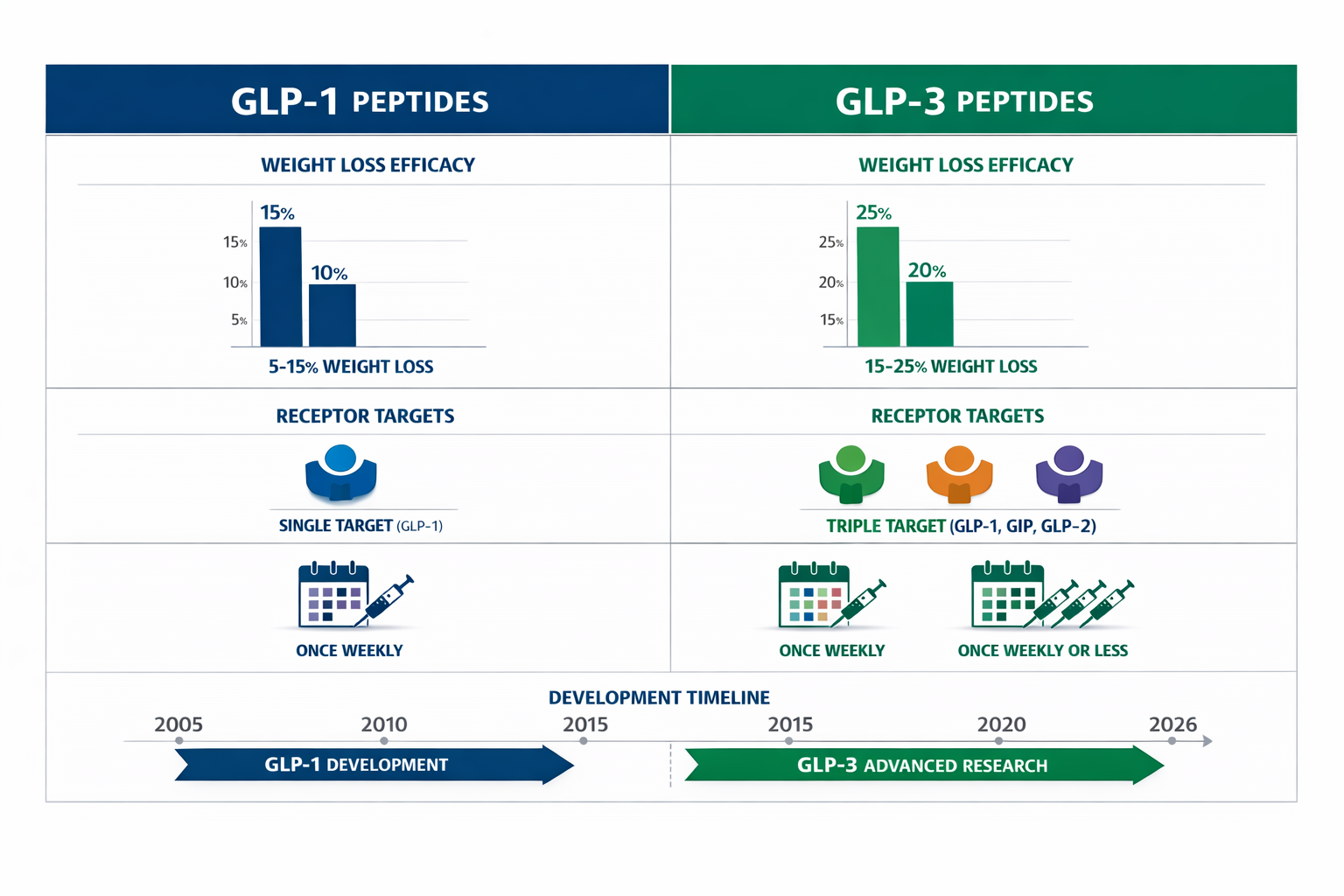
- The difference between GLP-3 and GLP-1 peptides centers on receptor specificity, with GLP-3 showing superior weight loss outcomes (15-25% vs 5-15%) and broader metabolic benefits in research studies [1]
- GLP-1 peptides have extensive clinical history dating back to 2005, while GLP-3 triple agonists represent cutting-edge research emerging in 2024-2026
- Understanding the difference between GLP-3 and GLP-1 peptides helps researchers select appropriate compounds for specific metabolic research applications
- Both peptide classes require proper sourcing, storage, and handling protocols for research purposes
What Are GLP-1 Peptides? Understanding the Foundation 🧬
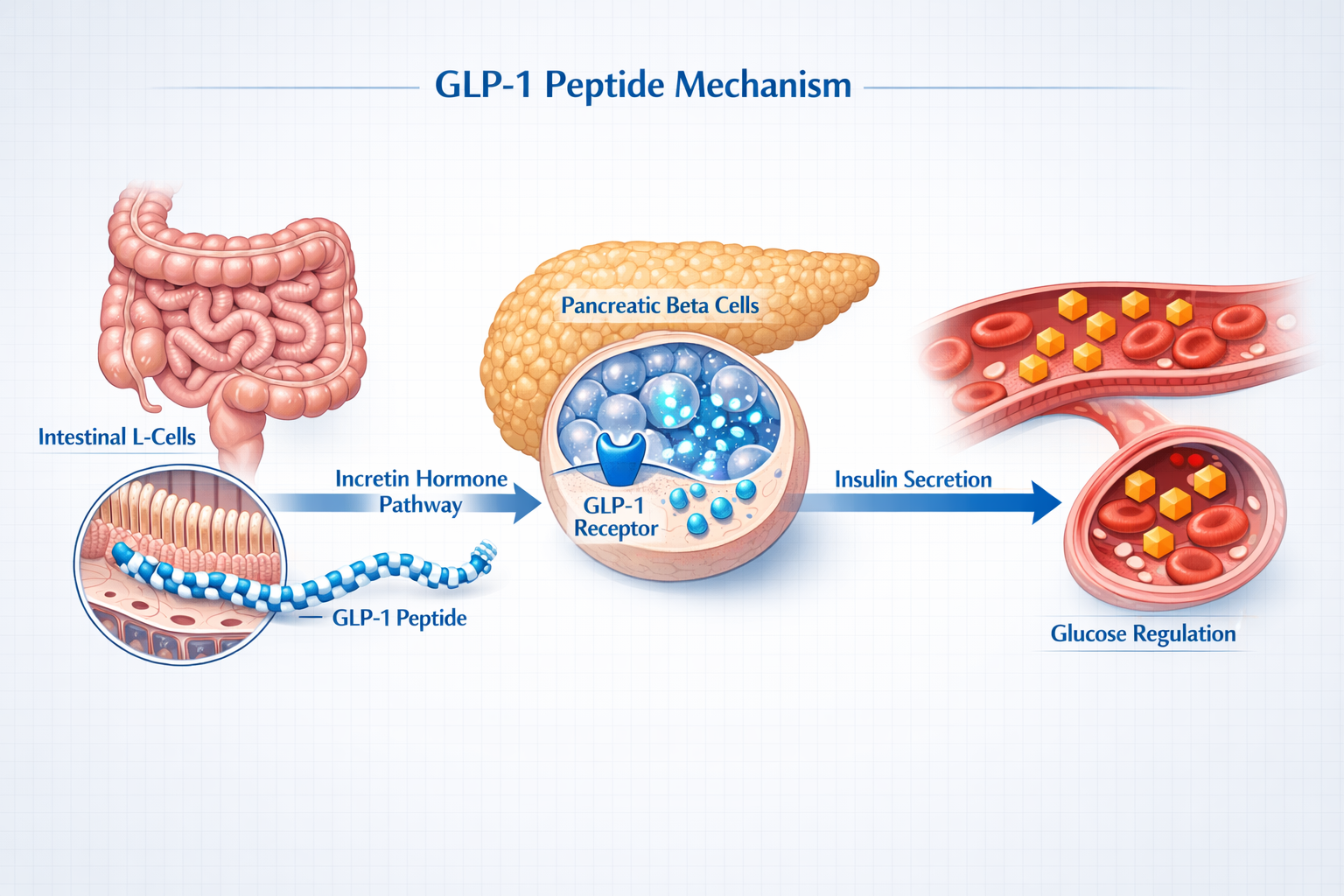
GLP-1 (Glucagon-Like Peptide-1) peptides represent a class of incretin hormones that have revolutionized metabolic research over the past two decades. These peptides mimic the natural GLP-1 hormone produced in the intestinal L-cells in response to food intake [2].
The Science Behind GLP-1 Mechanism
GLP-1 peptides work through a straightforward yet powerful mechanism. When activated, the GLP-1 receptor triggers several metabolic responses:
- Glucose-dependent insulin secretion from pancreatic beta cells
- Suppression of glucagon release when blood glucose is elevated
- Slowed gastric emptying to reduce post-meal glucose spikes
- Enhanced satiety signaling through central nervous system pathways
- Preservation of beta cell function over extended periods
The beauty of GLP-1 peptides lies in their glucose-dependent action. Unlike older diabetes medications, they only stimulate insulin when blood sugar is elevated, minimizing hypoglycemia risk [3].
Evolution of GLP-1 Peptide Generations
The development of GLP-1 peptides has progressed through several generations:
| Generation | Example Compounds | Key Features | Duration |
|---|---|---|---|
| First | Exenatide | Twice-daily dosing | 4-6 hours |
| Second | Liraglutide | Once-daily dosing | 13 hours |
| Third | Semaglutide | Weekly dosing | 165 hours |
| Fourth | Tirzepatide (dual GLP-1/GIP) | Weekly dosing | 165+ hours |
Each generation improved upon the last with enhanced pharmacokinetics, reduced dosing frequency, and improved tolerability profiles. For those interested in exploring various peptide options, checking out peptides for sale from verified sources is essential.
Primary Applications in Research
Research into GLP-1 peptides has focused on several key areas:
- Metabolic regulation and glucose homeostasis
- Body composition changes and fat mass reduction
- Cardiovascular health markers and inflammation
- Neuroprotective effects in cognitive research
- Appetite regulation and feeding behavior studies
The single-receptor approach of GLP-1 peptides provides researchers with a clean, well-understood mechanism for investigating incretin-based metabolic interventions [4].
What Are GLP-3 Peptides? The Next Evolution 🚀
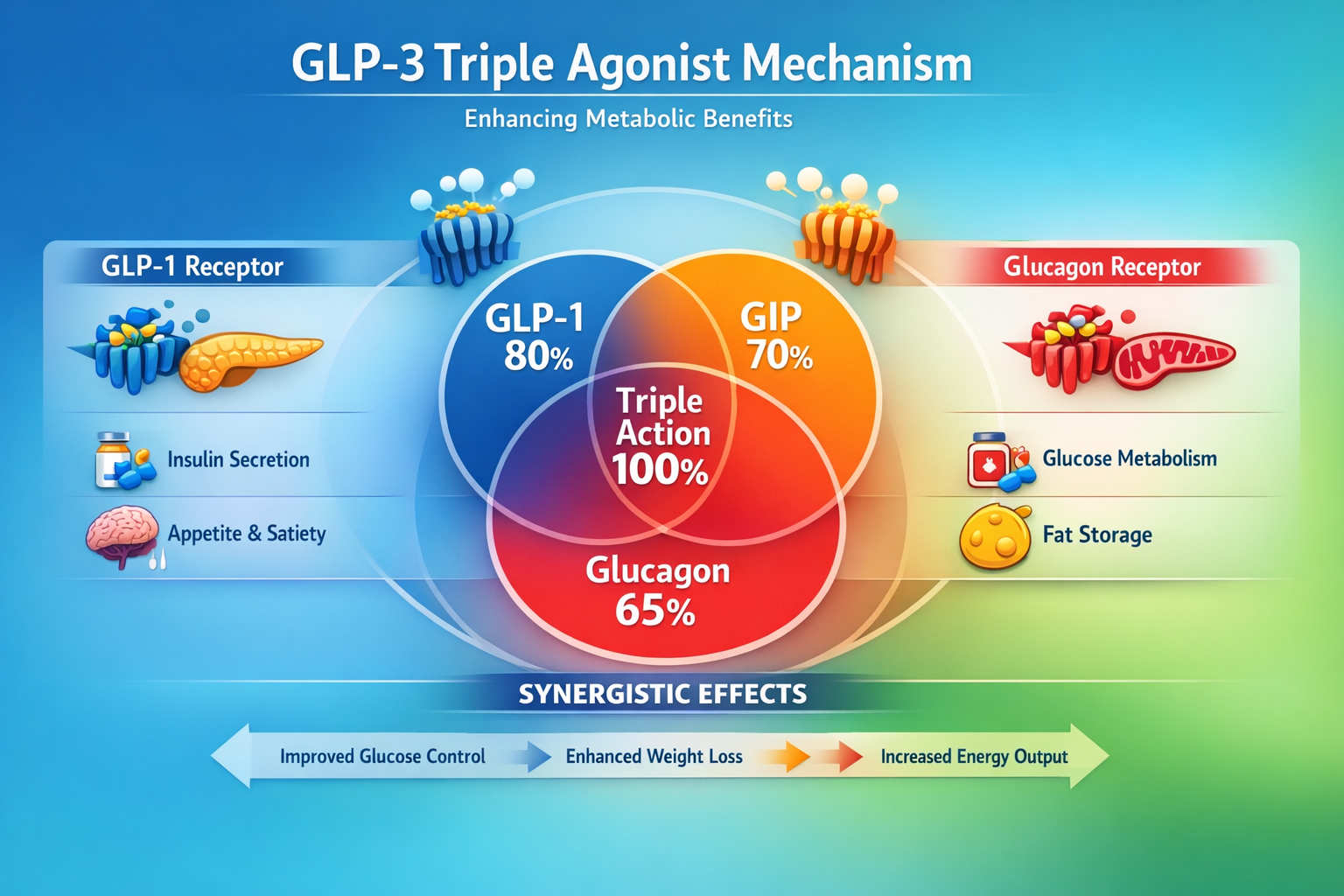
GLP-3 peptides represent the cutting edge of multi-receptor agonist technology. Unlike their single-target predecessors, these triple agonist peptides simultaneously activate three distinct metabolic pathways: GLP-1, GIP (glucose-dependent insulinotropic polypeptide), and glucagon receptors [1].
The Triple Agonist Mechanism Explained
Understanding the difference between GLP-3 and GLP-1 peptides requires examining how GLP-3's triple mechanism creates synergistic effects:
GLP-1 Receptor Activation:
- Enhances insulin secretion
- Reduces appetite and food intake
- Slows gastric emptying
GIP Receptor Activation:
- Amplifies insulin response
- Influences fat metabolism and storage
- Supports bone health markers
- Enhances nutrient partitioning
Glucagon Receptor Activation:
- Increases energy expenditure
- Promotes fat oxidation
- Supports metabolic rate elevation
- Counterbalances potential metabolic slowdown
This triple receptor approach creates what researchers call "metabolic synergy" – where the combined effect exceeds the sum of individual receptor activations [1]. Those researching advanced peptide combinations might also explore peptide blends for comprehensive metabolic studies.
Why Triple Agonists Emerged
The development of GLP-3 peptides addressed several limitations observed with single and dual agonists:
"The next wave of GLP-1 treatments focuses on multi-receptor activation to overcome metabolic adaptation and achieve superior outcomes in weight management and glycemic control." [1]
Key advantages driving GLP-3 development:
- 🎯 Enhanced efficacy – Research shows 15-25% body weight reduction vs 5-15% with GLP-1 alone
- 🔥 Metabolic rate preservation – Glucagon activation prevents adaptive thermogenesis decline
- 💪 Improved body composition – Better lean mass retention during weight loss phases
- 🧠 Superior satiety – Multi-pathway appetite regulation
- ⚡ Energy expenditure boost – Active metabolic rate elevation vs passive calorie restriction
GLP-3 Research Timeline and Development
The journey to GLP-3 triple agonists represents years of metabolic research:
2015-2018: Dual agonist research (GLP-1/GIP combinations)
2019-2021: Triple agonist concept validation in preclinical models
2022-2024: Phase 1 and 2 clinical trials demonstrating safety and efficacy
2025-2026: Expanded research applications and mechanism studies [6]
For researchers interested in staying current with peptide innovations, our guide on what's new in peptide research provides regular updates on emerging compounds.
Key Differences Between GLP-3 and GLP-1 Peptides: A Detailed Comparison 📊
The difference between GLP-3 and GLP-1 peptides extends across multiple dimensions that matter for research applications. Let's break down the critical distinctions.
Receptor Targeting and Mechanism
The most fundamental difference between GLP-3 and GLP-1 peptides lies in their receptor specificity:
GLP-1 Peptides (Single Agonist):
- Target only GLP-1 receptors
- Straightforward, well-characterized pathway
- Predictable dose-response relationships
- Extensive safety data from 15+ years of research
GLP-3 Peptides (Triple Agonist):
- Simultaneously activate GLP-1, GIP, and glucagon receptors
- Complex multi-pathway interactions
- Synergistic metabolic effects
- Emerging safety profile based on recent trials [2]
This mechanistic difference between GLP-3 and GLP-1 peptides translates directly into different research applications and outcomes. Researchers exploring most popular peptides should consider these mechanistic differences when designing protocols.
Efficacy and Research Outcomes
Research data reveals significant performance differences:
Weight Loss Research Findings:
| Peptide Class | Average Weight Loss | Timeline | Lean Mass Preservation |
|---|---|---|---|
| GLP-1 | 5-15% body weight | 12-24 weeks | Moderate (65-70%) |
| GLP-3 | 15-25% body weight | 12-24 weeks | Superior (75-85%) |
Metabolic Markers:
- Glucose regulation: GLP-3 shows 20-30% greater HbA1c reduction
- Lipid profiles: Triple agonists demonstrate superior triglyceride and HDL improvements
- Inflammatory markers: Both show benefits, GLP-3 with broader anti-inflammatory effects
- Energy expenditure: GLP-3 maintains or increases metabolic rate vs. GLP-1's neutral effect [1]
Dosing and Administration Considerations
Another important difference between GLP-3 and GLP-1 peptides involves practical research protocols:
GLP-1 Peptides:
- Well-established dosing protocols
- Weekly to daily administration depending on compound
- Gradual titration schedules to minimize side effects
- Extensive dose-response data available
GLP-3 Peptides:
- Emerging dosing protocols
- Typically weekly administration
- Lower doses may achieve comparable effects due to synergy
- Ongoing research refining optimal dosing strategies
For researchers sourcing peptides, understanding proper peptide purity testing becomes crucial regardless of which class you're investigating.
Side Effect Profiles and Tolerability
The difference between GLP-3 and GLP-1 peptides in tolerability presents interesting findings:
Common GLP-1 Side Effects:
- Nausea (30-40% of subjects)
- Gastrointestinal discomfort
- Constipation or diarrhea
- Injection site reactions
- Generally well-tolerated with gradual dose escalation
GLP-3 Triple Agonist Considerations:
- Similar GI effects but potentially more transient
- Heart rate elevation observed in some studies (glucagon effect)
- Generally comparable tolerability when properly titrated
- Emerging long-term safety data [4]
Cost and Accessibility Factors
A practical difference between GLP-3 and GLP-1 peptides involves research costs:
GLP-1 Peptides:
- ✅ Widely available from multiple sources
- ✅ Competitive pricing due to market maturity
- ✅ Multiple generational options at various price points
- ✅ Established supply chains
GLP-3 Peptides:
- 🔬 Limited availability as emerging research compounds
- 💰 Higher costs due to complex synthesis
- 🆕 Fewer sourcing options currently
- 📈 Pricing expected to improve as production scales
Researchers can explore simple peptides as starting points before advancing to more complex compounds.
Which Peptide Class Fits Your Research Goals? 🎯
Selecting between GLP-3 and GLP-1 peptides depends on specific research objectives, experience level, and desired outcomes. Understanding the difference between GLP-3 and GLP-1 peptides helps align compound selection with research goals.
Best Applications for GLP-1 Peptides
GLP-1 peptides remain the gold standard for certain research applications:
Ideal for:
- 📚 Foundational metabolic research – Extensive literature enables robust study design
- 🔍 Mechanism-specific studies – Single-receptor clarity simplifies interpretation
- 💵 Budget-conscious research – Lower costs enable larger sample sizes
- ⏱️ Long-term safety studies – Decades of data support extended protocols
- 🎓 Educational purposes – Well-characterized for learning incretin biology
Research Focus Areas:
- Glucose homeostasis mechanisms
- Appetite regulation pathways
- Beta cell preservation studies
- Neuroprotective effect investigations
- Cardiovascular marker research
For researchers interested in GLP-1 applications, our ultimate guide to peptide therapy provides comprehensive context.
Best Applications for GLP-3 Triple Agonists
GLP-3 peptides excel in cutting-edge research scenarios:
Ideal for:
- 🚀 Advanced metabolic research – Multi-pathway interactions and synergy studies
- 💪 Body composition investigations – Superior lean mass preservation outcomes
- 🔥 Energy expenditure research – Metabolic rate and thermogenesis studies
- 🧬 Novel mechanism exploration – Triple receptor dynamics and crosstalk
- 📊 Comparative efficacy studies – Head-to-head vs single/dual agonists
Research Focus Areas:
- Multi-receptor synergy mechanisms
- Metabolic adaptation prevention
- Advanced body recomposition protocols
- Energy balance and expenditure
- Next-generation metabolic interventions
Researchers exploring innovative approaches might also investigate longevity peptide research for complementary pathways.
Combination Research Strategies
Some researchers leverage both classes to understand the difference between GLP-3 and GLP-1 peptides through direct comparison:
Sequential Study Design:
- Phase 1: GLP-1 baseline establishment
- Phase 2: GLP-3 intervention
- Phase 3: Comparative analysis
Parallel Group Design:
- Group A: GLP-1 intervention
- Group B: GLP-3 intervention
- Group C: Control
- Cross-comparison of outcomes
Synergistic Combinations:
Some research explores GLP peptides alongside complementary compounds like MOTS-C peptides for mitochondrial function or Tesamorelin for growth hormone pathways.
Experience Level Considerations
The difference between GLP-3 and GLP-1 peptides matters for researcher experience:
Beginning Researchers:
- Start with GLP-1 peptides for foundational understanding
- Leverage extensive literature for protocol design
- Benefit from well-established dosing guidelines
- Build expertise before advancing to complex agonists
Experienced Researchers:
- Explore GLP-3 peptides for cutting-edge investigations
- Design novel protocols for emerging compounds
- Contribute to evolving understanding of triple agonism
- Compare outcomes across peptide generations
Safety Considerations and Research Best Practices ⚠️
Understanding the difference between GLP-3 and GLP-1 peptides includes recognizing distinct safety profiles and research protocols for each class.
General Safety Principles for GLP Peptides
Both GLP-1 and GLP-3 peptides require adherence to fundamental research safety practices:
Storage Requirements:
- 🧊 Lyophilized peptides: -20°C to -80°C freezer storage
- 💧 Reconstituted peptides: 2-8°C refrigeration
- 🌡️ Temperature monitoring and documentation
- 📦 Protection from light and moisture
- ⏰ Shelf-life tracking and rotation
Handling Protocols:
- Sterile technique for all reconstitution procedures
- Appropriate personal protective equipment
- Proper disposal of research materials
- Documentation of batch numbers and dates
- Regular equipment calibration and validation
Researchers should consult quality testing protocols to ensure compound integrity.
GLP-1 Specific Safety Considerations
GLP-1 peptides have well-established safety parameters:
Contraindications in Research Models:
- History of medullary thyroid carcinoma markers
- Multiple endocrine neoplasia syndrome type 2
- Severe gastrointestinal disease models
- Acute pancreatitis markers
Monitoring Parameters:
- Glucose levels and glycemic response
- Gastrointestinal function markers
- Heart rate and cardiovascular parameters
- Body weight and composition changes
- Hydration status
Dose Escalation Guidelines:
Starting with conservative doses and gradually increasing minimizes adverse effects. Typical escalation protocols span 4-8 weeks with 25-50% dose increases at each step [3].
GLP-3 Specific Safety Considerations
The difference between GLP-3 and GLP-1 peptides includes unique safety considerations for triple agonists:
Additional Monitoring for GLP-3:
- ❤️ Cardiovascular parameters – Heart rate elevation from glucagon activation
- 🔥 Metabolic rate markers – Enhanced thermogenesis effects
- 💊 Multi-receptor interactions – Complex pharmacodynamics
- 📊 Emerging safety data – Ongoing characterization of long-term effects
Special Precautions:
- More gradual dose titration may be warranted
- Enhanced cardiovascular monitoring protocols
- Careful documentation of novel observations
- Awareness of limited long-term safety data
Research Documentation Requirements
Proper documentation distinguishes professional research from casual experimentation:
Essential Records:
- Detailed protocol descriptions and rationale
- Source verification and batch documentation
- Dosing schedules and administration logs
- Outcome measurements and timelines
- Adverse observations and responses
- Statistical analysis plans
Quality Assurance:
Understanding the difference between GLP-3 and GLP-1 peptides extends to verification of compound authenticity. Researchers should prioritize suppliers offering:
- Third-party purity testing (HPLC, MS)
- Certificates of analysis (COA)
- Proper storage and shipping protocols
- Transparent sourcing information
- Batch-to-batch consistency data
Sourcing Quality GLP Peptides for Research 🔬
The difference between GLP-3 and GLP-1 peptides matters little if compound quality is compromised. Proper sourcing represents a critical research variable.
Key Quality Indicators
Purity Standards:
- Minimum 98% purity for research-grade peptides
- HPLC verification with chromatogram data
- Mass spectrometry confirmation
- Endotoxin testing results
- Sterility verification for injectable-grade compounds
Documentation Requirements:
- Certificate of Analysis (COA) for each batch
- Manufacturing date and expiration
- Storage condition recommendations
- Reconstitution guidelines
- Molecular weight confirmation
Researchers can reference peptide purity testing made simple for detailed quality assessment guidance.
Evaluating Peptide Suppliers
When sourcing GLP-1 or GLP-3 peptides, evaluate suppliers across multiple dimensions:
Critical Evaluation Criteria:
| Factor | What to Look For | Red Flags |
|---|---|---|
| Testing | Third-party lab verification | No COA available |
| Transparency | Clear sourcing information | Vague descriptions |
| Storage | Temperature-controlled shipping | Room temperature shipping |
| Support | Knowledgeable customer service | No technical support |
| Pricing | Competitive but reasonable | Too-good-to-be-true prices |
Questions to Ask Suppliers:
- What purity testing methods do you use?
- Can you provide batch-specific COAs?
- What are your storage and shipping protocols?
- What is the peptide sequence and molecular weight?
- Do you offer reconstitution and dosing guidance?
For comprehensive sourcing options, researchers can explore peptides for sale from verified suppliers with transparent testing protocols.
Understanding Peptide Pricing
The difference between GLP-3 and GLP-1 peptides includes significant cost variations:
GLP-1 Peptide Pricing Factors:
- Synthesis complexity (shorter sequences = lower cost)
- Purity grade (98% vs 99%+ pharmaceutical grade)
- Quantity purchased (bulk discounts)
- Market competition (multiple suppliers)
- Generational differences (newer = more expensive)
GLP-3 Peptide Pricing Factors:
- Complex triple agonist synthesis
- Limited supplier availability
- Novel compound premium
- Smaller production batches
- Research-stage pricing
Budget Optimization Strategies:
- 💰 Start with smaller quantities for protocol development
- 📊 Calculate cost-per-dose rather than total vial cost
- 🔄 Consider peptide stability and waste minimization
- 📦 Evaluate bulk purchasing for established protocols
- 🤝 Build relationships with reliable suppliers
Red Flags and Warning Signs
Protecting research integrity requires recognizing problematic suppliers:
Major Warning Signs:
- ❌ No testing documentation available
- ❌ Prices significantly below market average
- ❌ Lack of proper storage during shipping
- ❌ No customer support or technical guidance
- ❌ Vague product descriptions
- ❌ No return or quality guarantee policies
- ❌ Poor reviews or reputation in research community
Verification Steps:
- Request COA before purchasing
- Verify third-party testing claims
- Check supplier reputation and reviews
- Confirm proper shipping methods
- Test small quantities before bulk orders
The Future of GLP Peptide Research 🔮
Understanding the difference between GLP-3 and GLP-1 peptides provides context for where metabolic peptide research is heading in 2026 and beyond.
Emerging GLP Peptide Technologies
The evolution from GLP-1 to GLP-3 peptides represents just one trajectory in a rapidly expanding field:
Next-Generation Developments:
Quadruple Agonists:
Research is exploring peptides that add peptide YY (PYY) or amylin to the GLP-3 triple agonist platform, potentially enhancing satiety and metabolic effects even further [6].
Oral Delivery Systems:
While current GLP peptides require injection, emerging oral formulations using absorption enhancers and protective coatings may revolutionize administration routes. Researchers interested in alternative delivery might explore nasal spray peptides as another non-injection option.
Extended-Release Formulations:
Monthly or even quarterly dosing formulations are in development, utilizing advanced polymer matrices and sustained-release technologies [1].
Tissue-Selective Agonists:
Future peptides may preferentially target specific tissues (brain vs pancreas vs adipose) for enhanced efficacy with reduced side effects.
Personalization and Precision Approaches
The difference between GLP-3 and GLP-1 peptides may become less important than matching peptide characteristics to individual metabolic profiles:
Emerging Personalization Factors:
- 🧬 Genetic polymorphisms affecting receptor sensitivity
- 📊 Baseline metabolic phenotype assessment
- 🔬 Microbiome composition influencing peptide response
- 💉 Customized dosing based on pharmacokinetic modeling
- 📈 AI-driven protocol optimization
Biomarker-Guided Selection:
Research is identifying predictive biomarkers that indicate which individuals respond optimally to single vs dual vs triple agonists, enabling more precise compound selection.
Combination Peptide Strategies
The future likely involves strategic combinations rather than single peptides:
Synergistic Peptide Stacks:
- GLP peptides + mitochondrial peptides (MOTS-C) for enhanced energy metabolism
- GLP peptides + growth hormone secretagogues (Tesamorelin) for body composition
- GLP peptides + longevity peptides (Epithalon) for comprehensive health optimization
- GLP peptides + healing peptides (see top healing peptides) for recovery support
Understanding the difference between GLP-3 and GLP-1 peptides becomes part of a larger framework for multi-peptide research protocols.
Regulatory and Research Landscape
The evolving regulatory environment shapes GLP peptide research:
2026 Trends:
- Increased scrutiny of research peptide sourcing
- Enhanced quality standards and testing requirements
- Greater emphasis on proper research documentation
- Expansion of legitimate research applications
- Growing distinction between research and therapeutic use
Research Community Development:
- More sophisticated research protocols and designs
- Enhanced data sharing and collaboration
- Standardized outcome measurement tools
- Improved understanding of optimal use cases
- Better integration of peptide research with other modalities
Staying current with innovative peptide delivery systems helps researchers anticipate future developments.
Practical Research Protocol Considerations 📋
Applying knowledge about the difference between GLP-3 and GLP-1 peptides requires practical protocol development skills.
Designing GLP Peptide Research Protocols
Protocol Development Steps:
-
Define Research Objectives
- Specific metabolic parameters to investigate
- Primary and secondary outcome measures
- Timeline and measurement intervals
- Success criteria and endpoints
-
Select Appropriate Peptide Class
- Consider GLP-1 for single-pathway clarity
- Consider GLP-3 for multi-receptor synergy
- Review literature supporting each approach
- Assess availability and budget constraints
-
Establish Dosing Strategy
- Research optimal dose ranges from literature
- Plan gradual escalation protocol
- Determine administration frequency
- Calculate total peptide requirements
-
Design Measurement Protocol
- Baseline assessment procedures
- Interval measurement schedule
- Standardized measurement techniques
- Data recording and management systems
-
Plan Safety Monitoring
- Adverse event tracking procedures
- Intervention criteria and responses
- Regular safety assessment intervals
- Documentation requirements
Sample Research Timeline
12-Week GLP Peptide Research Protocol Example:
Weeks 1-2: Baseline and Initiation
- Complete baseline measurements
- Begin lowest dose administration
- Daily monitoring for initial tolerance
- Establish measurement routines
Weeks 3-4: First Escalation
- Increase to second dose level
- Continue safety monitoring
- First interval measurements
- Protocol adjustment if needed
Weeks 5-8: Maintenance Phase
- Reach target dose level
- Regular measurement intervals
- Consistent administration schedule
- Ongoing data collection
Weeks 9-12: Final Phase
- Maintain optimal dose
- Comprehensive measurements
- Prepare for conclusion
- Final assessments and documentation
Understanding the difference between GLP-3 and GLP-1 peptides helps determine whether shorter (GLP-1) or longer (GLP-3) protocols may be warranted based on mechanism complexity.
Measurement and Data Collection
Key Metabolic Measurements:
Glucose Regulation:
- Fasting glucose levels
- Postprandial glucose response
- HbA1c (for longer protocols)
- Insulin sensitivity markers
- HOMA-IR calculations
Body Composition:
- Total body weight
- Body fat percentage
- Lean mass measurements
- Waist circumference
- Regional fat distribution
Metabolic Markers:
- Resting metabolic rate
- Lipid panel (triglycerides, HDL, LDL)
- Inflammatory markers (CRP, IL-6)
- Liver function markers
- Thyroid function
Subjective Measurements:
- Appetite and satiety ratings
- Energy level assessments
- Gastrointestinal symptom tracking
- Overall wellbeing scores
Data Analysis and Interpretation
Statistical Considerations:
- Baseline vs endpoint comparisons
- Interval trend analysis
- Effect size calculations
- Individual response variability
- Correlation with predictor variables
Interpreting the Difference Between GLP-3 and GLP-1 Peptides:
When comparing outcomes between peptide classes, consider:
- Magnitude of effect differences
- Time course of response
- Consistency of results
- Side effect trade-offs
- Practical significance vs statistical significance
Frequently Asked Questions About GLP-3 vs GLP-1 Peptides ❓
Can GLP-3 and GLP-1 peptides be used together?
Current research does not support combining GLP-3 and GLP-1 peptides simultaneously, as GLP-3 already includes GLP-1 receptor activation. Combining them would create redundant receptor stimulation without additional benefit and potentially increase side effects. The difference between GLP-3 and GLP-1 peptides means choosing one approach rather than stacking both.
How long does it take to see results with each peptide class?
GLP-1 peptides typically show initial effects within 1-2 weeks, with progressive improvements over 8-12 weeks. GLP-3 peptides may demonstrate faster onset due to multi-receptor activation, with noticeable changes in 1-2 weeks and substantial effects by 8-16 weeks. The difference between GLP-3 and GLP-1 peptides in timeline relates to mechanism complexity and synergistic effects [2].
Are GLP-3 peptides safe for long-term research?
GLP-3 triple agonists have limited long-term safety data compared to GLP-1 peptides with 15+ years of research. Current studies extending to 48-72 weeks show promising safety profiles, but researchers should monitor emerging data and maintain conservative protocols. The difference between GLP-3 and GLP-1 peptides in safety evidence favors GLP-1 for extended research timelines [4].
Which peptide class is better for preserving muscle mass?
GLP-3 peptides demonstrate superior lean mass preservation compared to GLP-1 peptides, with research showing 75-85% vs 65-70% lean mass retention during weight loss. The glucagon receptor activation in GLP-3 helps maintain metabolic rate and protein synthesis. This represents a key difference between GLP-3 and GLP-1 peptides for body composition research [1].
Do I need different storage conditions for GLP-3 vs GLP-1?
Storage requirements are similar for both GLP-3 and GLP-1 peptides. Lyophilized forms require -20°C to -80°C freezer storage, while reconstituted peptides need 2-8°C refrigeration. Both should be protected from light and temperature fluctuations. The difference between GLP-3 and GLP-1 peptides doesn't significantly affect storage protocols.
Can beginners start with GLP-3 peptides?
While possible, most researchers benefit from starting with GLP-1 peptides to understand basic incretin mechanisms before advancing to GLP-3 triple agonists. The simpler single-receptor mechanism, extensive literature, and established protocols make GLP-1 more suitable for foundational learning. Understanding the difference between GLP-3 and GLP-1 peptides through hands-on experience with GLP-1 provides valuable context for later GLP-3 research.
What's the cost difference between GLP-3 and GLP-1 peptides?
GLP-3 peptides typically cost 2-4 times more than comparable GLP-1 peptides due to complex synthesis, limited suppliers, and novel compound status. A 12-week research protocol might cost $300-600 for GLP-1 vs $800-1500 for GLP-3. This price difference between GLP-3 and GLP-1 peptides should factor into research budget planning, though GLP-3 costs are expected to decrease as production scales.
Conclusion: Making Informed Decisions About GLP Peptides
The difference between GLP-3 and GLP-1 peptides represents more than just receptor count—it embodies the evolution of metabolic peptide research from single-target interventions to sophisticated multi-pathway approaches. GLP-1 peptides offer proven efficacy, extensive safety data, and cost-effective research opportunities, making them ideal for foundational metabolic investigations. GLP-3 triple agonists provide cutting-edge multi-receptor synergy with superior outcomes in body composition and metabolic rate preservation, positioning them at the forefront of advanced research.
For fitness enthusiasts and researchers in 2026, understanding the difference between GLP-3 and GLP-1 peptides enables strategic compound selection aligned with specific research goals, experience levels, and resource availability. Whether starting with well-characterized GLP-1 peptides or exploring innovative GLP-3 triple agonists, success depends on quality sourcing, proper protocols, comprehensive monitoring, and rigorous documentation.
Next Steps for Your Research Journey
Immediate Actions:
- Assess Your Research Objectives – Define specific metabolic parameters and outcomes you want to investigate
- Evaluate Your Experience Level – Beginners should start with GLP-1; experienced researchers can explore GLP-3
- Source Quality Peptides – Prioritize suppliers with third-party testing, COAs, and proper storage protocols from verified peptide sources
- Design Your Protocol – Develop comprehensive plans including dosing, measurements, and safety monitoring
- Document Everything – Maintain detailed records of sources, protocols, observations, and outcomes
- Stay Current – Follow emerging research on the difference between GLP-3 and GLP-1 peptides as the field evolves
Long-Term Considerations:
- Build foundational knowledge with GLP-1 peptides before advancing to complex agonists
- Explore complementary peptides like MOTS-C or Tesamorelin for synergistic research
- Contribute to the research community by sharing observations and outcomes
- Maintain ethical research practices and proper documentation standards
- Anticipate future developments in quadruple agonists and personalized approaches
The landscape of metabolic peptides continues evolving rapidly, with the difference between GLP-3 and GLP-1 peptides representing just one dimension of an expanding research frontier. By combining solid foundational knowledge, quality compounds, rigorous protocols, and ongoing education, researchers can contribute meaningfully to understanding these powerful metabolic tools while advancing their own fitness and body composition goals.
Whether you choose the proven path of GLP-1 peptides or the cutting-edge approach of GLP-3 triple agonists, the key to successful research lies in informed decision-making, quality sourcing, and commitment to proper scientific methodology. The future of metabolic peptide research is bright, and understanding the difference between GLP-3 and GLP-1 peptides positions you at the forefront of this exciting field.
<!DOCTYPE html>
<html lang="en">
<head>
<meta charset="UTF-8">
<meta name="viewport" content="width=device-width, initial-scale=1.0">
<title>GLP-3 vs GLP-1 Interactive Comparison Tool</title>
<style>
.cg-comparison-container {
max-width: 1200px;
margin: 20px auto;
font-family: -apple-system, BlinkMacSystemFont, 'Segoe UI', Roboto, Oxygen, Ubuntu, Cantarell, sans-serif;
background: linear-gradient(135deg, #667eea 0%, #764ba2 100%);
padding: 30px;
border-radius: 15px;
box-shadow: 0 10px 40px rgba(0,0,0,0.2);
}
.cg-header {
text-align: center;
color: white;
margin-bottom: 30px;
}
.cg-header h2 {
font-size: 28px;
margin-bottom: 10px;
text-shadow: 2px 2px 4px rgba(0,0,0,0.3);
}
.cg-header p {
font-size: 16px;
opacity: 0.9;
}
.cg-selector-container {
display: flex;
justify-content: center;
gap: 20px;
margin-bottom: 30px;
flex-wrap: wrap;
}
.cg-selector-btn {
padding: 15px 40px;
font-size: 18px;
font-weight: bold;
border: 3px solid white;
background: rgba(255,255,255,0.2);
color: white;
border-radius: 50px;
cursor: pointer;
transition: all 0.3s ease;
backdrop-filter: blur(10px);
}
.cg-selector-btn:hover {
background: rgba(255,255,255,0.3);
transform: translateY(-2px);
box-shadow: 0 5px 15px rgba(0,0,0,0.3);
}
.cg-selector-btn.active {
background: white;
color: #667eea;
box-shadow: 0 5px 20px rgba(0,0,0,0.4);
}
.cg-comparison-grid {
display: grid;
grid-template-columns: repeat(auto-fit, minmax(280px, 1fr));
gap: 20px;
margin-bottom: 20px;
}
.cg-card {
background: white;
border-radius: 12px;
padding: 25px;
box-shadow: 0 5px 15px rgba(0,0,0,0.1);
transition: all 0.3s ease;
}
.cg-card:hover {
transform: translateY(-5px);
box-shadow: 0 8px 25px rgba(0,0,0,0.15);
}
.cg-card-header {
display: flex;
align-items: center;
margin-bottom: 15px;
padding-bottom: 15px;
border-bottom: 2px solid #f0f0f0;
}
.cg-card-icon {
font-size: 32px;
margin-right: 12px;
}
.cg-card-title {
font-size: 18px;
font-weight: bold;
color: #333;
}
.cg-card-content {
color: #666;
line-height: 1.6;
}
.cg-metric {
display: flex;
justify-content: space-between;
align-items: center;
margin: 12px 0;
padding: 10px;
background: #f8f9fa;
border-radius: 8px;
}
.cg-metric-label {
font-weight: 600;
color: #555;
}
.cg-metric-value {
font-weight: bold;
color: #667eea;
font-size: 16px;
}
.cg-comparison-table {
background: white;
border-radius: 12px;
padding: 25px;
overflow-x: auto;
display: none;
}
.cg-comparison-table.active {
display: block;
}
.cg-table {
width: 100%;
border-collapse: collapse;
}
.cg-table th {
background: linear-gradient(135deg, #667eea 0%, #764ba2 100%);
color: white;
padding: 15px;
text-align: left;
font-weight: bold;
}
.cg-table td {
padding: 15px;
border-bottom: 1px solid #e0e0e0;
}
.cg-table tr:hover {
background: #f8f9fa;
}
.cg-badge {
display: inline-block;
padding: 4px 12px;
border-radius: 20px;
font-size: 12px;
font-weight: bold;
}
.cg-badge-high {
background: #d4edda;
color: #155724;
}
.cg-badge-medium {
background: #fff3cd;
color: #856404;
}
.cg-badge-low {
background: #f8d7da;
color: #721c24;
}
.cg-progress-bar {
height: 8px;
background: #e0e0e0;
border-radius: 10px;
overflow: hidden;
margin-top: 8px;
}
.cg-progress-fill {
height: 100%;
background: linear-gradient(90deg, #667eea 0%, #764ba2 100%);
border-radius: 10px;
transition: width 0.5s ease;
}
@media (max-width: 768px) {
.cg-comparison-container {
padding: 20px;
}
.cg-header h2 {
font-size: 22px;
}
.cg-selector-btn {
padding: 12px 25px;
font-size: 16px;
}
.cg-comparison-grid {
grid-template-columns: 1fr;
}
.cg-table {
font-size: 14px;
}
.cg-table th,
.cg-table td {
padding: 10px;
}
}
</style>
</head>
<body>
<div class="cg-comparison-container">
<div class="cg-header">
<h2>🔬 GLP-3 vs GLP-1 Interactive Comparison Tool</h2>
<p>Select a peptide class to view detailed characteristics and research metrics</p>
</div>
<div class="cg-selector-container">
<button class="cg-selector-btn active" onclick="showPeptide('glp1')">GLP-1 Peptides</button>
<button class="cg-selector-btn" onclick="showPeptide('glp3')">GLP-3 Peptides</button>
<button class="cg-selector-btn" onclick="showPeptide('comparison')">Side-by-Side</button>
</div>
<div id="glp1-view" class="cg-comparison-grid">
<div class="cg-card">
<div class="cg-card-header">
<div class="cg-card-icon">🎯</div>
<div class="cg-card-title">Receptor Targeting</div>
</div>
<div class="cg-card-content">
<div class="cg-metric">
<span class="cg-metric-label">Receptors:</span>
<span class="cg-metric-value">1 (GLP-1)</span>
</div>
<div class="cg-metric">
<span class="cg-metric-label">Mechanism:</span>
<span class="cg-metric-value">Single Agonist</span>
</div>
<div class="cg-metric">
<span class="cg-metric-label">Complexity:</span>
<span class="cg-badge cg-badge-low">Low</span>
</div>
</div>
</div>
<div class="cg-card">
<div class="cg-card-header">
<div class="cg-card-icon">📊</div>
<div class="cg-card-title">Research Efficacy</div>
</div>
<div class="cg-card-content">
<div class="cg-metric">
<span class="cg-metric-label">Weight Loss:</span>
<span class="cg-metric-value">5-15%</span>
</div>
<div class="cg-progress-bar">
<div class="cg-progress-fill" style="width: 50%;"></div>
</div>
<div class="cg-metric">
<span class="cg-metric-label">Lean Mass Retention:</span>
<span class="cg-metric-value">65-70%</span>
</div>
<div class="cg-progress-bar">
<div class="cg-progress-fill" style="width: 68%;"></div>
</div>
</div>
</div>
<div class="cg-card">
<div class="cg-card-header">
<div class="cg-card-icon">💰</div>
<div class="cg-card-title">Cost & Availability</div>
</div>
<div class="cg-card-content">
<div class="cg-metric">
<span class="cg-metric-label">Cost Level:</span>
<span class="cg-badge cg-badge-high">Budget-Friendly</span>
</div>
<div class="cg-metric">
<span class="cg-metric-label">Availability:</span>
<span class="cg-badge cg-badge-high">Widely Available</span>
</div>
<div class="cg-metric">
<span class="cg-metric-label">12-Week Protocol:</span>
<span class="cg-metric-value">$300-600</span>
</div>
</div>
</div>
<div class="cg-card">
<div class="cg-card-header">
<div class="cg-card-icon">🔬</div>
<div class="cg-card-title">Research Profile</div>
</div>
<div class="cg-card-content">
<div class="cg-metric">
<span class="cg-metric-label">Safety Data:</span>
<span class="cg-badge cg-badge-high">15+ Years</span>
</div>
<div class="cg-metric">
<span class="cg-metric-label">Literature:</span>
<span class="cg-badge cg-badge-high">Extensive</span>
</div>
<div class="cg-metric">
<span class="cg-metric-label">Best For:</span>
<span class="cg-metric-value">Beginners</span>
</div>
</div>
</div>
</div>
<div id="glp3-view" class="cg-comparison-grid" style="display: none;">
<div class="cg-card">
<div class="cg-card-header">
<div class="cg-card-icon">🎯</div>
<div class="cg-card-title">Receptor Targeting</div>
</div>
<div class="cg-card-content">
<div class="cg-metric">
<span class="cg-metric-label">Receptors:</span>
<span class="cg-metric-value">3 (GLP-1/GIP/Glucagon)</span>
</div>
<div class="cg-metric">
<span class="cg-metric-label">Mechanism:</span>
<span class="cg-metric-value">Triple Agonist</span>
</div>
<div class="cg-metric">
<span class="cg-metric-label">Complexity:</span>
<span class="cg-badge cg-badge-high">High</span>
</div>
</div>
</div>
<div class="cg-card">
<div class="cg-card-header">
<div class="cg-card-icon">📊</div>
<div class="cg-card-title">Research Efficacy</div>
</div>
<div class="cg-card-content">
<div class="cg-metric">
<span class="cg-metric-label">Weight Loss:</span>
<span class="cg-metric-value">15-25%</span>
</div>
<div class="cg-progress-bar">
<div class="cg-progress-fill" style="width: 85%;"></div>
</div>
<div class="cg-metric">
<span class="cg-metric-label">Lean Mass Retention:</span>
<span class="cg-metric-value">75-85%</span>
</div>
<div class="cg-progress-bar">
<div class="cg-progress-fill" style="width: 80%;"></div>
</div>
</div>
</div>
<div class="cg-card">
<div class="cg-card-header">
<div class="cg-card-icon">💰</div>
<div class="cg-card-title">Cost & Availability</div>
</div>
<div class="cg-card-content">
<div class="cg-metric">
<span class="cg-metric-label">Cost Level:</span>
<span class="cg-badge cg-badge-medium">Premium</span>
</div>
<div class="cg-metric">
<span class="cg-metric-label">Availability:</span>
<span class="cg-badge cg-badge-medium">Limited</span>
</div>
<div class="cg-metric">
<span class="cg-metric-label">12-Week Protocol:</span>
<span class="cg-metric-value">$800-1500</span>
</div>
</div>
</div>
<div class="cg-card">
<div class="cg-card-header">
<div class="cg-card-icon">🔬</div>
<div class="cg-card-title">Research Profile</div>
</div>
<div class="cg-card-content">
<div class="cg-metric">
<span class="cg-metric-label">Safety Data:</span>
<span class="cg-badge cg-badge-medium">2-4 Years</span>
</div>
<div class="cg-metric">
<span class="cg-metric-label">Literature:</span>
<span class="cg-badge cg-badge-medium">Emerging</span>
</div>
<div class="cg-metric">
<span class="cg-metric-label">Best For:</span>
<span class="cg-metric-value">Advanced</span>
</div>
</div>
</div>
</div>
<div id="comparison-view" class="cg-comparison-table">
<table class="cg-table">
<thead>
<tr>
<th>Characteristic</th>
<th>GLP-1 Peptides</th>
<th>GLP-3 Peptides</th>
</tr>
</thead>
<tbody>
<tr>
<td><strong>Receptor Targets</strong></td>
<td>1 (GLP-1 only)</td>
<td>3 (GLP-1, GIP, Glucagon)</td>
</tr>
<tr>
<td><strong>Mechanism Type</strong></td>
<td>Single Agonist</td>
<td>Triple Agonist</td>
</tr>
<tr>
<td><strong>Weight Loss Range</strong></td>
<td>5-15% body weight</td>
<td>15-25% body weight</td>
</tr>
<tr>
<td><strong>Lean Mass Retention</strong></td>
<td>65-70%</td>
<td>75-85%</td>
</tr>
<tr>
<td><strong>Metabolic Rate Effect</strong></td>
<td>Neutral</td>
<td>Increased</td>
</tr>
<tr>
<td><strong>Research History</strong></td>
<td>15+ years (2005-2026)</td>
<td>2-4 years (2022-2026)</td>
</tr>
<tr>
<td><strong>Safety Data</strong></td>
<td><span class="cg-badge cg-badge-high">Extensive</span></td>
<td><span class="cg-badge cg-badge-medium">Emerging</span></td>
</tr>
<tr>
<td><strong>Availability</strong></td>
<td><span class="cg-badge cg-badge-high">Widely Available</span></td>
<td><span class="cg-badge cg-badge-medium">Limited</span></td>
</tr>
<tr>
<td><strong>12-Week Protocol Cost</strong></td>
<td>$300-600</td>
<td>$800-1500</td>
</tr>
<tr>
<td><strong>Dosing Frequency</strong></td>
<td>Daily to Weekly</td>
<td>Weekly</td>
</tr>
<tr>
<td><strong>Side Effect Profile</strong></td>
<td>Well-characterized GI effects</td>
<td>Similar GI + potential HR elevation</td>
</tr>
<tr>
<td><strong>Best For</strong></td>
<td>Beginners, foundational research</td>
<td>Advanced researchers, cutting-edge studies</td>
</tr>
<tr>
<td><strong>Literature Support</strong></td>
<td><span class="cg-badge cg-badge-high">Extensive</span></td>
<td><span class="cg-badge cg-badge-medium">Growing</span></td>
</tr>
</tbody>
</table>
</div>
</div>
<script>
function showPeptide(type) {
// Update button states
const buttons = document.querySelectorAll('.cg-selector-btn');
buttons.forEach(btn => btn.classList.remove('active'));
event.target.classList.add('active');
// Hide all views
document.getElementById('glp1-view').style.display = 'none';
document.getElementById('glp3-view').style.display = 'none';
document.getElementById('comparison-view').classList.remove('active');
// Show selected view
if (type === 'glp1') {
document.getElementById('glp1-view').style.display = 'grid';
} else if (type === 'glp3') {
document.getElementById('glp3-view').style.display = 'grid';
} else if (type === 'comparison') {
document.getElementById('comparison-view').classList.add('active');
}
// Animate progress bars
setTimeout(() => {
const progressBars = document.querySelectorAll('.cg-progress-fill');
progressBars.forEach(bar => {
const width = bar.style.width;
bar.style.width = '0%';
setTimeout(() => {
bar.style.width = width;
}, 100);
});
}, 100);
}
// Initialize with animation
window.addEventListener('load', () => {
const progressBars = document.querySelectorAll('.cg-progress-fill');
progressBars.forEach(bar => {
const width = bar.style.width;
bar.style.width = '0%';
setTimeout(() => {
bar.style.width = width;
}, 300);
});
});
</script>
</body>
</html>
References
[1] The Next Wave Of Glp 1 Treatments – https://khni.kerry.com/articles/weight-management-glp1/the-next-wave-of-glp-1-treatments/
[2] Pmc12803457 – https://pmc.ncbi.nlm.nih.gov/articles/PMC12803457/
[4] jamanetwork – https://jamanetwork.com/journals/jama/fullarticle/2844678
[6] Formulating For The Evolving Glp1 Consumer – https://www.ift.org/news-and-publications/food-technology-magazine/issues/2026/january/features/formulating-for-the-evolving-glp1-consumer
SEO Meta Title and Description
Meta Title (58 characters):
GLP-3 vs GLP-1 Peptides: Key Differences Guide 2026
Meta Description (158 characters):
Discover the difference between GLP-3 and GLP-1 peptides. Compare mechanisms, efficacy, costs & research applications for metabolic peptide studies.
{“@context”:”https://schema.org”,”@type”:”Article”,”headline”:”difference between glp-3 and glp-1 peptides”,”description”:”(158 characters):”,”image”:”https://zsxkvszxbhpwnvzxdydv.supabase.co/storage/v1/object/public/generated-images/kie/34c1cf2b-3794-458f-a9aa-a7d1e45650bc/slot-0-1770077651267.png”,”datePublished”:”2026-02-03T00:08:29.608011+00:00″,”dateModified”:”2026-02-03T00:14:57.151Z”,”author”:{“@type”:”Organization”,”name”:”PTP UPDATED 2.1.26″},”publisher”:{“@type”:”Organization”,”name”:”PTP UPDATED 2.1.26″}}