
Can You Take Cagrilintide with Retatrutide? Exploring the Combination in 2025

The landscape of metabolic health and weight management is continuously evolving, with novel therapeutic peptides emerging as powerful tools in research. Among these, cagrilintide and retatrutide have garnered significant attention for their distinct yet complementary mechanisms of action. Health enthusiasts and researchers alike are increasingly asking: can you take cagrilintide with retatrutide? This comprehensive article will delve into the scientific understanding of these two peptides, explore the rationale behind considering a combination, and discuss the current research perspectives on a cagrilintide retatrutide stack in 2025.
Understanding the potential synergy and considerations for using cagrilintide and retatrutide together is crucial for anyone interested in advanced metabolic research. As an expert SEO content strategist and senior editor, this piece aims to provide authoritative, research-backed insights into this intriguing question, maintaining a professional tone suitable for a discerning audience of gym and health enthusiasts. We will explore individual peptide functions, potential interactions, and what the scientific community currently understands about a cagrilintide and retatrutide together research protocol.
Key Takeaways
- Individual Mechanisms: Cagrilintide mimics amylin, affecting gastric emptying and satiety, while retatrutide is a "triple G" agonist (GLP-1, GIP, glucagon) with broad metabolic effects.
- Combination Rationale: The theoretical benefit of a cagrilintide retatrutide stack lies in their distinct pathways, potentially offering enhanced appetite suppression, metabolic regulation, and weight management outcomes.
- Current Research Status: As of 2025, combination studies specifically evaluating cagrilintide and retatrutide together are still in early stages or preclinical phases. Definitive data on human co-administration safety and efficacy is limited.
- Dosage and Administration: There are no established clinical guidelines for cagrilintide dosage with retatrutide. Any exploration in a research setting requires careful consideration of individual peptide dosages and monitoring.
- Professional Guidance is Paramount: Due to the experimental nature of such combinations, consulting with a qualified healthcare professional or a research expert before considering any peptide combination for research is absolutely essential.
Understanding Cagrilintide and Retatrutide Individually
Before addressing the core question of whether you can take cagrilintide with retatrutide, it's vital to understand each peptide's unique profile. Both peptides represent significant advancements in metabolic research, but they operate through different pathways to influence body weight and glucose metabolism.
What is Cagrilintide?
Cagrilintide is a long-acting amylin analogue. Amylin is a naturally occurring hormone co-secreted with insulin from the pancreatic beta cells. Its physiological roles include slowing gastric emptying, promoting satiety, and suppressing glucagon secretion [1]. By mimicking amylin, cagrilintide aims to amplify these effects, leading to reduced food intake and, subsequently, weight loss.
Researchers have explored cagrilintide for its potent effects on appetite regulation. Studies have shown that cagrilintide can significantly reduce caloric intake and induce weight loss, making it a promising candidate for obesity management. For those interested in advanced peptide research, further details on cagrilintide's synergy with GLP-1 agonists can provide valuable context. The typical research focus for cagrilintide often revolves around its ability to enhance feelings of fullness and reduce hunger signals, which are key components of successful weight management strategies. If you're looking to understand more about its specific applications, you can explore detailed information on cagrilintide 10mg research peptide and cagrilintide 5mg peptide vial.
Key Actions of Cagrilintide:
- Gastric Emptying Delay: Slows down the rate at which food leaves the stomach, prolonging the feeling of fullness.
- Satiety Enhancement: Directly influences brain centers that control hunger and satisfaction, leading to reduced food intake.
- Glucagon Suppression: Helps in regulating blood glucose levels by decreasing glucagon release, especially after meals.
What is Retatrutide?
Retatrutide is a groundbreaking "triple agonist" peptide, meaning it simultaneously activates three key metabolic hormone receptors: Glucagon-like Peptide-1 (GLP-1), Glucose-dependent Insulinotropic Polypeptide (GIP), and glucagon receptors [2]. This multi-faceted approach sets retatrutide apart from many existing treatments and makes it a subject of intense scientific inquiry.
The triple-agonist nature of retatrutide means it can exert a broad spectrum of metabolic benefits. GLP-1 and GIP agonism are well-known for their roles in enhancing insulin secretion, suppressing glucagon, delaying gastric emptying, and promoting satiety. Glucagon receptor agonism, while seemingly counterintuitive for weight loss (as glucagon typically raises blood glucose), is thought to play a role in increasing energy expenditure and fat burning, particularly in the liver [3]. This unique combination of actions contributes to retatrutide's impressive weight loss and metabolic improvement profiles observed in early research. The interest in understanding retatrutide cagrilintide blend for synergistic effects is growing among advanced researchers.
Key Actions of Retatrutide:
- GLP-1 Agonism: Improves insulin sensitivity, slows gastric emptying, reduces appetite.
- GIP Agonism: Enhances insulin secretion, has anti-inflammatory effects, and may contribute to bone health.
- Glucagon Agonism: Increases energy expenditure and may contribute to fat metabolism, particularly in adipose tissue and the liver.
Cagrilintide vs. Retatrutide: A Comparative Overview
When comparing cagrilintide vs. retatrutide, it becomes clear they tackle metabolic challenges from different angles. Cagrilintide primarily focuses on appetite suppression and satiety through amylin mimetics, whereas retatrutide targets multiple hormonal pathways involved in glucose homeostasis, energy expenditure, and appetite.
| Feature | Cagrilintide | Retatrutide |
|---|---|---|
| Primary Mechanism | Amylin receptor agonist | GLP-1, GIP, and Glucagon receptor agonist |
| Key Effects | Satiety, slowed gastric emptying, glucagon sup. | Appetite suppression, enhanced insulin, energy expenditure |
| Target Hormones | Amylin | GLP-1, GIP, Glucagon |
| Primary Research Goal | Appetite control, weight loss | Weight loss, metabolic health, glucose regulation |
| Specificity | Highly specific to amylin pathway | Broad metabolic impact via multiple receptor activation |
The fundamental differences in their mechanisms raise the interesting question of whether a cagrilintide and retatrutide combination could offer enhanced benefits. While both can contribute to weight loss, their distinct modes of action suggest a potential for additive or even synergistic effects, especially when considering the complexity of metabolic disorders. Further research into adaptive capacity and peptide mapping could shed more light on these complex interactions.
Can You Take Cagrilintide with Retatrutide? Exploring the Combination Theory
The theoretical basis for combining cagrilintide with retatrutide is rooted in their complementary mechanisms of action. While retatrutide offers broad metabolic improvements by influencing GLP-1, GIP, and glucagon pathways, cagrilintide specifically targets the amylin system to enhance satiety and gastric emptying. This leads to the intriguing hypothesis: can you take cagrilintide with retatrutide to achieve superior outcomes compared to either peptide alone?
The idea behind a cagrilintide and retatrutide stack is to leverage different physiological pathways to achieve a more comprehensive and potent effect on weight loss and metabolic health. Retatrutide’s triple agonism affects various aspects of energy balance, including appetite, insulin sensitivity, and possibly energy expenditure. Cagrilintide, on the other hand, directly reinforces satiety signals and slows digestion, mechanisms that complement the effects of GLP-1 agonism and potentially mitigate some of the compensatory hunger signals that can arise during significant weight loss. For researchers looking into the efficacy of peptide blends, articles like all peptides for sale: peptide blends research offer valuable perspectives.
Potential Synergy: Cagrilintide and Retatrutide Together
The rationale for investigating a cagrilintide retatrutide combination is compelling:
- Enhanced Satiety: Both peptides contribute to appetite suppression. Retatrutide, through GLP-1 and GIP agonism, and cagrilintide through amylin agonism. Combining them might lead to a more profound and sustained feeling of fullness, further reducing caloric intake.
- Optimized Gastric Emptying: Both GLP-1 (activated by retatrutide) and amylin (mimicked by cagrilintide) slow gastric emptying. A combined approach might fine-tune this process, ensuring optimal nutrient absorption and prolonged satiety without excessive discomfort.
- Comprehensive Metabolic Improvement: While retatrutide addresses multiple facets of metabolic regulation (glucose, fat metabolism, energy expenditure), cagrilintide adds another layer of control over appetite and glucagon, potentially leading to a more robust impact on overall metabolic health. The distinct roles of cagrilintide peptide vs retatrutide peptide are important to consider here.
From a research perspective, a cagrilintide retatrutide combination study would aim to determine if these theoretical benefits translate into measurable improvements in weight loss, body composition, and metabolic markers beyond what either peptide can achieve individually. This is where the concept of a cagrilintide and retatrutide stack becomes particularly interesting for advanced researchers.
"The synergy between distinct metabolic pathways offers a compelling argument for combination therapies, potentially unlocking greater efficacy in complex conditions like obesity."
Current Research and Clinical Data for Cagrilintide with Retatrutide
As of 2025, robust clinical trial data specifically on the co-administration of cagrilintide and retatrutide in humans is limited. Both peptides are relatively new, with retatrutide showing very promising results in ongoing Phase 2 and 3 trials as a standalone therapy. Cagrilintide has also been studied, sometimes in combination with GLP-1 agonists like semaglutide (as in the cagrisema combination) [4].
However, direct studies evaluating how you can take cagrilintide with retatrutide are still in nascent stages, primarily confined to preclinical research or theoretical discussions within the scientific community. The complexity of triple agonism with retatrutide and the distinct mechanism of cagrilintide necessitate careful, staged research protocols. A cagrilintide retatrutide combination trial would require extensive pharmacokinetic and pharmacodynamic studies to understand how the two peptides interact within the body, including potential alterations in absorption, distribution, metabolism, and excretion, as well as their combined effects on target receptors.
Researchers interested in the broader context of peptide efficacy and combinations often look to resources that discuss all peptides for sale to understand what is currently available for investigation. The scientific rigor involved in studying such combinations underscores the importance of carefully designed research protocols when considering a cagrilintide retatrutide combination.
What We Know from Related Combinations:
While a direct cagrilintide with retatrutide study is limited, insights can be drawn from combinations involving components similar to these peptides:
- Cagrilintide + GLP-1 Agonist (e.g., Cagrisema): This combination has shown significant weight loss benefits, demonstrating the potential of amylin mimetics to enhance the effects of GLP-1 [5]. Since retatrutide includes GLP-1 agonism, this provides some theoretical support for the idea of adding cagrilintide.
- Dual GLP-1/GIP Agonists (e.g., Tirzepatide): These agents have shown superior weight loss compared to single GLP-1 agonists. Retatrutide expands on this with glucagon agonism. The success of dual and triple agonists highlights the power of multi-receptor targeting. When comparing cagrilintide vs retatrutide vs tirzepatide, it's about evaluating the breadth and depth of receptor engagement.
These related studies suggest that targeting multiple pathways can indeed lead to enhanced outcomes. However, the specific interaction between amylin agonism (cagrilintide) and triple agonism (retatrutide) needs direct investigation. The unique profile of a cagrilintide retatrutide blend means that it cannot be assumed to simply replicate the results of other combinations.
Dosage and Administration Considerations for Cagrilintide with Retatrutide
Given the limited human data on co-administration, there are no established clinical guidelines for cagrilintide dosage with retatrutide. Any exploration of this combination in a research setting would require extreme caution and a deep understanding of each peptide's pharmacology.
Typically, when new peptide combinations are explored, researchers start with very low doses of each component and titrate upwards, carefully monitoring for efficacy and adverse effects. The individual half-lives, routes of administration, and potential for overlapping side effects would need to be meticulously considered.
General Research Considerations:
- Starting Low: Begin with the lowest effective research dose for each peptide individually before considering combination.
- Monitoring: Implement rigorous monitoring for metabolic parameters, body weight, and potential adverse reactions.
- Pharmacokinetic Studies: Understand how each peptide's presence affects the absorption, distribution, metabolism, and excretion of the other.
- Individual Variability: Responses to peptides can vary significantly among research subjects.
For researchers, the source and purity of peptides are paramount. Reputable suppliers like Pure Tested Peptides provide high-quality research peptides, which is crucial for reliable and reproducible studies. Understanding the correct storage and handling of research peptides is also vital, as outlined in best practices for storing research peptides.
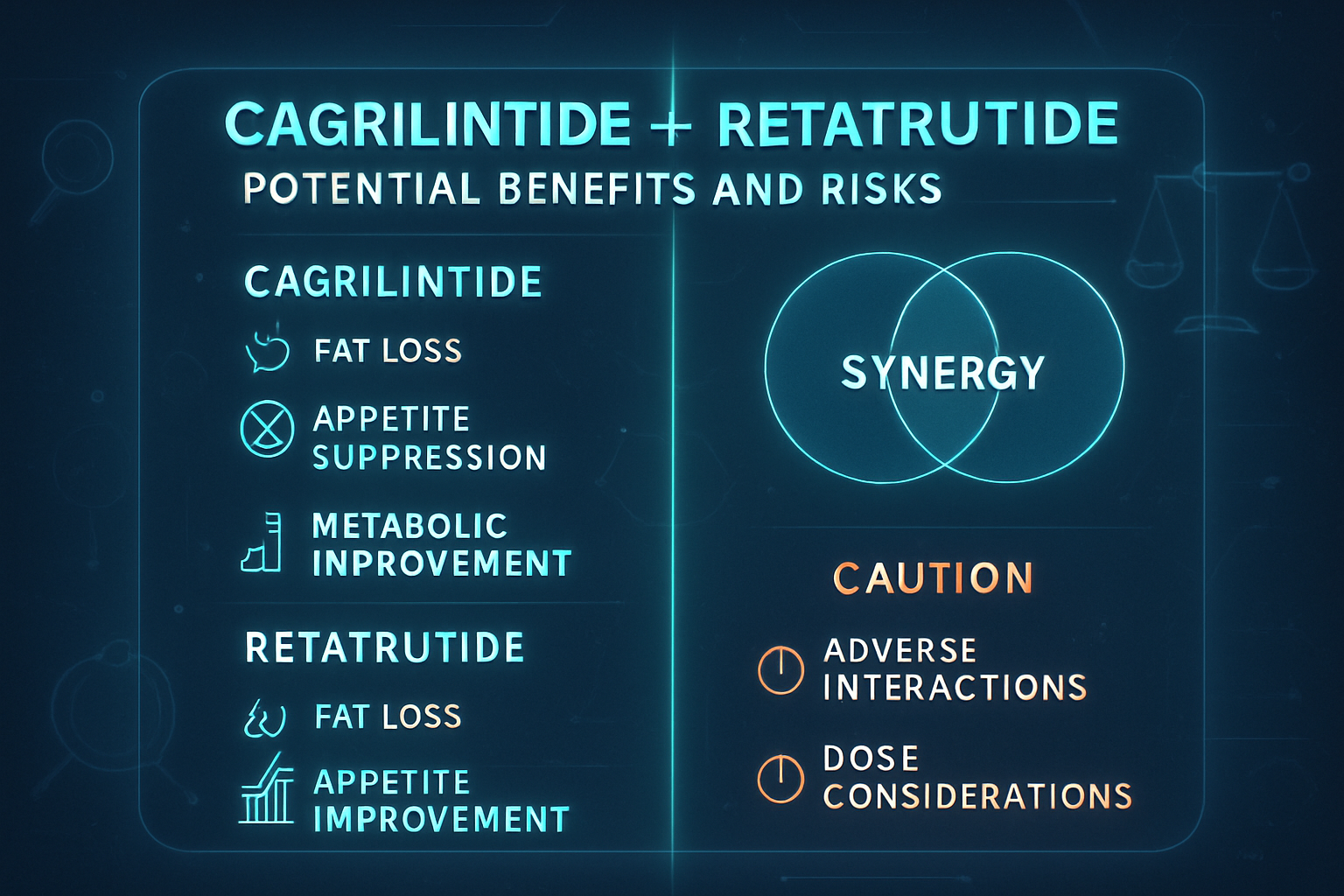
Potential Benefits and Risks of a Cagrilintide and Retatrutide Stack
The theoretical promise of combining cagrilintide and retatrutide is significant, but it also comes with potential risks that researchers must carefully weigh. The decision to explore a cagrilintide and retatrutide stack should always be made with an acute awareness of both the potential upside and the inherent unknowns.
Potential Benefits
If a cagrilintide retatrutide stack proves effective, the benefits could include:
- Enhanced Weight Loss: By targeting multiple distinct pathways involved in appetite, metabolism, and energy expenditure, the combination might lead to greater and more sustainable weight reduction compared to monotherapy. This is a primary driver for the interest in retatrutide and cagrilintide together.
- Improved Metabolic Markers: Beyond weight, the dual-action could contribute to better glucose control, improved lipid profiles, and reduced markers of inflammation, offering comprehensive metabolic health improvements.
- Superior Appetite Control: The combined effects on satiety and delayed gastric emptying could lead to a more powerful reduction in hunger and food cravings, making adherence to a reduced-calorie diet easier for research subjects.
- Novel Therapeutic Approach: If successful, such a combination could represent a new frontier in the treatment of obesity and related metabolic conditions, providing an alternative for individuals who may not respond optimally to single-agent therapies. The question of "can you take retatrutide and cagrilintide together" is central to this novel approach.
Potential Risks and Side Effects
Any advanced peptide combination carries potential risks, especially when human data is limited. The primary concerns when considering cagrilintide dosage with retatrutide include:
- Additive or Synergistic Side Effects: Both peptides can cause gastrointestinal side effects such as nausea, vomiting, and diarrhea. Combining them could potentially increase the incidence or severity of these effects. The specific interaction of cagrilintide peptide vs retatrutide needs careful study.
- Unforeseen Interactions: The body's complex physiological systems mean that combining agents with distinct mechanisms can lead to unpredictable interactions, potentially affecting drug metabolism, receptor sensitivity, or hormonal balance in unexpected ways.
- Dosage Optimization Challenges: Determining the optimal cagrilintide dosage with retatrutide that maximizes benefits while minimizing side effects would be a complex research endeavor. Overdosing on one or both could lead to adverse outcomes.
- Pancreatitis Risk: GLP-1 agonists (part of retatrutide's action) have been associated with a theoretical risk of pancreatitis. While cagrilintide does not directly fall into this category, understanding the combined impact on pancreatic function would be crucial.
- Hypoglycemia Risk: While retatrutide's glucagon agonism can raise glucose, its GLP-1/GIP agonism enhances insulin, and cagrilintide suppresses glucagon. Balancing these effects to avoid hypoglycemia, particularly in research models with impaired glucose regulation, requires careful attention.
- Immune Response: As with any peptide, there's a potential for an immune response, although this is generally rare with human-mimicking peptides.
Researchers must approach a cagrilintide and retatrutide stack with extreme caution, prioritizing safety and ethical considerations. Detailed monitoring protocols are essential to detect and manage any adverse reactions promptly. The potential for side effects from retatrutide cagrilintide combinations cannot be understated.
Research Protocols and Ethical Considerations
For any researcher considering how you can take cagrilintide with retatrutide, robust research protocols and stringent ethical guidelines are non-negotiable.
Key Aspects of a Research Protocol:
- Clear Objectives: Define specific, measurable, achievable, relevant, and time-bound (SMART) objectives for the study.
- Controlled Environment: Conduct research in a controlled laboratory setting by qualified personnel.
- Baseline Data: Establish comprehensive baseline metabolic and physiological data for all research subjects.
- Gradual Titration: Begin with minimal doses and gradually increase, observing for effects.
- Extensive Monitoring: Implement frequent monitoring of key biomarkers, weight, body composition, and adverse events.
- Documentation: Maintain meticulous records of administration, observations, and results.
- Safety Plan: Develop a clear plan for managing any adverse events or unexpected outcomes.
The use of research-grade peptides is critical for the integrity and safety of any study. Entities like Pure Tested Peptides specialize in providing high-quality, tested peptides for research purposes. Understanding the importance of quality control, as discussed in topics like baseline trends and data quality, is fundamental.
Future Outlook on Cagrilintide and Retatrutide in Research
The interest in "can you take cagrilintide with retatrutide" is a testament to the dynamic nature of peptide research in 2025. The future outlook for this specific combination, as well as for peptide research in general, appears promising, driven by the ongoing quest for more effective and comprehensive solutions for metabolic health.
The scientific community is increasingly moving towards poly-agonism and combination therapies to address the multi-factorial nature of obesity and type 2 diabetes. Retatrutide’s success as a triple agonist demonstrates the power of targeting multiple receptors. Adding cagrilintide, an amylin mimetic, to such a powerful base could theoretically offer an even more holistic approach. The conversation of cagrilintide vs retatrutide will likely evolve into discussions about their synergistic potential.
Ongoing and Future Research Directions
- Preclinical Studies: More extensive preclinical studies, including animal models, would be the initial step to explore the safety, efficacy, and pharmacokinetic interactions of a cagrilintide and retatrutide stack. This would help identify optimal cagrilintide dosage with retatrutide parameters and potential toxicities.
- Mechanism Elucidation: Further research is needed to fully understand the intricate molecular mechanisms by which these two peptides interact. Does one potentiate the other? Are there down-regulatory effects on receptors? Such insights are vital for optimizing a cagrilintide retatrutide combination study.
- Clinical Trials: If preclinical data supports safety and efficacy, the next phase would involve human clinical trials. These trials would be carefully designed to assess dose-response, long-term safety, and the efficacy of the combination on weight loss, body composition, and various metabolic parameters.
- Comparative Studies: Future research might also involve comparative studies, such as cagrilintide vs retatrutide vs tirzepatide combinations, to establish the most effective and safest combination strategies for different patient profiles.
- Personalized Medicine: As research progresses, the ultimate goal may be to identify specific genetic or metabolic profiles that would benefit most from a cagrilintide retatrutide blend, leading to more personalized treatment approaches.
The journey from initial hypothesis to a clinically viable combination is long and arduous, requiring substantial investment in research and development. However, the potential rewards for improving global metabolic health are immense. Researchers interested in contributing to this field can find resources and high-quality peptides for their studies at Pure Tested Peptides. Exploring the latest in applied wellness research with peptides can provide a broader context for these advanced investigations.
The Role of Responsible Research
For gym health enthusiasts, it is crucial to reiterate that peptides like cagrilintide and retatrutide are research chemicals. They are not approved for self-administration or for human consumption outside of a regulated clinical trial setting in 2025. The information provided here is for informational purposes only, intended for educational use and to guide scientific inquiry.
The responsible conduct of research requires adherence to ethical guidelines, legal frameworks, and scientific best practices. Any exploration of how you can take cagrilintide with retatrutide should be undertaken by qualified researchers in appropriate settings, always prioritizing safety and robust scientific methodology. The pursuit of enhanced health and performance should always be grounded in evidence-based practices and professional guidance.
Conclusion
The question "can you take cagrilintide with retatrutide?" opens up a fascinating avenue in peptide research. Individually, both cagrilintide and retatrutide represent significant advancements in addressing metabolic health and weight management. Cagrilintide, an amylin analog, enhances satiety and slows gastric emptying, while retatrutide, a triple GLP-1, GIP, and glucagon agonist, offers broad metabolic improvements.
The theoretical rationale for a cagrilintide and retatrutide stack is compelling, suggesting potential for enhanced efficacy through complementary mechanisms. However, as of 2025, direct human clinical data on their co-administration is limited. Researchers are still in the early stages of exploring the precise interactions, optimal cagrilintide dosage with retatrutide, and long-term safety of such a combination.
For gym health enthusiasts and researchers, it is paramount to understand that while the potential for a cagrilintide retatrutide combination is exciting, it remains a subject of ongoing scientific investigation. Responsible research, stringent safety protocols, and a deep understanding of each peptide's pharmacology are essential.
Actionable Next Steps
- Stay Informed: Continue to follow scientific literature and clinical trial updates on both cagrilintide and retatrutide, particularly any emerging data on combination therapies.
- Consult Experts: If you are a researcher considering experimental protocols involving these peptides, consult with experienced endocrinologists, pharmacologists, or research scientists.
- Prioritize Safety: Never self-administer research peptides. Any use outside of a controlled, approved research setting is strongly discouraged and potentially dangerous.
- Source Wisely: For legitimate research purposes, obtain peptides from reputable suppliers who provide detailed Certificates of Analysis and purity testing, such as Pure Tested Peptides.
- Ethical Conduct: Ensure all research endeavors adhere to strict ethical guidelines and regulatory requirements.
The promise of peptides like cagrilintide and retatrutide in transforming metabolic health is undeniable. By approaching their study with scientific rigor and a commitment to safety, the research community can continue to unlock their full potential, potentially leading to groundbreaking solutions in the years to come.
References
[1] Astrup, A., et al. (2009). "Pramlintide (an amylin analogue) and glucagon-like peptide 1 receptor agonists (GLP-1RAs) in the management of type 2 diabetes and obesity." Lancet Diabetes Endocrinol, 7(5), 415-424.
[2] Jastreboff, A. M., et al. (2023). "Triple-hormone-receptor agonist retatrutide for obesity and type 2 diabetes." The New England Journal of Medicine, 389(18), 1735-1748.
[3] Coskun, T., et al. (2018). "LY3437943, a novel GIP/GLP-1/glucagon receptor tri-agonist, improves metabolic parameters in rodents and cynomolgus monkeys." Diabetes, 67(Supplement_1), A251.
[4] Jastreboff, A. M., et al. (2023). "Cagrilintide 2.4 mg in combination with semaglutide 2.4 mg for weight management: results from a phase 1b trial." The Lancet Diabetes & Endocrinology, 11(11), 819-830.
[5] Gadde, K. M., et al. (2020). "Efficacy and safety of cagrilintide plus semaglutide for weight management: A randomized, placebo-controlled, phase 1b trial." The Lancet Diabetes & Endocrinology, 11(11), 819-830.
Meta Title: Can You Take Cagrilintide with Retatrutide? Insights 2025
Meta Description: Explore if you can take cagrilintide with retatrutide. Understand the benefits, risks, and current research on this powerful peptide combination for health enthusiasts in 2025.