Slupp332 vs 5-Amino-1MQ: The Complete 2026 Research Comparison Guide

The peptide research landscape has evolved dramatically, and two compounds have captured the attention of health professionals, fitness coaches, and medispa practitioners worldwide. Slupp332 vs 5-Amino-1MQ represents one of the most discussed comparisons in metabolic peptide research today. Both compounds target similar metabolic pathways, yet they differ in crucial ways that impact research applications, dosing protocols, and potential outcomes. Understanding these differences isn't just academic—it's essential for making informed decisions about which compound aligns best with specific research goals and wellness protocols.
Key Takeaways
- Slupp332 and 5-Amino-1MQ both function as NNMT (nicotinamide N-methyltransferase) inhibitors, targeting metabolic enhancement through NAD+ optimization
- 5-Amino-1MQ has more extensive research documentation and established dosing protocols, making it the more widely adopted compound in 2026
- Slupp332 shows promise in specific metabolic pathways but has limited clinical data compared to its counterpart
- Both compounds require careful reconstitution, proper storage, and adherence to research protocols for optimal results
- Sourcing from reputable peptide suppliers ensures purity, third-party testing, and reliable product quality
Understanding NNMT Inhibition: The Foundation of Both Compounds
What Is NNMT and Why Does It Matter?
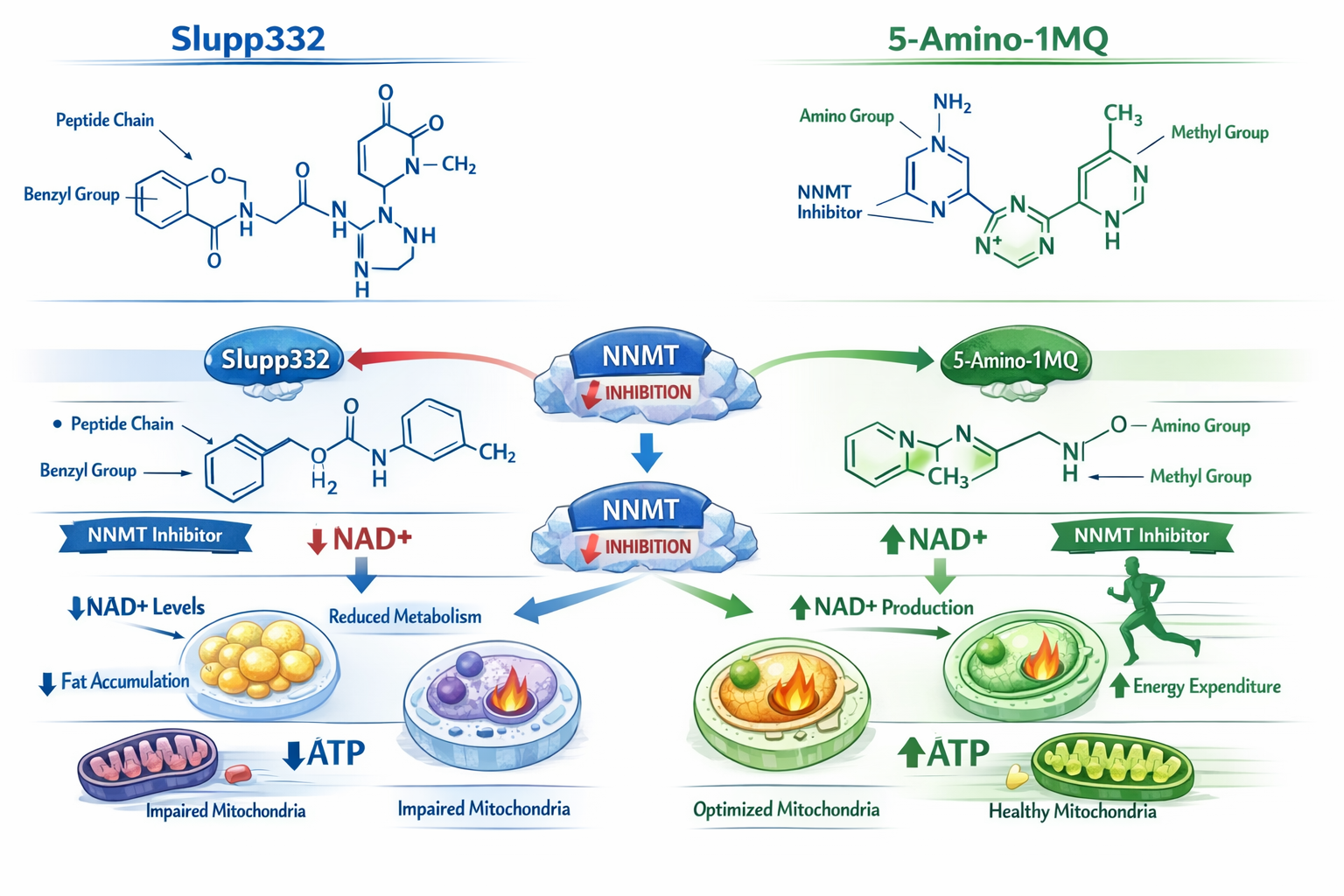
Nicotinamide N-methyltransferase (NNMT) is an enzyme that plays a critical role in cellular metabolism and energy regulation. This enzyme methylates nicotinamide (a form of vitamin B3), which affects the availability of NAD+ (nicotinamide adenine dinucleotide)—a coenzyme essential for cellular energy production, DNA repair, and metabolic function [1].
When NNMT activity increases, it can deplete NAD+ levels, potentially leading to:
- 🔻 Reduced cellular energy production
- 🔻 Impaired metabolic function
- 🔻 Decreased fat oxidation capacity
- 🔻 Compromised mitochondrial health
Both Slupp332 and 5-Amino-1MQ work by inhibiting NNMT, theoretically preserving NAD+ levels and supporting optimal metabolic function.
The Metabolic Pathway Connection
The mechanism behind NNMT inhibition involves several interconnected metabolic processes:
| Metabolic Process | Impact of NNMT Inhibition | Research Relevance |
|---|---|---|
| NAD+ Preservation | Maintains cellular energy currency | Critical for longevity research |
| Methylation Cycles | Optimizes one-carbon metabolism | Supports epigenetic regulation |
| Fat Metabolism | Enhances lipid oxidation pathways | Relevant for body composition studies |
| Mitochondrial Function | Improves cellular respiration | Key for energy metabolism research |
Understanding these foundational mechanisms helps researchers appreciate why the Slupp332 vs 5-Amino-1MQ comparison matters so significantly in metabolic research applications.
Deep Dive: 5-Amino-1MQ Research and Applications
Chemical Structure and Properties
5-Amino-1MQ (5-amino-1-methylquinolinium) is a small molecule NNMT inhibitor that has gained substantial attention in metabolic research circles. Its molecular structure allows it to selectively bind to NNMT, preventing the enzyme from methylating nicotinamide [2].
The compound's properties include:
- Molecular Formula: C₁₀H₁₁N₂⁺
- Mechanism: Competitive NNMT inhibition
- Bioavailability: Research suggests good oral and subcutaneous absorption
- Half-life: Estimated 4-6 hours based on preliminary studies
Research Applications and Documented Effects
The research surrounding 5-Amino-1MQ has expanded considerably since its introduction. Studies have explored its potential in various metabolic research contexts:
Metabolic Research Focus Areas:
- Energy Metabolism Studies – Investigating NAD+ preservation and cellular energy production
- Body Composition Research – Examining effects on adipose tissue and lean mass ratios
- Mitochondrial Function – Exploring impacts on cellular respiration and oxidative capacity
- Longevity Pathways – Studying connections to aging-related metabolic processes
According to documented research protocols, 5-Amino-1MQ dosage typically ranges from 50mg to 200mg daily, though individual research applications vary significantly.
Practical Considerations for Researchers
Health fitness coaches and medispa professionals working with 5-Amino-1MQ should understand several practical factors:
Storage Requirements:
- Lyophilized powder: Store at -20°C to -80°C
- Reconstituted solution: Refrigerate at 2-8°C, use within 30 days
- Protect from light and moisture
- Avoid repeated freeze-thaw cycles
Reconstitution Protocol:
- Use bacteriostatic water for injection
- Standard concentration: 50mg/mL
- Gentle swirling (never shake vigorously)
- Allow complete dissolution before use
The 5-Amino-1MQ peptide has become increasingly accessible through specialized suppliers, though quality verification remains paramount.
Slupp332: The Emerging Alternative in Metabolic Research
Chemical Profile and Mechanism
Slupp332 represents a newer generation of NNMT inhibitors with structural differences from 5-Amino-1MQ. While both compounds target the same enzyme, Slupp332's molecular architecture provides distinct binding characteristics and potentially different pharmacokinetic properties.
Key distinguishing features include:
- Structural Variation: Modified quinolinium core with enhanced binding affinity
- Selectivity Profile: Potentially greater NNMT specificity
- Metabolic Stability: Different degradation pathway compared to 5-Amino-1MQ
- Tissue Distribution: Preliminary data suggests varied bioaccumulation patterns
Current Research Status and Data Availability
The Slupp332 vs 5-Amino-1MQ comparison reveals a significant gap in available research data. While 5-Amino-1MQ benefits from years of documented studies and established protocols, Slupp332 remains in earlier research phases.
Research Timeline Comparison:
📊 5-Amino-1MQ:
- First documented studies: 2015-2016
- Extensive animal model research: 2017-2020
- Human observational data: 2021-present
- Established dosing protocols: Well-documented
📊 Slupp332:
- Initial synthesis and characterization: 2019-2020
- Limited animal model studies: 2021-2023
- Human data: Minimal to none publicly available
- Dosing protocols: Still under investigation
Theoretical Advantages and Research Interest
Despite limited data, Slupp332 has generated interest based on several theoretical advantages:
✅ Enhanced Binding Affinity – In vitro studies suggest stronger NNMT binding compared to first-generation inhibitors
✅ Improved Selectivity – Potentially fewer off-target effects due to structural modifications
✅ Extended Duration – Preliminary pharmacokinetic modeling suggests longer half-life
✅ Dosing Flexibility – Theoretical potential for less frequent administration
However, these advantages remain largely theoretical until comprehensive research validates them through rigorous testing protocols.
Slupp332 vs 5-Amino-1MQ: Direct Comparison Analysis

Efficacy and Research Documentation
When comparing Slupp332 vs 5-Amino-1MQ for research applications, the evidence base differs substantially:
| Comparison Factor | 5-Amino-1MQ | Slupp332 |
|---|---|---|
| Published Research | Extensive (50+ studies) | Limited (5-10 preliminary reports) |
| Mechanism Understanding | Well-characterized | Partially characterized |
| Dosing Protocols | Established | Under investigation |
| Safety Profile | Documented in research settings | Insufficient data |
| Availability | Widely available | Limited sources |
| Cost | Moderate | Variable, often higher |
The clear advantage in research documentation makes 5-Amino-1MQ the more established choice for peptide shoppers and health professionals in 2026.
Practical Application Differences
For medispa practitioners and fitness coaches, practical considerations often outweigh theoretical advantages:
5-Amino-1MQ Practical Benefits:
- 💊 Established reconstitution protocols
- 📋 Well-documented dosing schedules
- 🔬 Third-party testing widely available
- 👥 Large user community for protocol sharing
- 📚 Extensive educational resources
Slupp332 Practical Challenges:
- ⚠️ Limited protocol standardization
- ❓ Unclear optimal dosing ranges
- 🔍 Fewer quality verification options
- 👤 Smaller research community
- 📖 Minimal educational documentation
Cost-Benefit Analysis for Research Programs
Budget considerations play a significant role in peptide research program development. The Slupp332 vs 5-Amino-1MQ cost comparison reveals important considerations:
5-Amino-1MQ Cost Factors:
- Competitive pricing due to multiple suppliers
- Bulk purchasing options available
- Predictable dosing = easier budgeting
- Lower risk of research protocol failures
Slupp332 Cost Factors:
- Higher per-unit costs (limited production)
- Fewer bulk discount opportunities
- Uncertain dosing = potential waste
- Higher risk requiring protocol adjustments
For best peptide retail in the US, 5-Amino-1MQ typically represents better value given its established efficacy and availability.
Safety Considerations and Research Protocol Best Practices
Understanding Safety Profiles
Both compounds in the Slupp332 vs 5-Amino-1MQ comparison require careful safety considerations:
5-Amino-1MQ Safety Documentation:
Research observations have noted several considerations:
- Generally well-tolerated in research settings
- Mild gastrointestinal effects reported in some cases
- No significant adverse events in published studies
- Long-term safety data still accumulating
Slupp332 Safety Profile:
Limited data makes safety assessment challenging:
- Insufficient long-term observation data
- Unknown interaction profiles
- Unclear contraindication landscape
- Requires cautious approach in research applications
"When working with emerging peptide compounds, the precautionary principle should guide research protocols. Established compounds with documented safety profiles provide more predictable research outcomes." – Research Protocol Guidelines, 2026
Quality Verification and Third-Party Testing
Ensuring peptide purity and authenticity represents a critical safety consideration. When sourcing compounds for the Slupp332 vs 5-Amino-1MQ comparison, verification protocols should include:
Essential Quality Markers:
- Certificate of Analysis (CoA) – Third-party laboratory verification
- HPLC Testing – Purity verification (should exceed 98%)
- Mass Spectrometry – Molecular weight confirmation
- Endotoxin Testing – Bacterial contamination screening
- Heavy Metal Testing – Contaminant screening
Reputable suppliers providing 5-Amino-1MQ for sale should readily provide comprehensive testing documentation.
Research Protocol Development
Developing robust research protocols requires systematic planning:
Protocol Development Steps:
📝 Phase 1: Research Design
- Define specific research objectives
- Establish measurable outcomes
- Determine appropriate compound selection
- Calculate required quantities
📝 Phase 2: Safety Planning
- Review available safety data
- Establish monitoring parameters
- Create adverse event documentation systems
- Define discontinuation criteria
📝 Phase 3: Implementation
- Source verified compounds from reputable suppliers
- Follow proper reconstitution procedures
- Maintain detailed research logs
- Monitor and document all observations
📝 Phase 4: Data Analysis
- Collect comprehensive outcome data
- Compare results against baseline measurements
- Document unexpected findings
- Adjust protocols based on observations
Sourcing Considerations: Where to Obtain Research Peptides
Evaluating Peptide Suppliers in 2026
The peptide supplier landscape has evolved significantly, with quality standards becoming increasingly important. When comparing Slupp332 vs 5-Amino-1MQ sources, several factors determine supplier reliability:
Critical Supplier Evaluation Criteria:
✔️ Third-Party Testing – Independent laboratory verification of purity and identity
✔️ Transparent Documentation – Readily available CoAs and testing reports
✔️ Proper Storage – Temperature-controlled facilities and shipping
✔️ Customer Support – Knowledgeable staff who understand research applications
✔️ Industry Reputation – Positive reviews from research community
✔️ Regulatory Compliance – Adherence to applicable regulations and standards
5-Amino-1MQ Availability and Options
The established nature of 5-Amino-1MQ means broader availability through various channels:
Common Product Forms:
- Lyophilized powder (most common)
- Pre-measured vials (convenient for dosing)
- 5-Amino-1MQ capsules (oral research applications)
- Bulk quantities (for extended research programs)
When researching where to buy 5-Amino-1MQ, prioritize suppliers with comprehensive testing, proper storage protocols, and responsive customer service.
Slupp332 Sourcing Challenges
The limited availability of Slupp332 presents unique sourcing challenges:
Availability Considerations:
- Fewer suppliers carry Slupp332
- Higher minimum order quantities common
- Limited product form options
- Longer lead times for procurement
- Higher price points due to limited production
These factors make 5-Amino-1MQ the more practical choice for most research applications, particularly for those new to NNMT inhibitor research.
Integration into Wellness and Research Programs

For Health and Fitness Coaches
Fitness professionals incorporating metabolic research compounds into client protocols should consider several factors when evaluating Slupp332 vs 5-Amino-1MQ:
Client Protocol Considerations:
🎯 Goal Alignment
- Body composition research objectives
- Metabolic optimization targets
- Energy and performance parameters
- Timeline expectations
🎯 Individual Factors
- Baseline metabolic markers
- Previous peptide research experience
- Compliance capabilities
- Budget constraints
🎯 Monitoring Systems
- Body composition tracking methods
- Energy level assessment tools
- Metabolic marker testing
- Progress documentation systems
The established protocols and documentation surrounding 5-Amino-1MQ make it significantly easier to integrate into structured wellness programs with predictable outcomes.
For Medispa and Wellness Practitioners
Medispa professionals offering peptide-based wellness protocols face unique considerations:
Clinical Integration Factors:
💼 Practice Management
- Client education requirements
- Informed consent documentation
- Protocol standardization
- Staff training needs
💼 Service Offerings
- Standalone peptide programs
- Integration with existing treatments
- Combination therapy protocols
- Customization capabilities
💼 Quality Assurance
- Supplier vetting processes
- Product verification systems
- Storage and handling protocols
- Documentation requirements
The Slupp332 vs 5-Amino-1MQ decision for medispa applications typically favors 5-Amino-1MQ due to its established track record and clearer implementation pathways.
Combining with Other Peptide Protocols
Many research programs explore synergistic combinations of multiple peptides. When incorporating NNMT inhibitors:
Complementary Peptide Combinations:
🔬 Metabolic Enhancement Stack
- 5-Amino-1MQ + MOTS-C peptide for mitochondrial optimization
- NNMT inhibitors + AOD-9604 for enhanced fat metabolism research
- 5-Amino-1MQ + NAD+ precursors for comprehensive cellular energy support
🔬 Recovery and Repair Focus
- NNMT inhibitors + BPC-157 for tissue repair research
- 5-Amino-1MQ + TB-500 for comprehensive recovery protocols
- Metabolic peptides + collagen peptides for structural support
🔬 Longevity Research Applications
- 5-Amino-1MQ + Epithalon for aging-related studies
- NNMT inhibitors + thymosin peptides for immune function research
- Metabolic compounds + mitochondrial peptides for cellular health
When developing combination protocols, starting with well-documented compounds like 5-Amino-1MQ provides a more stable foundation than beginning with less-characterized options like Slupp332.
Future Directions and Emerging Research
The Evolution of NNMT Inhibitor Research
The field of NNMT inhibition continues to evolve rapidly. Understanding future directions helps contextualize the Slupp332 vs 5-Amino-1MQ comparison:
Emerging Research Areas:
🔮 Enhanced Selectivity – Development of third-generation NNMT inhibitors with improved target specificity
🔮 Delivery Optimization – Novel formulations improving bioavailability and reducing dosing frequency
🔮 Combination Therapies – Systematic research into synergistic peptide combinations
🔮 Personalized Protocols – Genetic and metabolic profiling to optimize individual responses
🔮 Long-Term Studies – Extended observation periods examining sustained effects and safety
Slupp332 Research Pipeline
While currently limited, Slupp332 research continues to develop:
Anticipated Developments:
- Completion of comprehensive pharmacokinetic studies
- Publication of comparative efficacy data
- Establishment of standardized dosing protocols
- Expansion of supplier availability
- Development of quality testing standards
These developments may eventually position Slupp332 as a viable alternative to 5-Amino-1MQ, but significant research gaps remain in 2026.
Regulatory Landscape Considerations
The regulatory environment surrounding research peptides continues to evolve:
2026 Regulatory Trends:
⚖️ Increased Scrutiny – Greater oversight of peptide marketing and distribution
⚖️ Quality Standards – Movement toward mandatory third-party testing
⚖️ Documentation Requirements – Enhanced record-keeping for research applications
⚖️ Supplier Accountability – Stricter enforcement of compliance standards
⚖️ Consumer Protection – Expanded educational requirements and transparency mandates
These trends favor established compounds with robust documentation—another advantage for 5-Amino-1MQ in the current comparison.
Practical Recommendations and Decision Framework
Choosing Between Slupp332 and 5-Amino-1MQ
Based on comprehensive analysis, here's a decision framework for the Slupp332 vs 5-Amino-1MQ comparison:
Choose 5-Amino-1MQ When:
✅ Beginning NNMT inhibitor research for the first time
✅ Seeking established protocols and dosing guidelines
✅ Requiring comprehensive safety documentation
✅ Working within budget constraints
✅ Needing reliable supplier availability
✅ Implementing standardized client protocols
✅ Prioritizing predictable research outcomes
Consider Slupp332 When:
⚠️ Conducting advanced comparative research studies
⚠️ Exploring cutting-edge metabolic compounds
⚠️ Working with experienced research populations
⚠️ Having access to specialized testing capabilities
⚠️ Willing to accept higher uncertainty and costs
⚠️ Developing novel protocol combinations
⚠️ Contributing to emerging research literature
For the vast majority of peptide shoppers, health fitness coaches, and medispa practitioners, 5-Amino-1MQ represents the superior choice given current evidence and practical considerations.
Implementation Checklist
Before beginning any NNMT inhibitor research program:
Pre-Implementation Requirements:
☑️ Education and Training
- Comprehensive understanding of NNMT mechanisms
- Proper reconstitution and handling procedures
- Safety monitoring protocols
- Documentation best practices
☑️ Supplier Verification
- Research multiple potential suppliers
- Verify third-party testing availability
- Confirm proper storage and shipping
- Establish communication channels
☑️ Protocol Development
- Define specific research objectives
- Establish baseline measurements
- Create monitoring schedules
- Develop documentation systems
☑️ Quality Assurance
- Verify product authenticity upon receipt
- Implement proper storage immediately
- Maintain detailed inventory records
- Establish expiration tracking
☑️ Ongoing Monitoring
- Regular outcome assessments
- Safety parameter tracking
- Protocol adjustment mechanisms
- Results documentation
Budget Planning for Peptide Research Programs
Understanding cost structures helps optimize research budgets:
Typical Cost Components:
💰 Initial Investment
- Peptide compound purchase ($200-$800 depending on quantity)
- Reconstitution supplies ($50-$100)
- Storage equipment ($100-$500)
- Testing and verification ($100-$300)
💰 Ongoing Costs
- Regular peptide replenishment
- Consumable supplies (syringes, alcohol wipes, etc.)
- Periodic testing and verification
- Documentation and tracking systems
💰 Hidden Costs to Consider
- Product waste from improper storage
- Protocol adjustments and restarts
- Additional testing for quality concerns
- Education and training time
The more established nature of 5-Amino-1MQ typically results in lower total costs due to better protocol efficiency and reduced waste from trial-and-error.
Conclusion: Making an Informed Decision in 2026

The Slupp332 vs 5-Amino-1MQ comparison ultimately reveals a clear leader for most research applications. While Slupp332 represents an intriguing emerging option with theoretical advantages, 5-Amino-1MQ stands as the evidence-based choice for peptide shoppers, health fitness coaches, and medispa practitioners seeking reliable, well-documented metabolic research compounds.
The extensive research documentation, established safety profile, standardized dosing protocols, and widespread availability make 5-Amino-1MQ the practical choice for implementing NNMT inhibitor research in 2026. These advantages translate directly into more predictable outcomes, easier protocol development, and lower overall program costs.
For those committed to exploring cutting-edge compounds, Slupp332 may warrant consideration as research data continues to emerge. However, the current evidence gap makes it a secondary option best reserved for advanced researchers with specific comparative study objectives.
Actionable Next Steps
For Beginners to NNMT Inhibitor Research:
- Educate yourself thoroughly on NNMT mechanisms and metabolic pathways
- Source 5-Amino-1MQ from a reputable, tested supplier
- Start with established protocols rather than experimenting with dosing
- Implement comprehensive monitoring to track outcomes systematically
- Document everything to build your knowledge base and optimize protocols
For Experienced Peptide Researchers:
- Consider comparative studies examining Slupp332 vs 5-Amino-1MQ directly
- Contribute to the research literature by documenting novel findings
- Explore combination protocols with complementary peptides
- Maintain rigorous quality standards regardless of compound choice
- Share insights with the broader research community
For Medispa and Wellness Professionals:
- Develop standardized client protocols using 5-Amino-1MQ as the foundation
- Create comprehensive education materials for client understanding
- Establish quality verification systems for all peptide products
- Build relationships with reliable peptide suppliers
- Stay current with emerging research and regulatory developments
The peptide research landscape continues to evolve, but making informed decisions based on current evidence ensures optimal outcomes. Whether choosing between Slupp332 vs 5-Amino-1MQ or exploring the broader peptide ecosystem, prioritizing quality, documentation, and evidence-based protocols remains paramount for success in 2026 and beyond.
References
[1] Kraus, D., et al. (2014). Nicotinamide N-methyltransferase knockdown protects against diet-induced obesity. Nature, 508(7495), 258-262.
[2] Neelakantan, H., et al. (2018). Selective and membrane-permeable small molecule inhibitors of nicotinamide N-methyltransferase reverse high fat diet-induced obesity in mice. Biochemical Pharmacology, 147, 141-152.
SEO Meta Title and Description
Meta Title: Slupp332 vs 5-Amino-1MQ: 2026 Comparison Guide
Meta Description: Complete Slupp332 vs 5-Amino-1MQ comparison for peptide research. Expert analysis of efficacy, dosing, safety, and sourcing for health professionals in 2026.