

Peptides vs Polypeptides: How Molecular Size and Structure Change Research Questions
A single amino acid added to a chain can shift a molecule from one regulatory category to another, and that shift changes the entire research strategy around it. The question of peptides vs polypeptides: how molecular size and structure change research questions is not a matter of academic trivia. It determines how compounds are synthesized, formulated, classified by regulators, and studied in the lab. In 2026, with over 80 FDA- and EMA-approved peptide drugs on the market and more than 650 candidates in development, getting this distinction right has direct consequences for research design and data interpretation.
Key Takeaways
- Peptides are conventionally defined as chains of 2-50 amino acids; polypeptides contain 51 or more, though some teaching contexts set the boundary at 20 residues.
- Chain length determines whether research focuses on receptor binding and delivery (peptides) or folding, expression, and immunogenicity (polypeptides).
- Mid-length molecules, 20 to 50 amino acids, create genuine ambiguity and require researchers to state their classification criteria explicitly.
- Research-use compounds like BPC-157, MOTS-c, and GLP-3 retatrutide sit at different points on this spectrum, each raising distinct mechanistic questions.
- Inconsistent cutoffs across publications can distort meta-analyses and comparative studies if researchers do not align definitions before pooling data.
Defining the Boundary: Where Peptides End and Polypeptides Begin
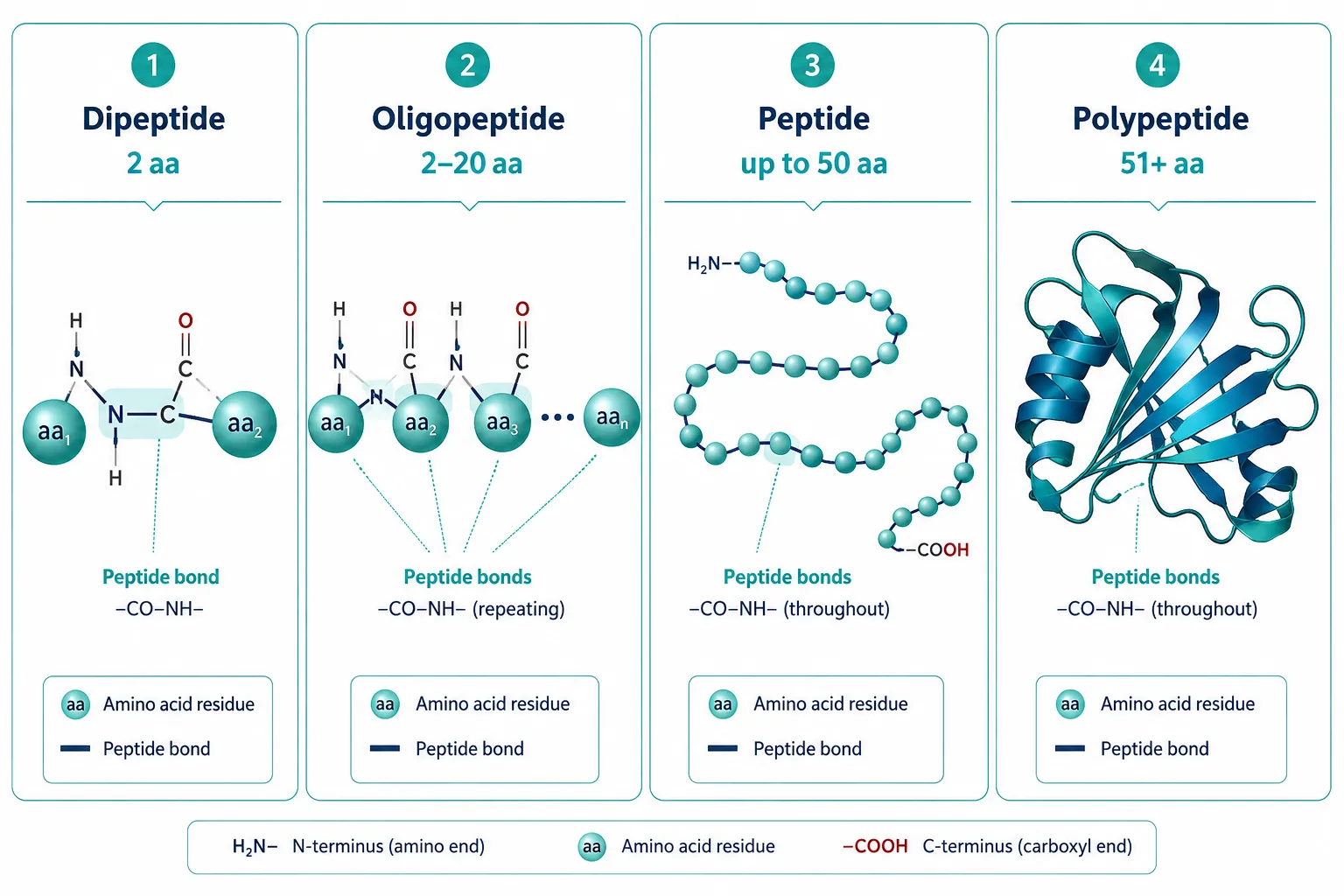
The most widely cited modern definition places peptides at 2-50 amino acids and polypeptides at 51 or more. The NIH-linked Genome.gov genetics glossary encodes this numerical boundary explicitly, making chain length part of the official language of molecular medicine. StatPearls refines the picture further, carving out "oligopeptides" at roughly 10-20 residues, while classifying chains above 20 amino acids as polypeptides in some educational contexts.
That overlap, chains between 20 and 50 amino acids, is where most confusion lives.
"Whether a 32-amino-acid hormone is called a peptide or a polypeptide depends entirely on which publication's definition you are reading."
These boundaries are practical conventions, not strict biochemical laws. They evolved to help researchers, clinicians, and regulators communicate efficiently. Drug-development literature updated in 2026 explicitly advises authors to state the residue range and classification used in any paper, because different cutoffs can change how a candidate is grouped in a meta-analysis or regulatory review.
| Category | Typical Residue Range | Primary Research Context |
|---|---|---|
| Dipeptide / Oligopeptide | 2-19 aa | Signaling, taste, neurotransmission |
| Peptide | 2-50 aa (therapeutic convention) | Receptor ligands, hormones, drug candidates |
| Polypeptide | 51+ aa (or 20+ in some teaching contexts) | Folded structures, enzymes, biologics |
| Protein | Variable; typically folded polypeptide(s) | Multi-domain function, antibody engineering |
For researchers working with compounds like MOTS-c and 5-Amino-1MQ, understanding where a molecule falls on this spectrum shapes every downstream decision, from synthesis method to stability testing.
How Molecular Size and Structure Change Research Questions in Practice
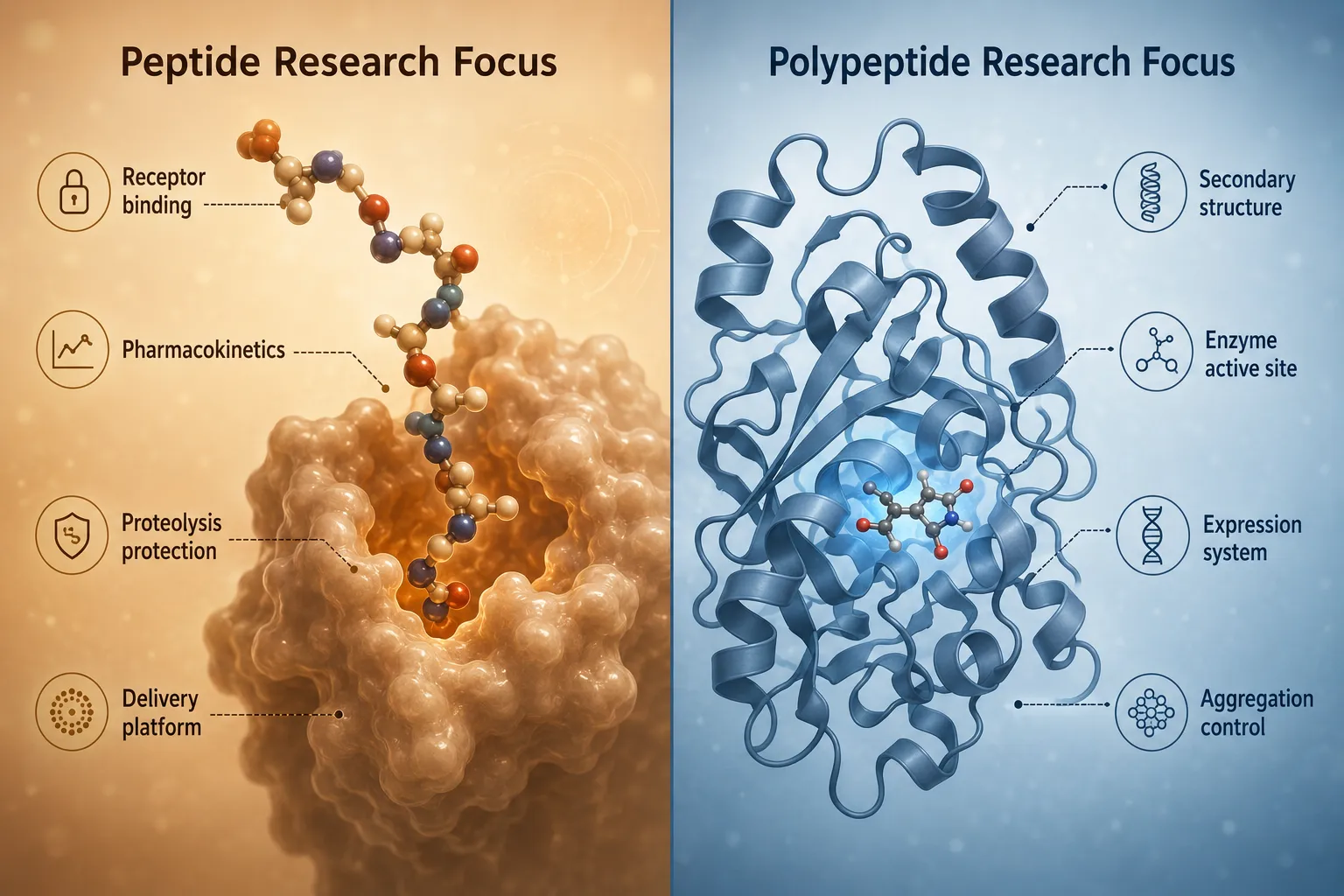
The core insight in understanding peptides vs polypeptides: how molecular size and structure change research questions is this: chain length changes functional expectation.
Short peptides, roughly 2 to 50 amino acids, are primarily studied as signaling molecules. They act as receptor ligands, hormones, and short regulatory motifs. Because they are small and flexible, research questions center on:
- How well does the compound bind its target receptor?
- How quickly is it degraded by proteases?
- What delivery platform, nasal spray, nanoparticle, depot injection, best protects it?
- How can half-life be extended without losing selectivity?
For example, research-use nasal spray peptides like Semax and Selank raise exactly these questions: mucosal absorption, carrier solvent stability, and CNS delivery efficiency.
Longer polypeptides, 51 or more residues, are long enough to fold into stable three-dimensional structures. Research questions shift dramatically:
- What secondary and tertiary structures does the chain adopt?
- Can it form an enzyme active site?
- How is it expressed in a microbial or mammalian system?
- Does it aggregate or generate immunogenic epitopes?
This is why polypeptide and protein engineering literature is dominated by folding, domain design, and bioprocess optimization, problems that simply do not arise at short chain lengths.
Mid-length molecules (20-50 amino acids) blur the line. Calcitonin (32 aa), glucagon (29 aa), atrial natriuretic peptide (28 aa), and thymosin beta-4 (43 aa) are long enough to adopt distinct conformations and interact with multiple targets, yet still short enough that solid-phase synthesis and peptide-style formulation remain appropriate. Compounds like GHK-Cu, a copper-binding peptide studied in collagen and tissue research, illustrate how even short chains can engage complex structural biology when metal coordination is involved.
Mapping Size Differences onto Modern Research-Use Compounds
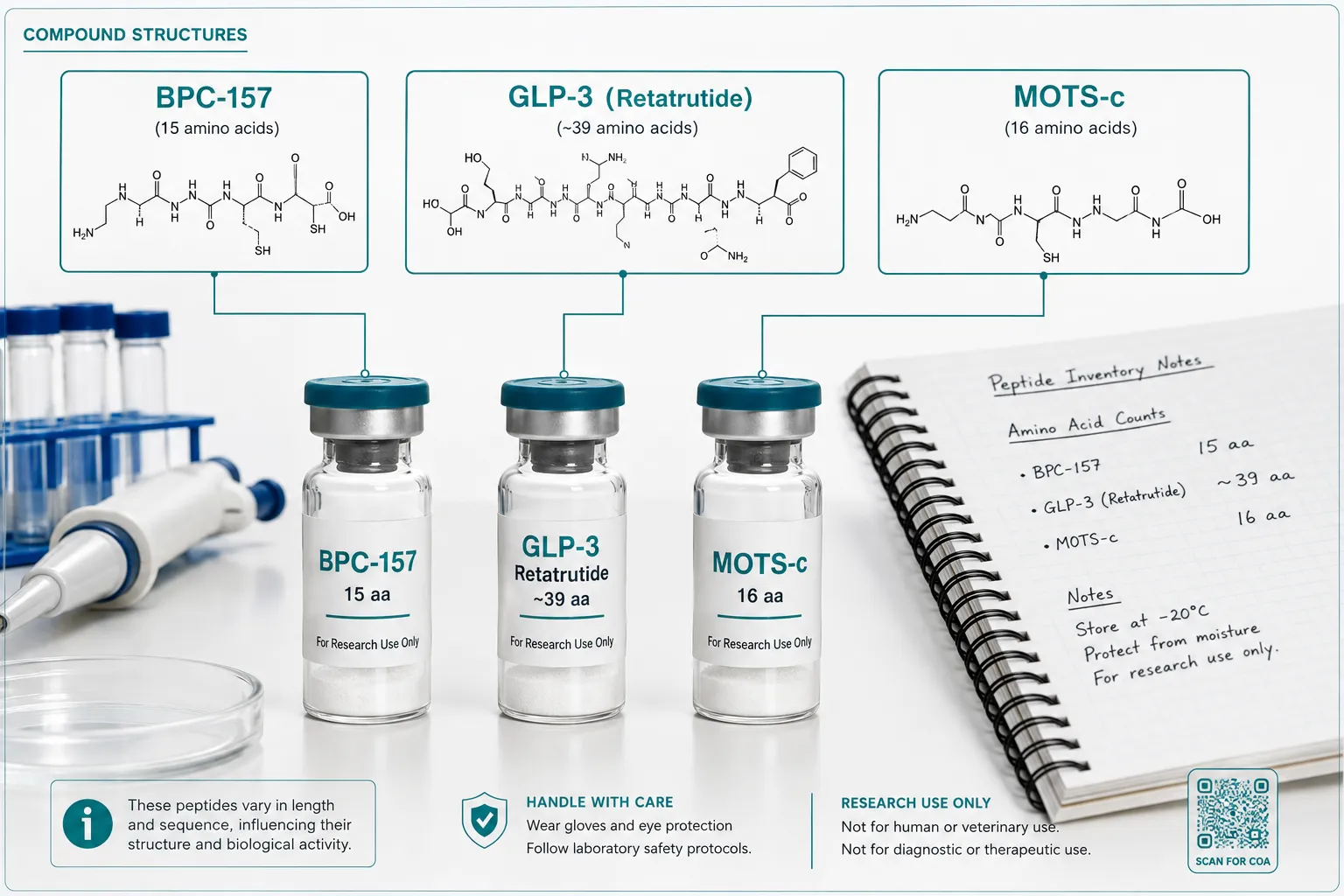
Applying peptides vs polypeptides: how molecular size and structure change research questions to specific research-use compounds clarifies why this distinction matters beyond textbooks.
BPC-157 is a 15-amino-acid synthetic peptide. Its short length places it firmly in peptide territory, meaning research priorities are stability in gastric or injectable environments, receptor interaction mapping, and tissue-specific delivery. The peptides and polypeptides framework connecting DNA, mitochondria, and modern research compounds helps contextualize how such short chains can still exert broad biological effects through targeted signaling.
MOTS-c is a 16-amino-acid mitochondria-derived peptide. Despite its small size, it interfaces with genomic and metabolic pathways in ways that raise questions more typically associated with longer regulatory molecules. Research on MOTS-c and its role in mitochondrial biology focuses on ATP production, insulin sensitivity, and cellular energy regulation, mechanistic questions driven by receptor-level signaling rather than folding.
GLP-3 retatrutide, a triple-agonist peptide in late-stage obesity trials, sits in the mid-length range. Its research questions span both categories: receptor selectivity (peptide-type question) and conformational stability at the receptor interface (a question that edges toward polypeptide territory). The emerging data from GLP-3 retatrutide phase 3 trials illustrate how mid-length peptides are reshaping metabolic research priorities in 2026.
CJC-1295, a growth hormone-releasing hormone analog, demonstrates another dimension: how DAC modification changes pharmacokinetics, a quintessentially peptide-focused research question about half-life extension rather than folding architecture.
The industry now treats peptides as a distinct modality sitting between classical small molecules and full biologics. This intermediate status forces unique considerations in:
- Synthesis: solid-phase peptide synthesis vs. recombinant expression
- Characterization: mass spectrometry and HPLC purity vs. protein structural assays
- Regulatory classification: CMC strategy, comparability, and biosimilarity rules differ by size category
Conclusion
The distinction between peptides and polypeptides is not semantic, it is operational. Chain length determines folding capacity, receptor interaction mode, synthesis strategy, delivery requirements, and regulatory classification. Short peptides raise questions about stability, targeting, and pharmacokinetics. Longer polypeptides raise questions about structure, expression, and immunogenicity. Mid-length molecules in the 20-50 amino acid range demand that researchers state their definitions clearly before pooling data or designing comparative studies.
Actionable next steps for researchers in 2026:
- Always specify the residue count and the classification convention used in any publication or protocol.
- When working with mid-length compounds (20-50 aa), explicitly address whether folding behavior or delivery stability is the primary concern, do not assume one framework applies.
- Before integrating datasets from multiple studies, verify that each study uses the same peptide/polypeptide boundary to avoid misclassification errors in meta-analyses.
- Match synthesis and formulation strategy to chain length: solid-phase synthesis and peptide-style delivery for shorter chains; expression systems and structural characterization for longer ones.
Understanding where a compound sits on the amino acid chain spectrum is the first step toward asking the right research questions, and getting meaningful answers.