

CJC-1295 and Ipamorelin Combination Protocols: Modeling Pulsatile GH Release in Animal Studies
Growth hormone does not flow in a steady stream — it fires in discrete pulses, with the largest burst occurring during deep sleep. That biological rhythm is the central challenge researchers face when designing peptide protocols. CJC-1295 and Ipamorelin combination protocols: modeling pulsatile GH release in animal studies has become one of the most studied approaches to recreating that natural rhythm in preclinical settings, precisely because the two peptides activate entirely different receptor pathways before converging on the same secretory outcome.
Key Takeaways
- CJC-1295 activates the GHRH receptor; Ipamorelin activates the GHS-R1a ghrelin receptor — dual stimulation produces synergistic GH output.
- Together, the peptides closely replicate the body's natural pulsatile GH secretion pattern in animal models.
- Ipamorelin's receptor selectivity avoids significant cortisol or prolactin elevation, making it a cleaner research tool.
- Fasted-state administration appears to optimize GH pulse amplitude in preclinical protocols.
- Both peptides are strictly for licensed laboratory research and are not approved for human use.
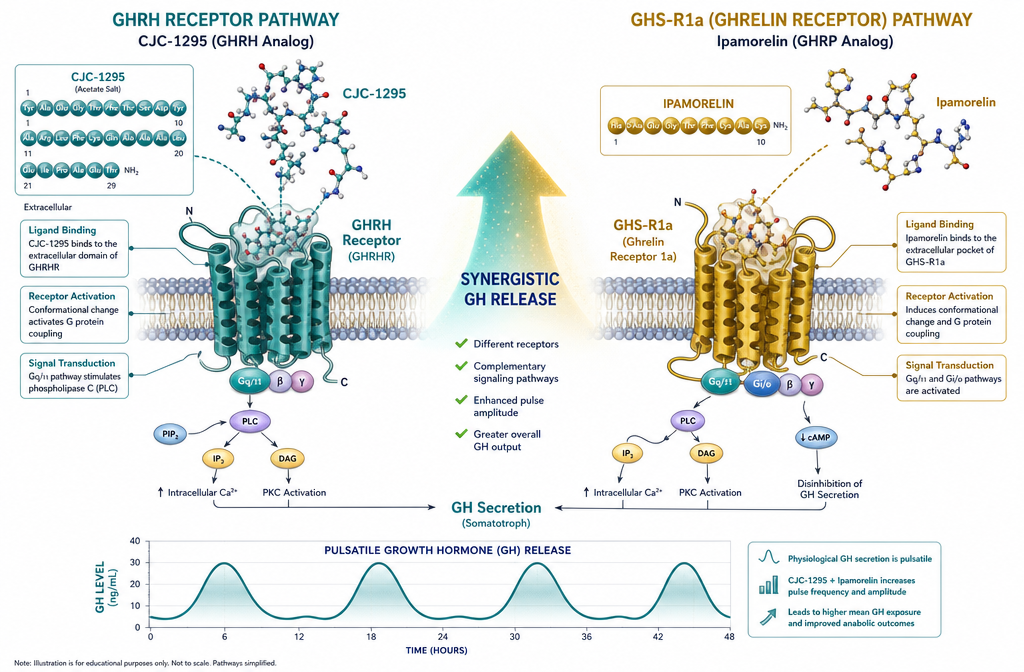
How Dual-Receptor Activation Drives Synergistic GH Output
The pituitary gland responds to at least two distinct chemical signals when releasing GH. CJC-1295 is a stabilized analog of growth hormone-releasing hormone (GHRH) that binds to the GHRH receptor on somatotroph cells, stimulating both GH synthesis and secretion. Ipamorelin, by contrast, is a selective ghrelin receptor agonist that targets the GHS-R1a receptor through a completely independent signaling cascade.
When researchers administer both peptides together, each receptor pathway amplifies the other's signal. The result is a GH release that consistently exceeds what either compound produces alone — a true synergistic effect rather than a simple additive one. Researchers exploring CJC-IPA synergy research themes have documented this complementary mechanism as a key reason the combination attracts sustained scientific interest.
What makes Ipamorelin particularly valuable in these models is its selectivity. Unlike earlier ghrelin mimetics, Ipamorelin does not significantly raise cortisol or prolactin levels at research doses. This cleaner hormonal profile allows investigators to isolate GH-specific effects without confounding variables — a critical advantage when the goal is precise mechanistic data.
For a broader look at how Ipamorelin fits within the GH-axis peptide family, the GH axis product line overview provides useful context on related compounds and their receptor targets.
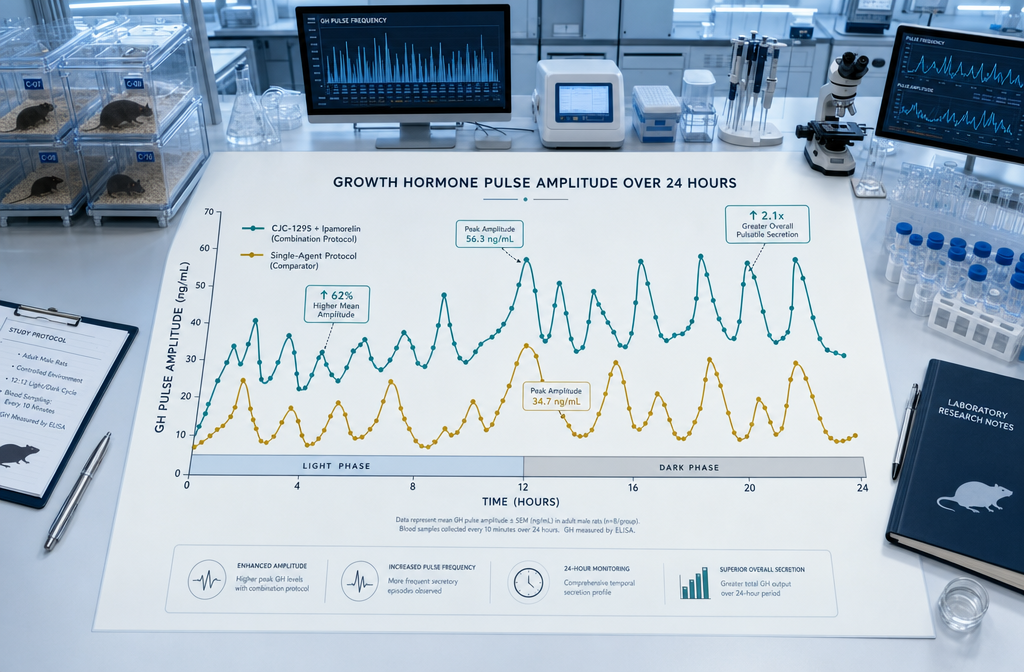
Modeling Pulsatile GH Release: What Animal Studies Reveal
Replicating physiologic GH pulsatility is harder than simply raising GH levels. Natural GH secretion follows a rhythmic pattern tied to sleep stages, fasting status, and hypothalamic feedback loops. The core research question in CJC-1295 and Ipamorelin combination protocols: modeling pulsatile GH release in animal studies is whether exogenous peptide administration can restore or mimic that rhythm rather than simply flooding the system with a sustained hormone elevation.
Preclinical data from rodent models show that CJC-1295 (no-DAC formulation) produces a sharp, transient GH spike rather than a prolonged plateau. When paired with Ipamorelin, the combined pulse closely resembles the amplitude and duration of endogenous GH bursts. Crucially, studies using continuous CJC-1295 stimulation confirm that pulsatile secretion patterns are maintained rather than suppressed — an important finding because tonic GH elevation can downregulate receptor sensitivity over time.
Researchers interested in the mechanistic distinctions between CJC-1295 formulations can review CJC-1295 no-DAC research themes for a detailed breakdown of half-life and pulse dynamics.
The IPA GHRH/GRF research page further explores how ghrelin receptor agonists interact with the GHRH axis at the hypothalamic level, which is directly relevant to understanding why combination dosing produces more physiologic pulse shapes than single-agent administration.
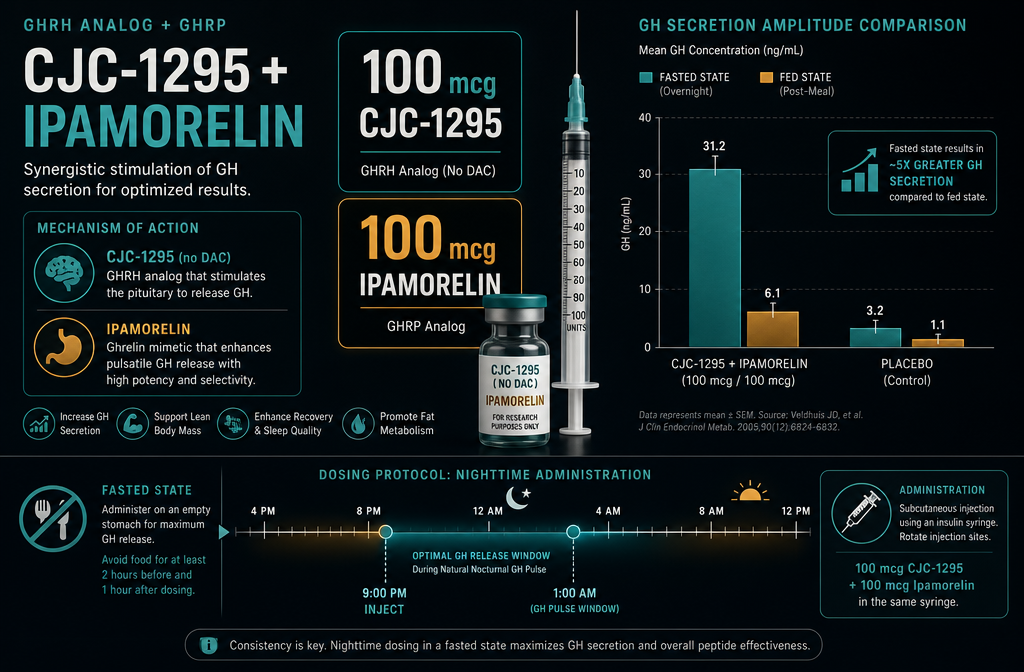
Protocol Design: Timing, Dosing, and Fasting State Considerations
Translating receptor biology into a workable research protocol requires attention to three variables: dose, timing, and metabolic context.
Established preclinical dosing parameters include:
| Variable | Research Parameter |
|---|---|
| CJC-1295 (no-DAC) dose | ~100 mcg per administration |
| Ipamorelin dose | ~100 mcg per administration |
| Preferred timing | Pre-sleep window |
| Metabolic state | Fasted preferred |
The pre-sleep timing is deliberate. The largest natural GH pulse in most mammals occurs during early deep sleep, so aligning exogenous stimulation with that window reinforces rather than disrupts endogenous rhythm. Administering the combination during a fasted state further optimizes results: elevated insulin and circulating free fatty acids are known to blunt GH release at the pituitary level, so low-insulin conditions allow the peptide signal to reach its full potential.
Researchers designing multi-peptide GH-axis protocols can also review the Sermorelin, Ipamorelin, and CJC-1295 dosage resource for comparative data on how different GHRH analogs perform alongside Ipamorelin across dosing schedules.
For studies requiring blended formulations, Tesamorelin/CJC-1295/Ipamorelin blend options represent an adjacent research tool worth evaluating. Purity verification remains non-negotiable in any peptide study; the quality testing protocols page outlines the analytical standards used to confirm compound identity and concentration before research use.
"The value of the CJC-1295/Ipamorelin pairing lies not in simply raising GH levels, but in recreating the pulsatile architecture that makes GH signaling biologically meaningful."
Conclusion
CJC-1295 and Ipamorelin combination protocols: modeling pulsatile GH release in animal studies offers researchers a mechanistically grounded framework for studying the GH axis. By engaging two independent receptor pathways — GHRH-R and GHS-R1a — the combination produces synergistic, pulse-shaped GH secretion that mirrors endogenous biology more closely than single-agent approaches.
Actionable next steps for researchers in 2026:
- Confirm peptide purity through validated third-party testing before any in vivo work.
- Design dosing schedules around the pre-sleep window and fasted metabolic state to maximize pulse amplitude.
- Use the no-DAC formulation of CJC-1295 when short, discrete GH pulses are the research objective.
- Compare combination outcomes against Ipamorelin-only and CJC-1295-only control groups to quantify the synergistic contribution.
- Review current blend formulations and receptor-specific literature before finalizing protocol parameters.
Both peptides remain strictly research-grade compounds, intended solely for licensed laboratory use and not approved for human administration.