
Semax and Selank Peptide Nasal Sprays: Comparative Mechanisms in Neurotrophic and Anxiolytic Research
Two synthetic heptapeptides developed at the Russian Academy of Sciences have drawn sustained attention in preclinical neuroscience: Semax and Selank. Despite sharing a seven-amino-acid backbone and the same intranasal delivery route, their downstream effects diverge sharply — one drives neurotrophin expression, the other recalibrates GABAergic tone. Understanding this divergence is central to Semax and Selank peptide nasal sprays: comparative mechanisms in neurotrophic and anxiolytic research.
Key Takeaways
- Semax is an ACTH(4-10) analog that upregulates BDNF and NGF, supporting cognitive and neuroprotective research models.
- Selank is derived from the immunomodulatory peptide tuftsin and modulates GABAergic signaling without direct receptor binding.
- Intranasal delivery bypasses first-pass metabolism, enabling rapid CNS uptake in animal research models.
- Both peptides carry favorable preclinical safety profiles, but large-scale Western-standard trials remain limited.
- Regulatory status differs by jurisdiction; researchers should verify current compliance requirements before sourcing.
Structural Origins and Mechanistic Divergence
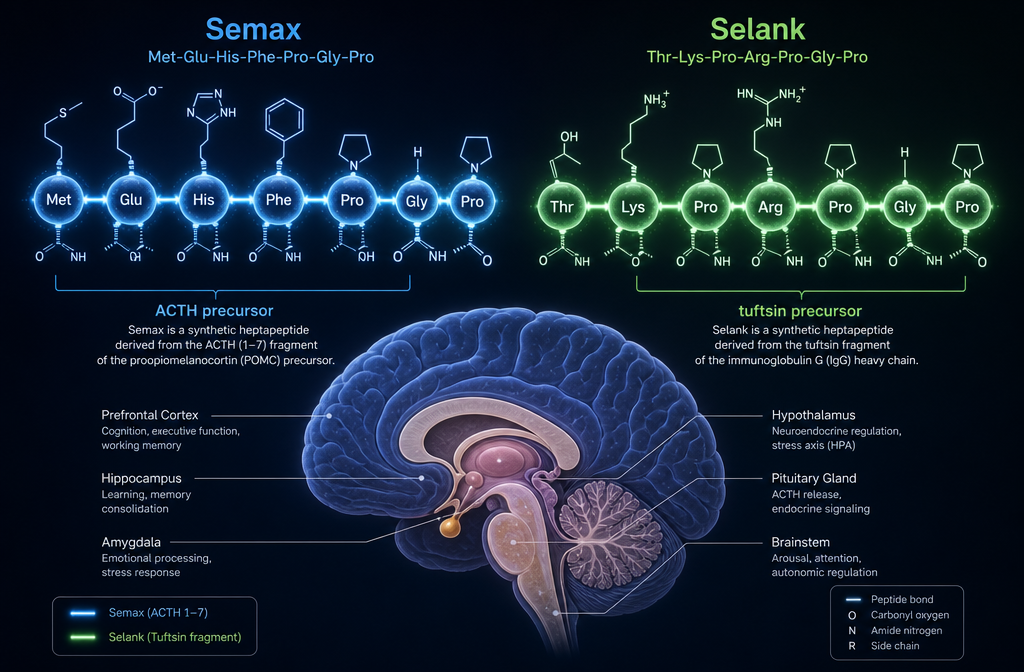
Both peptides are heptapeptides, yet their parent sequences define entirely different pharmacological identities.
Semax (Met-Glu-His-Phe-Pro-Gly-Pro) is a synthetic analog of the ACTH(4-10) fragment. Its primary research interest lies in neurotrophin modulation. Preclinical data from rat glial cultures show that Semax rapidly induces BDNF mRNA expression approximately eight-fold and NGF mRNA approximately five-fold within hours of administration. These upregulations are believed to underlie the peptide's cognitive-enhancing and neuroprotective properties, making it a focus in stroke and ischemic injury models. In Russia, it holds approved status for ischemic stroke and transient ischemic attacks.
Selank (Thr-Lys-Pro-Arg-Pro-Gly-Pro) descends from tuftsin, a naturally occurring immunomodulatory tetrapeptide. Rather than driving neurotrophin synthesis, Selank modulates the GABAergic system by increasing expression of genes encoding GABA-A receptor subunits in the hippocampus and prefrontal cortex. Critically, it does not directly bind GABA-A receptors. Instead, it enhances receptor sensitivity to endogenous GABA — a mechanism that produces anxiolytic effects without the sedation, dependence, or withdrawal risks associated with benzodiazepines. Selank is registered in Russia for generalized anxiety disorder.
| Feature | Semax | Selank |
|---|---|---|
| Parent sequence | ACTH(4-10) | Tuftsin |
| Primary mechanism | BDNF/NGF upregulation | GABAergic modulation |
| Key research area | Neuroprotection, cognition | Anxiety, stress response |
| Sedation risk | Minimal | None reported |
| Russian approval | Ischemic stroke | Generalized anxiety disorder |
Researchers exploring broader neuropeptide frameworks may also find value in reviewing GHK-Cu longevity research themes and neuroendocrine and innate immunity interactions for comparative context.
Intranasal Delivery as a CNS Research Tool
The shared intranasal route is not incidental — it is mechanistically significant in Semax and Selank peptide nasal sprays: comparative mechanisms in neurotrophic and anxiolytic research.
Intranasal administration bypasses the blood-brain barrier via olfactory and trigeminal pathways, enabling direct CNS uptake without first-pass hepatic metabolism. In animal models, this translates to faster onset and more predictable CNS bioavailability compared to oral routes. Both peptides benefit from this delivery advantage, which is why nasal spray formulations remain the standard in preclinical protocols.
"Intranasal delivery offers a non-invasive pathway to CNS-targeted peptide exposure, making it particularly valuable in rodent behavioral and neurochemical research."
This delivery principle is relevant across multiple peptide research lines. For example, PT-141 neural and metabolic research themes similarly highlight how administration route shapes CNS receptor engagement. Likewise, Epithalon research demonstrates how peptide structure and delivery interact in longevity-focused models.
Evidence Landscape, Safety, and Research Gaps
The clinical evidence base for Semax and Selank peptide nasal sprays: comparative mechanisms in neurotrophic and anxiolytic research is real but geographically concentrated. Most published studies originate from Russian-language literature and report positive outcomes — improved cognitive markers with Semax, reduced anxiety indices with Selank. However, large-scale, randomized, double-blind, placebo-controlled trials meeting Western regulatory standards are sparse, limiting generalizability.
Safety profiles for both peptides appear favorable in available data. Selank in particular shows no sedation, dependence, or withdrawal effects across reported use, a meaningful distinction from classical anxiolytics.
On the regulatory front, Selank was placed on the FDA's Category 2 list in September 2023, restricting pharmacy compounding. A reclassification announced in February 2026 is expected to return it to Category 1 status, which would restore legal compounding access in the United States.
Combination protocols pairing Semax's neurotrophic effects with Selank's anxiolytic profile are an emerging research direction. The rationale is straightforward: BDNF-driven plasticity and reduced stress-pathway interference may complement each other in cognitive performance models. Researchers interested in multi-pathway peptide stacking can also review the KLOW blend multipathway research overview and Selank side effects research for additional context.
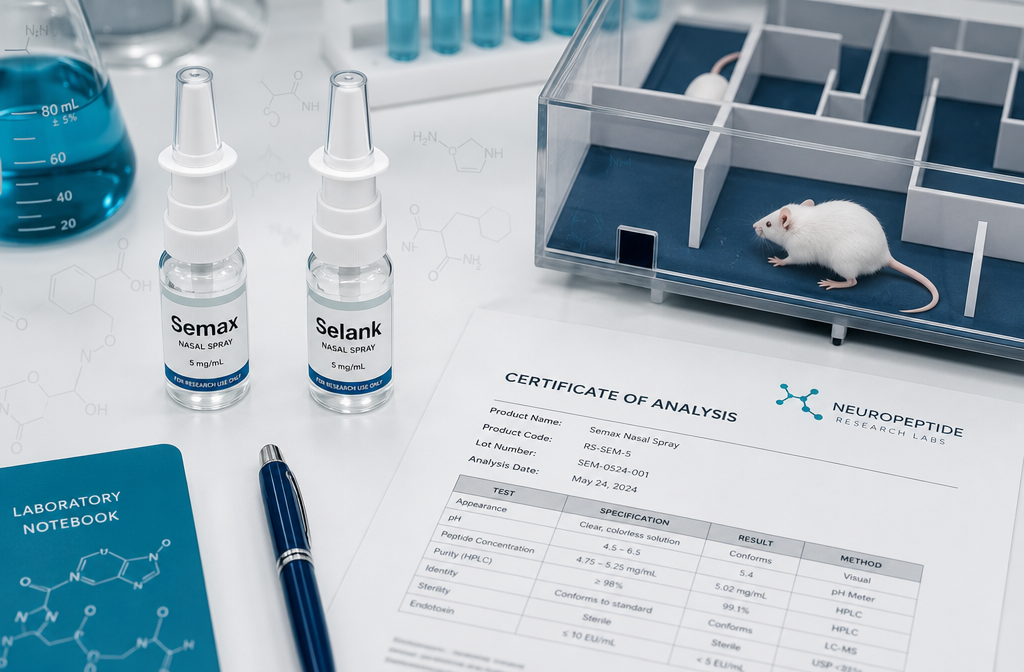
For sourcing decisions, verifying supplier quality documentation is essential. Reviewing a supplier's certificate of analysis standards helps ensure peptide purity and traceability in research applications.
Conclusion
Semax and Selank represent two distinct but complementary research tools within CNS-targeted peptide science. Semax drives neurotrophin expression — particularly BDNF and NGF — making it relevant to neuroprotection and cognitive research models. Selank modulates GABAergic receptor sensitivity without direct binding, offering anxiolytic effects free of dependence risk. Intranasal delivery amplifies both peptides' CNS accessibility, making nasal spray formulations the preferred vehicle in animal research.
Actionable next steps for researchers:
- Prioritize peer-reviewed preclinical data when designing protocols; acknowledge the Western-trial gap.
- Verify current regulatory status in your jurisdiction before sourcing either peptide.
- Request certificates of analysis from suppliers to confirm purity and batch consistency.
- Consider combination protocols only after establishing individual baseline responses in your model system.
- Monitor the FDA reclassification timeline for Selank, anticipated to shift in 2026.