
GLP-2 and GLP-2-Tirzepatide: Research into Intestinal Growth Factors and Gut Barrier Function
Short bowel syndrome affects roughly 3 in every million people, yet the peptide hormone at the center of emerging gut repair research — GLP-2 — was only identified in the 1980s. Today, research into GLP-2 and GLP-2-Tirzepatide: Research into Intestinal Growth Factors and Gut Barrier Function is reshaping how scientists understand the intestine as a dynamic, hormonally regulated organ.
Key Takeaways
- GLP-2 is an intestinally derived hormone that drives mucosal growth, barrier repair, and nutrient absorption.
- Its actions are largely indirect, mediated through IGF-1, EGF, and tight junction protein modulation.
- Dual-receptor agonists combining GLP-1 and GLP-2 activity (such as dapiglutide) show enhanced barrier protection in preclinical models.
- Tirzepatide's structural relationship to incretin biology opens new research questions about combined gut-metabolic signaling.
- Age-related gut decline may be a future target for GLP-2-based interventions.
What Is GLP-2 and Why Does It Matter for Gut Health
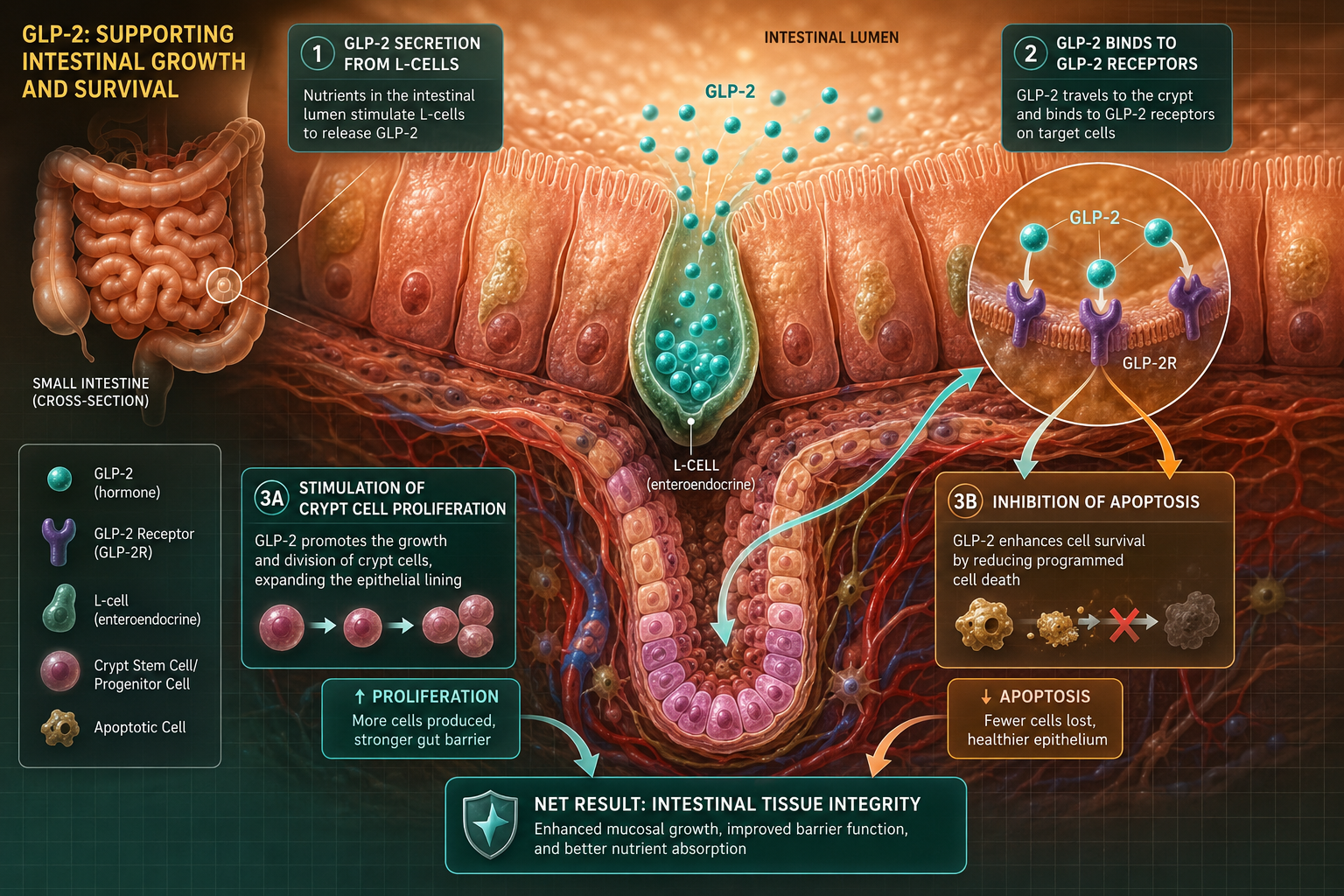
Glucagon-like peptide-2 (GLP-2) is a 33-amino acid hormone secreted by enteroendocrine L-cells lining the small and large intestine. It is released in direct response to nutrient intake, making it a key postprandial signal.
Its primary roles include:
- Stimulating crypt cell proliferation (intestinal growth)
- Inhibiting apoptosis and proteolysis in mucosal tissue
- Enhancing nutrient absorption and reducing mucosal permeability
- Regulating gastric emptying and acid secretion
GLP-2 does not act alone. Its intestinotropic effects are mediated through a network of indirect signals, particularly insulin-like growth factor-1 (IGF-1) and epidermal growth factor (EGF). These downstream mediators drive the crypt cell proliferation that gives GLP-2 its reputation as a potent intestinal growth factor.
Researchers studying related metabolic peptides — including those exploring GLP-1 and incretin research themes — have noted that the GLP family shares structural and functional overlap worth investigating in parallel.
GLP-2 and Gut Barrier Function: The Tight Junction Connection
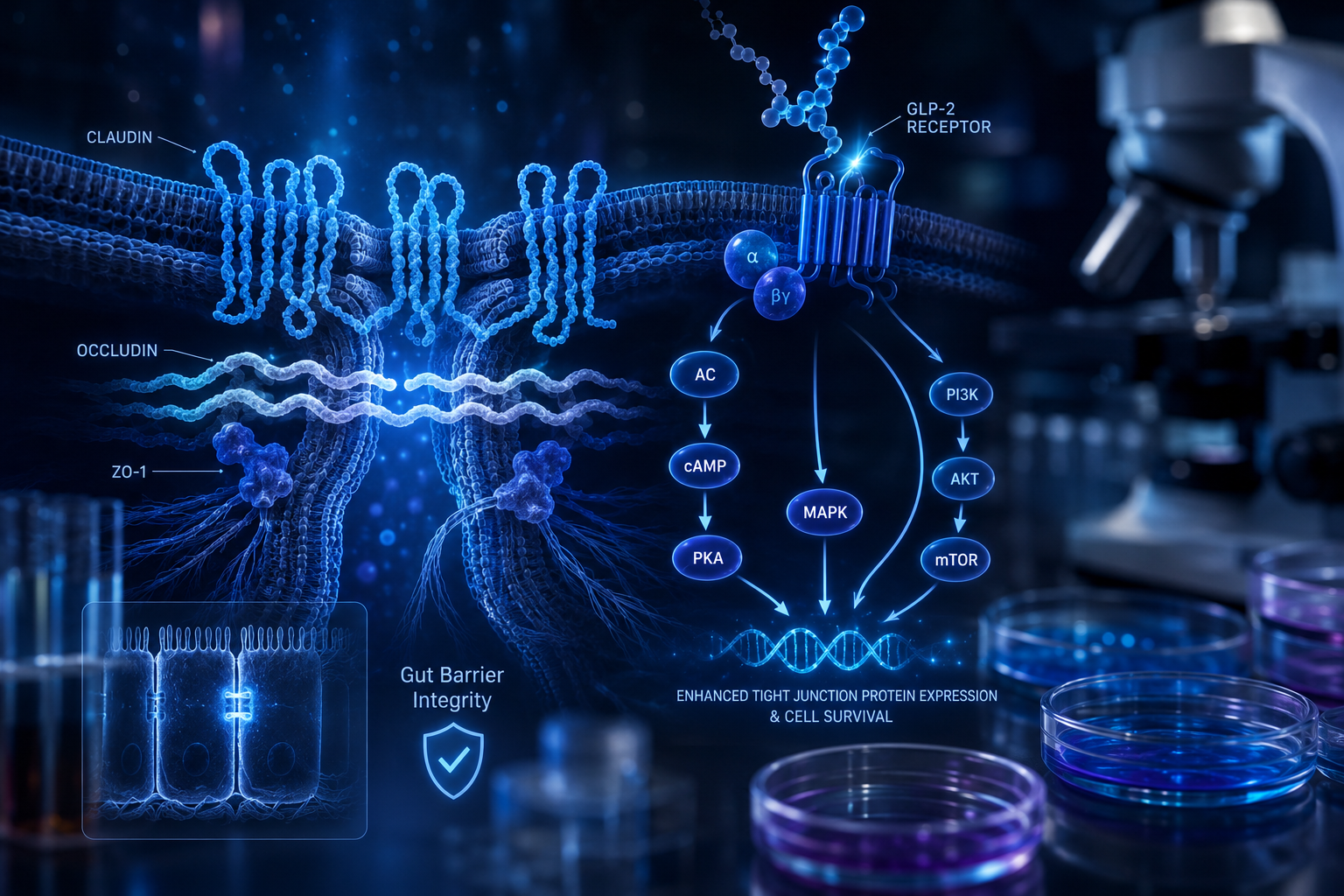
One of the most clinically significant findings in GLP-2 research involves its effect on the intestinal epithelial barrier. A healthy gut barrier depends on tight junction proteins — including claudin and occludin — that seal gaps between epithelial cells and prevent bacterial translocation.
GLP-2 improves both:
| Pathway | Mechanism |
|---|---|
| Transcellular | Enhanced nutrient transport across epithelial cells |
| Paracellular | Tight junction protein upregulation via IE-IGF-1R signaling |
The intestinal epithelial IGF-1 receptor (IE-IGF-1R) appears central to this process. When GLP-2 binds its receptor on subepithelial cells, it triggers IGF-1 release, which then acts on epithelial IGF-1 receptors to reinforce tight junction integrity.
Research in aged animal models found that GLP-2 administration reversed age-associated declines in mucosal barrier function — a finding with significant implications for longevity-focused gastrointestinal research. This connects naturally to broader work on mitochondrial and longevity research themes where cellular resilience is a shared focus.
GLP-2 also appears to orchestrate gut microbiota interactions, supporting immune homeostasis and reducing inflammatory signaling at the mucosal surface.
GLP-2 and GLP-2-Tirzepatide: Research into Intestinal Growth Factors and Gut Barrier Function — The Dual-Receptor Frontier
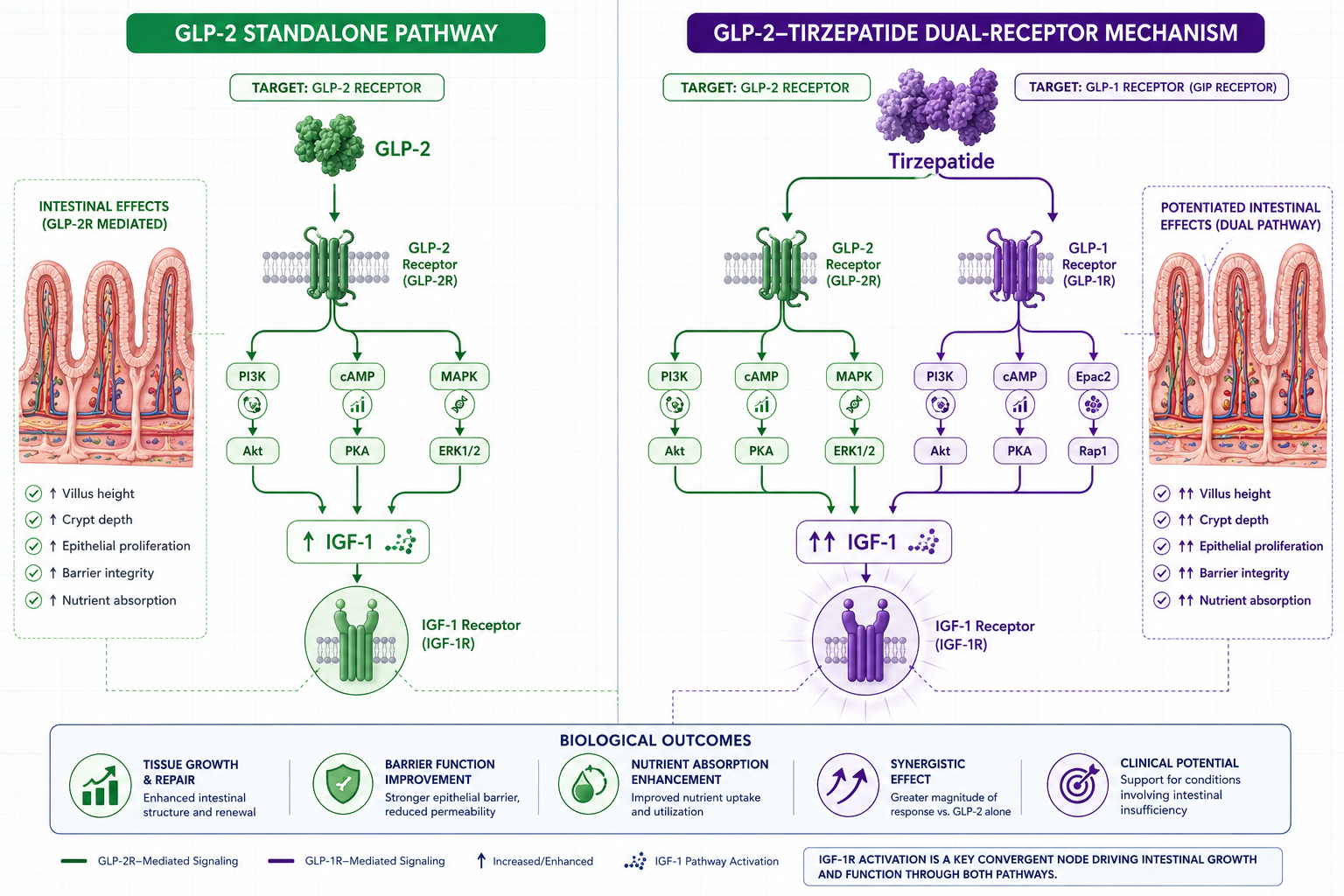
Tirzepatide is best known as a dual GIP/GLP-1 receptor agonist with metabolic effects. However, emerging structural pharmacology research is exploring whether tirzepatide's incretin backbone can be modified or combined with GLP-2 activity to create multi-target gut-metabolic agents.
A 2022 study on dapiglutide — a dual GLP-1/GLP-2 receptor agonist — demonstrated measurable improvements in intestinal barrier function in a murine short bowel model. This proof-of-concept supports the hypothesis that combining incretin signaling with GLP-2 intestinotrophic activity could offer additive benefits.
Researchers interested in GLP-3 and retatrutide research are also examining how multi-receptor engagement affects gut architecture beyond glycemic control.
Key research questions currently being explored include:
- Can tirzepatide-adjacent molecules be engineered to also activate GLP-2 receptors?
- Does combined GLP-1/GLP-2 signaling reduce intestinal permeability more effectively than either alone?
- What role does the gut microbiome play in modulating these effects?
For researchers exploring metabolic and body composition peptides, AOD9604 metabolic research and TESA body composition research themes offer relevant comparative frameworks for understanding how gut-derived hormones influence systemic metabolism.
Conclusion
Research into GLP-2 and GLP-2-Tirzepatide: Research into Intestinal Growth Factors and Gut Barrier Function represents one of the most promising frontiers in gastrointestinal biology in 2026. GLP-2 is not simply a growth signal — it is a multi-functional regulator of barrier integrity, immune balance, and nutrient homeostasis.
Actionable next steps for researchers:
- Review preclinical models using dual GLP-1/GLP-2 agonists to identify translatable endpoints.
- Examine IGF-1 receptor signaling as a measurable biomarker for GLP-2 barrier activity.
- Explore synergies between GLP-2 pathways and other gut-protective peptides, including those catalogued in the comprehensive peptide research catalog.
- Monitor emerging data on tirzepatide-derived multi-receptor molecules for intestinal applications.
The intersection of incretin pharmacology and intestinal growth factor biology is still early-stage — but the mechanistic groundwork laid by GLP-2 research makes it one of the most compelling areas to watch.