
What Is GLP2 Tirz Peptide? Understanding the GLP-2 and Tirzepatide Naming Confusion in Research Content
Researchers searching for tirzepatide compounds online frequently encounter a label that stops them cold: "GLP-2 Tirz." The term blends two distinct scientific concepts into one phrase, and the resulting confusion is widespread enough to affect sourcing decisions, literature reviews, and research planning. This article answers the question of what is GLP2 Tirz peptide, understanding the GLP-2 and tirzepatide naming confusion in research content, and provides a clear framework for navigating the terminology.
Key Takeaways
- "GLP-2 Tirz" is an informal research catalog label for tirzepatide, not a reference to the biological peptide GLP-2.
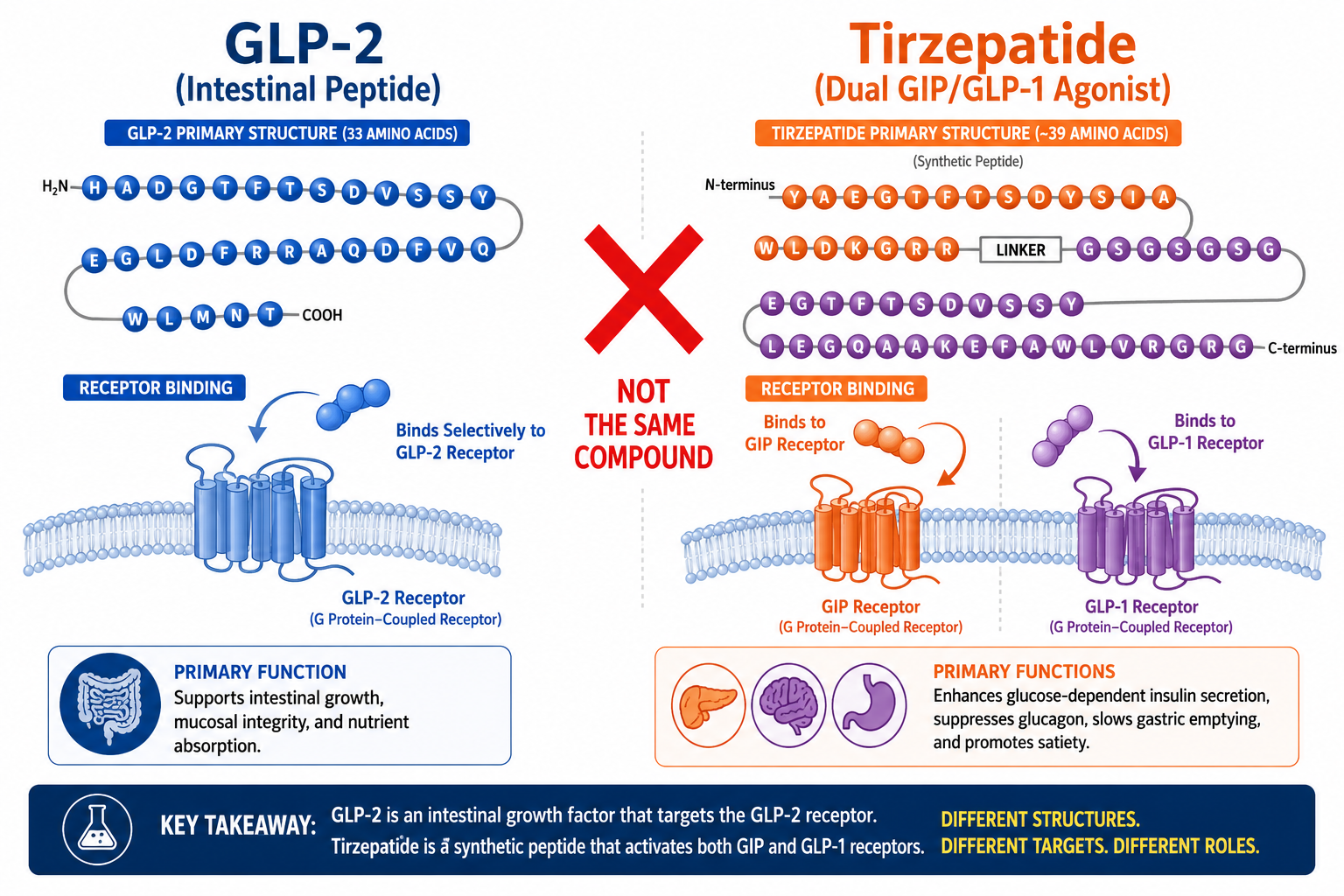
- Tirzepatide is a dual agonist that activates GIP and GLP-1 receptors — it does not activate the GLP-2 receptor.
- The World Health Organization's official generic name for this compound is tirzepatide, with "tirz-" indicating dual incretin activity.
- Informal numbering (GLP-2 for dual agonists, GLP-3 for triple agonists) is technically inaccurate and can mislead researchers.
- Always verify receptor targets and INN nomenclature before sourcing or citing any peptide compound.
Two Different Compounds, One Confusing Label
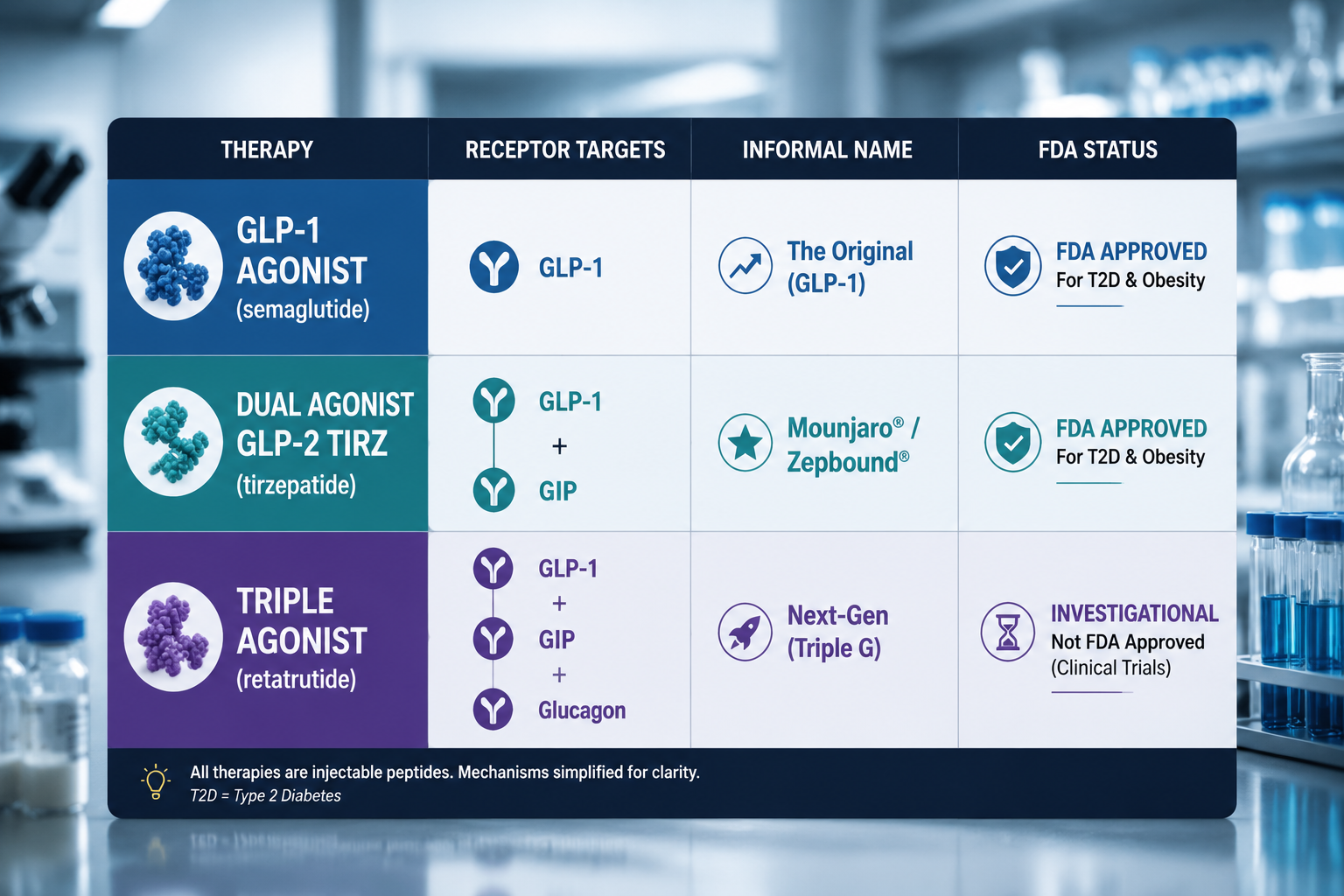
The confusion starts with a naming shortcut that spread through research vendor catalogs and online forums. In those spaces, some suppliers began labeling compounds by their "generation" of incretin activity rather than by their official name. Under this informal system, GLP-1 agonists like semaglutide became "first generation," dual agonists like tirzepatide were tagged "GLP-2," and triple agonists like retatrutide were called "GLP-3."
The problem is that GLP-2 already exists as a well-defined biological peptide. Glucagon-like peptide-2 is a 33-amino acid hormone secreted by intestinal L-cells. Its primary roles involve gut mucosal growth, intestinal barrier function, and nutrient absorption. It has nothing to do with the GIP or GLP-1 receptor pathways that tirzepatide targets.
When a vendor lists "GLP-2 Tirzepatide" or "GLP-2 Tirz," the "GLP-2" portion is not a receptor designation — it is a generational shorthand. This distinction matters enormously in research contexts where precision in nomenclature drives experimental design.
For a broader look at how incretin generations are being categorized, the breakdown of GLP-1 generations and their differences provides useful comparative context.
What Tirzepatide Actually Is
Tirzepatide is a synthetic peptide dual agonist. It activates two receptors simultaneously:
| Receptor | Hormone Mimicked | Primary Effect |
|---|---|---|
| GLP-1R | Glucagon-like peptide-1 | Insulin secretion, appetite suppression |
| GIPR | Glucose-dependent insulinotropic polypeptide | Enhanced insulin release, fat metabolism |
The World Health Organization's International Nonproprietary Names system assigned the generic name "tirzepatide." The stem "tirz-" was specifically chosen to signal its dual incretin mechanism, and "-tide" confirms its peptide structure. Eli Lilly markets the same molecule under two brand names: Mounjaro (approved for type 2 diabetes in May 2022) and Zepbound (approved for chronic weight management in November 2023).
Patent protection on tirzepatide extends to at least 2036, which is one reason compounded versions have appeared in research markets — though those formulations carry important purity and regulatory considerations that researchers must evaluate carefully.
For comparison, the GLP-1 T dual receptor agonism research breakdown explores the receptor-level science behind this class of compounds in greater detail.
Why the Informal Numbering System Creates Problems
Understanding what is GLP2 Tirz peptide — and why the naming confusion in research content matters — requires examining the downstream consequences of imprecise labeling.
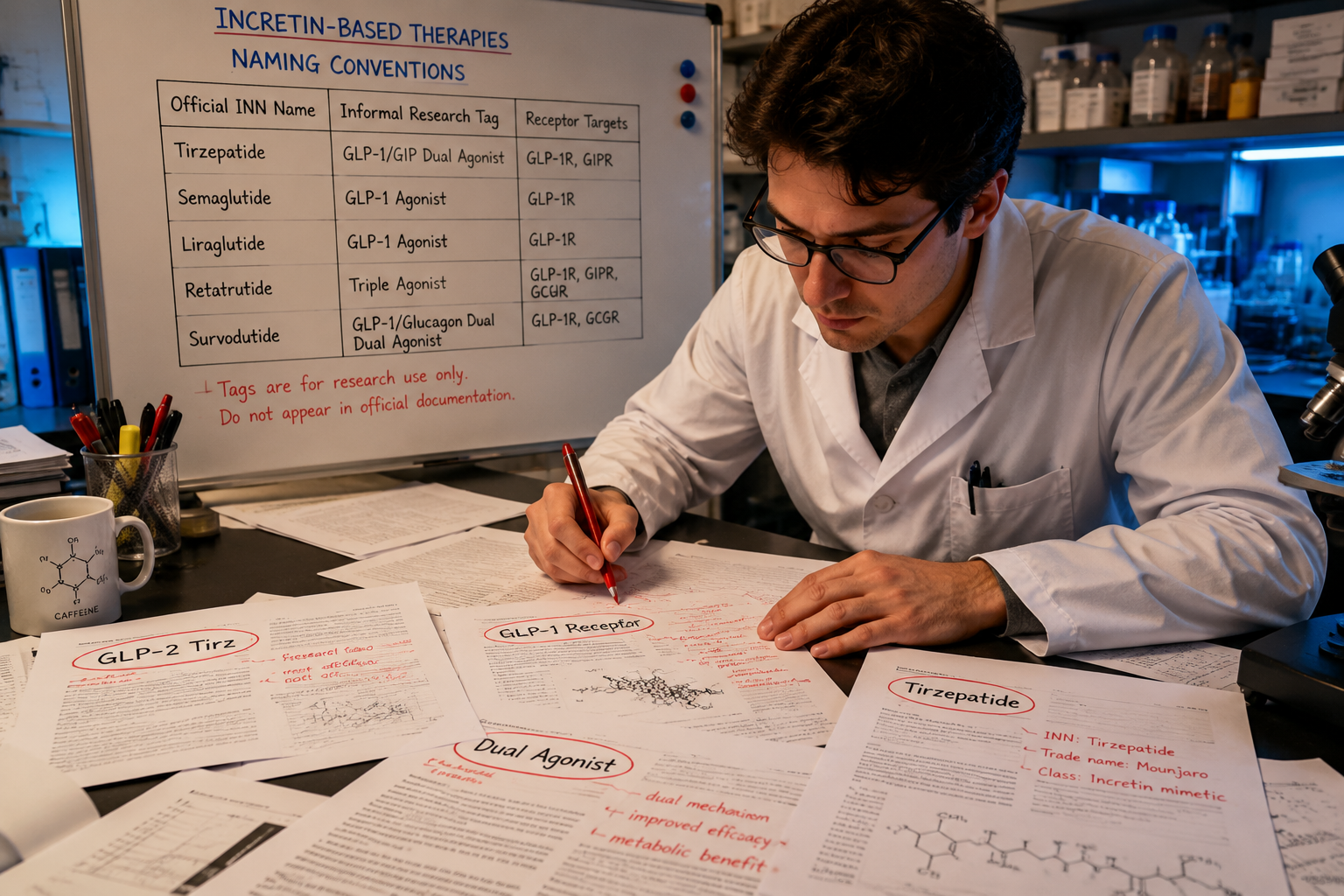
Three specific problems arise from the informal numbering approach:
- Literature mismatch — Searching "GLP-2" in PubMed returns hundreds of studies on intestinal mucosal biology, not dual incretin agonists.
- Sourcing errors — A researcher unfamiliar with the shorthand may order the wrong compound entirely.
- Regulatory misclassification — Conflating tirzepatide with GLP-2 biology could lead to incorrect assumptions about mechanism, safety profile, and applicable research protocols.
The preferred scientific terms are "dual GIP/GLP-1 agonist" for tirzepatide and "triple agonist" for compounds like retatrutide. The retatrutide and triple agonist research planning guide covers how that next generation of compounds is being cataloged and sourced.
The designation "GLP-2 (T)" — where the "(T)" stands for tirzepatide — has emerged in some vendor documentation as an attempt to acknowledge the distinction while preserving the generational shorthand. It is a partial solution at best.
Navigating Research Catalogs Accurately
When encountering "GLP-2 Tirz" in a research catalog, the following verification steps reduce the risk of confusion:
- Check the receptor targets listed — tirzepatide should specify GLP-1R and GIPR, not GLP-2R.
- Confirm the INN name — the compound should be identified as tirzepatide in any compliant documentation.
- Review available certificates of analysis — a certificate of analysis from the supplier confirms identity and purity independent of catalog naming.
- Cross-reference with clinical nomenclature — Mounjaro and Zepbound are the only FDA-approved branded forms.
Researchers working across multiple peptide classes will find it useful to navigate the full peptide catalog by research theme to keep compound categories organized and clearly separated.
For those exploring adjacent metabolic research areas, cagrilintide synergy with GLP-1 compounds offers related context on how combination approaches are being studied.
Conclusion
The label "GLP-2 Tirz" is a catalog shorthand, not a scientific designation. Tirzepatide targets GLP-1 and GIP receptors — it has no functional relationship to the intestinal peptide GLP-2. The informal generational numbering system that produced this label is convenient for vendors but creates genuine confusion for researchers who rely on precise terminology.
Actionable next steps for researchers in 2026:
- Default to the INN name "tirzepatide" in all documentation and literature searches.
- Treat any "GLP-2" label in a research catalog as a generational shorthand requiring verification.
- Request certificates of analysis that explicitly confirm receptor targets and compound identity.
- Use the terms "dual agonist" and "triple agonist" in research writing to avoid cross-contaminating search results with unrelated GLP-2 intestinal biology.
Precise naming is not a minor administrative concern — it is the foundation of reproducible, credible research.