GHK-Cu Peptide: Copper Binding, Collagen Synthesis, and Skin-Repair Pathways in Laboratory Models
Plasma levels of GHK-Cu drop by more than 60% between early adulthood and age 60 — a measurable biochemical shift that researchers now link directly to declining tissue repair capacity. This decline has made the study of GHK-Cu Peptide: Copper Binding, Collagen Synthesis, and Skin-Repair Pathways in Laboratory Models one of the more productive areas in dermatologic peptide research. Understanding what drives this peptide's activity at the molecular level is essential for designing rigorous preclinical assays and interpreting experimental results accurately.
Key Takeaways
- GHK-Cu is a tripeptide that binds copper(II) ions with high affinity, enabling targeted delivery to repair-critical enzymes
- It modulates the expression of more than 4,000 human genes, including those governing extracellular matrix remodeling and antioxidant defense
- In vitro models show increased synthesis of collagen types I and III, elastin, and glycosaminoglycans in GHK-Cu-treated fibroblasts
- Preclinical wound-healing models demonstrate accelerated re-epithelialization and improved tissue tensile strength
- No controlled human trials exist for injectable use; laboratory findings remain the primary evidence base as of 2026
Molecular Architecture: How GHK-Cu Binds Copper
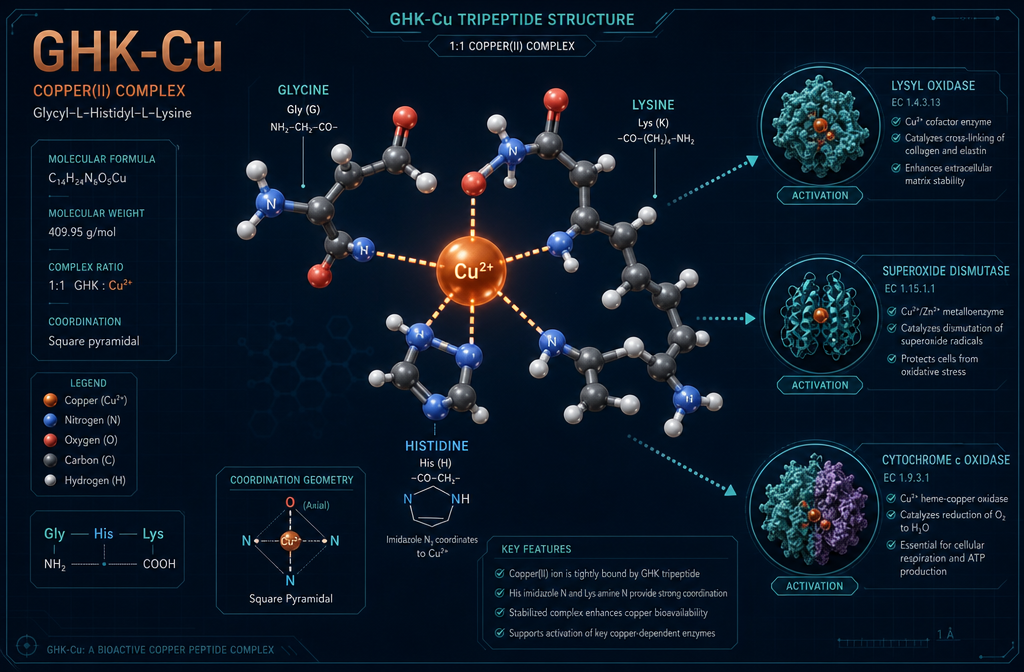
The peptide glycyl-L-histidyl-L-lysine (GHK) forms a stable 1:1 complex with copper(II) ions. The histidine residue plays a central role, providing the nitrogen coordination site that anchors the copper ion with high affinity. This structure is not incidental — it is precisely what allows GHK-Cu to act as a chaperone, delivering bioavailable copper to enzymes that would otherwise lack sufficient substrate.
Three enzymes are particularly relevant in skin-repair research:
| Enzyme | Function in Tissue Repair |
|---|---|
| Lysyl oxidase | Cross-links collagen and elastin fibers |
| Superoxide dismutase | Neutralizes reactive oxygen species |
| Cytochrome c oxidase | Supports mitochondrial energy production |
By supplying copper to these targets, GHK-Cu positions itself at the intersection of structural repair and oxidative defense — two processes that are tightly coupled in wound-healing biology.
Researchers exploring peptides in skincare and the science behind skin health will recognize this mechanism as foundational to how copper peptides differ from signaling peptides or carrier peptides in their mode of action.
Gene Expression Modulation and Extracellular Matrix Remodeling
Perhaps the most striking finding in GHK-Cu research is its breadth of genomic influence. Transcriptomic analyses have identified modulation of over 4,000 human genes following GHK-Cu exposure. These genes cluster around several key pathways:
- Extracellular matrix (ECM) synthesis and degradation
- Inflammatory signal regulation
- Antioxidant and stress-response systems
- Vascular remodeling via VEGF upregulation
- Fibroblast activation through TGF-beta signaling
Metalloproteinase (MMP) balance is a particularly important target. GHK-Cu appears to modulate both MMP activity and tissue inhibitors of metalloproteinases (TIMPs), preventing excessive ECM breakdown while still allowing remodeling to proceed. This bidirectional regulation is what makes it useful in wound-healing assay design, where uncontrolled proteolysis is a common confounding variable.
For researchers comparing multi-pathway peptide activity, the GLOW peptide blend benefits and KLOW blend multipathway research pages offer useful context on how combinatorial approaches are being studied alongside single-peptide models.
Collagen Synthesis, Wound Healing, and Assay Considerations in Laboratory Models
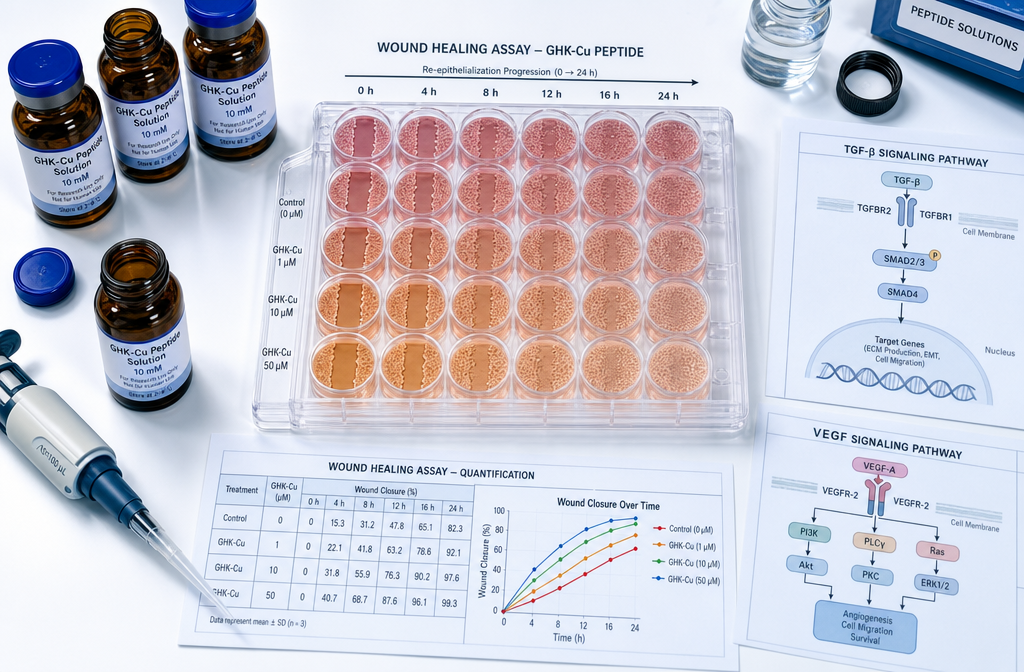
The core of GHK-Cu Peptide: Copper Binding, Collagen Synthesis, and Skin-Repair Pathways in Laboratory Models research centers on fibroblast behavior. In vitro studies consistently show that GHK-Cu-treated fibroblasts produce significantly more collagen type I and type III, along with elastin and glycosaminoglycans. These are the structural proteins that determine skin thickness, elasticity, and tensile strength.
In preclinical wound models, topical GHK-Cu application accelerates:
- Re-epithelialization — faster closure of the epidermal layer
- Granulation tissue formation — increased tensile strength in healing tissue
- Vascularization — supported by VEGF pathway upregulation
"The peptide's ability to simultaneously address structural protein synthesis and oxidative stress makes it a compelling candidate for multi-endpoint wound-healing assays."
Critical assay note: Researchers must monitor copper saturation carefully. Excess free copper ions generate reactive oxygen species, introducing cytotoxicity that can confound results. A well-designed assay includes copper-only controls to isolate peptide-specific effects from ionic copper effects.
Topical cosmetic studies report improvements in skin thickness and fine-line reduction, though many lack placebo controls. As of 2026, no controlled human trials support injectable GHK-Cu use — all mechanistic evidence comes from in vitro and preclinical models.
Emerging tissue engineering applications are also worth tracking. Recent work has explored GHK-Cu in peptide-guided supramolecular assembly for vascularized adipose tissue regeneration, suggesting the peptide's utility may extend well beyond dermatology.
For broader context on how peptides are being studied across repair and regeneration models, the BPC-157 core peptides research guide and TB-500 experimental models and QC workflow provide useful methodological comparisons. Researchers interested in oxidative stress endpoints may also find value in reviewing SS-31 mitochondrial research themes, given the overlapping antioxidant defense pathways.
Conclusion
The evidence base for GHK-Cu Peptide: Copper Binding, Collagen Synthesis, and Skin-Repair Pathways in Laboratory Models is robust at the preclinical level and mechanistically coherent. Researchers designing dermatologic or wound-healing studies in 2026 should prioritize three actionable steps:
- Include copper-only controls in every cellular assay to isolate GHK-Cu-specific effects
- Use transcriptomic endpoints alongside protein-level readouts to capture the full scope of gene expression modulation
- Standardize peptide purity and concentration — variability in source material remains a leading cause of inconsistent results across laboratories
For those building out peptide research programs, staying current with what is new in peptide research and reviewing aging support peptide categories can help contextualize GHK-Cu findings within the broader landscape of tissue repair science.