

Peptides vs Polypeptides: A Simple Scientific Guide for Research Buyers and Lab Readers
{"cover":"Professional landscape format (1536×1024) hero image with bold text overlay: 'Peptides vs Polypeptides: A Simple Scientific Guide' in extra large 72pt white sans-serif font with dark semi-transparent background panel, centered upper-third composition. Background shows a high-resolution molecular biology scene: glowing amino acid chain structures in blue and teal against a dark navy laboratory backdrop, with subtle helix formations and scientific data overlays. Color palette: deep navy, electric teal, crisp white. Magazine cover aesthetic, editorial quality, high contrast.","content":["Detailed landscape format (1536×1024) scientific infographic illustration showing two side-by-side molecular chain diagrams: a short peptide chain of 3-5 amino acids labeled 'Peptide' in bold teal text, and a longer polypeptide chain of 50+ amino acids labeled 'Polypeptide' in bold navy text. Clean white background with amino acid nodes shown as colored spheres connected by peptide bond lines. Size comparison arrows, numerical labels (2-49 residues vs 50+ residues), and a simple ruler graphic emphasizing chain length differences. Clinical, educational infographic style with modern sans-serif typography.","Detailed landscape format (1536×1024) overhead laboratory bench scene showing a researcher's gloved hands examining two labeled vials: one marked 'Short-Chain Peptide' and one marked 'Polypeptide Compound', with a lab notebook open showing a comparison table, a digital scale, and a HPLC chromatography printout in the background. Soft clinical lighting, white and stainless steel surfaces, teal accent lighting from lab equipment screens. Focus on the contrast between the two sample types. Photorealistic, editorial quality, research laboratory aesthetic.","Detailed landscape format (1536×1024) split-screen concept illustration: left panel shows a clean e-commerce product page wireframe for a peptide research compound with structured data fields, purity percentage badge, and chain-length specification callout; right panel shows a molecular 3D ribbon structure of a polypeptide folding into a protein shape with annotation arrows. Connected by a central dividing line labeled 'Research Buyer Decision Point'. Dark charcoal background with white and gold typography, modern UI design aesthetic, editorial quality."]
Only two amino acids separate a dipeptide from a tripeptide — yet that single bond can change how a compound is classified, priced, and regulated across the entire research supply chain. For anyone sourcing compounds or interpreting lab data, understanding the distinction covered in this Peptides vs Polypeptides: A Simple Scientific Guide for Research Buyers and Lab Readers is not a matter of academic curiosity. It directly affects purchasing decisions, product labeling, and how compound pages should be structured for search visibility.
Key Takeaways
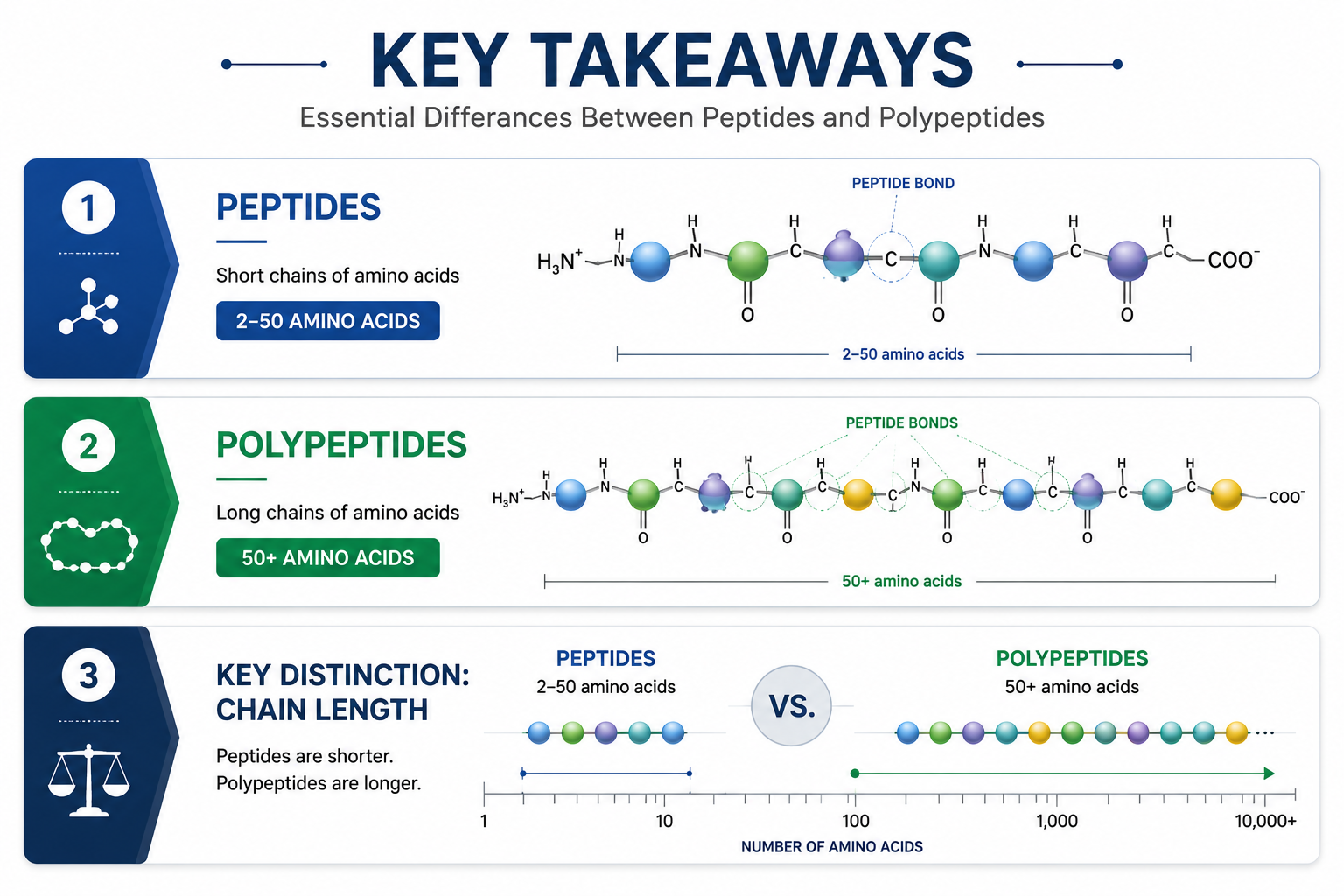
- A peptide contains 2 to 49 amino acid residues; a polypeptide contains 50 or more.
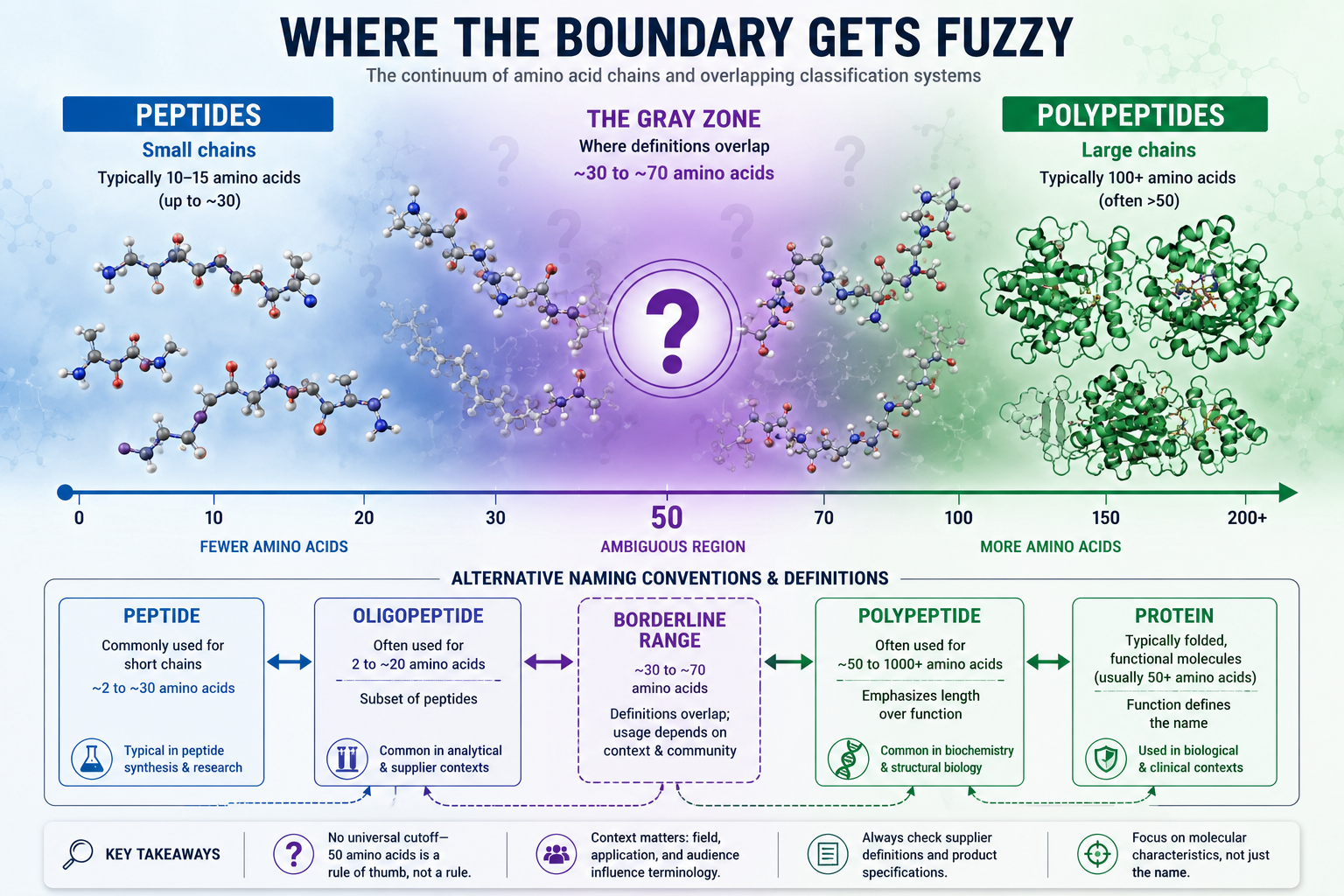
- The boundary between the two terms is scientifically fuzzy and context-dependent.
- Chain length affects stability, bioavailability, synthesis method, and research application.
- Research buyers should verify chain length specifications before ordering any compound.
- Proper classification on product pages improves both user trust and search engine relevance.
Defining the Terms: Where the Science Starts
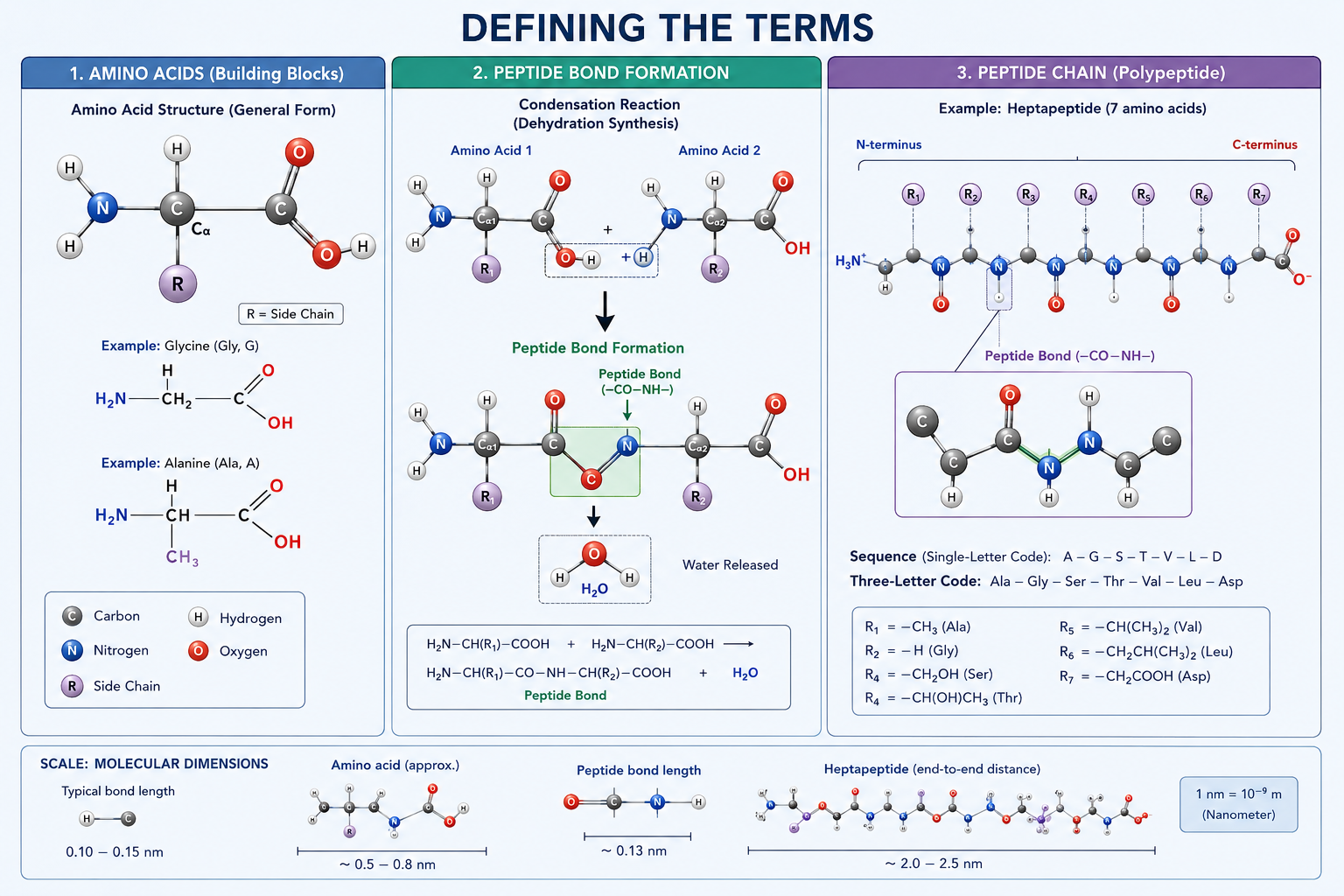
At the most basic level, both peptides and polypeptides are chains of amino acids linked by peptide bonds. The difference is size.
| Term | Amino Acid Residues | Common Examples |
|---|---|---|
| Dipeptide | 2 | Carnosine |
| Oligopeptide | 3-10 | BPC-157 (15 residues) |
| Peptide | 2-49 | Ipamorelin, Selank |
| Polypeptide | 50+ | Growth hormone fragments |
| Protein | 100+ | Insulin (51 residues, borderline) |
Peptide bonds form when the carboxyl group of one amino acid reacts with the amino group of another, releasing water. This reaction repeats along the chain. The longer the chain, the more complex the folding behavior and the greater the potential for biological activity — but also the greater the synthesis challenge.
Short-chain peptides like BPC-157 and Selank are relatively stable, easy to synthesize via solid-phase methods, and well-suited for research use. Longer polypeptides require more advanced manufacturing and are more sensitive to degradation.
Where the Boundary Gets Fuzzy
Here is where this Peptides vs Polypeptides: A Simple Scientific Guide for Research Buyers and Lab Readers must be honest: the scientific community does not agree on a single cutoff number.
Some biochemistry textbooks place the peptide-polypeptide boundary at 50 residues. Others use 30. Insulin — one of the most studied molecules in medicine — sits at 51 residues and is variously called a polypeptide, a small protein, and simply a peptide depending on the source.
"The terms peptide, polypeptide, and protein are used somewhat loosely." — Berg, Tymoczko & Stryer, Biochemistry, 8th Edition
This ambiguity has real consequences for research buyers:
- A compound listed as a "peptide" on one supplier's site may appear as a "polypeptide" on another.
- Chain length affects bioavailability — shorter chains are generally absorbed more readily.
- Stability under storage conditions varies significantly with molecular weight.
- Synthesis purity standards differ between short and long chains.
Compounds like Tesamorelin (44 residues) and MOTS-c (16 residues) illustrate how diverse the peptide category is even before crossing into polypeptide territory. Reviewing quality testing protocols from a supplier helps confirm that chain length and purity are properly verified.
What This Means for Research Buyers and Product Pages
This is the practical core of any Peptides vs Polypeptides: A Simple Scientific Guide for Research Buyers and Lab Readers discussion: classification shapes how compounds are found, evaluated, and trusted.
For research buyers, check these specifications before ordering:
- Molecular weight (Daltons) — a reliable proxy for chain length
- Number of amino acid residues — listed in the certificate of analysis
- Synthesis method — SPPS (solid-phase) for shorter chains, recombinant for longer ones
- Purity percentage — HPLC-verified purity above 98% is the research standard
For product pages and SEO structure, the distinction matters equally. A page for a short-chain compound like GHK-Cu should use "peptide" terminology throughout, while a page covering larger growth hormone fragments should accurately reflect polypeptide classification. Misclassification confuses both search engines and buyers.
Structured compound pages that include residue count, molecular weight, and synthesis method in the body copy tend to rank better for specific research queries. Buyers searching for peptides available for research benefit from this specificity because it reduces guesswork and supports informed purchasing.
Suppliers who publish certificates of analysis — accessible through a COA verification page — give buyers the data needed to confirm classification independently.
Conclusion
The peptide-polypeptide distinction comes down to chain length, but the exact boundary remains context-dependent. For research buyers, the actionable takeaway is straightforward: always request residue count and molecular weight data before purchasing. For content creators and lab communicators, accurate classification on product pages builds credibility with both readers and search engines.
Start by reviewing the certificate of analysis for any compound under consideration. Compare residue counts across supplier listings. Use precise terminology — "oligopeptide," "polypeptide," or "short-chain peptide" — rather than defaulting to generic labels. That precision is what separates a trusted research source from a vague catalog entry.