

SLUPP332 with 5-Amino-1MQ: Investigating Synergistic Mechanisms in Mitochondrial Biogenesis Research
{"cover":"Professional landscape format (1536×1024) hero image with bold text overlay: 'SLUPP332 + 5-Amino-1MQ: Synergistic Mitochondrial Biogenesis Research' in extra large 72pt white bold sans-serif font with dark semi-transparent overlay box, centered upper-third composition. Background shows a stunning macro visualization of glowing mitochondria networks inside a cell, rendered in deep teal and electric blue tones with golden energy highlights, suggesting cellular energy production and metabolic activation. Color scheme: deep navy, electric teal, gold accents. Magazine cover aesthetic, editorial quality, high contrast, science-forward visual identity.","content":["Detailed landscape format (1536×1024) scientific illustration showing two molecular compound structures, SLUPP332 and 5-Amino-1MQ, rendered as glowing 3D chemical models floating side by side, connected by luminous energy pathways suggesting synergy. Background features a dark navy gradient with subtle mitochondrial network patterns. Labels and molecular bonds are clearly visible. Color palette: electric blue for SLUPP332, warm amber for 5-Amino-1MQ, white connective energy lines. Research-lab aesthetic, editorial quality, no people, purely molecular and structural focus.","Detailed landscape format (1536×1024) cross-section diagram of a mitochondrion undergoing biogenesis, showing PGC-1-alpha pathway activation with labeled arrows indicating ERR-alpha receptor engagement and NNMT enzyme inhibition. Glowing green signals pulse along the inner mitochondrial membrane cristae. A split-panel design shows a low-energy mitochondrion on the left transforming into a dense, highly active network on the right. Color scheme: deep charcoal background, lime green activation signals, white labels, amber energy gradients. Scientific infographic style, editorial quality.","Detailed landscape format (1536×1024) overhead flat-lay research desk scene showing laboratory notebooks with handwritten metabolic pathway diagrams, glass vials labeled SLUPP332 and 5-Amino-1MQ, a microscope partially in frame, printed graphs showing NAD+ level increases and mitochondrial density curves, and a tablet displaying a molecular docking simulation. Warm clinical lighting, clean white surface, teal and gold accent objects. No people present. Compositionally balanced with rule-of-thirds framing. Editorial research aesthetic, high resolution, professional quality."]
Mitochondrial dysfunction is now linked to more than 50 chronic disease states, yet most metabolic research has focused on single-compound interventions rather than multi-pathway combinations. The emerging investigation of SLUPP332 with 5-Amino-1MQ: Investigating Synergistic Mechanisms in Mitochondrial Biogenesis Research represents a notable shift in that thinking, one that targets two distinct but complementary nodes of cellular energy regulation simultaneously.
Both compounds are currently research-stage molecules. Neither has established clinical dosing protocols as of 2026. The value of studying them together lies in the mechanistic overlap they share around mitochondrial biogenesis, NAD+ metabolism, and transcriptional energy signaling.
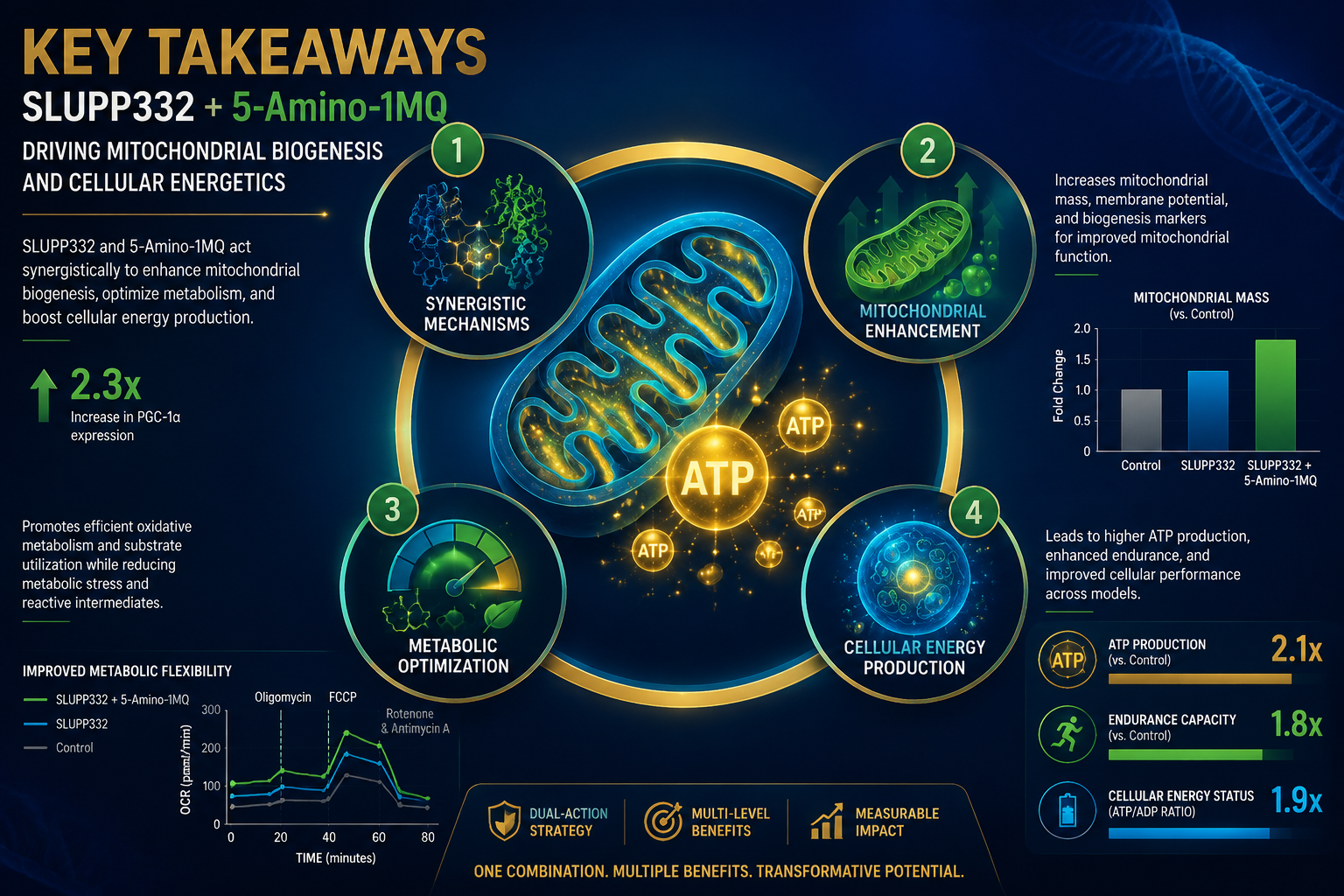
Key Takeaways
- SLUPP332 is a synthetic ERR-alpha agonist that activates the PGC-1-alpha transcriptional pathway, a master regulator of mitochondrial biogenesis.
- 5-Amino-1MQ is a selective NNMT inhibitor that raises intracellular NAD+ levels, supporting metabolic flexibility and cellular energy output.
- Research suggests the two compounds may act on complementary nodes of the same mitochondrial biogenesis cascade.
- Both compounds remain strictly in the preclinical and research phase, with no approved clinical protocols as of 2026.
- Investigating their combined mechanisms may offer new models for understanding metabolic disease at the cellular level.
Understanding the Individual Mechanisms Before Combining Them
Before examining SLUPP332 with 5-Amino-1MQ in a synergistic context, it is essential to understand what each compound does independently.
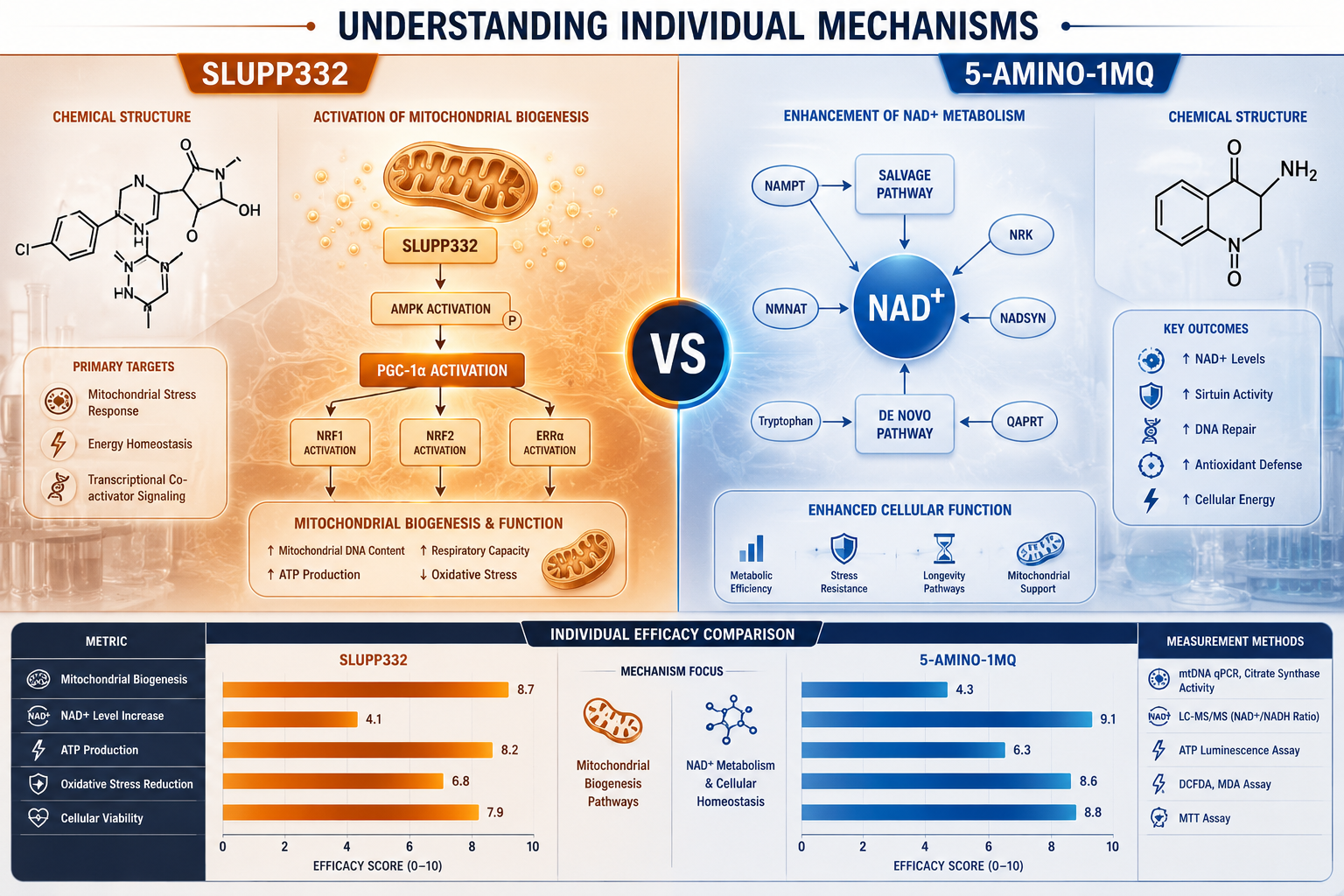
SLUPP332 (also written SLU-PP-332) is a small-molecule agonist of estrogen-related receptor alpha (ERR-alpha). ERR-alpha is an orphan nuclear receptor that, when activated, drives the expression of PGC-1-alpha, widely regarded as the master transcriptional regulator of mitochondrial biogenesis. In preclinical models, SLUPP332 has been shown to increase mitochondrial density, improve oxidative capacity in skeletal muscle, and enhance fatty acid oxidation. Researchers studying SLU-PP-332 metabolic research have noted its potential relevance to conditions involving impaired cellular energy production.
5-Amino-1MQ works through a different but related mechanism. It is a selective inhibitor of nicotinamide N-methyltransferase (NNMT), an enzyme that consumes SAM (S-adenosylmethionine) and indirectly depletes NAD+ precursors. By blocking NNMT, 5-Amino-1MQ preserves NAD+ availability within the cell. NAD+ is a critical cofactor for sirtuins and other enzymes that regulate mitochondrial function and metabolic homeostasis. Researchers exploring 5-Amino-1MQ research and data have documented its effects on adipocyte metabolism and energy expenditure in animal models.
"The significance of studying SLUPP332 with 5-Amino-1MQ together is that one compound activates the transcriptional machinery for building new mitochondria, while the other ensures the metabolic fuel, NAD+, is available to power them."
SLUPP332 with 5-Amino-1MQ: Investigating Synergistic Mechanisms in Mitochondrial Biogenesis Research
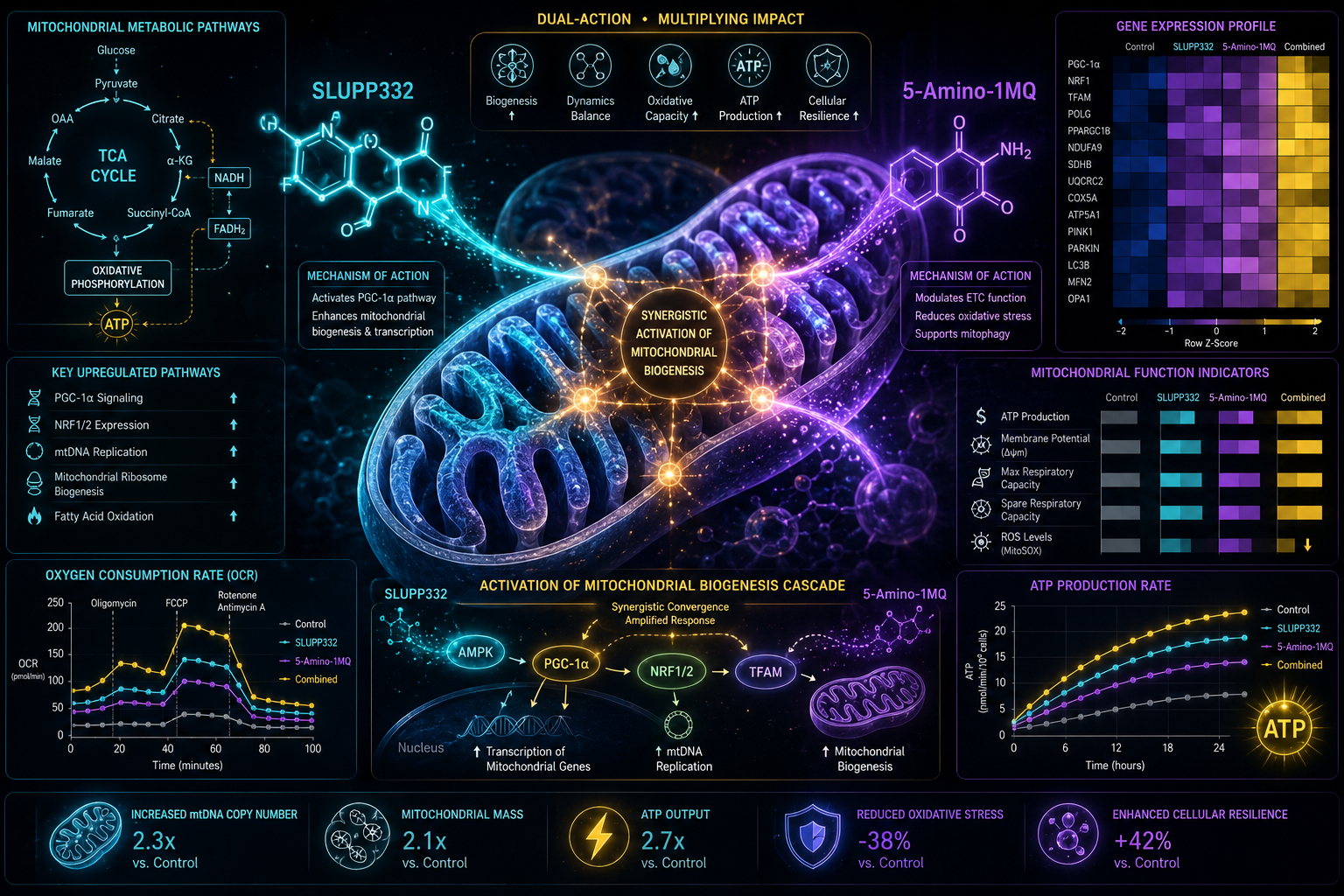
The hypothesis driving combined investigation is straightforward: SLUPP332 turns on the genetic program for mitochondrial biogenesis via ERR-alpha/PGC-1-alpha, while 5-Amino-1MQ ensures the NAD+ substrate pool is sufficient to sustain that new mitochondrial activity.
| Feature | SLUPP332 | 5-Amino-1MQ |
|---|---|---|
| Primary Target | ERR-alpha receptor | NNMT enzyme |
| Downstream Effect | PGC-1-alpha activation | NAD+ preservation |
| Mitochondrial Role | Biogenesis induction | Substrate availability |
| Research Status (2026) | Preclinical | Preclinical |
This complementary action is what makes the combination scientifically interesting. PGC-1-alpha activation alone is insufficient if downstream sirtuin activity, which depends on NAD+, is compromised. Conversely, restoring NAD+ levels has limited impact if the transcriptional program for building new mitochondria is not engaged.
Research into mitochondrial longevity-focused compounds and MOTS-c mitochondrial dynamics further supports the idea that multi-pathway approaches to mitochondrial health may produce more robust outcomes in preclinical models than single-target strategies.
Research Implications and Broader Metabolic Context
The combined study of SLUPP332 with 5-Amino-1MQ: Investigating Synergistic Mechanisms in Mitochondrial Biogenesis Research connects to a broader trend in metabolic science, moving from single-target pharmacology toward systems-level thinking about cellular energy.
Key research themes worth noting include:
- Skeletal muscle metabolism: SLUPP332 has shown particular activity in oxidative muscle fibers, where mitochondrial density is highest and most relevant to endurance and metabolic efficiency.
- Adipose tissue remodeling: 5-Amino-1MQ research in adipocyte models suggests it may reduce lipid accumulation by shifting cells toward oxidative metabolism, an effect that could be amplified when mitochondrial biogenesis is simultaneously upregulated.
- NAD+ and sirtuin crosstalk: Both SIRT1 and SIRT3 are NAD+-dependent enzymes that also interact with PGC-1-alpha. This creates a feedback loop where NAD+ availability, ERR-alpha signaling, and mitochondrial output are tightly interconnected.
Researchers interested in the NAD+ axis may also find value in reviewing NAD+ research overviews and MOTS-c mitochondrial research themes, which explore related mitochondria-targeted molecules. Additionally, the oral and subcutaneous evidence for SLU-PP-332 provides useful context on administration route considerations in preclinical settings.
Important research limitations to acknowledge:
- No human clinical trials for this combination exist as of 2026.
- Optimal dosing ratios, sequencing, and administration routes remain undefined.
- Long-term safety profiles for both compounds in combination are unknown.
- All current data derives from in vitro and animal model studies.
Conclusion
The investigation of SLUPP332 with 5-Amino-1MQ: Investigating Synergistic Mechanisms in Mitochondrial Biogenesis Research offers a compelling framework for understanding how two mechanistically distinct compounds might reinforce each other's effects on cellular energy production. SLUPP332 activates the transcriptional machinery that builds new mitochondria; 5-Amino-1MQ preserves the NAD+ substrate those mitochondria depend on. Together, they represent a dual-node approach to mitochondrial biogenesis that warrants rigorous preclinical investigation.
Actionable next steps for researchers and informed readers:
- Review existing preclinical literature on ERR-alpha agonism and NNMT inhibition independently before evaluating combination data.
- Monitor peer-reviewed publications for in vivo combination studies, particularly in skeletal muscle and adipose tissue models.
- Consult the available 5-Amino-1MQ research data and SLUPP332 metabolic research pages for updated findings.
- Recognize that both compounds remain strictly research-use molecules in 2026, and no clinical application should be inferred from preclinical findings.
The science of mitochondrial biogenesis is advancing rapidly. Dual-compound investigations like this one may help define the next generation of metabolic research models.