

5-Amino-1MQ Peptide: Exploring its Metabolic Pathway and Emerging Research Applications
Obesity affects more than one billion people worldwide, yet the enzyme at the center of its cellular machinery — nicotinamide N-methyltransferase (NNMT) — remains largely outside mainstream awareness. Research into 5-Amino-1MQ Peptide: Exploring its Metabolic Pathway and Emerging Research Applications has placed this small molecule at the forefront of metabolic science, offering a targeted approach to fat regulation and cellular energy that differs fundamentally from conventional strategies.
Key Takeaways
- 5-Amino-1MQ selectively inhibits NNMT, an enzyme overexpressed in the fat tissue of obese individuals, raising intracellular NAD+ levels and activating key metabolic regulators.
- Preclinical studies in obese mice show significant reductions in body weight and white adipose tissue without changes in food intake.
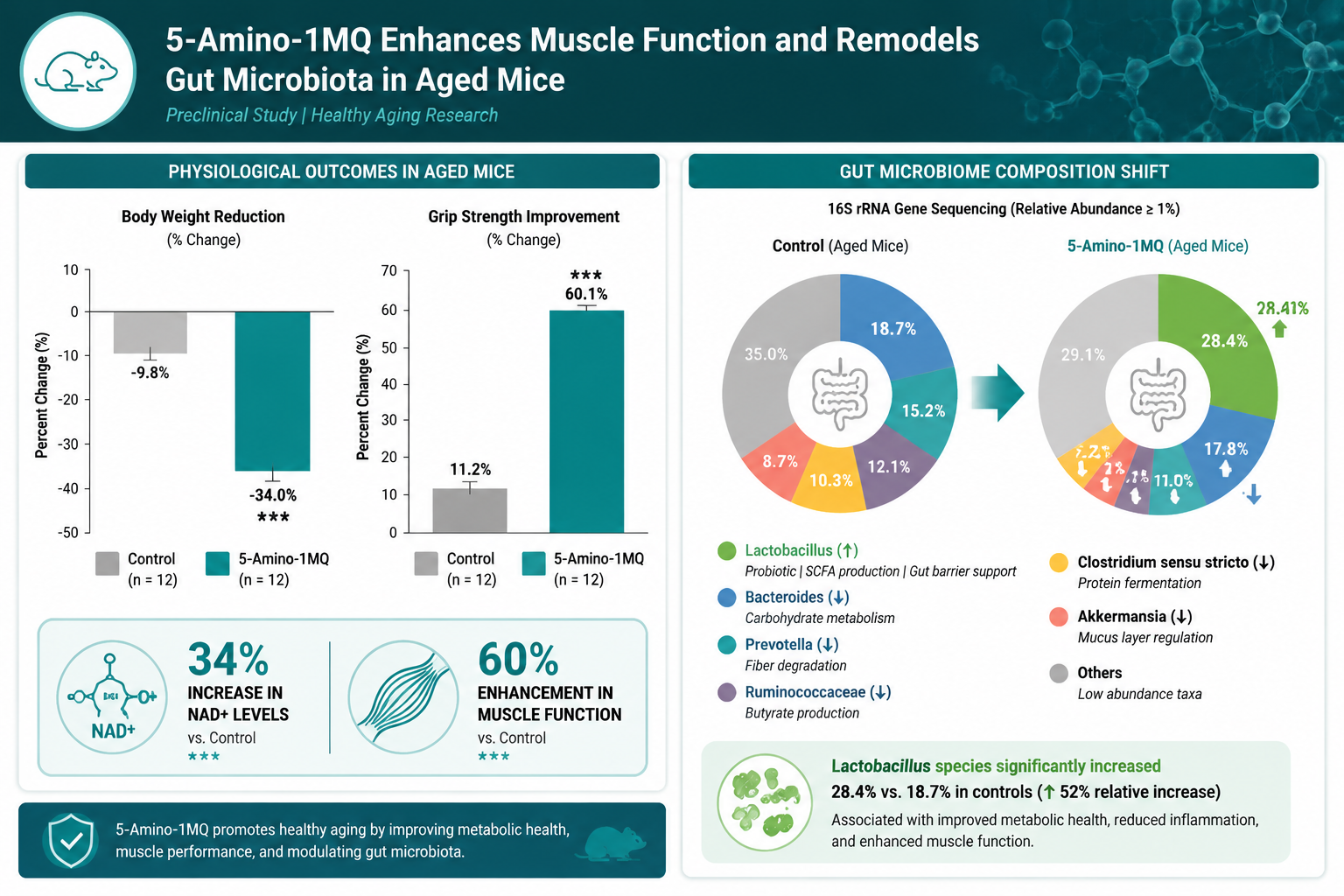
- Aged mice treated with 5-Amino-1MQ demonstrated up to a 60% improvement in muscle function when combined with exercise, suggesting anti-sarcopenia potential.
- The compound also appears to alter gut microbiome composition, adding another layer to its metabolic influence.
- As of 2026, 5-Amino-1MQ remains a research compound with no approved human clinical trials, requiring further validation before any therapeutic conclusions can be drawn.
How 5-Amino-1MQ Targets the Metabolic Pathway
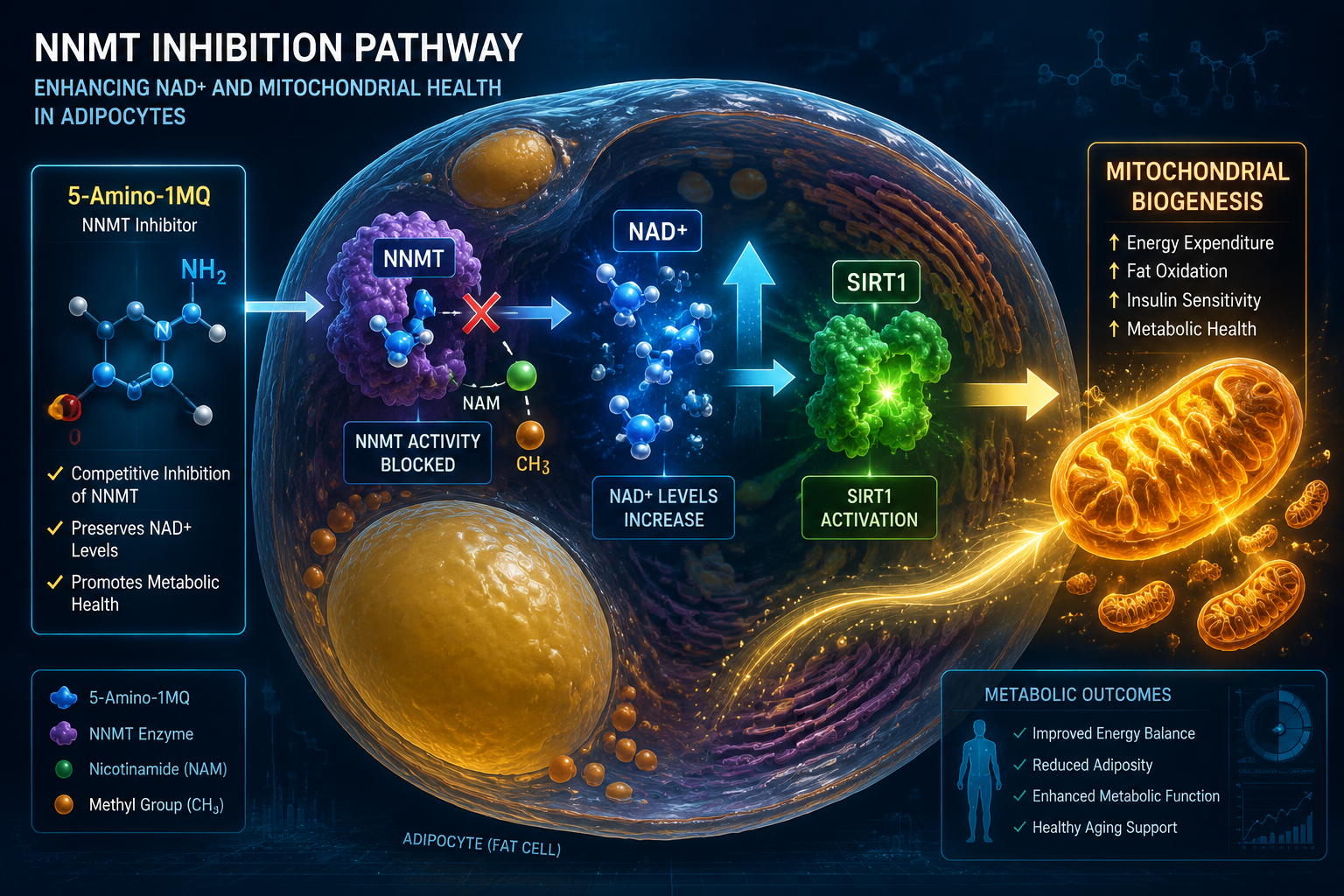
The core mechanism of 5-Amino-1MQ centers on NNMT inhibition. NNMT is an enzyme found at elevated levels in the adipose tissue of obese individuals. It consumes SAM (S-adenosylmethionine) and diverts it away from NAD+ biosynthesis, effectively slowing the cell's energy machinery.
By selectively blocking NNMT, 5-Amino-1MQ redirects metabolic resources. Within 48 hours of administration in diet-induced obese mice, researchers observed a 34% increase in intracellular NAD+ concentrations. This surge in NAD+ then activates sirtuins — particularly SIRT1 — which are proteins that regulate mitochondrial biogenesis, fat oxidation, and energy expenditure.
Key metabolic effects observed in preclinical models:
| Effect | Observation |
|---|---|
| NAD+ increase | 34% within 48 hours |
| Body weight reduction | Significant vs. control |
| White adipose tissue mass | Measurably reduced |
| Food intake change | None observed |
| Muscle function (aged mice + exercise) | 60% improvement |
This cascade — NNMT inhibition leading to NAD+ elevation, sirtuin activation, and mitochondrial enhancement — forms the backbone of 5-Amino-1MQ's proposed metabolic pathway. For researchers interested in related mitochondrial energy research, MOTS-c mitochondrial research themes offer a useful comparative framework.
"Raising NAD+ through NNMT inhibition represents a fundamentally different strategy than caloric restriction — it targets the enzyme machinery directly."
The compound also shows promise for metabolic syndrome components, including insulin resistance and dyslipidemia, in preclinical models. This positions it alongside other metabolically active compounds such as those explored in SLU-PP-332 metabolic research.
Emerging Research Applications of 5-Amino-1MQ Peptide
Beyond fat metabolism, 5-Amino-1MQ Peptide: Exploring its Metabolic Pathway and Emerging Research Applications reveals several compelling research directions.
Muscle Function and Aging
A 2024 preclinical study found that aged mice receiving 5-Amino-1MQ showed a 40% improvement in grip strength — double the 20% improvement seen with exercise alone. When treatment was combined with exercise, muscle function improved by 60%. This finding positions 5-Amino-1MQ as a candidate for research into age-related sarcopenia, a field also explored through mitochondrial longevity-focused compounds.
Gut Microbiome Modulation
Research in obese mice indicates that 5-Amino-1MQ treatment increases the abundance of Lactobacillus species — bacteria associated with favorable metabolic outcomes. This gut-metabolism connection adds a systemic dimension to what was initially viewed as a purely cellular mechanism.
Pharmacokinetics
- Oral half-life: approximately 6.9 hours
- Typical research dose range: 50–100 mg daily
- Supports once-daily dosing regimens
This oral bioavailability profile distinguishes 5-Amino-1MQ from many peptide compounds that require injection. Researchers comparing delivery methods may also find value in reviewing NAD+ scientific evidence for related pathway context.
Safety and Regulatory Status
Preclinical studies report no significant adverse effects at therapeutic doses. However, no published human clinical trials exist as of 2026, and the compound remains classified as a research chemical — not approved by the FDA for therapeutic use. Independent replication of existing findings is also limited, which is a meaningful caveat for any research team evaluating this compound.
For those sourcing compounds for research, peptide purity testing and working with a best peptide manufacturer are critical steps in ensuring data integrity.

Research Limitations and the Road Ahead
The science behind 5-Amino-1MQ Peptide: Exploring its Metabolic Pathway and Emerging Research Applications is promising, but it carries important caveats. Most studies originate from a small number of research groups, and independent replication remains sparse. All data are preclinical, meaning translation to human physiology is unconfirmed.
Future research directions may include:
- Muscle regeneration therapy models
- Synergistic protocols combining 5-Amino-1MQ with structured exercise in aging populations
- Gut microbiome interaction studies in metabolic syndrome models
- Long-term safety profiling across diverse preclinical models
Researchers exploring adjacent metabolic pathways may also benefit from reviewing Tesamorelin peptide research and AOD-9604 fat metabolism research for comparative context.
Conclusion
5-Amino-1MQ occupies a genuinely unique space in metabolic research. Its selective inhibition of NNMT, downstream elevation of NAD+, and activation of sirtuin pathways create a multi-layered mechanism that addresses fat storage, energy regulation, and potentially muscle aging from a single molecular target. The gut microbiome findings add further depth to an already compelling preclinical profile.
Actionable next steps for researchers:
- Review the existing preclinical literature critically, noting the limited number of independent replication studies.
- Ensure any research-grade compound is sourced from verified, purity-tested suppliers and review quality testing protocols before procurement.
- Design studies that pair 5-Amino-1MQ with exercise interventions, given the synergistic muscle function data.
- Monitor regulatory updates, as the compound's status may evolve as human trial data emerge.
- Cross-reference findings with related NAD+ and mitochondrial pathway research to build a more complete metabolic picture.
The compound is not a clinical therapy — it is a research tool with significant potential. Treating it as such, with rigorous methodology and appropriate sourcing standards, is the most responsible path forward.