

Retatrutide vs Tirzepatide vs Semaglutide vs Cagrilintide: Which Metabolic Pathways Matter Most in Research Models?
Fewer than five years ago, GLP-1 monotherapy was considered the ceiling of pharmacological weight management. Today, the question driving preclinical research is no longer whether to target GLP-1, but how many additional metabolic pathways to engage simultaneously. The comparison of Retatrutide vs Tirzepatide vs Semaglutide vs Cagrilintide sits at the center of that debate, and understanding which metabolic pathways matter most in research models is essential for interpreting emerging data correctly.
Key Takeaways
- Retatrutide activates three receptors (GLP-1, GIP, and glucagon), adding energy expenditure signaling absent in dual or single agonists.
- Tirzepatide's dual GLP-1/GIP agonism outperforms semaglutide monotherapy in weight reduction across multiple trials.
- Cagrilintide targets the amylin receptor, engaging a satiety pathway that is mechanistically distinct from incretin-based approaches.
- The CagriSema combination (cagrilintide plus semaglutide) demonstrated 22.7% weight loss over 48 weeks in Phase 3 research.
- For researchers, pathway breadth and receptor potency profiles determine how each compound performs across different metabolic models.
Mapping the Receptor Targets Across All Four Compounds
Before comparing outcomes, it helps to map exactly which receptors each compound engages.
| Compound | GLP-1R | GIPR | Glucagon R | Amylin R |
|---|---|---|---|---|
| Semaglutide | Yes | No | No | No |
| Tirzepatide | Yes | Yes | No | No |
| Retatrutide | Yes | Yes | Yes | No |
| Cagrilintide | No | No | No | Yes |
Semaglutide is a selective GLP-1 receptor agonist. It slows gastric emptying, reduces appetite through central hypothalamic signaling, and promotes insulin secretion in a glucose-dependent manner. It remains the most studied reference point for incretin-based research.
Tirzepatide adds GIP receptor co-agonism. GIP receptor activation enhances insulin secretion further and may improve adipose tissue metabolism. Research covered in this GLP-1 dual receptor agonism breakdown shows why the dual mechanism consistently outperforms semaglutide in weight reduction endpoints.
Retatrutide extends this further by incorporating glucagon receptor agonism. Its receptor potency profile is GIP-primary (EC50 = 0.064 nM), followed by GLP-1 (EC50 = 0.775 nM) and glucagon (EC50 = 5.79 nM). This hierarchy matters because GIP receptor activation dominates its anabolic and lipolytic signaling. Researchers exploring this triple agonist can find additional context in the GLP-3 Retatrutide incretin research overview.
Cagrilintide operates entirely outside the incretin axis. As a long-acting amylin analogue, it activates amylin receptors in the area postrema and hypothalamus to reduce meal size and slow gastric emptying through a pathway independent of GLP-1 signaling.
Why Glucagon Receptor Activation Changes the Research Picture

The inclusion of glucagon receptor agonism in Retatrutide is the most consequential mechanistic distinction in the Retatrutide vs Tirzepatide vs Semaglutide vs Cagrilintide comparison for research models focused on energy balance.
Glucagon receptor activation drives two processes that neither semaglutide nor tirzepatide can replicate:
- Increased basal energy expenditure through thermogenic signaling in brown adipose tissue
- Hepatic fat mobilization, making retatrutide particularly relevant in models of metabolic-associated steatotic liver disease
Phase 2 clinical data reported up to 24.2% mean body weight reduction at 48 weeks with retatrutide, the highest figure recorded among once-weekly injectable agents at that stage of development. For broader context on how metabolic modulation compounds are being studied, the metabolic modulation research overview provides useful framing.
"Glucagon receptor agonism shifts the mechanism from appetite suppression alone to a combined appetite-plus-expenditure model, which changes what research endpoints are most informative."
In contrast, tirzepatide's weight loss advantage over semaglutide is driven primarily by enhanced insulin secretion and improved adipose tissue insulin sensitivity through GIPR, not by meaningful increases in energy expenditure. Both are important mechanisms, but they are not interchangeable in research design.
Amylin Pathway Synergy and the CagriSema Model
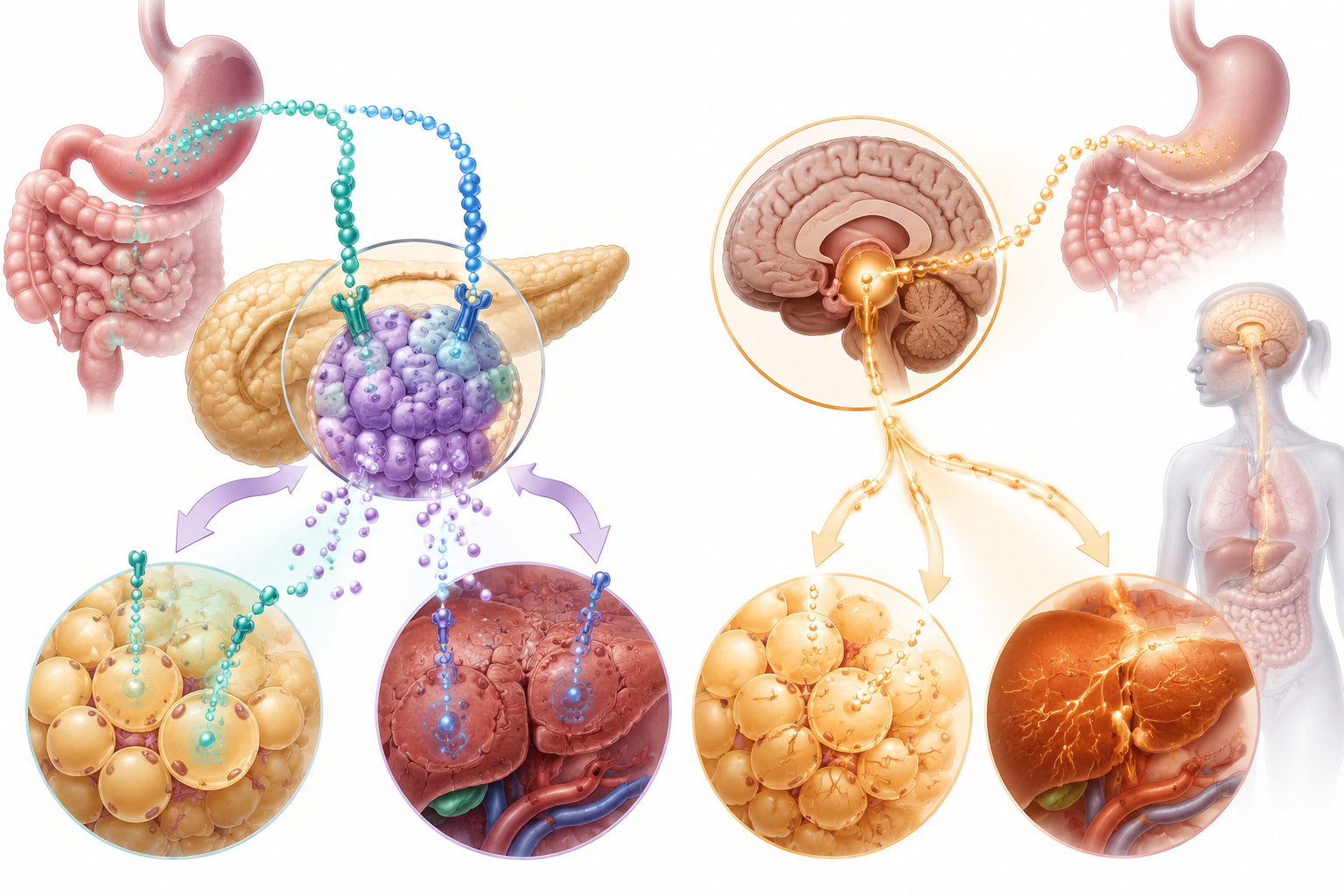
Cagrilintide represents a fundamentally different strategy. Rather than amplifying incretin signaling, it recruits the amylin pathway, which regulates satiety through different neural circuits. This is why combining cagrilintide with semaglutide (CagriSema) produces additive effects that exceed either agent alone.
The Phase 3 REDEFINE 1 trial reported 22.7% weight loss in non-diabetic adults over 48 weeks with CagriSema, with an FDA decision anticipated later in 2026. The mechanistic rationale for this synergy is explored in depth in the cagrilintide and GLP-1 synergy research summary.
Key distinctions for research models comparing amylin-based to incretin-based strategies:
- Amylin receptor signaling primarily reduces meal size rather than altering energy expenditure
- GLP-1 receptor agonism reduces meal frequency and caloric intake through central satiety circuits
- Combined, these mechanisms address appetite from two non-overlapping angles
For researchers also examining how peptide combinations interact with body composition endpoints, the IPA muscle and fat research themes page offers relevant comparative data on lean mass preservation.
Researchers investigating the newest generation of triple agonists can also review the GLP-3 triple agonist research page for additional mechanistic detail.
Conclusion
The comparison of Retatrutide vs Tirzepatide vs Semaglutide vs Cagrilintide is not simply a ranking exercise. Each compound engages a distinct receptor profile, and the metabolic pathways that matter most depend entirely on the research question being asked.
For models focused on maximum weight reduction, retatrutide's triple agonism and energy expenditure component give it a mechanistic edge. For models examining incretin synergy and insulin dynamics, tirzepatide offers a well-characterized dual receptor platform. For appetite suppression benchmarking, semaglutide remains the standard reference. For amylin pathway research or combination strategies, cagrilintide and CagriSema open a mechanistically separate avenue.
Actionable next steps for researchers:
- Define the primary metabolic endpoint before selecting a compound for a model
- Account for receptor potency hierarchy, not just the number of receptors targeted
- Consider combination models when studying non-overlapping satiety pathways
- Review the latest peptide research developments to stay current as Phase 3 data continues to emerge in 2026