
Call or Text 727-513-9780
  • Shopping Cart Shopping Cart
    0Shopping Cart
Pure Tested Peptides | America's most trusted Peptides for sale online
  • Peptides for sale
    • Oral Peptides for sale
      • Peptide Capsules for sale
      • BPC 157 Capsules 1000mcg
      • SLU-PP-332 Capsules | 1000 mcg
      • 5-Amino-1MQ 50mg Capsules
      • Tesofensine 500mcg
    • All Peptides for sale
    • Peptide Sprays
      • BPC 157 Nasal Spray Kit
      • BPC-157 TB500 Nasal Spray Kit
      • Semax Nasal Spray 10mg
      • Selank – Nasal Spray Kit – 10mg
      • Epithalon 50MG Nasal Spray Kit
      • Ipamorelin 10mg Nasal Spray
      • Klow Nasal Spray (BPC-157 + TB-500 + GHK-Cu + KPV) | 80mg
      • Hulk Nasal Spray Tesa / Ipa Blend 6/3 MG
      • Klow Nasal Spray
      • NAD + 500 mg Nasal Spray
      • PT-141 Nasal Spray Kit
    • GHRH Peptides
      • Ipa Peptides
      • CJC-1295 Peptides
        • CJC-1295 with DAC 5 mg
        • CJC-1295 without DAC 5 mg
        • CJC-1295 Ipa 10mg
      • Tesa Peptides
        • Tesa Peptide
        • Tesa 20 mg
    • GHK-Cu Peptides
      • All GHK-Cu Peptides
      • GHK-Cu 100mg
      • KLOW Peptide Blend – Buy KLOW blend online
    • BPC Peptides
      • All BPC Peptides
      • BPC-157
      • BPC-157 TB-500
      • BPC 157 capsules 1000mcg
    • SLU-PP-332 Peptides
      • All SLU-PP-332 Peptides
      • SLU-PP-332 5mg
    • GLP3 Peptides
      • GLP3-R
      • GLP3-R CAG 10mg
      • GLP3-R 20mg
    • PT-141 Peptides
      • PT-141 Peptides for sale
      • PT-141 10mg
      • PT-141 Nasal Spray
    • CAG Peptides
      • Lipo-C Peptide Blend
      • CAG 5mg
      • CAG 10mg
    • MOTS-C Peptides
      • MOTS-C Peptides for sale
      • MOTS-c peptide
      • MOTS-c 10mg *6 pack*
    • 5 Amino 1MQ Peptides
      • 5 Amino 1MQ Peptides for sale
      • 5-Amino-1MQ 50mg Capsules
      • 5-Amino-1MQ 5mg
    • Epithalon Peptides
      • Epithalon Peptides for sale
      • Epithalon 10mg
      • Epithalon 50mg
  • Shop
    • GLPs
      • 5-Amino-1MQ 50mg Capsules
      • 5-Amino-1MQ 5mg
      • GLP3-Reta
      • L-Carnitine 500mg/ml
      • Tesofensine 500mcg
      • SLU-PP-332 5mg
      • MOTS-c 10mg *6 pack*
    • Epithalon & BPC Peptides
      • Epithalon 10mg
      • Epithalon 50mg
      • BPC-157
      • BPC 157 capsules 1000mcg
      • BPC-157 TB-500
      • BPC-157 TB500 Nasal Spray Kit
      • BPC 157 Nasal Spray Kit
    • BPC TB-500 & NAD+ Peptides
      • NAD+ 500 mg
      • KLOW Peptide Blend – Buy KLOW blend online
      • GLOW Peptide Blend
      • TB 500 5mg
      • BPC 157 capsules 1000mcg – Supplement
      • BPC 157 Nasal Spray Kit
      • BPC-157
      • BPC-157 TB500 Nasal Spray Kit
      • BPC-157 TB-500
      • BPC 157 capsules 1000mcg
    • LL-37 Peptide
      • LL-37 10 mg
    • MOTS-C & Selank
      • MOTS-c peptide
      • Selank 10mg
    • GHK Peptides
      • GHK-Cu 100mg
      • GLOW Peptide Blend
      • KLOW Peptide Blend – Buy KLOW blend online
  • COAs
  • Wholesale
    • Wholesale Peptides for sale
  • PTP FAQ
  • Affiliates
    • Affiliate Program
    • Affiliate Signup
  • Contact
    • Contact Customer Service
    • Text Customer Support
  • About US
  • Shop all peptides
  • Login / Register Login / Register Page Link Login / Register Page Link
  • Click to open the search input field Click to open the search input field Search
  • Menu Menu

Tag Archive for: endocrine signaling

Peptides and Polypeptides in Human Physiology: How Molecular Size Shapes Research Applications

Peptides and Polypeptides in Human Physiology: How Molecular Size Shapes Research Applications

July 17, 2026/0 Comments/in Uncategorized/by

Over 80 peptide-based drugs have received clinical approval worldwide, yet the structural logic that separates a two-amino-acid dipeptide from a 200-residue polypeptide hormone still escapes most research summaries. That gap matters enormously. In the study of peptides and polypeptides in human physiology, molecular size is not a minor detail, it determines receptor binding geometry, metabolic stability, delivery route, and ultimately which research models are even viable.

This article moves beyond introductory definitions to examine how chain length and molecular weight shape endocrine signaling, immune modulation, and mitochondrial biology, with direct implications for researchers working with compounds like GLP-1 analogs, MOTS-c, and BPC-157.

Key Takeaways

  • Peptides range from 2 to ~50 amino acid residues (500-5,000 daltons); polypeptides exceed 50 residues and can fold into functional proteins.
  • Molecular size directly governs pharmacokinetics: shorter peptides degrade faster but penetrate tissues more readily than larger polypeptides.
  • Proglucagon-derived peptides (GLP-1, GLP-2, glucagon) illustrate how small sequence variations in the same precursor polypeptide produce radically different physiological effects.
  • Mitochondria-targeted peptides such as MOTS-c and SS-31 demonstrate that even very short chains can exert organelle-level regulatory effects.
  • Machine learning and AI-driven design tools are accelerating the identification of novel peptide sequences with optimized size-to-function ratios.

Key Takeaways

Defining the Size Spectrum: From Dipeptides to Polypeptides

The boundary between a peptide and a polypeptide is a matter of chain length and, by extension, structural complexity.

Category Residue Range Approximate MW Example
Dipeptide 2 < 300 Da Carnosine
Oligopeptide 3-10 300-1,000 Da GHK-Cu (tripeptide)
Peptide 10-50 1,000-5,000 Da BPC-157 (15 aa)
Polypeptide 50-200+ 5,000-25,000 Da GLP-1 precursor fragments

Peptide hormones sit within the 3-to-200 amino acid window and act as water-soluble signaling molecules that bind cell-surface receptors with high selectivity. Their water solubility is a direct consequence of size: chains short enough to remain in solution without hydrophobic collapse can reach membrane-bound targets efficiently.

Micropeptides, polypeptides with fewer than 100-150 amino acids encoded by short open reading frames, represent a newer research frontier. Unlike peptides produced by post-translational cleavage of larger precursors, micropeptides are primary gene products, which changes how researchers model their synthesis and regulation.

For researchers exploring simple peptides at the shorter end of this spectrum, understanding where a compound sits on the size continuum is the first step in predicting its behavior in a biological system.


How Molecular Size Shapes Research Applications in Endocrine and Metabolic Models

The proglucagon gene is one of the clearest demonstrations of how a single polypeptide precursor can be cleaved into multiple functionally distinct peptides. Glucagon, GLP-1, GLP-2, and oxyntomodulin all derive from the same precursor but differ in length and sequence. Each regulates a distinct axis, glucose homeostasis, appetite, gastrointestinal motility, and lipid metabolism, because each binds a different receptor with a different affinity profile shaped by its specific residue count and tertiary structure.

This is why the study of peptides and polypeptides in human physiology: how molecular size shapes research applications cannot be reduced to "bigger is more potent." A longer chain introduces more folding possibilities, which can increase receptor selectivity but also increase susceptibility to proteolytic degradation.

GLP-1 peptide research exemplifies this tension. Native GLP-1 has a plasma half-life of under two minutes due to rapid cleavage by dipeptidyl peptidase-4 (DPP-4). Analog development has focused on modifying the N-terminal residues, a size and sequence intervention, to resist that cleavage without disrupting receptor binding geometry.

"Molecular size is not just a classification tool, it is the primary engineering variable in peptide drug design."

Similarly, cagrilintide and GLP-1 synergy research explores dual-receptor agonism, where two peptides of different lengths act on complementary metabolic pathways simultaneously.

How Molecular Size Shapes Research Applications in Endocrine and Metabolic Models

Mitochondrial and Immune Research: Where Small Chains Carry Large Consequences

Two research areas illustrate the outsized physiological impact that short peptide chains can have: mitochondrial biology and innate immune modulation.

MOTS-c is a 16-amino acid peptide encoded within mitochondrial DNA, an unusual origin that places it outside the nuclear genome entirely. Research models examining MOTS-c and mitochondrial dynamics have linked this short chain to metabolic flexibility, insulin sensitivity, and stress response regulation. Its small size allows rapid intracellular transit, a pharmacokinetic advantage that larger polypeptides cannot replicate.

SS-31 (elamipretide) is a tetrapeptide, just four amino acids, that targets the inner mitochondrial membrane. Despite its minimal chain length, SS-31 research has examined its role in cardiolipin stabilization and mitochondrial membrane potential. Four residues, precisely arranged, are sufficient to engage a highly specific subcellular target.

On the immune side, BPC-157 at 15 amino acids sits in the mid-peptide range. BPC-157 research themes have investigated tissue repair signaling and mucosal integrity, with its moderate chain length providing a balance between tissue penetration and receptor engagement duration.

Epithalon, a tetrapeptide derived from the thymus, represents another short-chain compound with broad research interest. Epithalon research has explored telomere biology and cellular aging models, a reminder that four residues can carry significant biological information when the sequence is precise.


Pharmacokinetics, Delivery, and the Size-Stability Trade-Off

Peptides face a fundamental pharmacokinetic challenge: the same structural features that make them potent and selective also make them vulnerable. Proteases and peptidases in the gastrointestinal tract and bloodstream degrade most unmodified peptides within minutes. Oral bioavailability is typically low, which is why most research-grade peptides are administered parenterally.

Key size-related pharmacokinetic principles include:

  • Shorter chains (< 10 residues) are cleared faster but distribute into tissues more readily.
  • Mid-range peptides (10-50 residues) offer a window of improved stability with retained receptor specificity.
  • Polypeptides (> 50 residues) may require structural modification (PEGylation, cyclization) to achieve clinically relevant half-lives.

Machine learning models are now being applied to predict which sequence modifications at specific residue positions will improve stability without altering receptor binding. This computational approach treats molecular size as a tunable parameter rather than a fixed property.

For researchers sourcing compounds like tesa, a 44-amino acid GHRH analog, or ipamorelin, a 5-amino acid ghrelin mimetic, understanding the size-stability relationship is essential for designing valid experimental protocols.


Pharmacokinetics, Delivery, and the Size-Stability Trade-Off

Conclusion

The study of peptides and polypeptides in human physiology: how molecular size shapes research applications is ultimately a study in precision. Chain length determines folding behavior, receptor compatibility, metabolic half-life, and delivery feasibility. Researchers who treat molecular size as a primary variable, rather than a background specification, gain a more predictive framework for designing experiments and interpreting results.

Actionable next steps for researchers:

  1. Map each compound in a study to its residue count and molecular weight before selecting an administration route.
  2. Cross-reference size data with known protease cleavage sites to anticipate degradation timelines.
  3. When working with polypeptide-derived fragments (e.g., proglucagon products), account for the parent precursor's folding behavior when modeling fragment activity.
  4. Explore AI-assisted sequence screening tools to identify size-optimized analogs for target pathways.
  5. Source compounds from verified suppliers with documented purity data to ensure that molecular weight specifications match actual product composition.

As the field advances in 2026, the intersection of structural biochemistry, computational design, and rigorous sourcing standards will define which peptide research programs yield reproducible, translatable findings.

https://www.puretestedpeptides.com/wp-content/uploads/2026/07/peptides-and-polypeptides-in-human-physiology-how-molecular-size-shapes-research.webp 1024 1536 https://www.puretestedpeptides.com/wp-content/uploads/2026/01/buy-peptides-online.jpg 2026-07-17 13:05:522026-07-17 13:05:52Peptides and Polypeptides in Human Physiology: How Molecular Size Shapes Research Applications
Enclomiphene Research for Male Hormone Optimization: LH, FSH, and Testosterone Signaling Without the Clomiphene Noise

Enclomiphene Research for Male Hormone Optimization: LH, FSH, and Testosterone Signaling Without the Clomiphene Noise

June 7, 2026/0 Comments/in Uncategorized/by

Men with secondary hypogonadism who start standard clomiphene citrate often see testosterone numbers improve — but they also report mood swings, visual disturbances, and erratic estrogen readings that are hard to explain from the testosterone signal alone. The culprit is not the therapy concept; it is a single unwanted isomer. Enclomiphene research for male hormone optimization: LH, FSH, and testosterone signaling without the clomiphene noise is now a serious clinical conversation, and the lab data behind it deserves a clear-eyed look.

Key Takeaways

  • Enclomiphene is the active trans-isomer of clomiphene citrate; isolating it removes the estrogenic "noise" caused by zuclomiphene.
  • It stimulates LH and FSH release through the HPG axis, raising endogenous testosterone without suppressing spermatogenesis.
  • Phase II and III trials confirm meaningful increases in total and free testosterone in men with secondary hypogonadism.
  • Standard oral dosing ranges from 12.5 to 25 mg per day, with estradiol monitoring required at higher doses.
  • It is not suitable for primary hypogonadism or cases requiring highly predictable testosterone levels from injectable TRT.
Key Takeaways

The Isomer Problem: Why Clomiphene Carries Unwanted Signals

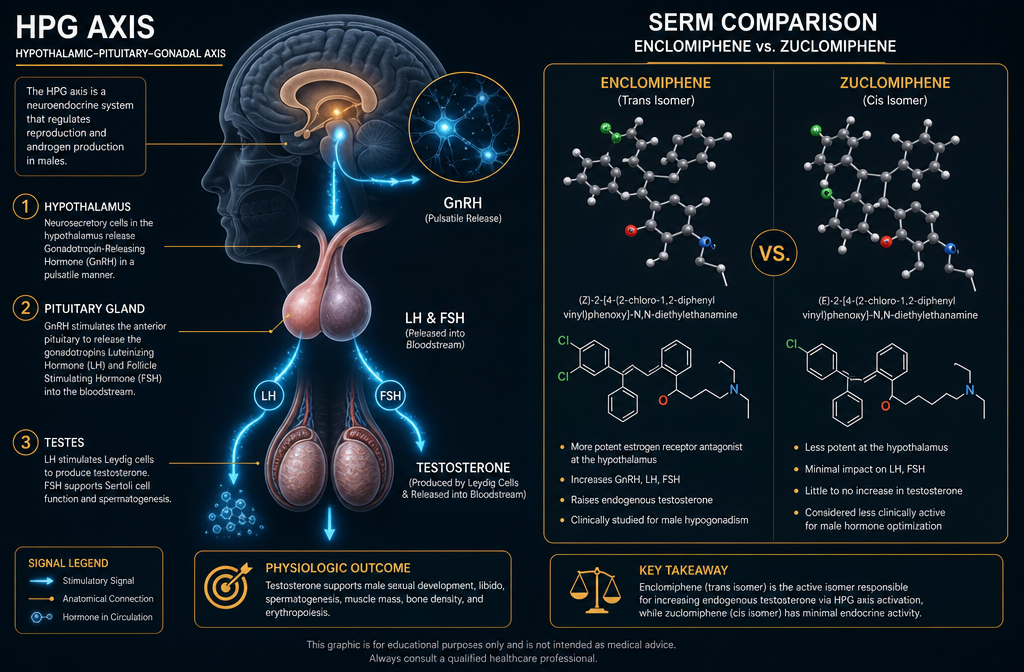
Clomiphene citrate is a 50/50 mixture of two geometric isomers: enclomiphene (trans) and zuclomiphene (cis). They behave very differently inside the body.

Enclomiphene blocks estrogen receptors in the hypothalamus. That blockade triggers increased gonadotropin-releasing hormone (GnRH) output, which tells the pituitary to release more LH and FSH. Higher LH drives Leydig cells in the testes to produce testosterone. Higher FSH supports Sertoli cell function and sperm production. The entire HPG axis stays intact and active.

Zuclomiphene, by contrast, is a weak estrogen receptor agonist with a notably long half-life. It accumulates over weeks of dosing, activating rather than blocking estrogen receptors. That activation contributes to mood disturbances, visual side effects, and confusing estradiol readings that complicate lab interpretation.

"The clinical noise attributed to clomiphene therapy in men is largely a zuclomiphene problem, not an enclomiphene problem."

Isolating enclomiphene removes that competing signal entirely, leaving a cleaner pharmacological profile for male hormone optimization.

Researchers studying multi-pathway peptide compounds face similar signal-isolation challenges. For context on how compound purity affects research outcomes, the discussion on multi-pathway research blends offers useful framing.

Reading the Lab Panel: LH, FSH, and Testosterone Under Enclomiphene

Understanding enclomiphene research for male hormone optimization: LH, FSH, and testosterone signaling without the clomiphene noise requires knowing what to look for on a hormone panel — and in what order.
Reading the Lab Panel: LH, FSH, and Testosterone Under Enclomiphene

Baseline Labs Before Starting

Before initiating enclomiphene, a complete baseline panel should include:

Lab Marker Why It Matters
Total Testosterone Establishes starting point
Free Testosterone Reflects bioavailable fraction
LH and FSH Confirms secondary (not primary) hypogonadism
Estradiol (E2) Monitors aromatization risk
Complete Metabolic Panel Assesses liver and kidney function
Lipid Panel Cardiovascular baseline
Complete Blood Count Rules out hematologic issues

What Changes at 4 to 6 Weeks

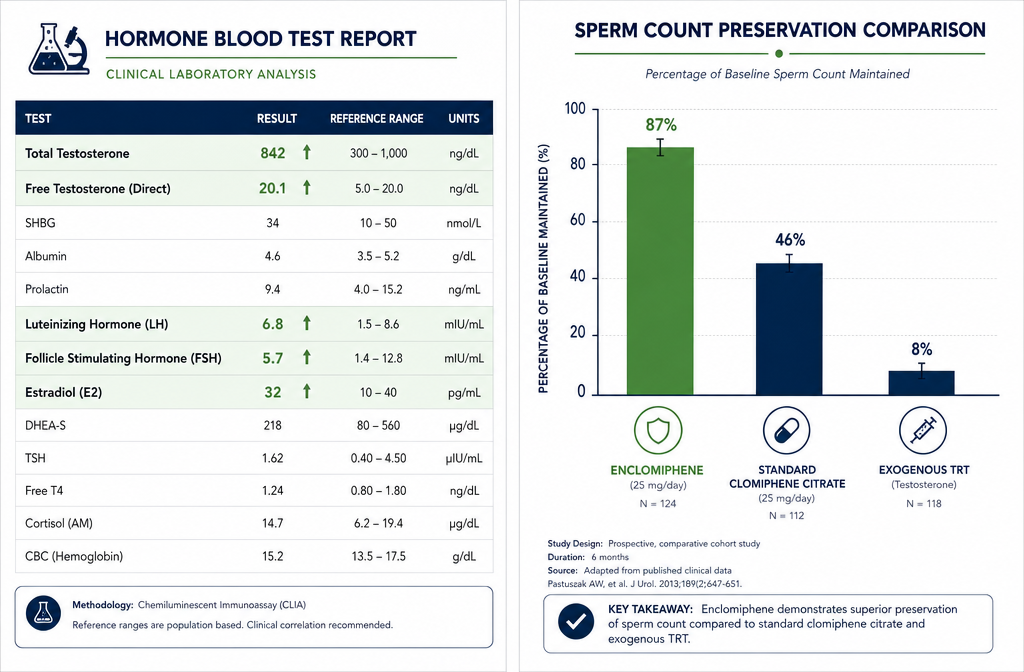
Phase II and III clinical trials show that enclomiphene produces statistically significant increases in both total and free testosterone in men with secondary hypogonadism. Crucially, LH and FSH rise alongside testosterone — the opposite of what happens with exogenous TRT, which suppresses both gonadotropins through negative feedback.

Sperm counts are maintained or improved, a finding that distinguishes enclomiphene sharply from injectable testosterone, which reliably reduces sperm production.

Estradiol should be rechecked at the 4-to-6-week follow-up. At doses above 25 mg daily, increased aromatization to estradiol has been observed, which may require dose adjustment or monitoring strategy changes.

For researchers exploring peptide-based growth hormone secretagogues alongside hormonal optimization protocols, the CJC-1295 with DAC deeper dive provides relevant background on pituitary-axis signaling. Similarly, those examining body composition endpoints may find the IPA muscle and fat research themes useful for comparative context.

Practical Research Considerations: Dosing, Patient Selection, and Monitoring

Enclomiphene research for male hormone optimization: LH, FSH, and testosterone signaling without the clomiphene noise is most productive when patient selection criteria are applied carefully.

Who Is a Strong Research Candidate

  • Men with confirmed secondary hypogonadism (low testosterone with low or normal LH/FSH)
  • Men who want to raise testosterone while preserving fertility
  • Younger men who may plan to have children
  • Men who prefer oral administration over injectable protocols

Who Is Not

  • Men with primary hypogonadism (testicular failure) — the testes cannot respond to LH stimulation
  • Men requiring highly predictable, high-level testosterone that only injectable TRT reliably delivers

Standard Dosing Protocol

The most studied oral dosing range is 12.5 to 25 mg per day. Lower doses reduce aromatization risk while still producing meaningful gonadotropin stimulation. Higher doses should be paired with closer estradiol monitoring.

As of 2026, enclomiphene is available via prescription under the brand name Androxal and is also accessible as a research compound. Any clinical application requires physician oversight and proper lab monitoring.

For researchers interested in related peptide compounds that intersect with metabolic and hormonal research, the tesa benefits overview and the PT-141 research context provide relevant comparative reading on endocrine-adjacent signaling pathways.

Ongoing research in 2026 continues to examine enclomiphene's long-term effects on bone density, cardiovascular markers, and broader applications in testosterone-deficiency conditions beyond secondary hypogonadism.

Conclusion

Enclomiphene research for male hormone optimization: LH, FSH, and testosterone signaling without the clomiphene noise represents one of the more clinically precise tools available for secondary hypogonadism management. By removing zuclomiphene from the equation, researchers and clinicians gain a cleaner signal — rising LH, rising FSH, rising testosterone, and preserved spermatogenesis — without the estrogenic interference that has historically complicated clomiphene therapy interpretation.

Actionable next steps for researchers and clinicians:

  1. Confirm secondary hypogonadism with a full baseline panel before initiating any protocol.
  2. Start at 12.5 mg daily and recheck total testosterone, free testosterone, LH, FSH, and estradiol at 4 to 6 weeks.
  3. Adjust dosing based on estradiol response, not testosterone alone.
  4. Exclude primary hypogonadism candidates early to avoid non-response.
  5. Track sperm parameters if fertility preservation is a stated research or clinical goal.

The endocrine signal is only as clean as the compound producing it. Enclomiphene's isomer isolation is precisely why its lab results are finally readable.

https://www.puretestedpeptides.com/wp-content/uploads/2026/06/Enclomiphene-Research-for-Male-Hormone-Optimization-LH-FSH-and-Testosterone-Signaling-Without-the-Clomiphene-Noise.png 672 1024 https://www.puretestedpeptides.com/wp-content/uploads/2026/01/buy-peptides-online.jpg 2026-06-07 13:04:162026-06-07 13:04:16Enclomiphene Research for Male Hormone Optimization: LH, FSH, and Testosterone Signaling Without the Clomiphene Noise
×

Helpful Links

  • My account
  • Cart
  • Checkout
  • Refund and Returns Policy
  • Privacy Policy
  • SMS Privacy Policy
  • Login
  • My Account
  • Logout

USA Made Lab Tested Peptides

All products are sold for research, laboratory, or analytical purposes only, and are not for human consumption


Pure Tested Peptides is a chemical supplier. Pure Tested Peptides is not a compounding / chemical compounding facility as defined under 503A of the Federal Food, Drug, and Cosmetic act. Pure Tested Peptides is not an outsourcing facility as defined under 503B of the Federal Food, Drug, and Cosmetic act.

The statements made within this website have not been evaluated by the US Food and Drug Administration. The products we offer are not intended to diagnose, treat, cure or prevent any disease.

Human/Animal Consumption Prohibited. Laboratory/In-Vitro Experimental Use Only

Scroll to top Scroll to top Scroll to top