
Prostate-Specific Antigen and Peptide Research: Why PSA Appears in Hormone, Prostate, and Biomarker Content Strategy
Fewer than 5% of men under 40 have elevated PSA levels — yet the term "PSA" appears in an enormous share of research content spanning hormones, peptides, and biomarker diagnostics. That overlap is not accidental. Understanding Prostate-Specific Antigen and Peptide Research: Why PSA Appears in Hormone, Prostate, and Biomarker Content Strategy requires a clear look at what PSA actually is, how peptide science intersects with its measurement and targeting, and why content covering endocrine health, prostate biology, and research peptides so often converges on this single biomarker.
Key Takeaways
- PSA is a serine protease enzyme — a peptide-cleaving protein — making it directly relevant to peptide research frameworks.
- Hormone regulation, particularly androgen signaling, controls PSA expression, linking it firmly to endocrine content.
- Newer biomarkers such as GRPR and modified PSA assays are expanding the diagnostic landscape beyond standard PSA testing.
- Peptide-based prodrugs and imaging agents that exploit PSA's enzymatic activity represent an active research frontier.
- Content covering prostate health, biomarker science, or research peptides will naturally intersect with PSA as a reference point.
What PSA Actually Is — And Why Peptide Research Overlaps
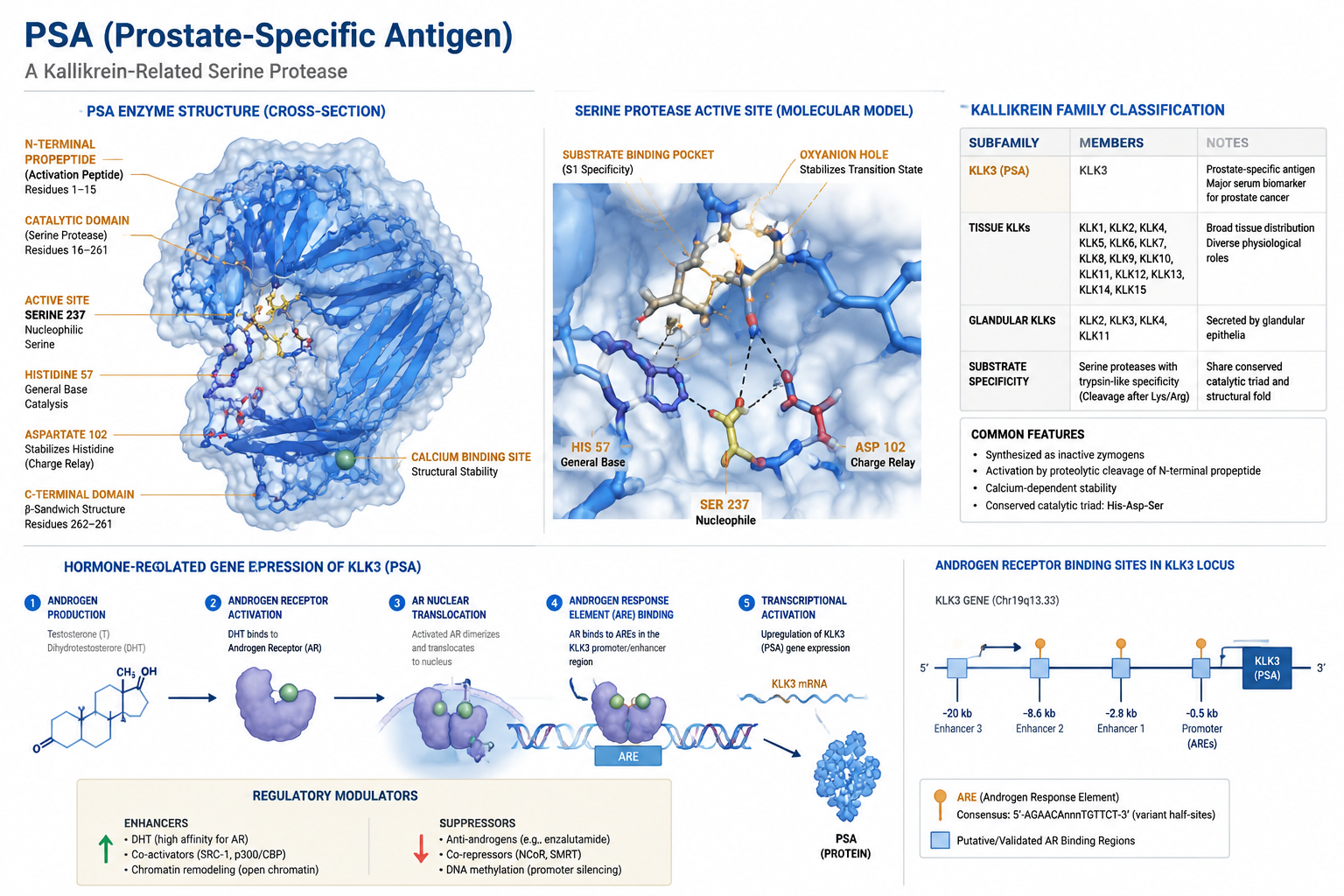
PSA, or Prostate-Specific Antigen, is a serine protease enzyme produced primarily by prostate epithelial cells. Its biological job is to liquefy seminal proteins — it does this by cleaving peptide bonds. That single function places PSA squarely within peptide biochemistry, not just urology.
Because PSA belongs to the human kallikrein family (specifically KLK3), it shares structural and functional characteristics with other kallikrein peptidases. Researchers studying peptide substrates, enzyme kinetics, or protease-activated drug delivery systems encounter PSA as a natural reference point.
"PSA is not merely a cancer screening number — it is an active peptide-processing enzyme whose substrate specificity has been mapped and exploited for targeted drug design."
This enzymatic identity explains why Prostate-Specific Antigen and Peptide Research topics appear together so frequently. Researchers have used phage display screening to identify peptides that bind specifically to PSA-low prostate cancer cells — work that is directly relevant to castration-resistant prostate cancer targeting. Separately, peptide-based inhibitors of PSA have been optimized as targeted imaging agents, and PSA-cleavable peptide substrates have been screened to develop albumin-binding anticancer prodrugs.
For researchers already exploring peptide mechanisms and research applications, PSA represents a well-characterized enzymatic model with translational implications.
Hormone Regulation, Androgen Signaling, and PSA Expression
PSA expression is tightly regulated by androgen hormones, particularly testosterone and dihydrotestosterone (DHT), acting through androgen receptors. This hormonal control is why PSA levels drop when androgen deprivation therapy is used in prostate cancer management.
This connection to hormone signaling is a key reason Prostate-Specific Antigen and Peptide Research: Why PSA Appears in Hormone, Prostate, and Biomarker Content Strategy is such a relevant framework. Any content platform covering endocrine health, growth hormone peptides, or hormonal biomarkers will encounter PSA as a downstream androgen-regulated marker.
Key hormonal relationships involving PSA:
| Factor | Effect on PSA |
|---|---|
| Testosterone / DHT | Upregulates PSA gene transcription |
| Androgen deprivation | Suppresses PSA production |
| Estrogen (high levels) | May reduce PSA expression |
| Inflammation | Can elevate PSA independent of cancer |
Research exploring gonadorelin and GnRH pulsatility is directly upstream of androgen signaling — and therefore upstream of PSA regulation. Similarly, content covering GLP-1 peptide research concepts or NAD research and metabolic peptides sits within the same broad endocrine-metabolic ecosystem that PSA inhabits.

Biomarker Evolution: Beyond Standard PSA Testing
Standard PSA immunoassays have well-documented limitations in specificity. Recent research has moved in two important directions: refining PSA measurement and identifying companion biomarkers.
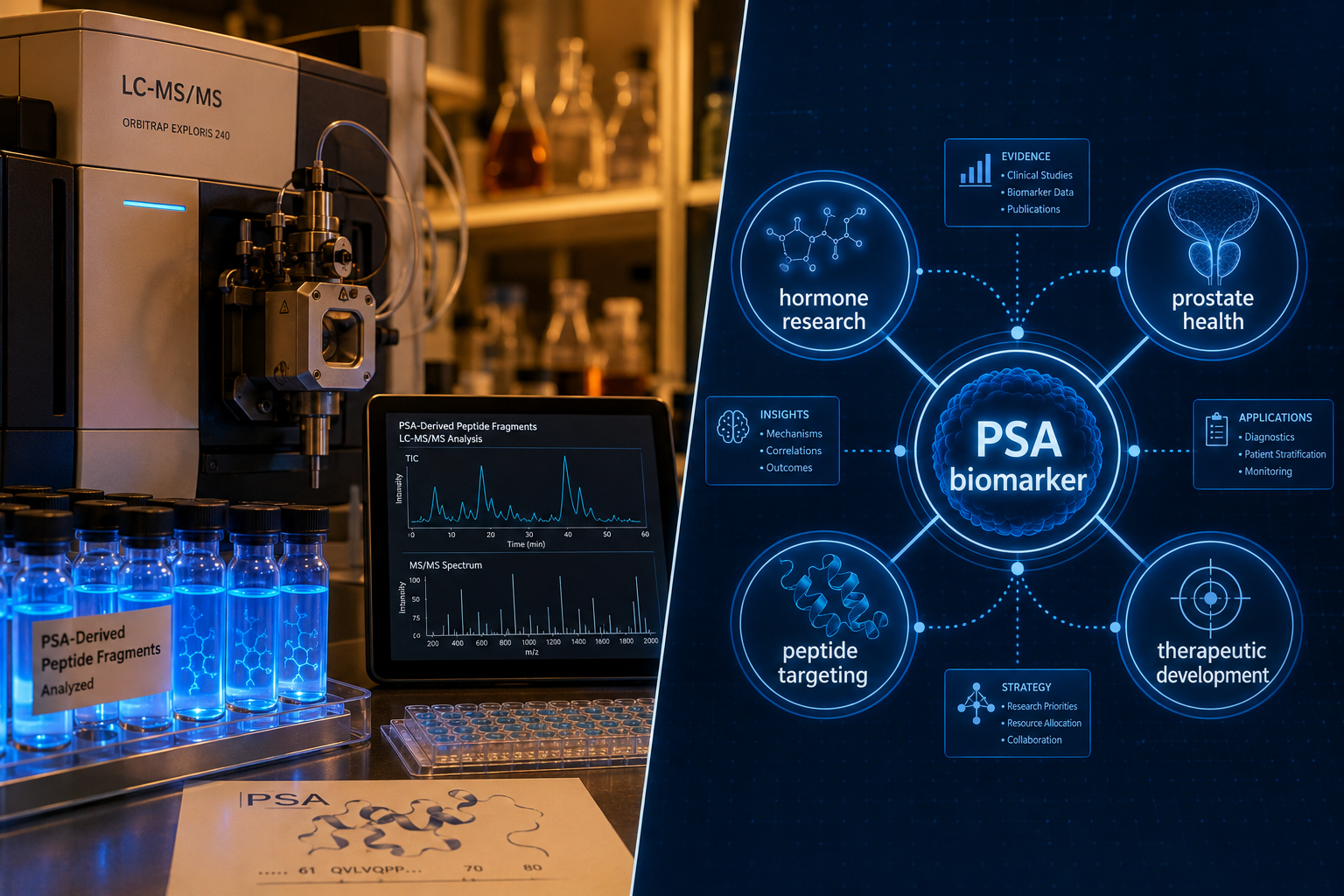
On the measurement side, mass spectrometry-based approaches now allow direct quantification of PSA-derived peptides, offering a path to harmonize inconsistencies across different immunoassay platforms. A first-in-class antibody targeting alpha-1,6-fucosylated PSA has also been developed to improve diagnostic specificity — a glycoproteomic refinement that sits at the intersection of peptide chemistry and clinical diagnostics.
On the companion biomarker side, Gastrin-Releasing Peptide Receptor (GRPR) has emerged as a significant parallel target. Studies evaluating GRPR alongside PSMA and Neurotensin Receptor 1 suggest that multi-receptor panels improve prostate cancer stratification compared to PSA alone. Research published in 2026 continues to explore theranostic targets beyond PSMA, reflecting a broader shift toward peptide-receptor-based diagnostics.
Ultrasensitive biosensors using octabranched peptide scaffolds and silver nanoparticles now enable PSA quantification at extremely low concentrations in human serum — a development with direct implications for early detection research.
For those tracking quality testing protocols in peptide research, this evolution in biomarker measurement methodology is directly applicable. Researchers interested in epithalon and aging biomarkers or GHK-Cu longevity research themes will recognize the same pattern: single-marker approaches give way to multi-pathway, peptide-informed frameworks.
PSA-Targeted Prodrugs and Peptide Delivery
One of the most compelling intersections between Prostate-Specific Antigen and Peptide Research: Why PSA Appears in Hormone, Prostate, and Biomarker Content Strategy is the field of PSA-activated prodrugs. Because PSA cleaves specific peptide sequences, researchers have engineered prodrugs that remain inactive until PSA cleaves a peptide linker — releasing the therapeutic payload selectively at the tumor site. Disulfide-constrained peptides that bind to the extracellular portion of PSMA (Prostate-Specific Membrane Antigen, a related but distinct target) have also been identified, further expanding the peptide-targeting toolkit.
Conclusion
PSA occupies a unique position in biomedical research — it is simultaneously a clinical screening marker, an androgen-regulated gene product, and an active peptide-cleaving enzyme. That triple identity explains precisely why Prostate-Specific Antigen and Peptide Research: Why PSA Appears in Hormone, Prostate, and Biomarker Content Strategy is a legitimate and valuable content framework, not keyword overlap.
Actionable next steps for researchers and content strategists:
- Treat PSA as a peptide biochemistry topic, not just a urology metric, when building research content architecture.
- Explore companion biomarkers (GRPR, Neurotensin Receptor 1) alongside PSA for a more complete prostate health research picture.
- Follow developments in PSA-cleavable prodrug design as a model for targeted peptide delivery systems.
- Use PSA's hormonal regulation as a bridge between endocrine peptide content and prostate health discussions.
Readers exploring broader peptide research themes can find relevant context in MOTS-C mitochondrial peptide research and IPA muscle and fat research themes — both of which operate within the same endocrine-metabolic landscape that PSA monitoring informs.