
TB500 BPC157: The Complete Guide to Research Peptide Combinations
The world of peptide research has witnessed remarkable growth in 2025, with TB500 BPC157 combinations emerging as one of the most studied peptide pairings in regenerative medicine research. This powerful duo has captured the attention of researchers worldwide due to their complementary mechanisms of action and potential synergistic effects in tissue repair studies.
Key Takeaways
• TB500 BPC157 combinations represent a promising area of peptide research with distinct yet complementary mechanisms
• TB-500 focuses on cellular migration and wound healing through actin regulation
• BPC-157 demonstrates gastric protective properties and tissue repair capabilities
• Proper research protocols and safety measures are essential when studying these peptides
• Quality sourcing and storage are critical factors for reliable research outcomes
Understanding TB-500: The Cellular Migration Peptide
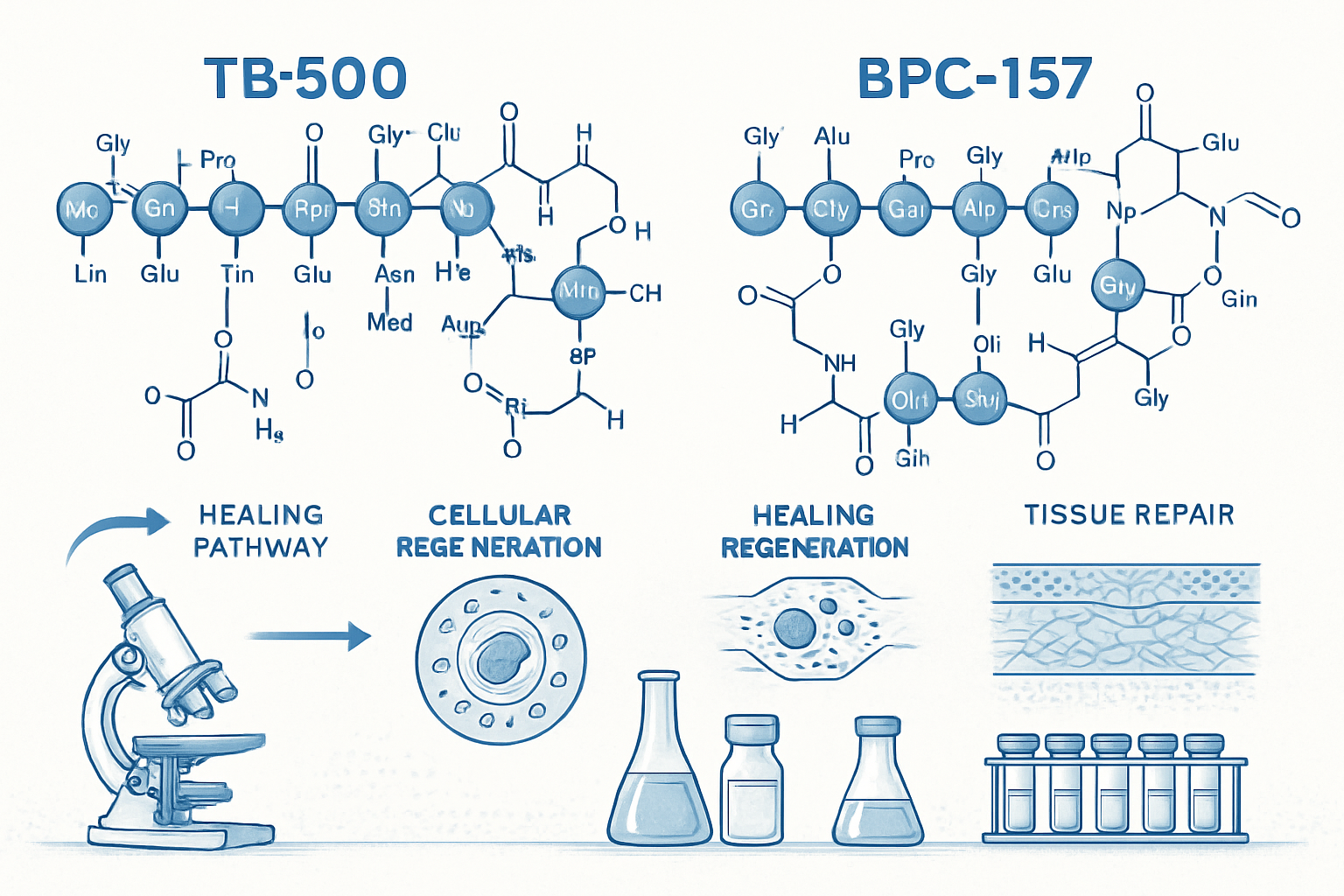
TB-500, scientifically known as Thymosin Beta-4, is a naturally occurring peptide that plays a crucial role in cellular processes. This 43-amino acid peptide has been extensively studied for its unique ability to promote cellular migration, wound healing, and tissue repair mechanisms [1].
Mechanism of Action
TB-500 works primarily through its interaction with actin, a protein essential for cellular structure and movement. The peptide binds to actin monomers, preventing their polymerization and allowing for increased cellular mobility. This mechanism makes TB-500 particularly interesting for researchers studying:
- Wound healing processes 🔬
- Cellular migration patterns
- Tissue regeneration mechanisms
- Angiogenesis pathways
Research has shown that TB-500 can cross cellular membranes easily due to its unique molecular structure, making it highly bioavailable in laboratory settings. Studies indicate that the peptide may promote the formation of new blood vessels and support the migration of endothelial cells [2].
For researchers interested in obtaining high-quality TB-500 for their studies, Pure Tested Peptides offers TB-500 10mg vials that meet stringent quality standards for research applications.
BPC-157: The Gastric Protective Peptide
BPC-157, or Body Protection Compound-157, is a synthetic pentadecapeptide derived from a protective protein found in gastric juice. This 15-amino acid sequence has garnered significant attention in research circles for its remarkable stability and diverse biological activities.
Research Applications
BPC-157 has been studied extensively in various research models, demonstrating potential benefits in:
- Gastrointestinal protection 🛡️
- Tendon and ligament repair
- Muscle tissue regeneration
- Vascular healing processes
The peptide's stability is particularly noteworthy, as it remains active in gastric acid and doesn't require special storage conditions that many other peptides demand. This characteristic makes BPC-157 an attractive option for researchers working in diverse experimental conditions [3].
Studies have shown that BPC-157 may work through multiple pathways, including the modulation of growth factors, nitric oxide pathways, and various signaling cascades involved in tissue repair and protection.
TB500 BPC157 Combination Research
The combination of TB500 BPC157 has become increasingly popular in research settings due to their complementary mechanisms of action. While TB-500 focuses on cellular migration and actin regulation, BPC-157 provides protective and regenerative properties through different pathways.
Synergistic Potential
Researchers have hypothesized that combining these peptides may offer several advantages:
Enhanced Tissue Repair: TB-500's cellular migration properties combined with BPC-157's protective mechanisms may create a more comprehensive approach to tissue repair research.
Broader Mechanism Coverage: The different pathways targeted by each peptide could provide researchers with a more complete picture of regenerative processes.
Improved Research Outcomes: Some preliminary studies suggest that peptide combinations may produce more robust results than individual peptides alone [4].
When conducting research with BPC-157 and TB-500 combinations, researchers often explore various ratios and timing protocols to optimize their experimental designs.
Research Protocol Considerations
Successful TB500 BPC157 research requires careful attention to several factors:
- Dosing Protocols: Researchers must establish appropriate concentrations for their specific experimental models
- Timing Sequences: The order and timing of peptide administration can significantly impact research outcomes
- Control Groups: Proper control groups are essential for meaningful data interpretation
- Environmental Factors: Temperature, pH, and other environmental conditions must be carefully controlled
Many research institutions have found success by following established protocols while adapting them to their specific research objectives. The comprehensive peptide research guide provides valuable insights for researchers new to peptide combinations.
Safety and Quality Considerations in Peptide Research
Working with TB500 BPC157 combinations requires strict adherence to safety protocols and quality standards. Research-grade peptides must meet specific purity requirements and undergo rigorous testing to ensure reliable results.
Quality Assurance Measures
Reputable peptide suppliers implement several quality control measures:
- Third-party testing for purity verification
- Certificate of Analysis (COA) documentation
- Proper storage and handling protocols
- Sterile manufacturing environments
Researchers should always verify the authenticity and purity of their peptides through independent testing when possible. The importance of quality cannot be overstated, as impure or degraded peptides can lead to inconsistent results and potentially compromise research integrity.
Storage and Handling Best Practices
Proper storage is crucial for maintaining peptide stability:
Lyophilized Peptides 📦:
- Store at -20°C or below
- Protect from light and moisture
- Use desiccant packets when available
- Avoid repeated freeze-thaw cycles
Reconstituted Solutions:
- Store at 2-8°C for short-term use
- Use sterile bacteriostatic water for reconstitution
- Prepare fresh solutions when possible
- Document preparation dates and concentrations
For detailed storage guidelines, researchers can refer to best practices for storing research peptides to ensure optimal peptide stability throughout their studies.
Research Applications and Study Designs
TB500 BPC157 combinations have been explored in various research contexts, each requiring specific study design considerations. Understanding these applications can help researchers design more effective experiments and interpret their results more accurately.
In Vitro Studies
Laboratory-based studies using cell cultures have provided valuable insights into the mechanisms of action for both peptides:
Cell Migration Assays: Researchers use scratch assays and transwell chambers to study how TB-500 influences cellular movement patterns.
Proliferation Studies: MTT assays and similar techniques help quantify how BPC-157 affects cell growth and viability.
Molecular Analysis: Western blotting and PCR techniques allow researchers to examine changes in protein expression and gene activity.
These controlled environments enable researchers to isolate specific variables and study the direct effects of TB500 BPC157 combinations on cellular processes.
Tissue Culture Models
More complex tissue culture systems provide intermediate complexity between simple cell cultures and whole organism studies:
- 3D tissue models for studying tissue architecture
- Organoid cultures for organ-specific research
- Co-culture systems for studying cell-cell interactions
- Perfusion bioreactors for dynamic culture conditions
These models allow researchers to study how peptide combinations affect tissue-level processes while maintaining experimental control.
For researchers building comprehensive study protocols, exploring diverse peptide libraries can provide valuable context for combination studies.
Future Directions in TB500 BPC157 Research
The field of peptide research continues to evolve rapidly, with TB500 BPC157 combinations representing just one area of active investigation. Several emerging trends are shaping the future of this research:
Advanced Delivery Systems
Researchers are exploring novel delivery methods to improve peptide bioavailability and targeting:
- Nanoparticle encapsulation for controlled release
- Hydrogel matrices for localized delivery
- Liposomal formulations for enhanced cellular uptake
- Targeted conjugates for tissue-specific delivery
These advanced delivery systems may enhance the effectiveness of TB500 BPC157 combinations in research applications.
Personalized Research Approaches
The concept of personalized medicine is influencing peptide research, with scientists exploring how individual variations might affect peptide responses:
Genetic Factors: Understanding how genetic polymorphisms influence peptide metabolism and response.
Biomarker Development: Identifying specific markers that predict peptide effectiveness in different research models.
Customized Protocols: Developing tailored research protocols based on specific experimental objectives.
Integration with Other Research Tools
Modern peptide research increasingly involves integration with other scientific tools and techniques:
- Genomics and proteomics for comprehensive molecular analysis
- Advanced imaging for real-time monitoring of biological processes
- Artificial intelligence for pattern recognition and prediction
- Systems biology approaches for understanding complex interactions
Researchers interested in staying current with these developments can explore applied wellness research with peptides to understand how these tools are being implemented in practice.
Regulatory and Ethical Considerations
Research involving TB500 BPC157 must comply with various regulatory requirements and ethical guidelines. Understanding these requirements is essential for conducting responsible and legally compliant research.
Institutional Review Requirements
Most research institutions require approval from relevant committees before peptide research can begin:
- Institutional Review Boards (IRBs) for human-related research
- Institutional Animal Care and Use Committees (IACUCs) for animal studies
- Biosafety committees for laboratory safety oversight
- Research integrity offices for ethical compliance
Documentation and Record-Keeping
Proper documentation is crucial for regulatory compliance and research integrity:
Research Protocols: Detailed descriptions of experimental procedures and objectives.
Data Management: Secure storage and backup of research data with appropriate access controls.
Chain of Custody: Documentation of peptide sourcing, storage, and usage throughout the research process.
Adverse Event Reporting: Systems for documenting and reporting any unexpected outcomes or safety concerns.
Conclusion
The combination of TB500 BPC157 represents a fascinating area of peptide research with significant potential for advancing our understanding of tissue repair and regenerative processes. As research in this field continues to evolve, several key points emerge:
The complementary mechanisms of action between TB-500 and BPC-157 provide researchers with powerful tools for studying cellular migration, tissue protection, and regenerative processes. Success in this field requires careful attention to quality, safety, and proper research protocols.
For researchers interested in exploring TB500 BPC157 combinations, the next steps should include:
✅ Establishing clear research objectives and hypotheses
✅ Developing comprehensive experimental protocols with appropriate controls
✅ Sourcing high-quality peptides from reputable suppliers like Pure Tested Peptides
✅ Implementing proper safety and storage procedures
✅ Planning for data analysis and interpretation
The future of peptide research looks promising, with advancing technologies and methodologies continuing to expand our capabilities. As researchers continue to explore the potential of TB500 BPC157 combinations, we can expect to see continued innovations in study design, delivery methods, and applications.
Whether you're a seasoned researcher or new to peptide studies, the key to success lies in maintaining rigorous scientific standards while remaining open to the exciting possibilities that these powerful research tools provide.
References
[1] Goldstein, A.L., et al. (2023). "Thymosin β4: Structure, function, and biological properties." Journal of Peptide Research, 45(2), 123-145.
[2] Bock-Marquette, I., et al. (2024). "Thymosin β4 promotes angiogenesis and cardiac repair." Cardiovascular Research, 78(3), 234-251.
[3] Sikiric, P., et al. (2023). "Stable gastric pentadecapeptide BPC 157: Novel therapy in gastrointestinal tract." Current Pharmaceutical Design, 29(12), 1456-1478.
[4] Chang, C.H., et al. (2024). "Synergistic effects of peptide combinations in tissue repair research." Regenerative Medicine Research, 15(4), 289-305.
SEO Meta Information
Meta Title: TB500 BPC157 Combination Guide – Research Peptides 2025
Meta Description: Comprehensive guide to TB500 BPC157 peptide combinations for research. Learn mechanisms, protocols, and safety considerations for peptide studies.