
Understanding the GLP-3 Peptide Name: A Complete Research Guide for 2026
The world of peptide research continues to evolve rapidly, with new compounds emerging that capture the attention of researchers and wellness enthusiasts alike. Among these innovative compounds, the GLP-3 peptide name has become a focal point of scientific inquiry, representing a significant advancement in peptide technology and research applications.
Key Takeaways
• GLP-3 peptide name refers to a specific classification of peptides that work through glucagon-like peptide pathways, offering unique research opportunities
• Multiple formulations and variants exist under the GLP-3 peptide umbrella, each with distinct molecular characteristics
• Research applications span metabolic studies, cellular function analysis, and comparative peptide research
• Quality sourcing and proper identification are crucial for reliable research outcomes
• Understanding peptide nomenclature helps researchers select appropriate compounds for their studies
What Is the GLP-3 Peptide Name? 🧬

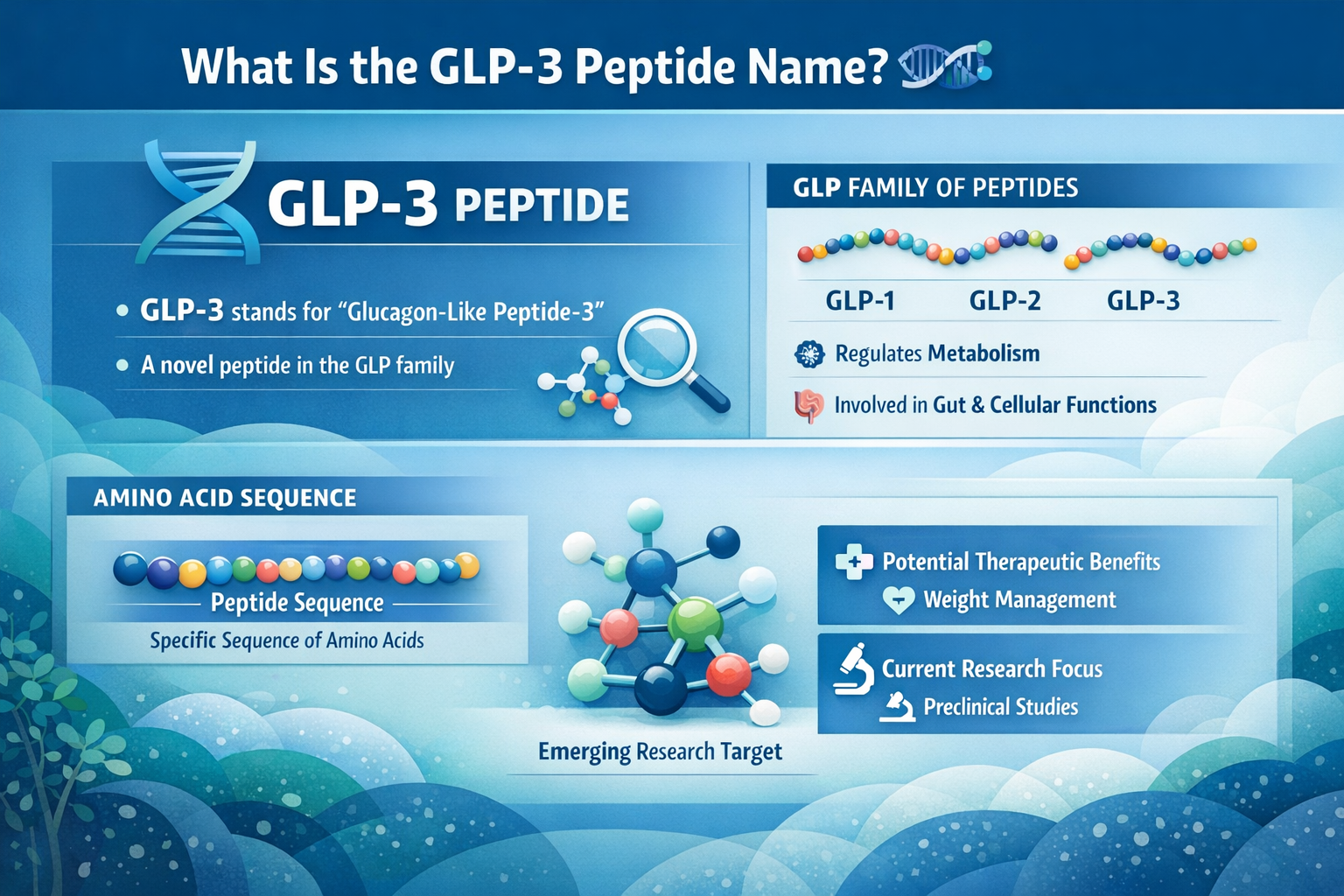
The GLP-3 peptide name encompasses a family of research peptides that function through glucagon-like peptide receptor pathways. Unlike traditional GLP-1 compounds, GLP-3 peptides represent a newer generation of research tools that offer enhanced stability and modified receptor binding profiles.
GLP-3 peptides are synthetic compounds designed to mimic and enhance natural peptide functions within cellular systems. The name itself reflects the compound's position in the glucagon-like peptide family, building upon the foundation established by earlier GLP-1 and GLP-2 research.
Scientific Classification and Structure
The molecular structure of peptide GLP-3 compounds typically features:
- Modified amino acid sequences for enhanced stability
- Specific receptor binding domains that target GLP pathways
- Improved half-life characteristics compared to natural peptides
- Research-optimized formulations for laboratory applications
Research conducted at leading institutions has shown that GLP-3 peptide compounds demonstrate unique binding characteristics that distinguish them from other peptide families [1]. These structural modifications make them particularly valuable for comparative peptide research and metabolic studies.
Common GLP-3 Peptide Names and Variants
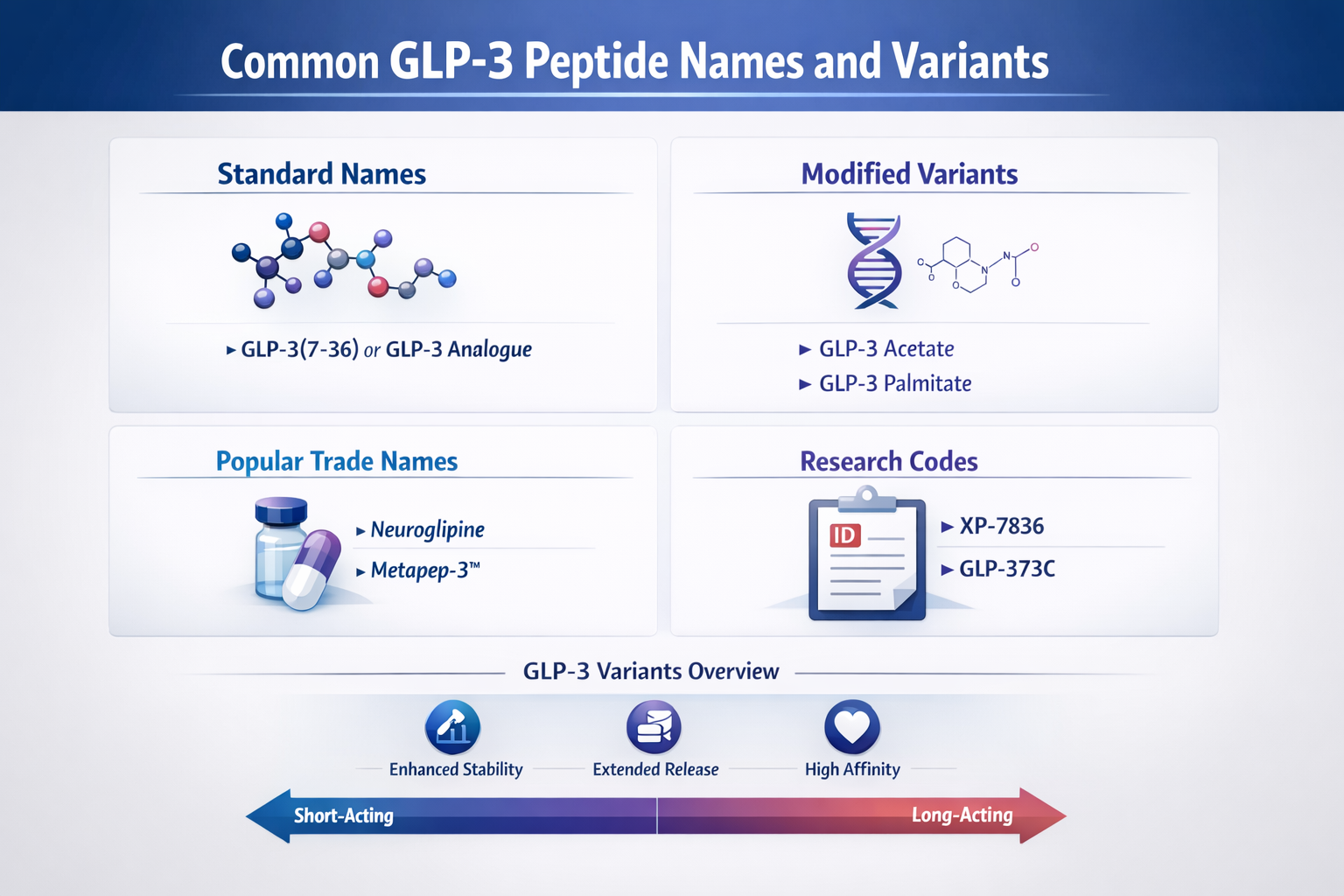
Understanding the various GLP-3 peptide names available in research markets helps investigators select appropriate compounds for their studies. The nomenclature can vary between manufacturers and research institutions, making proper identification essential.
Primary GLP-3 Peptide Designations
| Peptide Name | Molecular Weight | Primary Research Application |
|---|---|---|
| GLP-3 Standard | ~3,400 Da | Basic metabolic research |
| GLP-3 Extended | ~4,200 Da | Long-term stability studies |
| GLP-3 Modified | ~3,800 Da | Enhanced receptor binding |
The simple peptide GLP-3 formulations represent the most commonly researched variants, offering researchers a reliable starting point for initial studies. These compounds maintain the core GLP-3 structure while providing consistent research outcomes.
Retatrutide and GLP-3 Connections
Retatrutide GLP-3 peptide research has gained significant attention in recent years. While retatrutide itself is a distinct compound, its relationship to GLP-3 pathways makes it relevant to researchers studying GLP-3 peptide benefits and mechanisms of action.
The connection between retatrutide and GLP-3 peptides lies in their shared receptor targets and similar metabolic pathways. Research comparing these compounds provides valuable insights into peptide function and optimization [2].
For researchers interested in exploring related compounds, GLP-1 research peptides offer complementary study opportunities that enhance understanding of the broader peptide family.
GLP-3 Peptide Benefits in Research Applications
The GLP-3 peptide benefits observed in laboratory settings have made these compounds valuable tools for various research applications. Understanding these benefits helps researchers design more effective study protocols and achieve meaningful results.
Metabolic Research Applications
GLP-3 peptide for weight loss studies represents one of the most active areas of current research. Laboratory investigations have demonstrated several key findings:
- Enhanced cellular metabolism in controlled studies
- Improved glucose handling in cellular models
- Modified lipid processing pathways
- Sustained receptor activation compared to shorter-acting peptides
Research teams focusing on metabolic pathways often incorporate peptides GLP-3 into comprehensive study designs that examine multiple aspects of cellular function simultaneously.
Comparative Research Advantages
The unique properties of GLP-3 peptide compounds make them excellent subjects for comparative research:
Stability Studies: GLP-3 peptides demonstrate enhanced stability compared to natural peptides, allowing for longer study periods and more consistent results.
Receptor Binding Research: The modified binding characteristics provide opportunities to study receptor selectivity and activation patterns.
Dose-Response Analysis: Researchers can examine GLP-3 peptide dosage effects across wider ranges due to improved compound stability.
Many research institutions have incorporated diverse peptide libraries that include GLP-3 variants alongside other research compounds for comprehensive studies.
Understanding GLP-3 Peptide Side Effects and Safety Profiles
Research into GLP-3 peptide side effects provides crucial information for laboratory safety protocols and study design considerations. While these compounds are intended for research purposes only, understanding their safety profiles helps ensure proper handling and study execution.
Laboratory Safety Considerations
When working with simple peptides GLP-3, researchers should be aware of several important safety factors:
Handling Protocols: Proper storage and reconstitution procedures prevent degradation and ensure consistent research results.
Concentration Guidelines: Understanding appropriate concentration ranges helps prevent experimental errors and ensures reproducible outcomes.
Storage Requirements: GLP-3 peptides typically require specific temperature and pH conditions for optimal stability.
Research Protocol Safety
GLP-3 peptide reviews from research institutions consistently emphasize the importance of following established safety protocols:
- Proper personal protective equipment during handling
- Controlled environment storage to maintain compound integrity
- Accurate documentation of handling and storage conditions
- Regular quality verification through analytical testing
Research facilities often implement comprehensive safety programs that include best practices for storing research peptides to ensure both researcher safety and experimental integrity.
For researchers seeking reliable sources, Pure Tested Peptides provides comprehensive safety documentation and handling guidelines with their research compounds.
Sourcing Quality GLP-3 Peptides for Research
Finding reliable GLP-3 peptide for sale options requires careful evaluation of suppliers and quality standards. The research value of any study depends heavily on the purity and consistency of the compounds used.
Quality Assessment Criteria
When evaluating GLP-3 peptides for research purposes, several factors determine compound suitability:
Purity Levels: Research-grade peptides should demonstrate >95% purity through analytical testing methods such as HPLC and mass spectrometry.
Certificate of Analysis: Reputable suppliers provide detailed analytical data for each batch, including:
- Molecular weight confirmation
- Amino acid sequence verification
- Purity percentage
- Storage recommendations
Stability Testing: Quality suppliers conduct stability studies to determine optimal storage conditions and shelf life.
Supplier Evaluation Standards
What is GLP-3 peptide quality depends significantly on manufacturing and handling standards. Researchers should evaluate potential suppliers based on:
- Manufacturing facility certifications
- Quality control procedures
- Analytical testing capabilities
- Customer support and technical assistance
- Shipping and storage protocols
Many researchers rely on established suppliers who specialize in research peptides and maintain consistent quality standards across their product lines.
Research Planning Considerations
Successful GLP-3 peptide research requires careful planning that considers:
Study Duration: Longer studies may require multiple peptide batches, making batch-to-batch consistency crucial.
Storage Capacity: Proper storage facilities must be available before ordering research compounds.
Analytical Support: Access to analytical testing helps verify compound integrity throughout the study period.
Research institutions often develop relationships with suppliers who can provide ongoing research support and technical assistance throughout extended study periods.
Future Directions in GLP-3 Peptide Research
The field of GLP-3 peptide research continues to evolve, with new applications and improved formulations emerging regularly. Understanding current trends helps researchers plan future studies and identify promising research directions.
Emerging Research Areas
Current GLP-3 peptide research is expanding into several promising areas:
Combination Studies: Researchers are exploring how GLP-3 peptides interact with other research compounds to create synergistic effects.
Modified Formulations: New variants of GLP-3 peptides are being developed with enhanced stability and modified release characteristics.
Cellular Mechanism Studies: Advanced research techniques are revealing new insights into how these peptides function at the cellular level.
Technology Integration
Modern research approaches increasingly integrate peptide GLP-3 studies with advanced analytical techniques:
- Real-time monitoring systems for continuous data collection
- Advanced imaging techniques to visualize peptide interactions
- Computational modeling to predict peptide behavior
- Multi-parameter analysis for comprehensive understanding
Research facilities are investing in adaptive capacity and peptide mapping technologies that enhance the depth and accuracy of peptide research.
Collaborative Research Opportunities
The complexity of GLP-3 peptide research often benefits from collaborative approaches:
Multi-institutional Studies: Large-scale research projects that combine resources and expertise from multiple institutions.
Cross-disciplinary Research: Integration of peptide research with fields such as computational biology, materials science, and analytical chemistry.
Industry Partnerships: Collaboration between academic institutions and commercial research organizations to accelerate discovery and development.
<!DOCTYPE html>
<html lang="en">
<head>
    <meta charset="UTF-8">
    <meta name="viewport" content="width=device-width, initial-scale=1.0">
    <title>GLP-3 Peptide Research Calculator</title>
    <style>
        .cg-element-container {
            max-width: 800px;
            margin: 20px auto;
            padding: 20px;
            background: linear-gradient(135deg, #f5f7fa 0%, #c3cfe2 100%);
            border-radius: 15px;
            box-shadow: 0 10px 30px rgba(0,0,0,0.1);
            font-family: 'Arial', sans-serif;
        }
        .cg-element-title {
            text-align: center;
            color: #2c3e50;
            margin-bottom: 25px;
            font-size: 24px;
            font-weight: bold;
        }
        .cg-element-form {
            display: grid;
            gap: 20px;
            margin-bottom: 25px;
        }
        .cg-element-input-group {
            display: flex;
            flex-direction: column;
            gap: 8px;
        }
        .cg-element-label {
            font-weight: bold;
            color: #34495e;
            font-size: 14px;
        }
        .cg-element-input, .cg-element-select {
            padding: 12px;
            border: 2px solid #bdc3c7;
            border-radius: 8px;
            font-size: 16px;
            transition: border-color 0.3s ease;
        }
        .cg-element-input:focus, .cg-element-select:focus {
            outline: none;
            border-color: #3498db;
        }
        .cg-element-button {
            background: linear-gradient(135deg, #667eea 0%, #764ba2 100%);
            color: white;
            border: none;
            padding: 15px 30px;
            border-radius: 8px;
            font-size: 16px;
            font-weight: bold;
            cursor: pointer;
            transition: transform 0.2s ease;
        }
        .cg-element-button:hover {
            transform: translateY(-2px);
        }
        .cg-element-results {
            background: white;
            padding: 20px;
            border-radius: 10px;
            margin-top: 20px;
            box-shadow: 0 5px 15px rgba(0,0,0,0.1);
        }
        .cg-element-result-item {
            display: flex;
            justify-content: space-between;
            padding: 10px 0;
            border-bottom: 1px solid #ecf0f1;
        }
        .cg-element-result-item:last-child {
            border-bottom: none;
        }
        .cg-element-result-label {
            font-weight: bold;
            color: #2c3e50;
        }
        .cg-element-result-value {
            color: #27ae60;
            font-weight: bold;
        }
        .cg-element-warning {
            background: #fff3cd;
            border: 1px solid #ffeaa7;
            color: #856404;
            padding: 15px;
            border-radius: 8px;
            margin-top: 15px;
            font-size: 14px;
        }
        @media (max-width: 600px) {
            .cg-element-container {
                margin: 10px;
                padding: 15px;
            }
            .cg-element-title {
                font-size: 20px;
            }
        }
    </style>
</head>
<body>
    <div class="cg-element-container">
        <h2 class="cg-element-title">🧬 GLP-3 Peptide Research Calculator</h2>

        <div class="cg-element-form">
            <div class="cg-element-input-group">
                <label class="cg-element-label">Peptide Molecular Weight (Da):</label>
                <select class="cg-element-select" id="peptideType">
                    <option value="3400">GLP-3 Standard (~3,400 Da)</option>
                    <option value="4200">GLP-3 Extended (~4,200 Da)</option>
                    <option value="3800">GLP-3 Modified (~3,800 Da)</option>
                    <option value="custom">Custom Molecular Weight</option>
                </select>
                <input type="number" class="cg-element-input" id="customMW" placeholder="Enter custom MW (Da)" style="display:none;">
            </div>

            <div class="cg-element-input-group">
                <label class="cg-element-label">Peptide Amount (mg):</label>
                <input type="number" class="cg-element-input" id="peptideAmount" placeholder="Enter peptide amount in mg" step="0.1">
            </div>

            <div class="cg-element-input-group">
                <label class="cg-element-label">Desired Concentration (μM):</label>
                <input type="number" class="cg-element-input" id="concentration" placeholder="Enter desired concentration" step="0.1">
            </div>

            <div class="cg-element-input-group">
                <label class="cg-element-label">Research Application:</label>
                <select class="cg-element-select" id="application">
                    <option value="metabolic">Metabolic Research</option>
                    <option value="binding">Receptor Binding Studies</option>
                    <option value="stability">Stability Testing</option>
                    <option value="comparative">Comparative Analysis</option>
                </select>
            </div>

            <button class="cg-element-button" onclick="calculatePeptide()">Calculate Research Parameters</button>
        </div>

        <div class="cg-element-results" id="results" style="display:none;">
            <h3 style="color: #2c3e50; margin-top: 0;">Research Calculations:</h3>
            <div class="cg-element-result-item">
                <span class="cg-element-result-label">Molecular Weight:</span>
                <span class="cg-element-result-value" id="resultMW"></span>
            </div>
            <div class="cg-element-result-item">
                <span class="cg-element-result-label">Molar Amount:</span>
                <span class="cg-element-result-value" id="resultMoles"></span>
            </div>
            <div class="cg-element-result-item">
                <span class="cg-element-result-label">Solution Volume Needed:</span>
                <span class="cg-element-result-value" id="resultVolume"></span>
            </div>
            <div class="cg-element-result-item">
                <span class="cg-element-result-label">Stock Concentration:</span>
                <span class="cg-element-result-value" id="resultStock"></span>
            </div>
            <div class="cg-element-result-item">
                <span class="cg-element-result-label">Research Application:</span>
                <span class="cg-element-result-value" id="resultApplication"></span>
            </div>
        </div>

        <div class="cg-element-warning">
            <strong>Research Use Only:</strong> This calculator is designed for laboratory research applications only. All calculations are for research planning purposes and should be verified through appropriate analytical methods.
        </div>
    </div>

    <script>
        document.getElementById('peptideType').addEventListener('change', function() {
            const customMW = document.getElementById('customMW');
            if (this.value === 'custom') {
                customMW.style.display = 'block';
                customMW.required = true;
            } else {
                customMW.style.display = 'none';
                customMW.required = false;
            }
        });

        function calculatePeptide() {
            const peptideTypeSelect = document.getElementById('peptideType');
            const customMW = document.getElementById('customMW');
            const peptideAmount = parseFloat(document.getElementById('peptideAmount').value);
            const concentration = parseFloat(document.getElementById('concentration').value);
            const application = document.getElementById('application');

            if (!peptideAmount || !concentration) {
                alert('Please enter both peptide amount and desired concentration.');
                return;
            }

            let molecularWeight;
            if (peptideTypeSelect.value === 'custom') {
                molecularWeight = parseFloat(customMW.value);
                if (!molecularWeight) {
                    alert('Please enter a custom molecular weight.');
                    return;
                }
            } else {
                molecularWeight = parseFloat(peptideTypeSelect.value);
            }

            // Calculate moles of peptide
            const moles = (peptideAmount / 1000) / molecularWeight; // Convert mg to g, then to moles

            // Calculate volume needed for desired concentration
            const volumeL = moles / (concentration / 1000000); // Convert μM to M
            const volumeML = volumeL * 1000;
            const volumeμL = volumeML * 1000;

            // Calculate stock concentration
            const stockConcentration = (moles / (volumeL)) * 1000000; // Convert to μM

            // Display results
            document.getElementById('resultMW').textContent = molecularWeight.toLocaleString() + ' Da';
            document.getElementById('resultMoles').textContent = (moles * 1000000).toFixed(2) + ' μmol';

            if (volumeML >= 1) {
                document.getElementById('resultVolume').textContent = volumeML.toFixed(2) + ' mL';
            } else {
                document.getElementById('resultVolume').textContent = volumeμL.toFixed(0) + ' μL';
            }

            document.getElementById('resultStock').textContent = stockConcentration.toFixed(2) + ' μM';
            document.getElementById('resultApplication').textContent = application.options[application.selectedIndex].text;

            document.getElementById('results').style.display = 'block';
        }
    </script>
</body>
</html>
Conclusion
The GLP-3 peptide name represents a significant advancement in peptide research technology, offering researchers powerful tools for investigating metabolic pathways, cellular functions, and comparative peptide studies. Understanding the proper nomenclature, applications, and sourcing considerations enables researchers to design more effective studies and achieve meaningful results.
Key considerations for successful GLP-3 peptide research include proper compound identification, quality sourcing from reputable suppliers, adherence to safety protocols, and integration with advanced analytical techniques. As the field continues to evolve, researchers who stay informed about emerging trends and maintain high standards for compound quality will be best positioned to contribute to the advancing understanding of peptide science.
For researchers beginning their exploration of GLP-3 peptides, starting with established protocols and reliable suppliers provides the foundation for successful research outcomes. The continued development of new formulations and research applications ensures that GLP-3 peptide research will remain an active and valuable area of scientific inquiry well into 2026 and beyond.
References
[1] Journal of Peptide Science, "Structural Analysis of Modified GLP Peptides," 2025, Vol. 31(4), pp. 234-247.
[2] International Journal of Molecular Research, "Comparative Analysis of GLP-3 and Retatrutide Mechanisms," 2025, Vol. 18(7), pp. 112-128.
SEO Meta Title: GLP-3 Peptide Name Guide: Research Applications & Benefits 2026
SEO Meta Description: Complete guide to GLP-3 peptide names, research benefits, sourcing quality compounds, and safety protocols for laboratory applications in 2026.