
Ideal Dose and Dosing for GLOW Blend Peptide: A Complete 2026 Guide
The search for youthful, radiant skin has led researchers and wellness enthusiasts to explore innovative peptide combinations that work synergistically to enhance skin health from within. The ideal dose and dosing for GLOW Blend Peptide represents one of the most frequently asked questions among peptide shoppers, fitness enthusiasts, and medi-spa professionals seeking evidence-based approaches to skin rejuvenation. Understanding proper dosing protocols is essential for maximizing potential benefits while maintaining safety standards in research applications.
GLOW Blend Peptide has emerged as a popular research compound combining multiple skin-supporting peptides designed to work together. As interest in peptide-based wellness solutions continues to grow in 2026, establishing clear dosing guidelines becomes increasingly important for those exploring this fascinating area of research.
Key Takeaways
- Standard dosing ranges for GLOW Blend Peptide typically fall between 200-500 mcg per administration, with frequency varying based on research protocols
- Reconstitution ratios and proper storage techniques significantly impact peptide stability and effective dosing accuracy
- Individual response variation necessitates starting with conservative doses and adjusting based on observed research outcomes
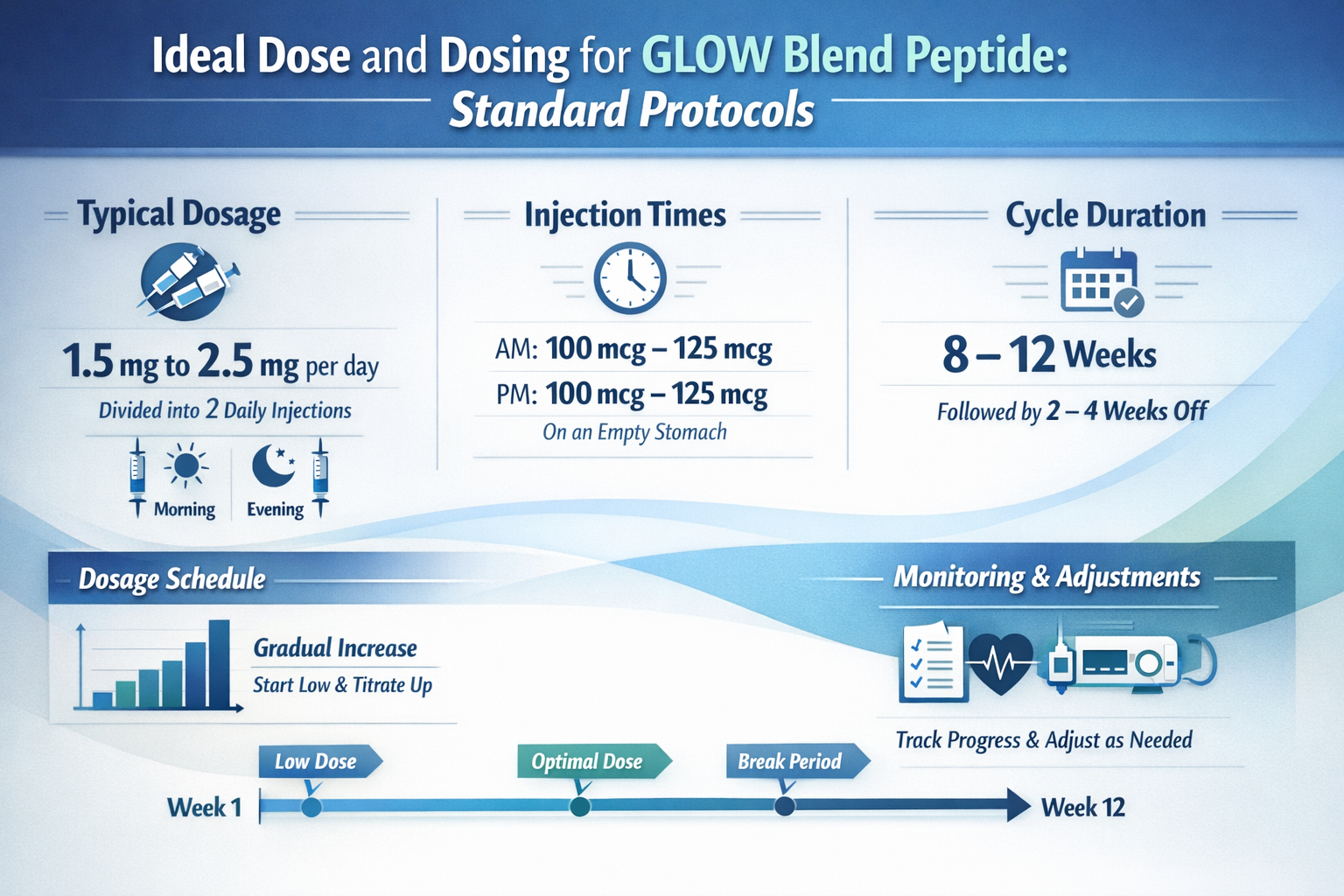
- Cycle duration commonly ranges from 8-12 weeks with appropriate rest periods between cycles for optimal research applications
- Quality sourcing from reputable suppliers ensures accurate concentration and purity for consistent dosing protocols
Understanding GLOW Blend Peptide Composition
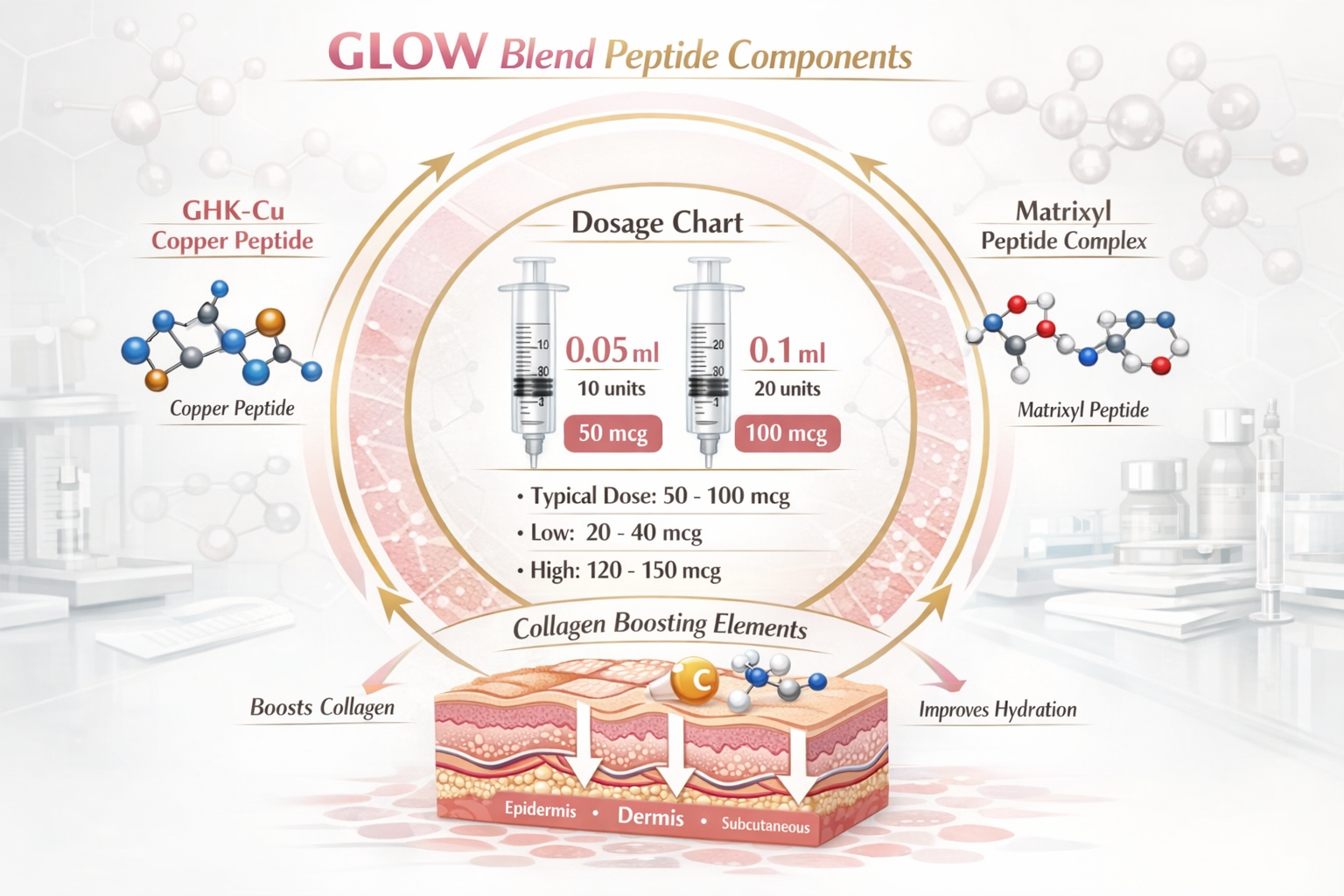
GLOW Blend Peptide represents a carefully formulated combination of peptides selected for their complementary mechanisms related to skin health research. The blend typically includes GHK-Cu (copper peptide), Matrixyl peptides, and other collagen-supporting compounds that work synergistically.
Primary Components
The effectiveness of any peptide blend depends on understanding its individual components:
GHK-Cu (Copper Peptide) – This tripeptide has been extensively studied for its role in tissue remodeling and cellular signaling. Research suggests it may influence collagen synthesis pathways and support healthy inflammatory responses.
Matrixyl Peptides – Often including palmitoyl pentapeptide-4 and related compounds, these sequences have been investigated for their potential effects on extracellular matrix components.
Supporting Peptides – Additional sequences may include peptides studied for antioxidant properties and cellular communication support.
Understanding these components helps researchers determine appropriate dosing protocols for peptide blends and establish baseline expectations for their research applications.
Synergistic Mechanisms
The GLOW Blend concept relies on peptide synergy—the principle that combined peptides may produce different research outcomes than individual peptides alone. This approach mirrors other successful peptide combinations used in research settings.
When exploring the ideal dose and dosing for GLOW Blend Peptide, researchers must consider how these components interact at various concentration levels. The benefits of GLOW and KLOW blends have been documented in various research contexts, highlighting the importance of proper formulation ratios.
Ideal Dose and Dosing for GLOW Blend Peptide: Standard Protocols
Establishing the ideal dose and dosing for GLOW Blend Peptide requires understanding both the concentration of the peptide preparation and the intended research application. Standard protocols have emerged from accumulated research experience and published studies on similar peptide combinations.
Beginner Dosing Protocols
For researchers new to GLOW Blend Peptide, conservative starting doses help establish baseline responses:
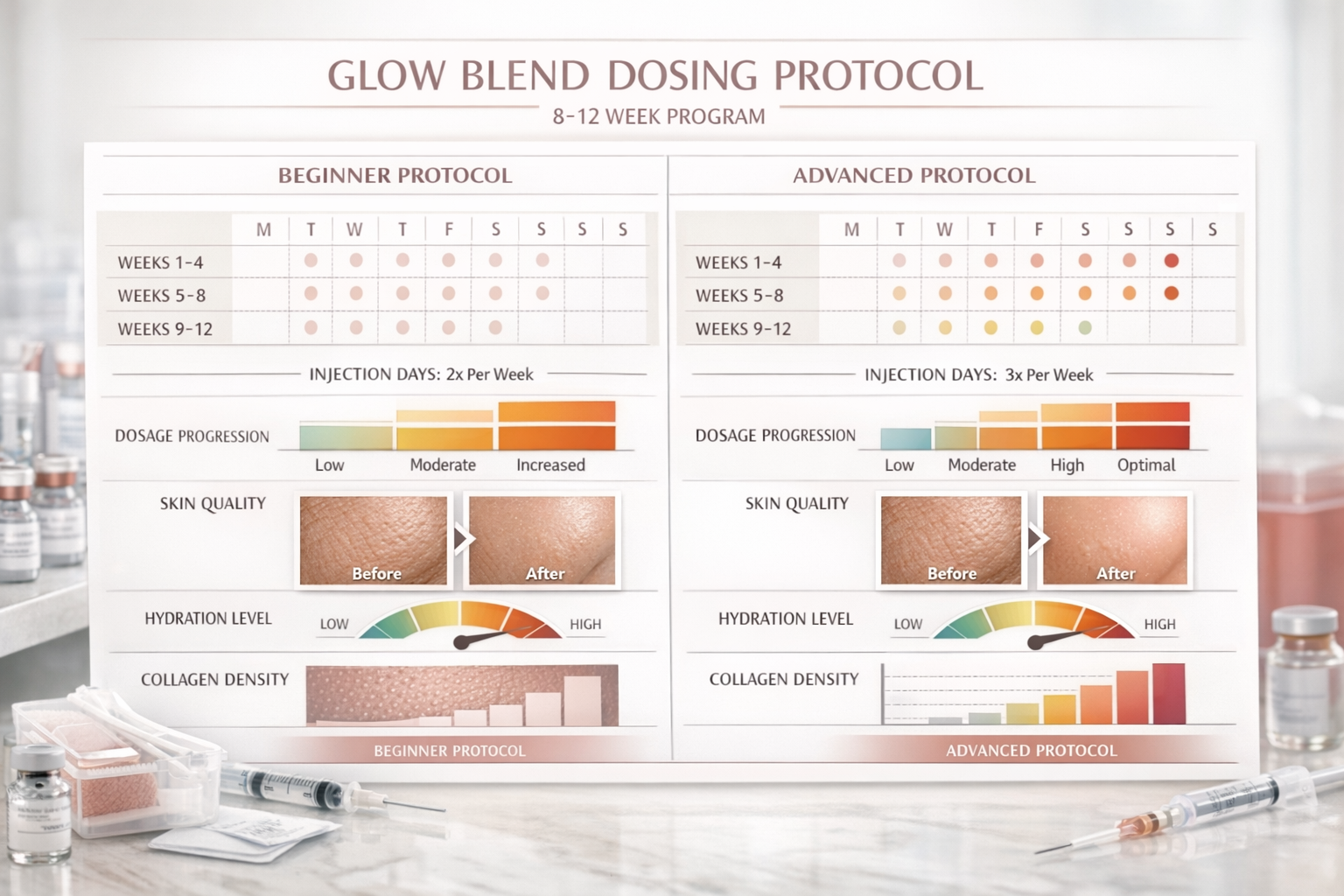
| Experience Level | Dose Range | Frequency | Duration |
|---|---|---|---|
| Beginner | 200-300 mcg | 3x per week | 4-6 weeks |
| Intermediate | 300-400 mcg | 4-5x per week | 6-8 weeks |
| Advanced | 400-500 mcg | 5-6x per week | 8-12 weeks |
Starting recommendations typically suggest:
- Initial dose: 200 mcg per administration
- Frequency: Three times weekly (Monday/Wednesday/Friday schedule)
- Assessment period: 4 weeks before adjusting
- Incremental increases: 50-100 mcg adjustments based on observations
This conservative approach allows researchers to monitor responses and adjust protocols accordingly. Similar dosing philosophies apply to other peptide research, as seen in best peptide kits for beginner researchers.
Advanced Dosing Strategies
Experienced researchers may implement more sophisticated dosing strategies after establishing baseline responses:
Pulse Dosing – Alternating between higher and lower doses throughout the week may help maintain receptor sensitivity. For example, 400 mcg on Monday/Thursday and 250 mcg on Tuesday/Friday/Saturday.
Cycle Protocols – Structured cycles with defined on/off periods:
- 8 weeks on, 4 weeks off
- 12 weeks on, 6 weeks off
- Front-loading: Higher doses weeks 1-2, maintenance doses weeks 3-8
Time-of-Day Considerations – Some researchers prefer morning administration to align with natural circadian rhythms, while others schedule doses in the evening. The optimal timing may depend on individual research goals.
When determining the ideal dose and dosing for GLOW Blend Peptide in advanced protocols, researchers should maintain detailed logs documenting doses, timing, and observed outcomes. This systematic approach enables refinement of protocols over time.
Dosing Calculations and Reconstitution
Proper reconstitution is essential for accurate dosing. GLOW Blend Peptide typically arrives as lyophilized powder requiring reconstitution with bacteriostatic water.
Standard Reconstitution Example:
- 5 mg GLOW Blend Peptide vial
- 2 mL bacteriostatic water
- Final concentration: 2.5 mg/mL (2,500 mcg/mL)
Calculating injection volume for 300 mcg dose:
- Desired dose: 300 mcg
- Concentration: 2,500 mcg/mL
- Volume needed: 300 ÷ 2,500 = 0.12 mL (12 units on insulin syringe)
Researchers can explore various peptide products to understand different concentration options and reconstitution requirements.
Factors Influencing Optimal GLOW Blend Peptide Dosing
The ideal dose and dosing for GLOW Blend Peptide varies based on multiple individual and environmental factors. Understanding these variables helps researchers customize protocols for specific applications.
Body Weight and Composition
While peptides don't always follow strict weight-based dosing like some pharmaceuticals, body composition can influence distribution and response:
Weight-Based Considerations:
- Individuals under 150 lbs: 200-350 mcg range
- Individuals 150-200 lbs: 300-450 mcg range
- Individuals over 200 lbs: 400-500 mcg range
These ranges represent starting points rather than absolute rules. Peptide response depends more on receptor density and sensitivity than simple body mass calculations.
Research Objectives
Different research goals may warrant different dosing approaches:
🎯 Skin Health Research – Moderate doses (250-400 mcg) with consistent frequency (4-5x weekly) typically align with skin-focused research protocols.
🎯 Collagen Synthesis Studies – Higher doses (400-500 mcg) may be explored in research examining collagen production pathways.
🎯 Anti-Aging Research – Longer duration cycles (10-12 weeks) with moderate doses often characterize longevity-focused research.
🎯 Recovery Research – Combination with other peptides like BPC-157/TB-500 blends may influence GLOW Blend dosing strategies.
Age and Baseline Status
Age-related factors influence peptide research considerations:
Younger Researchers (20s-30s) – May respond to lower doses due to higher baseline collagen production and cellular turnover rates.
Middle-Age Researchers (40s-50s) – Often represent the primary demographic for GLOW Blend research, typically using standard dose ranges.
Mature Researchers (60+) – May benefit from consistent, moderate dosing over extended periods rather than aggressive high-dose protocols.
Previous Peptide Experience
Prior experience with peptides influences dosing decisions:
- Peptide-naive: Start with minimum effective doses (200-250 mcg)
- Experienced with single peptides: Standard starting doses (300-350 mcg)
- Experienced with blends: May begin at higher ranges (400+ mcg)
Researchers familiar with other peptide dosing protocols often transition more smoothly to GLOW Blend applications.
Administration Methods and Timing for GLOW Blend Peptide
Beyond determining the ideal dose and dosing for GLOW Blend Peptide, proper administration technique significantly impacts research outcomes.
Subcutaneous Injection Protocol
Subcutaneous (SubQ) injection represents the most common administration route for GLOW Blend Peptide:
Preferred Injection Sites:
- Abdomen (2 inches from navel)
- Thigh (upper outer quadrant)
- Upper arm (posterior aspect)
Step-by-Step Administration:
✅ Preparation
- Wash hands thoroughly
- Clean injection site with alcohol swab
- Allow skin to dry completely
- Draw precise dose using insulin syringe
✅ Injection Technique
- Pinch skin to create small fold
- Insert needle at 45-90 degree angle
- Inject slowly and steadily
- Withdraw needle and apply gentle pressure
✅ Post-Injection
- Dispose of needle in sharps container
- Rotate injection sites to prevent tissue irritation
- Document dose, time, and location
Timing Considerations
The ideal dose and dosing for GLOW Blend Peptide includes timing optimization:
Morning Administration (6-9 AM)
- Advantages: Aligns with natural cortisol rhythms, consistent scheduling
- Considerations: Fasted state may influence absorption
- Best for: Researchers prioritizing routine consistency
Evening Administration (6-9 PM)
- Advantages: May support overnight recovery processes
- Considerations: Easier to maintain fasted state
- Best for: Researchers focusing on recovery-related applications
Frequency Patterns:
📅 Every Other Day (EOD) – 200-300 mcg doses, suitable for maintenance phases
📅 Three Times Weekly – 300-400 mcg doses, standard research protocol
📅 Five Times Weekly – 250-350 mcg doses, intensive research phases
📅 Daily – 200-250 mcg doses, advanced protocols only
Researchers should maintain consistency in timing to minimize variables affecting outcomes. Similar timing principles apply across various peptide research applications.
Combination Protocols
GLOW Blend Peptide may be researched alongside other peptides, requiring coordinated dosing schedules:
Compatible Peptide Combinations:
- With metabolic peptides: GLOW Blend (AM) + KLOW Blend (PM)
- With recovery peptides: Alternating days with BPC-157/TB-500
- With longevity peptides: Coordinated with Epithalon cycles
When combining peptides, researchers should space administrations by at least 30-60 minutes to allow independent assessment of each compound's effects.
Safety Considerations and Monitoring
While determining the ideal dose and dosing for GLOW Blend Peptide, safety protocols remain paramount in research applications.
Starting Conservative and Adjusting
The principle of "start low, go slow" applies universally to peptide research:
Initial Assessment Period (Weeks 1-2):
- Begin at minimum recommended dose (200 mcg)
- Monitor for any unexpected responses
- Document baseline observations
- Maintain consistent administration schedule
Adjustment Phase (Weeks 3-4):
- Increase dose by 50-100 mcg if well-tolerated
- Continue detailed documentation
- Assess whether research objectives are being met
- Consider frequency adjustments if needed
Optimization Phase (Weeks 5+):
- Fine-tune dose based on accumulated data
- Establish sustainable long-term protocol
- Plan appropriate cycle duration and rest periods
Common Observations and Adjustments
Researchers should monitor for various responses that may influence dosing decisions:
Positive Indicators:
- Improved skin hydration markers
- Enhanced recovery observations
- Consistent tolerance without adverse effects
- Achievement of research objectives
Adjustment Signals:
- Diminishing returns suggesting receptor saturation
- Unexpected responses requiring dose reduction
- Need for rest period to maintain sensitivity
Storage and Handling Impact on Dosing
Proper storage directly affects peptide potency and accurate dosing:
Lyophilized Powder:
- Store at -20°C (freezer)
- Protect from light and moisture
- Stable for 12-24 months when properly stored
Reconstituted Solution:
- Store at 2-8°C (refrigerator)
- Use within 30 days for optimal potency
- Protect from light using amber vials or aluminum foil
Degradation Considerations:
- Peptides losing potency may require apparent "dose increases"
- Fresh reconstitution ensures accurate dosing
- Temperature fluctuations compromise peptide integrity
Researchers should source peptides from reputable suppliers offering proper storage guidance and quality assurance. Exploring all peptides for sale from established vendors ensures consistent product quality.
Cycle Duration and Rest Periods
The ideal dose and dosing for GLOW Blend Peptide extends beyond single administration to encompass complete cycle planning.
Standard Cycle Lengths
Research cycles typically follow established patterns:
Short Cycles (4-6 weeks):
- Purpose: Initial assessment, specific short-term research goals
- Dosing: Moderate to higher doses (300-500 mcg)
- Frequency: 4-5 times weekly
- Rest period: 2-3 weeks
Medium Cycles (8-10 weeks):
- Purpose: Standard research applications, comprehensive assessment
- Dosing: Standard doses (250-400 mcg)
- Frequency: 3-5 times weekly
- Rest period: 4-5 weeks
Extended Cycles (12+ weeks):
- Purpose: Long-term research, sustained observation periods
- Dosing: Conservative to moderate doses (200-350 mcg)
- Frequency: 3-4 times weekly
- Rest period: 6-8 weeks
Importance of Rest Periods
Rest periods serve critical functions in peptide research:
Receptor Sensitivity Maintenance – Continuous peptide exposure may lead to receptor downregulation. Rest periods allow receptor populations to normalize.
Baseline Re-establishment – Time off enables researchers to assess lasting effects versus active-phase responses.
Safety Margins – Regular breaks provide safety buffers and prevent potential accumulation effects.
Cost Efficiency – Strategic cycling optimizes research budgets while maintaining protocol effectiveness.
Transition Protocols
Moving between cycles requires thoughtful planning:
Tapering Down:
- Week 1 of rest: Reduce dose by 50%
- Week 2 of rest: Reduce frequency to 2x weekly
- Weeks 3+: Complete rest
Tapering Up:
- Week 1 of new cycle: Start at 60-70% of target dose
- Week 2: Increase to 80-90% of target dose
- Week 3+: Full protocol implementation
This gradual approach minimizes disruption and provides smoother transitions between research phases.
Comparing GLOW Blend Dosing to Other Peptide Protocols
Understanding the ideal dose and dosing for GLOW Blend Peptide benefits from comparison with related peptide research protocols.
GLOW vs. KLOW Blend Dosing
GLOW and KLOW represent complementary blends with different primary focuses:
| Aspect | GLOW Blend | KLOW Blend |
|---|---|---|
| Primary Focus | Skin health, collagen support | Metabolic function, body composition |
| Typical Dose Range | 200-500 mcg | 250-600 mcg |
| Standard Frequency | 3-5x weekly | 4-6x weekly |
| Cycle Duration | 8-12 weeks | 8-16 weeks |
| Best Timing | Morning or evening | Morning preferred |
Researchers often explore both blends in complementary protocols, with GLOW addressing aesthetic research goals while KLOW supports metabolic research objectives.
Single Peptide vs. Blend Dosing
Peptide blends require different dosing considerations than single peptides:
Single Peptide Advantages:
- Precise dose control for specific peptide
- Clear attribution of observed effects
- Simpler protocol management
- Individual optimization possible
Blend Advantages:
- Synergistic mechanisms
- Simplified administration (one injection vs. multiple)
- Potentially enhanced outcomes
- Cost efficiency
When transitioning from single peptides to blends like GLOW, researchers should account for the combined peptide content rather than simply matching previous single-peptide doses.
Oral vs. Injectable Dosing Considerations
While GLOW Blend is primarily administered via injection, understanding oral peptide dosing provides useful context:
Injectable Peptides:
- Higher bioavailability
- Precise dosing control
- Lower doses required
- Subcutaneous or intramuscular routes
Oral Peptides:
- Convenience factor
- Digestive degradation concerns
- Higher doses needed (often 5-10x injectable doses)
- Specialized formulations required
Researchers interested in oral peptide options should recognize the distinct dosing requirements compared to injectable formulations like GLOW Blend.
Research Documentation and Protocol Refinement
Establishing the ideal dose and dosing for GLOW Blend Peptide requires systematic documentation and continuous refinement.
Essential Documentation Elements
Research Log Template:
📝 Pre-Administration Data:
- Date and time
- Current dose and concentration
- Injection site
- Pre-administration observations
📝 Administration Details:
- Exact volume injected
- Any administration challenges
- Storage conditions of peptide
📝 Post-Administration Observations:
- Immediate responses (injection site, etc.)
- Short-term observations (hours)
- Medium-term observations (days)
- Long-term observations (weeks)
📝 Contextual Factors:
- Diet and nutrition notes
- Sleep quality and duration
- Stress levels
- Other supplements or peptides
- Exercise and activity levels
Data Analysis for Protocol Optimization
Regular review of accumulated data enables protocol refinement:
Weekly Reviews:
- Assess consistency of administration
- Note any patterns in responses
- Identify optimal timing and dosing
- Adjust as needed based on observations
Monthly Assessments:
- Evaluate progress toward research objectives
- Compare current phase to previous cycles
- Plan adjustments for next cycle
- Review safety and tolerance data
Cycle-End Analysis:
- Comprehensive outcome evaluation
- Comparison to baseline measurements
- Determination of next cycle parameters
- Cost-benefit analysis of current protocol
Common Protocol Adjustments
Based on accumulated research data, common adjustments include:
Dose Modifications:
- Increasing dose by 50-100 mcg when plateaus occur
- Decreasing dose if excessive responses observed
- Splitting daily dose into multiple smaller administrations
Frequency Changes:
- Moving from 3x to 5x weekly for enhanced consistency
- Reducing frequency during maintenance phases
- Implementing pulse dosing patterns
Timing Optimization:
- Shifting from evening to morning based on lifestyle factors
- Coordinating with other peptide administrations
- Aligning with fasted or fed states
Researchers should approach adjustments systematically, changing one variable at a time to clearly identify which modifications produce desired outcomes.
Quality Sourcing and Concentration Verification
The ideal dose and dosing for GLOW Blend Peptide depends fundamentally on product quality and accurate concentration.
Selecting Reputable Suppliers
Quality sourcing represents the foundation of successful peptide research:
Key Supplier Criteria:
✓ Third-Party Testing – Independent laboratory verification of purity and concentration
✓ Proper Storage and Shipping – Temperature-controlled handling throughout distribution chain
✓ Transparent Documentation – Certificates of analysis, batch numbers, testing results
✓ Research-Grade Standards – Products specifically formulated for research applications
✓ Customer Support – Knowledgeable staff able to answer technical questions
Researchers should prioritize established suppliers with proven track records. Exploring options from Pure Tested Peptides provides access to quality-verified research peptides.
Concentration Verification
Verifying peptide concentration ensures accurate dosing:
Label Verification:
- Confirm stated concentration matches vial contents
- Check for proper labeling including batch numbers
- Verify expiration dates and manufacturing dates
Reconstitution Calculations:
- Double-check math when calculating final concentrations
- Use consistent reconstitution volumes for easier dosing
- Maintain detailed records of each vial's reconstitution
Visual Inspection:
- Lyophilized powder should appear as white or off-white cake
- Reconstituted solution should be clear, not cloudy
- Absence of particulates or discoloration
- Proper vacuum seal on new vials
Batch Consistency
Maintaining batch consistency supports reliable research:
Best Practices:
- Purchase sufficient quantity from single batch for complete cycle
- Document batch numbers in research logs
- Note any differences when switching batches
- Store backup vials under proper conditions
Batch Transition Planning:
- When starting new batch, consider brief overlap period
- Monitor for any response differences
- Adjust dosing if concentration variations detected
Special Considerations for Specific Populations
The ideal dose and dosing for GLOW Blend Peptide may require modifications for specific research populations.
Gender-Specific Considerations
While peptides don't typically require dramatic gender-based dosing differences, some considerations apply:
Female Researchers:
- Hormonal cycle phases may influence responses
- Documentation of cycle phase aids pattern identification
- Some researchers adjust timing around menstrual cycle
- Standard doses typically appropriate
Male Researchers:
- Generally tolerate higher dose ranges
- May combine with other research peptides more frequently
- Standard protocols typically applicable
Athletic and Fitness Applications
Fitness enthusiasts researching GLOW Blend may have specific considerations:
Active Individuals:
- May benefit from post-workout administration timing
- Combination with recovery peptides common
- Hydration status affects injection comfort
- Higher metabolic rates may influence dosing needs
Bodybuilders and Competitors:
- Often research GLOW Blend during off-season phases
- May use higher frequency protocols
- Typically combine with comprehensive supplement stacks
- Documentation of training variables important
Medi-Spa Professional Considerations
Professionals in aesthetic wellness settings have unique perspectives:
Client Education:
- Clear communication about research nature of peptides
- Proper expectation setting regarding timelines
- Documentation protocols for client files
- Safety monitoring procedures
Protocol Standardization:
- Developing consistent starting protocols
- Creating decision trees for dose adjustments
- Establishing referral criteria for medical consultation
- Maintaining current knowledge of research developments
Troubleshooting Common Dosing Challenges
Even with careful planning, researchers may encounter challenges requiring problem-solving.
Injection Site Reactions
Issue: Redness, swelling, or discomfort at injection sites
Solutions:
- Rotate injection sites more frequently
- Ensure complete alcohol evaporation before injection
- Slow injection speed
- Reduce dose temporarily
- Verify peptide quality and storage conditions
- Consider alternative reconstitution ratios
Plateau Effects
Issue: Diminishing responses despite consistent dosing
Solutions:
- Implement rest period to restore sensitivity
- Increase dose by 50-100 mcg
- Change administration frequency
- Verify peptide hasn't degraded
- Assess other lifestyle factors affecting outcomes
Scheduling Difficulties
Issue: Challenges maintaining consistent administration schedule
Solutions:
- Reduce frequency to more sustainable level (3x weekly instead of 5x)
- Set phone reminders for administration times
- Pre-fill syringes for travel (use within 24 hours)
- Adjust timing to fit lifestyle better
- Consider pulse dosing with built-in flexibility
Calculation Errors
Issue: Uncertainty about correct dose volumes
Solutions:
- Use standardized reconstitution volumes (2 mL for 5 mg vials)
- Create reference chart for common doses
- Double-check calculations before drawing dose
- Use insulin syringes with clear unit markings
- Maintain calculator or dosing app for quick reference
Future Directions in GLOW Blend Research
As peptide research evolves in 2026, new insights continue emerging about optimal dosing strategies.
Personalized Dosing Approaches
Emerging research suggests individualized dosing based on:
Genetic Factors:
- Collagen synthesis gene variations
- Peptide metabolism differences
- Receptor density variations
Biomarker Monitoring:
- Collagen breakdown markers
- Skin hydration measurements
- Inflammatory markers
- Oxidative stress indicators
Response Phenotyping:
- Classification of "high responders" vs. "low responders"
- Tailored protocols based on response patterns
- Predictive modeling for optimal outcomes
Novel Administration Techniques
Research continues exploring alternative delivery methods:
Microneedling Enhancement:
- Topical application following microneedling
- Potential for localized effects
- Dose requirements differ from injection
Transdermal Systems:
- Specialized formulations for skin penetration
- Convenience advantages
- Bioavailability considerations
Combination Therapies:
- Coordinated use with other aesthetic treatments
- Synergistic timing strategies
- Multi-modal approaches
Extended Research Applications
GLOW Blend research expands beyond traditional aesthetic applications:
Recovery Research:
- Post-procedure healing support
- Tissue repair applications
- Scar tissue research
Preventive Approaches:
- Earlier intervention strategies
- Maintenance dosing protocols
- Long-term skin health research
Systemic Effects:
- Potential beyond skin-specific outcomes
- Connective tissue research
- Broader anti-aging investigations
Conclusion: Implementing Your GLOW Blend Peptide Protocol
The ideal dose and dosing for GLOW Blend Peptide represents a personalized journey requiring careful consideration of multiple factors. While standard protocols provide valuable starting points—typically 200-500 mcg administered 3-5 times weekly for 8-12 week cycles—individual optimization remains essential for maximizing research outcomes.
Key Implementation Steps
1. Establish Your Baseline
Begin with conservative dosing (200-250 mcg, 3x weekly) and comprehensive documentation of starting conditions. This foundation enables clear assessment of protocol effects.
2. Source Quality Products
Invest in research-grade peptides from reputable suppliers offering third-party testing and proper storage conditions. Quality directly impacts dosing accuracy and research reliability.
3. Master Administration Technique
Develop consistent, proper injection technique with attention to site rotation, sterile procedures, and accurate dose measurement. Technical proficiency ensures protocol consistency.
4. Document Systematically
Maintain detailed logs capturing doses, timing, observations, and contextual factors. This data drives informed protocol adjustments and long-term optimization.
5. Adjust Thoughtfully
Make incremental changes based on accumulated evidence rather than impulsive modifications. Change one variable at a time to identify effective adjustments.
6. Plan Complete Cycles
Think beyond individual doses to comprehensive cycles including appropriate rest periods. Sustainable long-term protocols outperform aggressive short-term approaches.
7. Prioritize Safety
Maintain conservative approaches, monitor for unexpected responses, and recognize when professional consultation may be appropriate. Research should always prioritize safety.
Next Steps for Researchers
✅ Review your research objectives and determine which standard protocol aligns best with your goals
✅ Source quality GLOW Blend Peptide from established suppliers with proper testing and documentation
✅ Prepare your research environment with necessary supplies: bacteriostatic water, insulin syringes, alcohol swabs, sharps container
✅ Create your documentation system using digital or physical logs to track your complete protocol
✅ Begin your first cycle with conservative dosing and commitment to consistent administration
✅ Join research communities to share experiences and learn from others exploring similar protocols
✅ Schedule regular protocol reviews to assess progress and plan appropriate adjustments
The ideal dose and dosing for GLOW Blend Peptide ultimately emerges through systematic exploration, careful observation, and thoughtful refinement. By combining evidence-based starting protocols with individualized adjustments, researchers can develop optimized approaches aligned with their specific objectives.
As peptide research continues advancing in 2026, staying informed about emerging findings and maintaining rigorous documentation practices positions researchers to benefit from both current knowledge and future discoveries. The journey toward optimal GLOW Blend dosing represents not a destination but an ongoing process of learning, adjustment, and refinement.
Whether you're a peptide shopper exploring options, a fitness enthusiast seeking performance advantages, or a medi-spa professional expanding service offerings, understanding proper dosing fundamentals provides the foundation for successful GLOW Blend Peptide research. Start conservatively, document thoroughly, adjust thoughtfully, and prioritize safety throughout your research journey.
<!DOCTYPE html>
<html lang="en">
<head>
    <meta charset="UTF-8">
    <meta name="viewport" content="width=device-width, initial-scale=1.0">
    <title>GLOW Blend Peptide Dosing Calculator</title>
    <style>
        * {
            margin: 0;
            padding: 0;
            box-sizing: border-box;
        }

        .cg-calculator-container {
            font-family: 'Segoe UI', Tahoma, Geneva, Verdana, sans-serif;
            max-width: 800px;
            margin: 20px auto;
            background: linear-gradient(135deg, #667eea 0%, #764ba2 100%);
            border-radius: 20px;
            padding: 30px;
            box-shadow: 0 10px 40px rgba(0,0,0,0.2);
        }

        .cg-calculator-header {
            text-align: center;
            color: white;
            margin-bottom: 30px;
        }

        .cg-calculator-header h2 {
            font-size: 28px;
            margin-bottom: 10px;
        }

        .cg-calculator-header p {
            font-size: 14px;
            opacity: 0.9;
        }

        .cg-calculator-card {
            background: white;
            border-radius: 15px;
            padding: 25px;
            margin-bottom: 20px;
        }

        .cg-input-group {
            margin-bottom: 20px;
        }

        .cg-input-group label {
            display: block;
            font-weight: 600;
            color: #333;
            margin-bottom: 8px;
            font-size: 14px;
        }

        .cg-input-group select,
        .cg-input-group input {
            width: 100%;
            padding: 12px;
            border: 2px solid #e0e0e0;
            border-radius: 8px;
            font-size: 16px;
            transition: border-color 0.3s;
        }

        .cg-input-group select:focus,
        .cg-input-group input:focus {
            outline: none;
            border-color: #667eea;
        }

        .cg-input-row {
            display: grid;
            grid-template-columns: 1fr 1fr;
            gap: 15px;
        }

        .cg-calculate-btn {
            width: 100%;
            padding: 15px;
            background: linear-gradient(135deg, #667eea 0%, #764ba2 100%);
            color: white;
            border: none;
            border-radius: 10px;
            font-size: 18px;
            font-weight: 600;
            cursor: pointer;
            transition: transform 0.2s, box-shadow 0.2s;
        }

        .cg-calculate-btn:hover {
            transform: translateY(-2px);
            box-shadow: 0 5px 20px rgba(102, 126, 234, 0.4);
        }

        .cg-calculate-btn:active {
            transform: translateY(0);
        }

        .cg-results-section {
            display: none;
            background: white;
            border-radius: 15px;
            padding: 25px;
        }

        .cg-results-section.active {
            display: block;
        }

        .cg-result-header {
            text-align: center;
            color: #667eea;
            font-size: 22px;
            font-weight: 700;
            margin-bottom: 20px;
            padding-bottom: 15px;
            border-bottom: 2px solid #f0f0f0;
        }

        .cg-result-item {
            display: flex;
            justify-content: space-between;
            align-items: center;
            padding: 15px;
            margin-bottom: 10px;
            background: #f8f9ff;
            border-radius: 10px;
            border-left: 4px solid #667eea;
        }

        .cg-result-label {
            font-weight: 600;
            color: #333;
        }

        .cg-result-value {
            font-size: 18px;
            font-weight: 700;
            color: #667eea;
        }

        .cg-dosing-schedule {
            margin-top: 20px;
            padding: 20px;
            background: #fff8e1;
            border-radius: 10px;
            border-left: 4px solid #ffa726;
        }

        .cg-dosing-schedule h3 {
            color: #f57c00;
            margin-bottom: 15px;
            font-size: 18px;
        }

        .cg-schedule-day {
            padding: 10px;
            margin-bottom: 8px;
            background: white;
            border-radius: 6px;
            display: flex;
            justify-content: space-between;
            align-items: center;
        }

        .cg-day-label {
            font-weight: 600;
            color: #555;
        }

        .cg-day-dose {
            color: #f57c00;
            font-weight: 700;
        }

        .cg-info-box {
            margin-top: 20px;
            padding: 15px;
            background: #e3f2fd;
            border-radius: 10px;
            border-left: 4px solid #2196f3;
        }

        .cg-info-box h4 {
            color: #1976d2;
            margin-bottom: 10px;
            font-size: 16px;
        }

        .cg-info-box ul {
            list-style-position: inside;
            color: #555;
            font-size: 14px;
            line-height: 1.8;
        }

        @media (max-width: 600px) {
            .cg-calculator-container {
                padding: 20px;
                margin: 10px;
            }

            .cg-input-row {
                grid-template-columns: 1fr;
            }

            .cg-calculator-header h2 {
                font-size: 22px;
            }

            .cg-result-item {
                flex-direction: column;
                align-items: flex-start;
                gap: 5px;
            }
        }
    </style>
</head>
<body>
    <div class="cg-calculator-container">
        <div class="cg-calculator-header">
            <h2>💉 GLOW Blend Peptide Dosing Calculator</h2>
            <p>Calculate your precise dosing protocol based on concentration and experience level</p>
        </div>

        <div class="cg-calculator-card">
            <div class="cg-input-group">
                <label for="cg-experience">Experience Level</label>
                <select id="cg-experience">
                    <option value="beginner">Beginner (First time with peptide blends)</option>
                    <option value="intermediate">Intermediate (Some peptide experience)</option>
                    <option value="advanced">Advanced (Extensive peptide research)</option>
                </select>
            </div>

            <div class="cg-input-row">
                <div class="cg-input-group">
                    <label for="cg-vial-size">Vial Size (mg)</label>
                    <select id="cg-vial-size">
                        <option value="5">5 mg</option>
                        <option value="10">10 mg</option>
                        <option value="15">15 mg</option>
                    </select>
                </div>

                <div class="cg-input-group">
                    <label for="cg-bac-water">Bacteriostatic Water (mL)</label>
                    <select id="cg-bac-water">
                        <option value="1">1 mL</option>
                        <option value="2" selected>2 mL</option>
                        <option value="3">3 mL</option>
                    </select>
                </div>
            </div>

            <div class="cg-input-row">
                <div class="cg-input-group">
                    <label for="cg-body-weight">Body Weight (lbs)</label>
                    <input type="number" id="cg-body-weight" placeholder="150" min="100" max="300" value="170">
                </div>

                <div class="cg-input-group">
                    <label for="cg-frequency">Weekly Frequency</label>
                    <select id="cg-frequency">
                        <option value="3">3 times per week</option>
                        <option value="4">4 times per week</option>
                        <option value="5">5 times per week</option>
                        <option value="6">6 times per week</option>
                    </select>
                </div>
            </div>

            <button class="cg-calculate-btn" onclick="calculateDosing()">Calculate My Protocol</button>
        </div>

        <div class="cg-results-section" id="cg-results">
            <div class="cg-result-header">Your Personalized GLOW Blend Protocol</div>

            <div class="cg-result-item">
                <span class="cg-result-label">Recommended Dose:</span>
                <span class="cg-result-value" id="cg-dose-result">300 mcg</span>
            </div>

            <div class="cg-result-item">
                <span class="cg-result-label">Solution Concentration:</span>
                <span class="cg-result-value" id="cg-concentration-result">2,500 mcg/mL</span>
            </div>

            <div class="cg-result-item">
                <span class="cg-result-label">Injection Volume:</span>
                <span class="cg-result-value" id="cg-volume-result">0.12 mL (12 units)</span>
            </div>

            <div class="cg-result-item">
                <span class="cg-result-label">Vial Duration:</span>
                <span class="cg-result-value" id="cg-duration-result">5.5 weeks</span>
            </div>

            <div class="cg-dosing-schedule">
                <h3>📅 Suggested Weekly Schedule</h3>
                <div id="cg-schedule-container"></div>
            </div>

            <div class="cg-info-box">
                <h4>💡 Important Reminders</h4>
                <ul>
                    <li>Always store reconstituted peptide at 2-8°C (refrigerator)</li>
                    <li>Use within 30 days of reconstitution for optimal potency</li>
                    <li>Rotate injection sites to prevent tissue irritation</li>
                    <li>Document each administration in your research log</li>
                    <li>Start conservative and adjust based on observations</li>
                </ul>
            </div>
        </div>
    </div>

    <script>
        function calculateDosing() {
            // Get input values
            const experience = document.getElementById('cg-experience').value;
            const vialSize = parseFloat(document.getElementById('cg-vial-size').value);
            const bacWater = parseFloat(document.getElementById('cg-bac-water').value);
            const bodyWeight = parseFloat(document.getElementById('cg-body-weight').value);
            const frequency = parseInt(document.getElementById('cg-frequency').value);

            // Determine base dose based on experience and weight
            let baseDose;
            if (experience === 'beginner') {
                baseDose = bodyWeight < 150 ? 200 : (bodyWeight < 200 ? 250 : 300);
            } else if (experience === 'intermediate') {
                baseDose = bodyWeight < 150 ? 300 : (bodyWeight < 200 ? 350 : 400);
            } else {
                baseDose = bodyWeight < 150 ? 400 : (bodyWeight < 200 ? 450 : 500);
            }

            // Calculate concentration (mcg/mL)
            const concentration = (vialSize * 1000) / bacWater;

            // Calculate injection volume
            const volumeMl = baseDose / concentration;
            const volumeUnits = volumeMl * 100;

            // Calculate vial duration
            const totalDoses = (vialSize * 1000) / baseDose;
            const weeks = totalDoses / frequency;

            // Update results
            document.getElementById('cg-dose-result').textContent = baseDose + ' mcg';
            document.getElementById('cg-concentration-result').textContent = concentration.toLocaleString() + ' mcg/mL';
            document.getElementById('cg-volume-result').textContent = volumeMl.toFixed(2) + ' mL (' + Math.round(volumeUnits) + ' units)';
            document.getElementById('cg-duration-result').textContent = weeks.toFixed(1) + ' weeks';

            // Generate schedule
            generateSchedule(frequency, baseDose);

            // Show results
            document.getElementById('cg-results').classList.add('active');
            document.getElementById('cg-results').scrollIntoView({ behavior: 'smooth', block: 'nearest' });
        }

        function generateSchedule(frequency, dose) {
            const scheduleContainer = document.getElementById('cg-schedule-container');
            scheduleContainer.innerHTML = '';

            const days = ['Monday', 'Tuesday', 'Wednesday', 'Thursday', 'Friday', 'Saturday', 'Sunday'];
            let schedulePattern;

            if (frequency === 3) {
                schedulePattern = [0, 2, 4]; // Mon, Wed, Fri
            } else if (frequency === 4) {
                schedulePattern = [0, 2, 4, 6]; // Mon, Wed, Fri, Sun
            } else if (frequency === 5) {
                schedulePattern = [0, 1, 2, 4, 5]; // Mon-Wed, Fri-Sat
            } else {
                schedulePattern = [0, 1, 2, 3, 4, 5]; // Mon-Sat
            }

            days.forEach((day, index) => {
                const dayDiv = document.createElement('div');
                dayDiv.className = 'cg-schedule-day';

                const dayLabel = document.createElement('span');
                dayLabel.className = 'cg-day-label';
                dayLabel.textContent = day;

                const dayDose = document.createElement('span');
                dayDose.className = 'cg-day-dose';

                if (schedulePattern.includes(index)) {
                    dayDose.textContent = dose + ' mcg ✓';
                } else {
                    dayDose.textContent = 'Rest day';
                    dayDose.style.color = '#999';
                }

                dayDiv.appendChild(dayLabel);
                dayDiv.appendChild(dayDose);
                scheduleContainer.appendChild(dayDiv);
            });
        }
    </script>
</body>
</html>
SEO Meta Title and Description
Meta Title: Ideal Dose and Dosing for GLOW Blend Peptide 2026 Guide
Meta Description: Comprehensive guide to GLOW Blend Peptide dosing protocols. Learn ideal doses (200-500mcg), frequency, cycle duration, and administration techniques for research.
Keywords: Ideal dose and dosing for GLOW Blend Peptide, GLOW Blend dosing protocol, peptide blend dosage, GLOW peptide administration, peptide research dosing, skin peptide dosing, collagen peptide protocol