
Understanding TB500 Dose: Complete Research Guide for 2025
The world of peptide research has exploded in recent years, with TB-500 emerging as one of the most studied compounds for tissue regeneration and healing applications. Understanding the proper TB500 dose protocols is crucial for researchers looking to maximize the therapeutic potential of this powerful synthetic peptide derived from Thymosin Beta-4.
Key Takeaways
• Standard TB500 dose ranges from 2-10 mg per week, typically divided into multiple injections for optimal absorption
• Loading phases generally use 5-10 mg weekly for 4-6 weeks, followed by maintenance doses of 2-5 mg weekly
• Subcutaneous injection is the preferred administration method due to ease of use and consistent bioavailability
• Combination protocols with BPC-157 are commonly researched, enhancing overall healing potential
• Treatment duration varies from 4-12 weeks depending on research objectives and injury severity
What is TB-500 and Why Does Dosing Matter? 🧬
TB-500 represents a synthetic version of Thymosin Beta-4, a naturally occurring protein that plays a fundamental role in cellular migration, wound healing, and tissue regeneration. The importance of proper dosing cannot be overstated, as it directly impacts the peptide's efficacy in research applications.
Unlike many other peptides that require daily administration, TB-500's unique pharmacokinetic profile allows for less frequent dosing schedules. This characteristic makes it particularly attractive for researchers studying long-term healing protocols and tissue regeneration mechanisms.
The peptide works by promoting actin polymerization, which facilitates cell migration and tissue repair processes. Research indicates that TB-500 can enhance angiogenesis, reduce inflammation, and accelerate healing in various tissue types [1].
For researchers interested in exploring peptide combinations and synergistic effects, understanding TB-500's dosing requirements forms the foundation for developing effective research protocols.
Standard TB500 Dose Protocols and Guidelines
Loading Phase Dosing
The TB500 dose during the initial loading phase typically ranges from 5-10 mg per week, divided into 2-3 injections. This approach ensures consistent plasma levels while minimizing potential injection site reactions.
Week 1-4 Loading Protocol:
- Dose: 5-10 mg total weekly
- Frequency: 2-3 injections per week
- Individual injection: 2.5-5 mg per injection
- Administration: Subcutaneous injection preferred
Maintenance Phase Dosing
Following the initial loading period, researchers typically transition to a maintenance phase with reduced dosing frequency. The TB500 dose during maintenance ranges from 2-5 mg per week or bi-weekly administration.
Maintenance Protocol Options:
- Option 1: 2.5 mg twice weekly
- Option 2: 5 mg once weekly
- Option 3: 5 mg every two weeks (for long-term maintenance)
Research from Pure Tested Peptides indicates that maintenance dosing can be adjusted based on research objectives and observed responses during the loading phase.
Body Weight Considerations
Some research protocols incorporate body weight-based dosing, typically calculating 0.05-0.1 mg per kilogram of body weight per week. However, fixed dosing remains more common in practice due to its simplicity and consistent results across studies.
Body Weight Dosing Example:
- 70 kg subject: 3.5-7 mg per week
- 80 kg subject: 4-8 mg per week
- 90 kg subject: 4.5-9 mg per week
TB500 Dose Frequency and Administration Methods
Injection Frequency Protocols
The relatively long half-life of TB-500 allows for flexible dosing schedules. Research protocols commonly employ the following frequency patterns:
Common Frequency Options:
- Twice weekly (Monday/Thursday or Tuesday/Friday)
- Every 3-4 days during active treatment phases
- Weekly during maintenance phases
- Bi-weekly for long-term protocols
Administration Routes
Subcutaneous injection remains the gold standard for TB-500 administration due to several advantages:
✅ Ease of administration
✅ Consistent absorption rates
✅ Minimal tissue trauma
✅ Reduced injection site reactions
Intramuscular injection is occasionally used but offers no significant advantages over subcutaneous administration for most research applications.
Reconstitution and Preparation
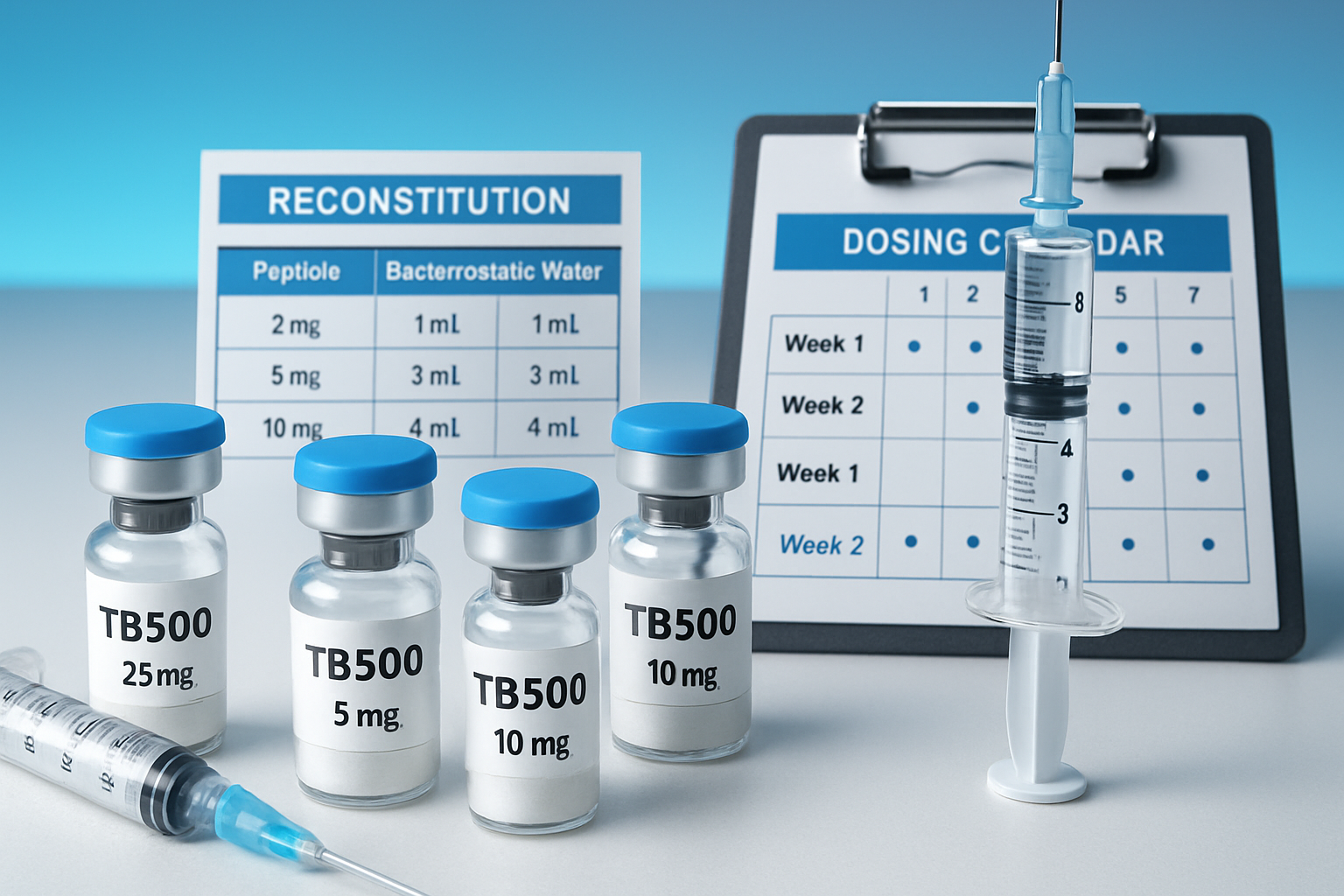
Proper reconstitution is critical for maintaining peptide integrity and achieving accurate dosing. TB-500 10mg vials are typically reconstituted with bacteriostatic water to create concentrations of 2-2.5 mg per mL.
Standard Reconstitution Protocol:
- 10 mg vial + 4 mL bacteriostatic water = 2.5 mg/mL
- 5 mg vial + 2 mL bacteriostatic water = 2.5 mg/mL
This concentration allows for easy measurement and administration while maintaining stability during storage.
Combination Protocols: TB500 Dose with Other Peptides
TB-500 and BPC-157 Synergy
One of the most researched combinations involves TB-500 and BPC-157, creating a synergistic approach to tissue healing and regeneration. The BPC-157 and TB-500 combination has shown promising results in various research models.
Typical Combination Protocol:
- TB-500: 2.5-5 mg twice weekly
- BPC-157: 250-500 mcg daily
- Duration: 4-8 weeks for acute protocols
- Administration: Both via subcutaneous injection
Advanced Multi-Peptide Protocols
Researchers exploring comprehensive healing protocols often incorporate additional peptides alongside TB-500. These multi-peptide approaches require careful consideration of dosing interactions and timing.
Example Multi-Peptide Stack:
- TB-500: 5 mg twice weekly
- BPC-157: 250 mcg daily
- Growth hormone releasing peptides: As per specific protocol
- Timing: Staggered administration to optimize absorption
Factors Affecting TB500 Dose Selection
Research Objectives
The specific research goals significantly influence TB500 dose selection:
Acute Injury Research:
- Higher initial doses (7.5-10 mg weekly)
- Shorter treatment duration (4-6 weeks)
- More frequent monitoring
Chronic Condition Studies:
- Moderate doses (5-7.5 mg weekly)
- Extended treatment periods (8-12 weeks)
- Gradual dose reduction protocols
Preventive Research:
- Lower maintenance doses (2.5-5 mg weekly)
- Long-term administration
- Periodic cycling protocols
Individual Response Factors
Research indicates that several factors can influence optimal dosing:
🔬 Age and metabolic rate
🔬 Baseline health status
🔬 Concurrent medications or supplements
🔬 Previous peptide exposure
🔬 Specific tissue types being studied
Safety and Tolerance Considerations
While TB-500 demonstrates excellent safety profiles in research settings, proper dosing helps minimize potential adverse effects:
Common Dose-Related Considerations:
- Injection site reactions (more common with higher volumes)
- Fatigue or lethargy (typically mild and transient)
- Headaches (rare, usually with higher doses)
- Nausea (uncommon, dose-dependent)
Optimizing TB500 Dose Timing and Cycling
Optimal Injection Timing
Research suggests that TB500 dose timing can influence efficacy:
Morning Administration:
- May align with natural circadian rhythms
- Convenient for consistent scheduling
- Good for combination with other morning peptides
Evening Administration:
- May enhance recovery during sleep
- Suitable for post-exercise protocols
- Less interference with daily activities
Cycling Protocols
Some research protocols incorporate cycling to prevent potential receptor desensitization:
Example Cycling Protocol:
- On-cycle: 6 weeks at standard doses
- Off-cycle: 2-4 weeks complete break
- Maintenance: Low-dose continuation option
However, evidence supporting the necessity of cycling remains limited, and many successful protocols use continuous administration [2].
Storage and Stability Considerations for TB500 Dose Accuracy
Proper Storage Methods
Maintaining peptide integrity is crucial for accurate dosing:
Lyophilized (Powder) Storage:
- Refrigerated (2-8°C) for up to 2 years
- Room temperature stable for several months
- Protect from light and moisture
Reconstituted Solution Storage:
- Refrigerated storage required
- Use within 30 days for optimal potency
- Sterile handling procedures essential
Understanding best practices for storing research peptides ensures consistent dosing accuracy throughout research protocols.
Quality and Purity Considerations
The source and quality of TB-500 directly impact dosing accuracy and research outcomes. High-quality peptides from reputable suppliers ensure:
✅ Accurate peptide content
✅ Minimal impurities
✅ Consistent batch-to-batch quality
✅ Proper packaging and storage
Common TB500 Dose Mistakes and How to Avoid Them
Dosing Errors to Prevent
Mistake #1: Inconsistent Timing
- Solution: Establish fixed injection schedule
- Use calendar reminders or apps
- Maintain consistent intervals between doses
Mistake #2: Improper Reconstitution
- Solution: Follow standardized protocols
- Use appropriate bacteriostatic water volumes
- Ensure complete dissolution before use
Mistake #3: Inadequate Loading Phase
- Solution: Commit to full 4-6 week loading protocol
- Don't reduce doses prematurely
- Monitor progress throughout loading phase
Mistake #4: Ignoring Individual Response
- Solution: Adjust protocols based on observed effects
- Document all changes and responses
- Consult research literature for guidance
Monitoring and Documentation
Successful TB-500 research requires comprehensive monitoring:
Key Metrics to Track:
- Injection dates and doses
- Injection sites and rotation
- Observed effects and timeline
- Any adverse reactions
- Concurrent interventions or treatments
<!DOCTYPE html>
<html lang="en">
<head>
    <meta charset="UTF-8">
    <meta name="viewport" content="width=device-width, initial-scale=1.0">
    <title>TB-500 Dose Calculator</title>
    <style>
        .cg-element-container {
            max-width: 800px;
            margin: 20px auto;
            padding: 20px;
            font-family: Arial, sans-serif;
            background: linear-gradient(135deg, #f5f7fa 0%, #c3cfe2 100%);
            border-radius: 15px;
            box-shadow: 0 10px 30px rgba(0,0,0,0.1);
        }
        .cg-element-header {
            text-align: center;
            color: #2c3e50;
            margin-bottom: 30px;
        }
        .cg-element-form {
            display: grid;
            gap: 20px;
            margin-bottom: 30px;
        }
        .cg-element-input-group {
            display: flex;
            flex-direction: column;
            gap: 8px;
        }
        .cg-element-label {
            font-weight: bold;
            color: #34495e;
            font-size: 14px;
        }
        .cg-element-input, .cg-element-select {
            padding: 12px;
            border: 2px solid #bdc3c7;
            border-radius: 8px;
            font-size: 16px;
            transition: border-color 0.3s ease;
        }
        .cg-element-input:focus, .cg-element-select:focus {
            outline: none;
            border-color: #3498db;
        }
        .cg-element-button {
            background: linear-gradient(135deg, #667eea 0%, #764ba2 100%);
            color: white;
            padding: 15px 30px;
            border: none;
            border-radius: 8px;
            font-size: 16px;
            font-weight: bold;
            cursor: pointer;
            transition: transform 0.2s ease;
        }
        .cg-element-button:hover {
            transform: translateY(-2px);
        }
        .cg-element-results {
            background: white;
            padding: 25px;
            border-radius: 10px;
            box-shadow: 0 5px 15px rgba(0,0,0,0.1);
            display: none;
        }
        .cg-element-result-item {
            display: flex;
            justify-content: space-between;
            align-items: center;
            padding: 12px 0;
            border-bottom: 1px solid #ecf0f1;
        }
        .cg-element-result-item:last-child {
            border-bottom: none;
        }
        .cg-element-result-label {
            font-weight: bold;
            color: #2c3e50;
        }
        .cg-element-result-value {
            color: #27ae60;
            font-weight: bold;
            font-size: 18px;
        }
        .cg-element-warning {
            background: #fff3cd;
            border: 1px solid #ffeaa7;
            color: #856404;
            padding: 15px;
            border-radius: 8px;
            margin-top: 20px;
            font-size: 14px;
        }
        @media (max-width: 600px) {
            .cg-element-container {
                margin: 10px;
                padding: 15px;
            }
            .cg-element-result-item {
                flex-direction: column;
                align-items: flex-start;
                gap: 5px;
            }
        }
    </style>
</head>
<body>
    <div class="cg-element-container">
        <div class="cg-element-header">
            <h2>TB-500 Dose Calculator</h2>
            <p>Calculate optimal TB-500 dosing protocols for research applications</p>
        </div>

        <div class="cg-element-form">
            <div class="cg-element-input-group">
                <label class="cg-element-label" for="bodyWeight">Body Weight (kg)</label>
                <input type="number" id="bodyWeight" class="cg-element-input" placeholder="Enter weight in kg" min="40" max="150" value="70">
            </div>

            <div class="cg-element-input-group">
                <label class="cg-element-label" for="protocolType">Protocol Type</label>
                <select id="protocolType" class="cg-element-select">
                    <option value="loading">Loading Phase (4-6 weeks)</option>
                    <option value="maintenance">Maintenance Phase</option>
                    <option value="acute">Acute Injury Protocol</option>
                    <option value="chronic">Chronic Condition Protocol</option>
                </select>
            </div>

            <div class="cg-element-input-group">
                <label class="cg-element-label" for="frequency">Injection Frequency</label>
                <select id="frequency" class="cg-element-select">
                    <option value="2">Twice Weekly</option>
                    <option value="3">Three Times Weekly</option>
                    <option value="1">Once Weekly</option>
                    <option value="0.5">Bi-weekly</option>
                </select>
            </div>

            <div class="cg-element-input-group">
                <label class="cg-element-label" for="concentration">Vial Concentration</label>
                <select id="concentration" class="cg-element-select">
                    <option value="2.5">2.5 mg/mL (10mg vial + 4mL)</option>
                    <option value="5">5 mg/mL (10mg vial + 2mL)</option>
                    <option value="2">2 mg/mL (10mg vial + 5mL)</option>
                </select>
            </div>

            <button class="cg-element-button" onclick="calculateDose()">Calculate Dosing Protocol</button>
        </div>

        <div id="results" class="cg-element-results">
            <h3 style="color: #2c3e50; margin-bottom: 20px;">Recommended Dosing Protocol</h3>
            <div class="cg-element-result-item">
                <span class="cg-element-result-label">Total Weekly Dose:</span>
                <span class="cg-element-result-value" id="weeklyDose">-</span>
            </div>
            <div class="cg-element-result-item">
                <span class="cg-element-result-label">Per Injection Dose:</span>
                <span class="cg-element-result-value" id="perInjectionDose">-</span>
            </div>
            <div class="cg-element-result-item">
                <span class="cg-element-result-label">Injection Volume:</span>
                <span class="cg-element-result-value" id="injectionVolume">-</span>
            </div>
            <div class="cg-element-result-item">
                <span class="cg-element-result-label">Frequency:</span>
                <span class="cg-element-result-value" id="frequencyDisplay">-</span>
            </div>
            <div class="cg-element-result-item">
                <span class="cg-element-result-label">Protocol Duration:</span>
                <span class="cg-element-result-value" id="duration">-</span>
            </div>
            <div class="cg-element-result-item">
                <span class="cg-element-result-label">Vials Needed (4 weeks):</span>
                <span class="cg-element-result-value" id="vialsNeeded">-</span>
            </div>
        </div>

        <div class="cg-element-warning">
            <strong>Research Use Only:</strong> This calculator is for research planning purposes only. Always consult current literature and follow proper research protocols. Dosing recommendations are based on published research studies and may need adjustment based on specific research objectives.
        </div>
    </div>

    <script>
        function calculateDose() {
            const bodyWeight = parseFloat(document.getElementById('bodyWeight').value);
            const protocolType = document.getElementById('protocolType').value;
            const frequency = parseFloat(document.getElementById('frequency').value);
            const concentration = parseFloat(document.getElementById('concentration').value);

            if (!bodyWeight || bodyWeight < 40 || bodyWeight > 150) {
                alert('Please enter a valid body weight between 40-150 kg');
                return;
            }

            let weeklyDose, duration, frequencyText;

            // Calculate weekly dose based on protocol type
            switch(protocolType) {
                case 'loading':
                    weeklyDose = Math.max(5, Math.min(10, bodyWeight * 0.08));
                    duration = '4-6 weeks';
                    break;
                case 'maintenance':
                    weeklyDose = Math.max(2.5, Math.min(5, bodyWeight * 0.04));
                    duration = '4-8 weeks';
                    break;
                case 'acute':
                    weeklyDose = Math.max(7.5, Math.min(10, bodyWeight * 0.1));
                    duration = '2-4 weeks';
                    break;
                case 'chronic':
                    weeklyDose = Math.max(5, Math.min(7.5, bodyWeight * 0.06));
                    duration = '8-12 weeks';
                    break;
                default:
                    weeklyDose = 5;
                    duration = '4-6 weeks';
            }

            // Round to practical dosing
            weeklyDose = Math.round(weeklyDose * 4) / 4; // Round to nearest 0.25mg

            const perInjectionDose = weeklyDose / frequency;
            const injectionVolume = perInjectionDose / concentration;
            const vialsNeeded = Math.ceil((weeklyDose * 4) / 10); // 10mg vials for 4 weeks

            // Set frequency display text
            if (frequency === 2) frequencyText = 'Twice Weekly';
            else if (frequency === 3) frequencyText = 'Three Times Weekly';
            else if (frequency === 1) frequencyText = 'Once Weekly';
            else if (frequency === 0.5) frequencyText = 'Bi-weekly';
            else frequencyText = frequency + 'x per week';

            // Display results
            document.getElementById('weeklyDose').textContent = weeklyDose.toFixed(1) + ' mg';
            document.getElementById('perInjectionDose').textContent = perInjectionDose.toFixed(1) + ' mg';
            document.getElementById('injectionVolume').textContent = injectionVolume.toFixed(2) + ' mL';
            document.getElementById('frequencyDisplay').textContent = frequencyText;
            document.getElementById('duration').textContent = duration;
            document.getElementById('vialsNeeded').textContent = vialsNeeded + ' vials (10mg each)';

            document.getElementById('results').style.display = 'block';
            document.getElementById('results').scrollIntoView({ behavior: 'smooth' });
        }

        // Initialize with default calculation
        window.onload = function() {
            calculateDose();
        };
    </script>
</body>
</html>
Future Directions in TB500 Dose Research
Emerging Research Areas
Current research is exploring several promising directions for TB500 dose optimization:
Personalized Dosing Protocols:
- Genetic markers influencing peptide response
- Biomarker-guided dose adjustments
- Individual metabolism considerations
Novel Delivery Methods:
- Transdermal delivery systems
- Oral bioavailable formulations
- Sustained-release preparations
Combination Synergies:
- Multi-peptide healing protocols
- Growth factor combinations
- Stem cell therapy integration
Advanced Research Applications
Researchers are investigating TB-500 in increasingly sophisticated applications:
🔬 Tissue engineering applications
🔬 Regenerative medicine protocols
🔬 Sports medicine research
🔬 Age-related tissue decline studies
For researchers interested in expanding their peptide knowledge, exploring core peptides for optimal health research provides valuable insights into comprehensive peptide protocols.
Conclusion
Understanding proper TB500 dose protocols is fundamental for successful peptide research in 2025. The evidence clearly supports a structured approach beginning with loading phases of 5-10 mg weekly, followed by maintenance protocols of 2-5 mg weekly. The flexibility of TB-500's dosing schedule, combined with its excellent safety profile, makes it an ideal candidate for both acute and chronic research applications.
Key Action Steps for Researchers:
- Start with established protocols – Begin with proven dosing ranges and adjust based on research objectives
- Maintain consistent administration – Establish regular injection schedules and stick to them throughout the research period
- Document everything – Keep detailed records of doses, timing, and observed effects
- Consider combinations – Explore synergistic effects with other peptides like BPC-157
- Source quality peptides – Work with reputable suppliers who provide proper documentation and testing
The future of TB-500 research looks promising, with ongoing studies exploring personalized dosing approaches and novel delivery methods. As our understanding of this remarkable peptide continues to evolve, proper dosing will remain the cornerstone of successful research outcomes.
Whether investigating acute injury healing, chronic tissue regeneration, or preventive applications, mastering TB500 dose protocols provides researchers with a powerful tool for advancing our understanding of peptide-based therapeutics.
References
[1] Goldstein, A.L., et al. (2005). Thymosin beta4: a multi-functional regenerative peptide. Basic properties and clinical applications. Expert Opinion on Biological Therapy, 5(1), 37-53.
[2] Bock-Marquette, I., et al. (2004). Thymosin beta4 activates integrin-linked kinase and promotes cardiac cell migration, survival and cardiac repair. Nature, 432(7016), 466-472.
SEO Meta Title: TB500 Dose Guide: Research Protocols & Dosing Calculator 2025
SEO Meta Description: Complete TB500 dose guide with research protocols, dosing calculator, and expert recommendations for peptide researchers in 2025.