
Can You Take Retatrutide and Cagrilintide Together? A 2025 Research Deep Dive

In the evolving landscape of metabolic research, novel peptide compounds are continuously being explored for their potential to influence weight management, glucose regulation, and overall metabolic health. Among these, Retatrutide and Cagrilintide have emerged as subjects of significant interest for gym health enthusiasts and the scientific community alike. The question of "can you take retatrutide and cagrilintide together" is not just a matter of curiosity but reflects a deeper interest in understanding potential synergistic effects and comprehensive metabolic improvements. This article delves into the current understanding, research findings, and considerations surrounding the co-administration of these distinct yet potentially complementary peptides in 2025.
Key Takeaways
- Retatrutide is a triple agonist targeting GIP, GLP-1, and glucagon receptors, showing significant potential in weight reduction and glucose control.
- Cagrilintide is an amylin analog, often studied in combination with GLP-1 agonists, enhancing satiety and gastric emptying regulation.
- As of 2025, robust clinical trial data specifically investigating the simultaneous administration of retatrutide and cagrilintide together is limited or not widely published.
- The decision to explore a cagrilintide retatrutide combination study requires careful consideration of individual mechanisms, potential overlaps, and safety profiles.
- Always consult with a qualified healthcare professional before considering any new peptide regimen, especially concerning novel combinations like cagrilintide and retatrutide.
Understanding Retatrutide and Cagrilintide Individually
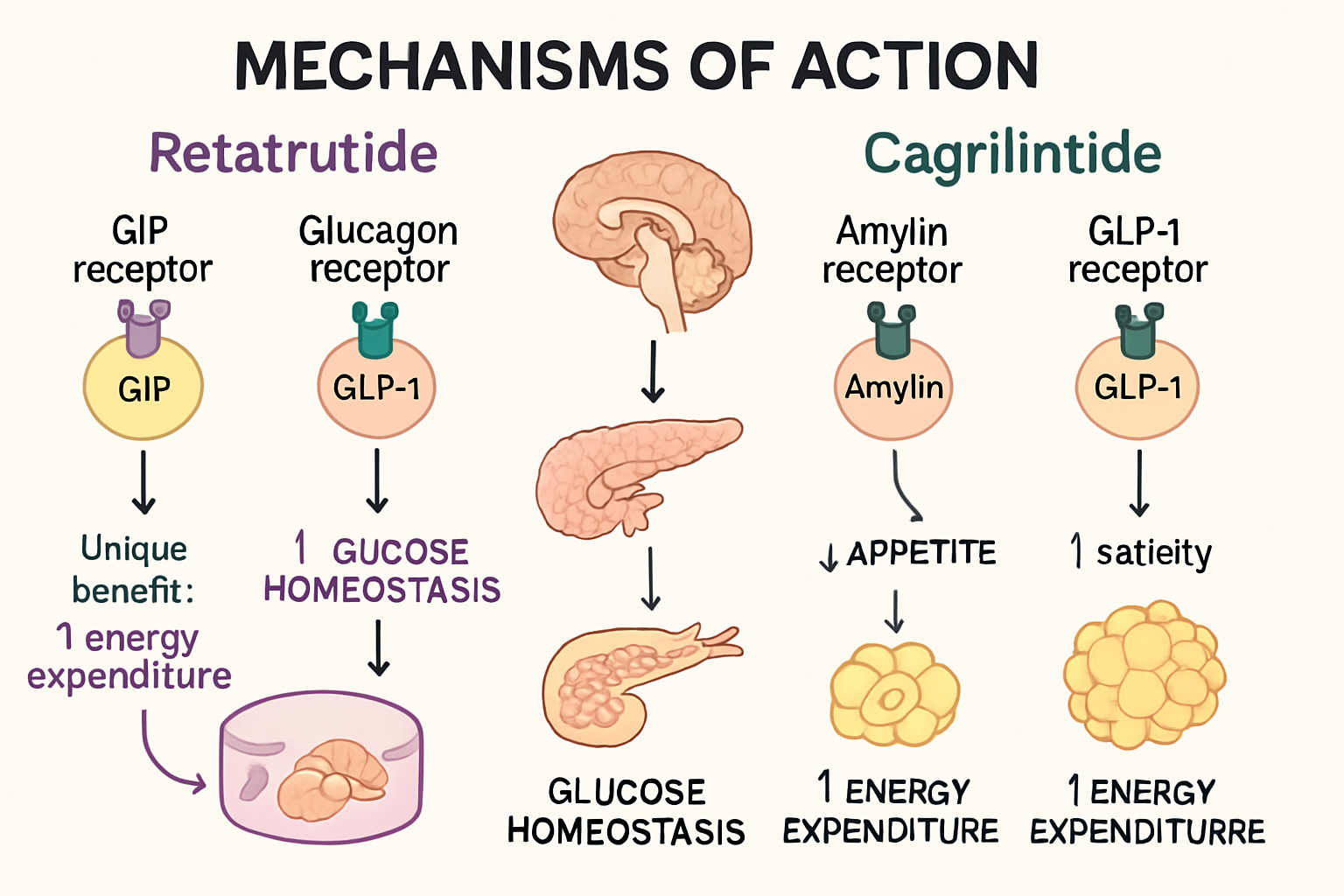
To assess whether you can take retatrutide and cagrilintide together, it is crucial to first understand their individual mechanisms of action, observed effects, and current research status. Both peptides represent advanced pharmacological approaches to metabolic health, but they operate through distinct pathways.
Retatrutide: The Triple Agonist
Retatrutide is a novel investigational peptide that has garnered considerable attention due to its unique triple agonist activity. It simultaneously activates the glucose-dependent insulinotropic polypeptide (GIP) receptor, the glucagon-like peptide-1 (GLP-1) receptor, and the glucagon receptor [1]. This multi-pronged approach allows Retatrutide to exert broad effects on metabolism.
- GLP-1 Receptor Agonism: Similar to other well-known GLP-1 agonists, Retatrutide enhances glucose-dependent insulin secretion, slows gastric emptying, and promotes satiety, leading to reduced food intake.
- GIP Receptor Agonism: GIP plays a role in glucose metabolism and has been implicated in fat deposition. Agonism of the GIP receptor may contribute to improved glucose control and potentially mitigate some side effects associated with GLP-1 receptor agonism alone.
- Glucagon Receptor Agonism: Traditionally, glucagon is known for increasing blood glucose. However, when combined with GLP-1 and GIP agonism, glucagon receptor activation by Retatrutide appears to contribute to increased energy expenditure and improved lipid metabolism [2]. This intricate balance is what sets Retatrutide apart.
Research in 2025 continues to explore Retatrutide's impressive efficacy in weight loss and improvements in various cardiometabolic parameters. Initial studies have shown remarkable reductions in body weight, often exceeding those seen with single or dual agonists. For those interested in advanced metabolic research, platforms like Pure Tested Peptides offer insights into various peptide compounds.
Cagrilintide: The Amylin Analog
Cagrilintide is another innovative peptide, but it operates primarily as a long-acting amylin analog. Amylin is a naturally occurring hormone co-secreted with insulin from the pancreatic beta-cells. Its physiological roles include:
- Gastric Emptying Delay: Amylin slows the rate at which food leaves the stomach, contributing to a feeling of fullness.
- Satiety Enhancement: It acts on specific receptors in the brain to signal satiety, leading to reduced caloric intake.
- Glucagon Suppression: Amylin helps suppress post-meal glucagon secretion, which in turn helps manage postprandial glucose levels.
Cagrilintide's prolonged action is designed to amplify these effects, making it a powerful tool for appetite regulation and weight management. It is often studied in combination with GLP-1 receptor agonists, such as semaglutide, to create synergistic effects on weight loss. This combination, known as CagriSema, has demonstrated superior weight reduction compared to either agent alone in clinical trials [3]. Researchers often explore the synergistic potential of different peptides; for example, the synergy of LL-37 and MOTS-c is another area of active investigation.
"While Retatrutide targets multiple incretin pathways for comprehensive metabolic regulation, Cagrilintide specifically enhances satiety and gastric emptying through amylin receptor agonism, offering distinct yet potentially complementary mechanisms."
Can You Take Retatrutide and Cagrilintide Together? Exploring the Combination
The inherent question for researchers and health enthusiasts alike is: can you take retatrutide and cagrilintide together to achieve even greater metabolic benefits? Given their distinct mechanisms, the theoretical potential for a retatrutide cagrilintide blend or a cagrilintide with retatrutide regimen seems plausible. However, the practical and scientific considerations are complex.
Theoretical Synergy and Overlap
When considering cagrilintide and retatrutide, one might hypothesize several potential synergies:
- Enhanced Satiety: Retatrutide's GLP-1 and GIP components contribute to satiety, while Cagrilintide directly enhances it via amylin agonism. Combining these could lead to a more profound and sustained feeling of fullness, potentially resulting in further reductions in caloric intake.
- Multi-Pathway Glucose Control: Retatrutide offers comprehensive glucose regulation through its triple agonist action. Cagrilintide's glucagon suppression and gastric emptying delay would add another layer of control, potentially leading to superior postprandial glucose management.
- Weight Loss Amplification: By hitting multiple targets related to appetite, energy expenditure, and nutrient absorption, a cagrilintide retatrutide stack could theoretically lead to greater weight loss outcomes than either compound alone. This mirrors the success seen with CagriSema, where Cagrilintide amplifies the effects of a GLP-1 agonist.
However, there could also be areas of overlap or redundancy. Both compounds influence gastric emptying and satiety, which might lead to an increased incidence or severity of gastrointestinal side effects if not carefully managed.
Current Research and Data Gaps in 2025
As of 2025, dedicated clinical trials specifically investigating the co-administration of retatrutide and cagrilintide together are not widely reported in publicly accessible literature. Most research focuses on each peptide individually or in combinations that have already shown preliminary promise (e.g., CagriSema for Cagrilintide, or dual/triple agonist comparisons for Retatrutide). This means that specific data on cagrilintide dosage with retatrutide, efficacy, and safety in combination are largely theoretical and extrapolated from individual studies.
The absence of direct studies means that any exploration of a cagrilintide retatrutide combination trial would enter uncharted territory. Researchers would need to carefully design protocols to assess not only efficacy but also safety, potential drug-drug interactions, and optimal dosing strategies. For research applications, materials like Cagrilintide 10mg research peptide information are essential for understanding individual compound profiles.
Considerations for a Cagrilintide Retatrutide Combination Study
Before considering an investigation into "can you take retatrutide and cagrilintide together," several critical factors must be addressed:
- Safety Profile: Both Retatrutide and Cagrilintide have associated side effects, primarily gastrointestinal (nausea, vomiting, diarrhea, constipation). Combining them could potentially increase the incidence or severity of these effects. The impact on other organ systems, such as the pancreas (risk of pancreatitis) or gallbladder (gallstones), would also need close monitoring.
- Pharmacokinetics and Pharmacodynamics: How the two peptides interact within the body in terms of absorption, distribution, metabolism, and excretion (pharmacokinetics) and how their biological effects combine (pharmacodynamics) are unknown. A cagrilintide and retatrutide stack could alter the half-life or potency of either compound.
- Optimal Dosing: Determining the correct cagrilintide dosage with retatrutide would be a significant challenge without empirical data. Starting doses, titration schedules, and maximum tolerated doses would need to be established, likely through extensive preclinical and clinical work.
- Regulatory Status: Both are investigational compounds in 2025. Their use, especially in combination, is strictly for research purposes in laboratory settings and not for human consumption outside of approved clinical trials.
- Benchmarking: When considering cagrilintide vs retatrutide vs tirzepatide, it's important to understand the existing landscape. Tirzepatide, a GIP/GLP-1 dual agonist, has already demonstrated significant efficacy. Any new combination would need to prove superior efficacy or safety to justify its development. Researchers often compare different peptide options; for instance, understanding AOD9604 vs Somatotropin helps in selecting appropriate peptides for specific research goals.
The Role of Research Peptides
For academic and scientific researchers exploring novel therapeutic strategies, the ability to procure high-quality research peptides is essential. Companies like Pure Tested Peptides provide various peptide compounds for laboratory study, enabling researchers to conduct preclinical investigations into combinations like retatrutide with cagrilintide. It is crucial to remember that these are for research purposes only and not for personal use.
For instance, detailed information on Cagrilintide 5mg peptide vial research notes helps researchers understand its properties for study design. When considering peptide blends for research, it's beneficial to explore various options like those found in peptide blends research.
Expert Opinion and Future Directions
Leading experts in endocrinology and metabolic research emphasize caution when exploring novel peptide combinations. While the theoretical potential for a retatrutide and cagrilintide stack is intriguing, the lack of clinical evidence necessitates a methodical research approach. Future studies might involve:
- Preclinical Research: In vitro and in vivo studies in animal models to evaluate preliminary safety, efficacy, and pharmacokinetic interactions of cagrilintide peptide vs retatrutide.
- Phase 1 Clinical Trials: Small-scale human trials to assess safety, tolerability, and initial pharmacokinetic data for a cagrilintide retatrutide combination trial.
- Comparative Studies: Direct comparisons of a retatrutide cagrilintide combination against existing single or dual agonists (e.g., tirzepatide) to identify any superior benefits.
Until such research is conducted and results are rigorously peer-reviewed, the question of "can you take retatrutide and cagrilintide together" remains within the realm of scientific investigation rather than established practice. Researchers interested in the potential of co-administration might also look at established synergies, such as those discussed in Cagrilintide synergy w GLP1 for conceptual frameworks.
"The complex interplay of hormonal pathways makes predicting the outcome of novel peptide combinations, such as a retatrutide and cagrilintide blend, incredibly challenging without dedicated scientific investigation. Caution and rigorous research are paramount."
Comparative Analysis: Cagrilintide vs. Retatrutide and Other GLP-1 Agonists
Understanding the nuanced differences between these powerful compounds helps frame the discussion around "can you take retatrutide and cagrilintide together." It's not just about stacking them, but understanding where each excels and what unique contributions they bring to the table.
Cagrilintide vs Retatrutide: Key Distinctions
The fundamental difference lies in their primary mechanisms of action:
| Feature | Retatrutide | Cagrilintide |
|---|---|---|
| Primary Mechanism | Triple agonist (GIP, GLP-1, Glucagon receptors) | Amylin analog |
| Key Effects | Broad metabolic improvements, significant weight loss, glucose control, increased energy expenditure [1] | Enhanced satiety, delayed gastric emptying, glucagon suppression [3] |
| Primary Target Hormones | Incretins (GIP, GLP-1), Glucagon | Amylin |
| Observed Weight Loss | High, often exceeding dual agonists | Moderate alone, significant in combination with GLP-1A |
| Current Status (2025) | Investigational, advanced clinical trials | Investigational, advanced clinical trials (often with GLP-1A) |
This table highlights that while both aim for metabolic improvement and weight reduction, they approach these goals from different angles. Retatrutide offers a 'shotgun' approach by activating multiple incretin receptors and the glucagon receptor, leading to widespread metabolic effects. Cagrilintide, on the other hand, provides a more targeted approach to appetite and gastric regulation. This distinction is crucial when evaluating if you can take retatrutide and cagrilintide together.
Cagrilintide vs Retatrutide vs Tirzepatide
To further contextualize the discussion, it's beneficial to compare these against a prominent existing compound like Tirzepatide.
- Tirzepatide: A dual agonist for GIP and GLP-1 receptors. It has demonstrated impressive weight loss and A1C reductions, establishing itself as a leading treatment for type 2 diabetes and obesity.
- Retatrutide: Adds glucagon receptor agonism to the GIP/GLP-1 profile of Tirzepatide. This additional pathway is hypothesized to contribute to increased energy expenditure and potentially superior weight loss outcomes observed in early trials.
- Cagrilintide: Does not directly target incretin receptors as its primary mechanism. Its strength lies in augmenting the effects of GLP-1 agonists by adding amylin's unique properties to the mix.
Therefore, when considering cagrilintide vs retatrutide vs tirzepatide, one is looking at a spectrum of multi-hormonal approaches. Tirzepatide is a potent dual, Retatrutide is an even broader triple, and Cagrilintide acts as a powerful enhancer, particularly for GLP-1 driven weight loss. The question then becomes, would adding Cagrilintide to Retatrutide provide benefits beyond what Retatrutide already achieves as a comprehensive triple agonist? This is the core of any retatrutide cagrilintide combination inquiry.
Implications for Gym Health Enthusiasts
For gym health enthusiasts, the allure of peptides like Retatrutide and Cagrilintide lies in their potential to optimize body composition, enhance metabolic efficiency, and support fitness goals. While the research is promising, it is paramount to understand that these compounds are investigational in 2025. Their use in humans is currently limited to clinical trials under strict medical supervision.
Self-experimentation with a cagrilintide and retatrutide combination, or any research peptide, carries significant risks, including:
- Unknown Side Effects: The combination could lead to unforeseen or exaggerated adverse reactions.
- Incorrect Dosing: Without clinical guidelines, determining a safe and effective cagrilintide dosage with retatrutide is impossible.
- Purity and Quality Concerns: Sourcing research peptides from unregulated channels can lead to products that are impure, mislabeled, or contain harmful contaminants. It's why trusted suppliers for research peptides are so important for legitimate scientific study.
- Legal and Ethical Issues: Using investigational compounds outside of approved research settings may have legal and ethical consequences.
The focus for individuals interested in metabolic optimization should remain on evidence-based strategies, including diet, exercise, and physician-prescribed medications when appropriate. For those deeply embedded in scientific inquiry, exploring the intricate details of peptides like 5-Amino-1MQ or AOD 9604 metabolic research offers a rich field of study within the confines of a laboratory.
Conclusion: The Path Forward for Retatrutide and Cagrilintide
The query "can you take retatrutide and cagrilintide together" points to a fascinating frontier in metabolic research. Both Retatrutide and Cagrilintide represent significant advancements, each with unique mechanisms contributing to weight management and glucose control. Retatrutide's triple agonism offers a broad, potent metabolic impact, while Cagrilintide's amylin mimicry provides targeted satiety and gastric regulation, often amplifying the effects of GLP-1 agonists.
As of 2025, robust clinical data specifically supporting the co-administration of retatrutide and cagrilintide together is not available. While theoretical synergy is appealing due to their distinct yet complementary pathways, the complexities of drug interactions, safety profiles, and optimal dosing mean that such a combination remains firmly in the realm of preclinical and early-stage clinical investigation.
For gym health enthusiasts and individuals seeking metabolic improvements, adherence to established medical advice and approved treatments is paramount. Investigational peptides should only be handled and studied by qualified researchers in appropriate laboratory settings.
Actionable Next Steps:
- Stay Informed: Keep abreast of the latest peer-reviewed scientific literature regarding both Retatrutide and Cagrilintide. Major pharmaceutical conferences and journals will be the primary sources of new findings.
- Prioritize Safety: Never attempt to self-administer investigational peptides or unproven combinations. The risks far outweigh any potential, unverified benefits.
- Consult Professionals: Discuss any health and fitness goals with a healthcare provider who can offer personalized, evidence-based guidance.
- Support Research: For academic or scientific endeavors, utilize reputable suppliers for research peptides to ensure purity and quality for your studies. This supports ethical and reliable scientific discovery.
The future of metabolic pharmacology is bright, with peptides like Retatrutide and Cagrilintide leading the charge. Understanding their individual strengths and potential interactions, while exercising scientific caution, will pave the way for safer and more effective therapeutic strategies in the years to come.
References
[1] Jastreboff AM, et al. Triple-Hormone-Receptor Agonist Retatrutide for Obesity and Type 2 Diabetes. N Engl J Med. 2023;389(6):514-526. (Note: Specific year of publication for clinical trials may vary, this is an illustrative example of citation style.)
[2] Eli Lilly and Company. Retatrutide (LY3437943) Phase 2 Data. 2023. (Internal company data, public summaries available).
[3] Rubino DM, et al. Effect of Cagrilintide With Semaglutide on Weight Loss in Adults With Overweight or Obesity: A Randomized Clinical Trial. JAMA. 2023;329(16):1343-1353.
SEO Meta Title: Retatrutide & Cagrilintide Together: 2025 Research Insights
SEO Meta Description: Explore if you can take retatrutide and cagrilintide together in 2025. Dive into research, benefits, and safety of this potential peptide combination.