

Two synthetic peptides developed in Russia have quietly generated some of the most compelling neuroscience research of the past two decades — yet most Western researchers are only beginning to take notice. Semax and Selank peptides comparative research on neurogenesis and synaptic plasticity reveals two compounds with overlapping yet distinctly different mechanisms, making a side-by-side analysis essential for anyone studying cognitive enhancement or neurological recovery in 2026.
Key Takeaways
- Semax is derived from the ACTH(4-10) fragment and strongly upregulates BDNF and NGF, supporting neurogenesis and neuroprotection.
- Selank is a tuftsin analog that modulates GABAergic signaling and also increases BDNF, producing anxiolytic effects without sedation.
- Both peptides influence brain functional connectivity, particularly in regions associated with anxiety and cognition.
- Semax has demonstrated neuroprotective effects in ischemic models; Selank is approved for generalized anxiety disorder.
- Most existing research originates from Russian studies, and large-scale international clinical trials remain limited.
Structural Origins and Core Mechanisms
Understanding the differences in Semax and Selank peptides comparative research on neurogenesis and synaptic plasticity begins at the molecular level.
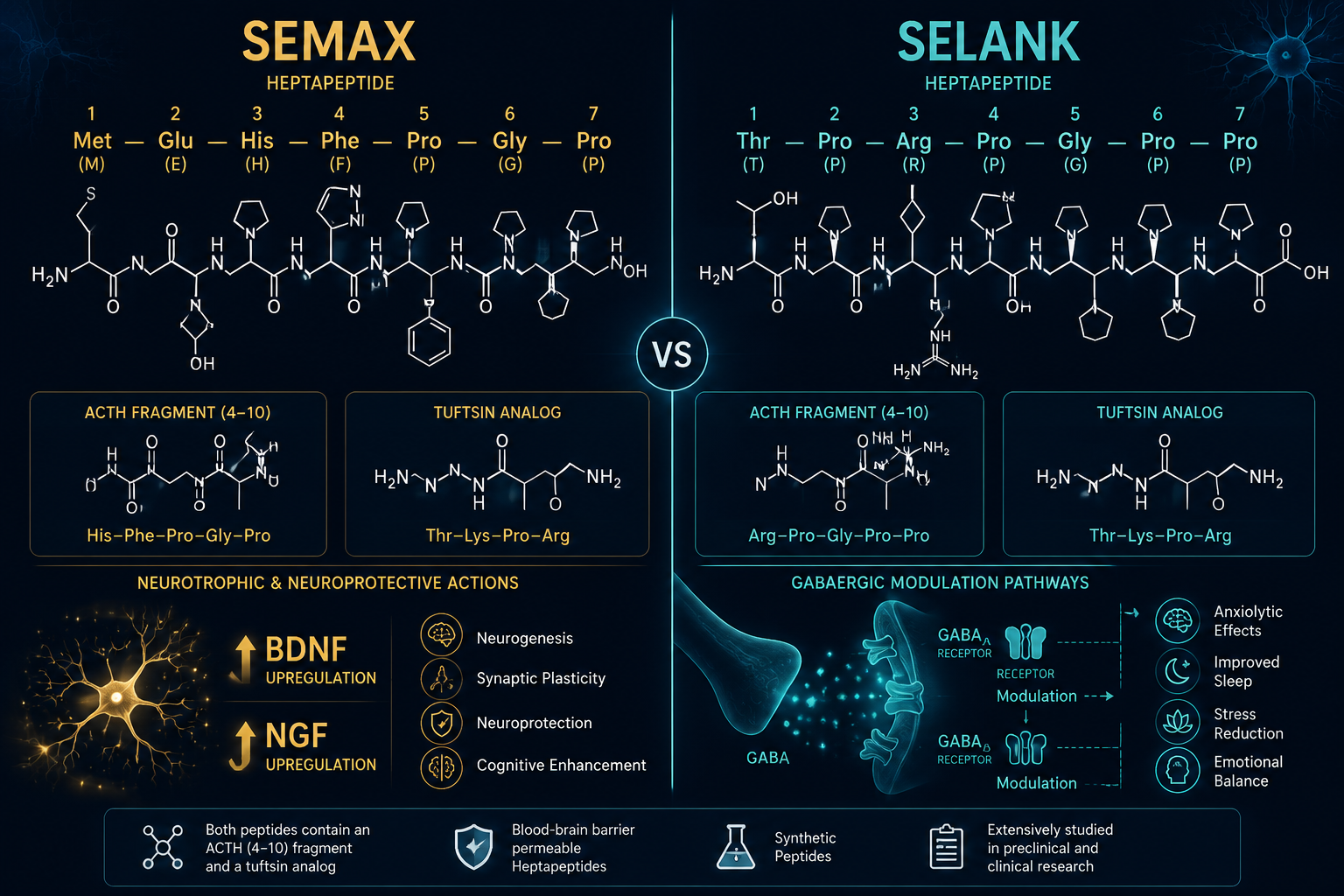
Semax is a synthetic heptapeptide derived from the ACTH(4-10) fragment, extended with a Pro-Gly-Pro sequence to improve metabolic stability. Its primary mechanism involves the rapid upregulation of brain-derived neurotrophic factor (BDNF) and nerve growth factor (NGF). In rat glial cultures, Semax has been shown to increase BDNF mRNA approximately eight-fold and NGF mRNA roughly five-fold within hours of administration. A single intranasal dose can elevate hippocampal BDNF protein and activate TrkB receptor signaling — a pathway critical for synaptic plasticity and long-term memory consolidation.
Selank, by contrast, is a synthetic analog of tuftsin, an endogenous immunomodulatory tetrapeptide. Rather than driving neurotrophin production as its primary action, Selank modulates GABAergic signaling while also increasing BDNF expression. This dual action produces meaningful anxiolytic effects without the sedation typically associated with GABA-targeting compounds.
| Feature | Semax | Selank |
|---|---|---|
| Structural basis | ACTH(4-10) fragment | Tuftsin analog |
| Primary mechanism | BDNF/NGF upregulation | GABAergic modulation + BDNF |
| Key clinical use | Stroke, neuroprotection | Generalized anxiety disorder |
| Sedation risk | Low | Very low |
Researchers exploring innovative peptide delivery systems will find both compounds relevant, as intranasal delivery is a defining feature of their administration protocols.
BDNF Upregulation, Synaptic Plasticity, and Neuroprotection
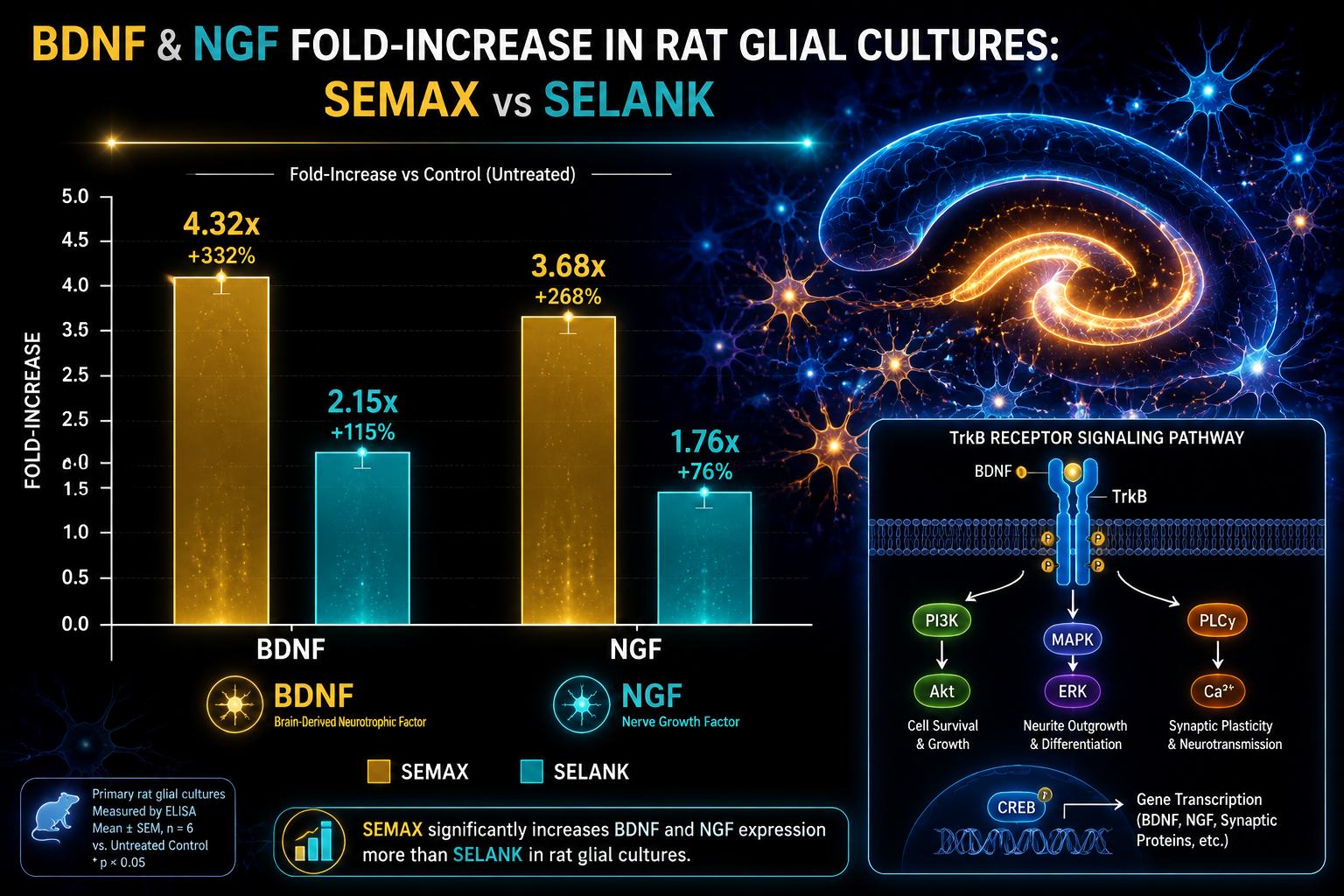
The divergence in how each peptide influences neurogenesis becomes clearest when examining downstream signaling. Semax's activation of TrkB receptors drives cascades associated with dendritic branching, long-term potentiation, and neuronal survival — processes at the heart of synaptic plasticity. In a rat cerebral ischemia-reperfusion model, Semax administration upregulated active CREB in subcortical structures, downregulated MMP-9 and c-Fos in the adjacent frontoparietal cortex, and reduced active JNK levels. These changes collectively point to reduced inflammation, attenuated apoptosis, and enhanced recovery signaling.
Selank's contribution to neuroplasticity is more indirect. By stabilizing GABAergic tone, it reduces the neurochemical noise that can impair synaptic consolidation. Its BDNF-elevating effect, while less dramatic than Semax's, still supports neuronal health and may complement anxiety-reduction strategies in research models.
"Semax's effects are more pronounced in cognitive enhancement and neuroprotection, whereas Selank's modulation of GABAergic signaling defines its anxiolytic profile — these are non-interchangeable roles."
Researchers interested in other neuroprotective peptide compounds may also want to review GHK-Cu longevity research themes and thymalin thymus bioregulation for broader context on peptide-driven cellular repair.
Functional Connectivity, Clinical Applications, and Research Gaps

A resting-state fMRI study in 52 healthy participants found that both Semax and Selank influenced connectivity between the right amygdala and regions of the right temporal cortex. This suggests both peptides modulate neural networks tied to emotional regulation and cognitive processing — though through different primary mechanisms.
Registered clinical applications reinforce this distinction:
- Semax is approved in Russia for ischemic stroke, transient ischemic attack, optic nerve atrophy, and neurasthenia.
- Selank is approved for generalized anxiety disorder.
For researchers monitoring regulatory developments, Semax is scheduled to appear before the FDA's Pharmacy Compounding Advisory Committee in July 2026 for potential inclusion on the 503A Bulks List, which could significantly affect its research availability in the United States.
Those studying Selank's safety profile should review Selank side effects research before designing protocols. For broader peptide sourcing considerations, the peptide supplier comparison guide offers practical quality-control context.
Key research limitations to note:
- Most published studies originate from Russian institutions.
- Large-scale, randomized international clinical trials are scarce.
- Long-term effects in diverse populations remain poorly characterized.
Researchers exploring multi-pathway cognitive support may also find value in reviewing the KLOW blend multipathway research for complementary mechanistic context.
Conclusion
Semax and Selank peptides comparative research on neurogenesis and synaptic plasticity makes one thing clear: these compounds are complementary rather than interchangeable. Semax offers stronger neurotrophin-driven neuroprotection and cognitive enhancement, while Selank provides GABAergic anxiolytic effects with secondary neuroplasticity benefits.
Actionable next steps for researchers:
- Design protocols that distinguish BDNF-driven endpoints (favoring Semax) from anxiety-modulation endpoints (favoring Selank).
- Monitor the FDA's 2026 advisory committee proceedings for updated compounding regulations affecting Semax availability.
- Prioritize sourcing from verified suppliers with documented purity testing to ensure experimental validity.
- Consider combination studies only after establishing individual baseline responses in the target model.
- Review the comprehensive peptide catalog to identify research-grade compounds with certificates of analysis.
The field is advancing rapidly, and rigorous, internationally replicated studies will be essential to fully validate what early research strongly suggests.
Leave a Reply
Want to join the discussion?Feel free to contribute!