

Elevated homocysteine is detected in roughly 5–7% of the general population, yet its upstream enzyme — cystathionine beta synthase — remains underappreciated outside specialist circles. The intersection of Cystathionine Beta Synthase, Homocysteine, and Peptides: Where Metabolism Pathways Meet Experimental MOTS‑c and 5‑Amino‑1MQ Research is drawing growing preclinical attention, particularly as researchers probe how mitochondrial peptides and NNMT-targeting small molecules might interact with the same metabolic nodes that CBS dysfunction disrupts.
Key Takeaways
- CBS is the gatekeeper enzyme of the transsulfuration pathway, directly controlling homocysteine clearance and cysteine synthesis.
- CBS deficiency links to oxidative stress, mitochondrial dysfunction, and elevated thrombosis risk.
- MOTS-c, a mitochondrial-derived peptide, influences metabolic signaling pathways that overlap with CBS-related dysfunction.
- 5-Amino-1MQ targets NNMT, an enzyme connected to methylation balance and metabolic regulation.
- Both compounds remain strictly experimental and are subjects of preclinical research only.
Understanding CBS and the Transsulfuration Pathway
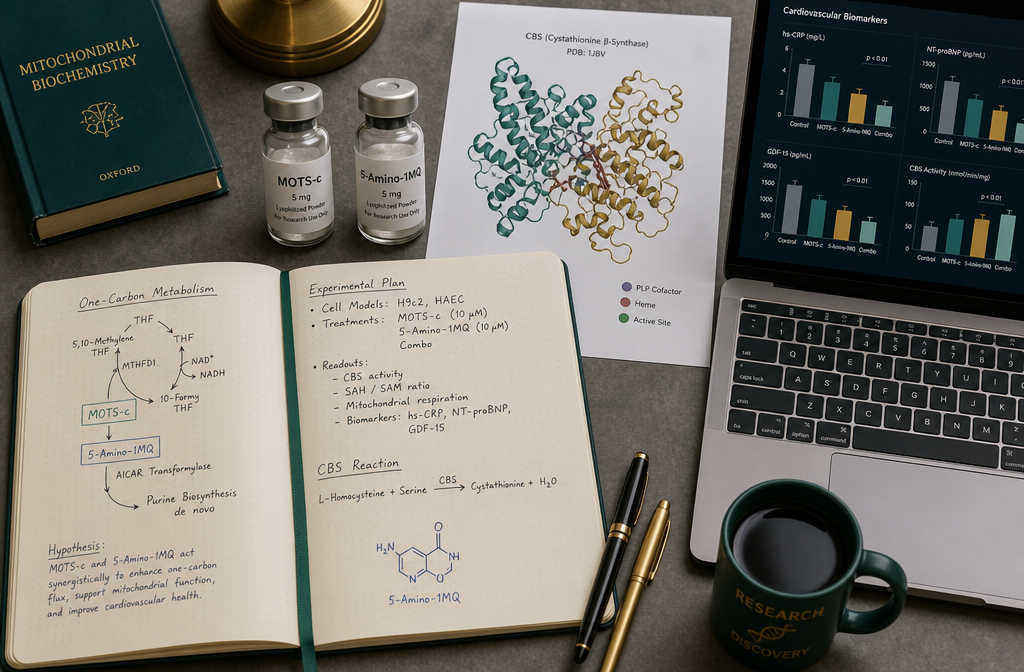
Cystathionine beta synthase (CBS) is a pyridoxal-5-phosphate-dependent enzyme that catalyzes the condensation of homocysteine and serine into cystathionine. That intermediate is then cleaved into cysteine — a precursor to glutathione, the body's primary intracellular antioxidant.
The CBS enzyme has three structural domains:
| Domain | Role |
|---|---|
| Catalytic core | Performs the condensation reaction |
| N-terminal heme domain | Responds to redox signals |
| C-terminal regulatory domain | Activated by S-adenosylmethionine (SAM) |
This architecture makes CBS uniquely sensitive to both oxidative status and methylation capacity. When CBS activity falls — due to genetic mutation or cofactor deficiency — homocysteine accumulates, driving a cascade that includes oxidative damage, mitochondrial dysfunction, and prothrombotic changes in vascular tissue.
CBS also produces hydrogen sulfide (H2S), a neuromodulatory gasotransmitter. This secondary function underscores the enzyme's broad influence beyond simple amino acid metabolism.
"CBS sits at a metabolic crossroads: its dysfunction simultaneously impairs antioxidant synthesis, disrupts methylation balance, and reduces a key signaling molecule in the nervous system."
Betaine supplementation combined with methionine restriction has demonstrated the ability to reduce plasma homocysteine in CBS-deficient individuals who do not respond to vitamin B6, illustrating how nutritional cofactors modulate this pathway.
How MOTS-c Research Connects to Cystathionine Beta Synthase, Homocysteine, and Peptides
MOTS-c is a 16-amino-acid peptide encoded within the mitochondrial 12S rRNA gene. Its discovery repositioned mitochondria as active signaling organelles rather than passive energy producers.
In preclinical models, MOTS-c has been shown to:
- Activate AMPK, a master energy sensor
- Improve insulin sensitivity in skeletal muscle
- Reduce oxidative stress markers
- Support cardiovascular metabolic function
These effects are directly relevant to the CBS-homocysteine axis. CBS deficiency is associated with mitochondrial dysfunction and elevated oxidative damage — the same cellular environment that MOTS-c appears to modulate in experimental settings. Researchers studying MOTS-c mechanisms and research themes note its potential role in metabolic resilience, which positions it as a candidate for co-investigation alongside methylation pathway research.
The synergy of LL-37 and MOTS-c in combined preclinical protocols further illustrates how mitochondrial peptides are being studied alongside other signaling molecules to address overlapping metabolic deficits.
5-Amino-1MQ, NNMT, and the Methylation Connection
5-Amino-1MQ is a small-molecule inhibitor of nicotinamide N-methyltransferase (NNMT), an enzyme that consumes SAM — the same methyl donor that regulates CBS activity. When NNMT is overactive, SAM availability drops, potentially impairing the methylation reactions that keep homocysteine in check.
This creates a logical experimental rationale: by inhibiting NNMT, 5-Amino-1MQ may help preserve SAM pools, indirectly supporting CBS function and reducing homocysteine burden. Preclinical data on 5-Amino-1MQ suggest effects on fat metabolism and cellular energy balance, consistent with its NNMT-targeting mechanism.
Researchers examining NAD+ energetics and longevity themes have noted that NNMT inhibition also affects NAD+ availability — another metabolite tied to mitochondrial function and oxidative stress response. This places 5-Amino-1MQ squarely within the same metabolic territory as CBS dysfunction and MOTS-c research.
For context on related mitochondrial peptide work, the SS-31 research peptide is also studied for its mitochondrial membrane-stabilizing properties, offering a complementary angle to MOTS-c in cardiovascular and metabolic preclinical models.
Conclusion
The convergence of CBS biology, homocysteine metabolism, and experimental peptide research represents one of the more intellectually rich areas in current preclinical science. Cystathionine Beta Synthase, Homocysteine, and Peptides: Where Metabolism Pathways Meet Experimental MOTS‑c and 5‑Amino‑1MQ Research highlights a framework where mitochondrial signaling, methylation capacity, and antioxidant synthesis are treated as an integrated system rather than isolated targets.
Actionable next steps for researchers and informed readers:
- Review current CBS enzyme literature to understand the full scope of transsulfuration pathway dysregulation.
- Explore preclinical MOTS-c data, particularly studies examining AMPK activation and cardiovascular metabolic outcomes.
- Investigate NNMT inhibition research to understand how SAM preservation may support methylation balance.
- Consult MOTS-c peptides for research and related compound pages for sourcing and purity specifications relevant to laboratory use.
- Consider how humanin cellular protection research — another mitochondrial-derived peptide — may complement CBS-related metabolic investigations.
All compounds discussed here are strictly for research purposes and are not approved for human therapeutic use.
Leave a Reply
Want to join the discussion?Feel free to contribute!