

Telomeres shorten with every cell division — and that biological clock ticking at the tips of chromosomes may hold the key to understanding why cells age. At the center of a growing body of research sits Epithalon peptide, a synthetic tetrapeptide that has drawn serious scientific attention for its proposed ability to activate telomerase and slow markers of cellular aging. Exploring Epithalon Peptide: Telomerase Activation and its Role in Cellular Aging Research reveals both remarkable early findings and important open questions that researchers continue to investigate in 2026.
Key Takeaways
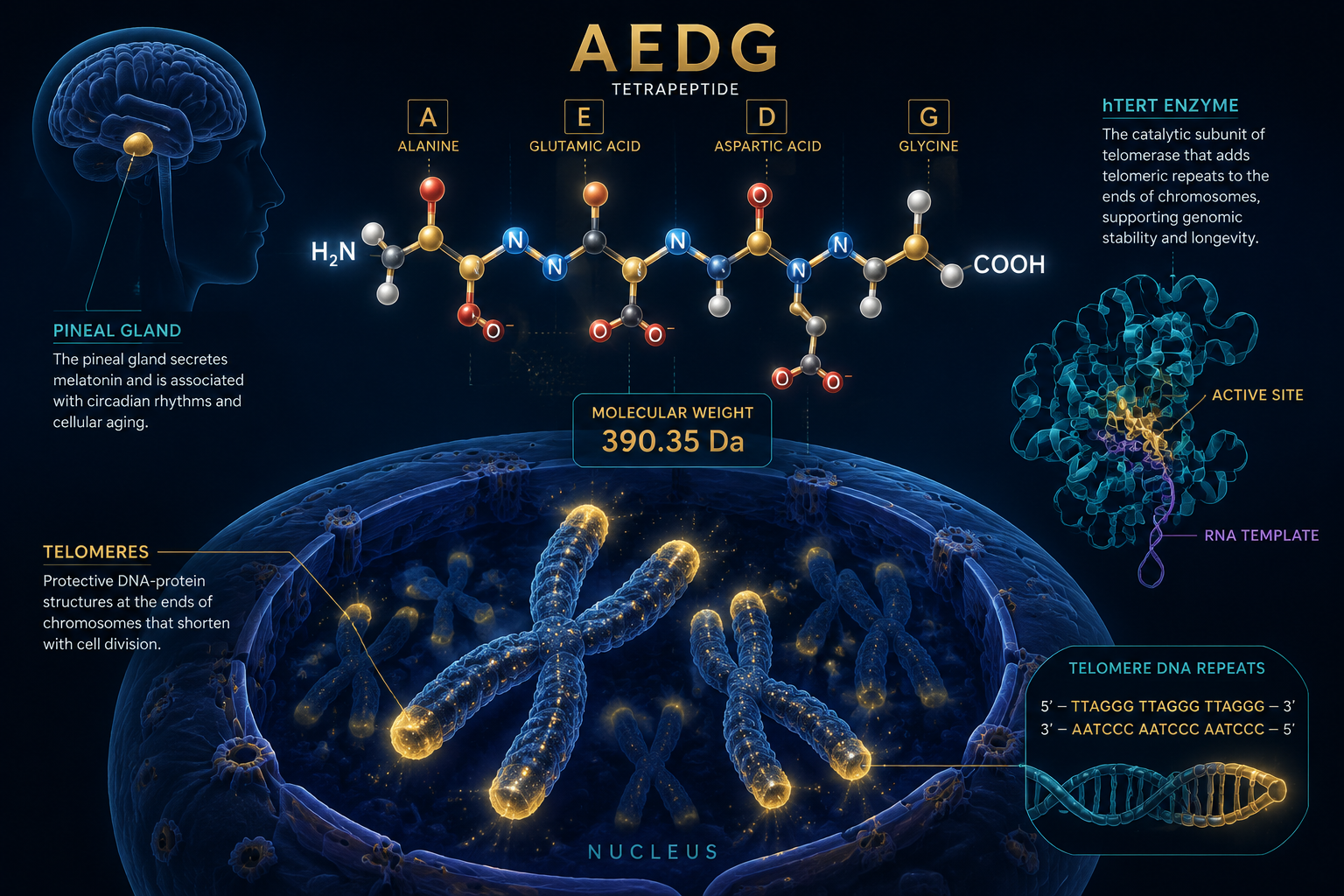
- Epithalon is a synthetic tetrapeptide (Ala-Glu-Asp-Gly) with a molecular weight of 390.35 Da, originally derived from the pineal gland peptide Epithalamin.
- Research suggests Epithalon activates the hTERT enzyme, which drives telomerase activity and may extend cellular replicative lifespan.
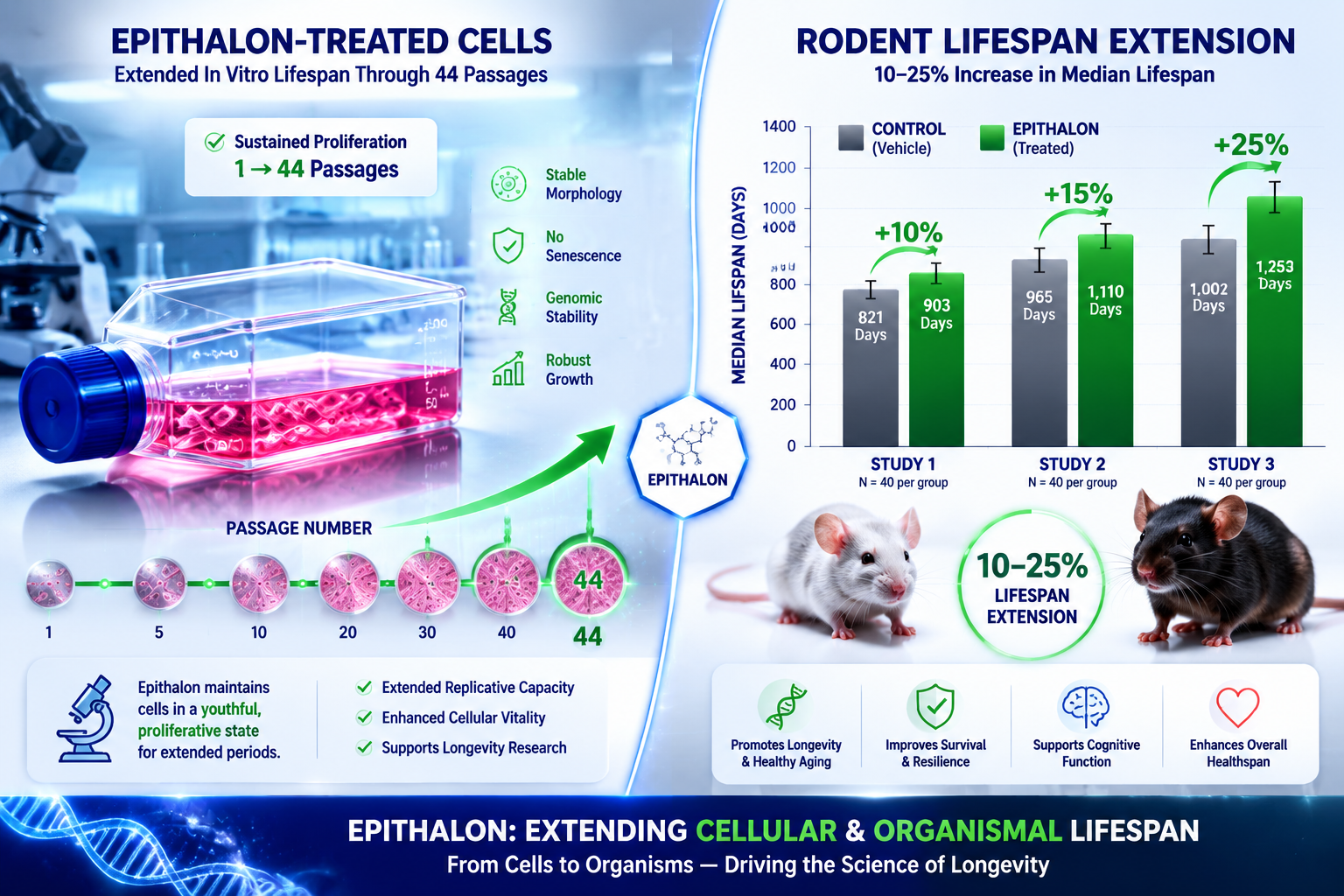
- Rodent studies have reported lifespan extensions of 10-25%, while human cell studies show measurable reductions in senescence markers.
- Most existing research originates from a single Russian laboratory, and independent Western replication remains limited.
- Regulatory status is a key consideration: the FDA has not approved Epithalon for any medical use.
What Is Epithalon and How Does It Work
Epithalon (also spelled Epitalon) is a four-amino-acid peptide with the sequence Ala-Glu-Asp-Gly (AEDG) and a molecular weight of 390.35 Da. It was synthesized as a shorter, more stable analog of Epithalamin, a natural polypeptide extracted from bovine pineal gland tissue.
Its proposed mechanisms center on two pathways:
- Telomerase activation: Epithalon upregulates hTERT, the catalytic subunit of telomerase, which adds protective nucleotide sequences back onto telomere ends.
- Pineal gland stimulation: The peptide appears to restore melatonin production in aging subjects, with small human studies reporting improved circadian rhythm function and sleep quality in elderly individuals.
These dual pathways position Epithalon within the broader field of longevity peptide research, where researchers are mapping how molecular signals influence the pace of biological aging.
Epithalon Peptide: Telomerase Activation and its Role in Cellular Aging Research — Key Study Findings
The scientific record on Epithalon spans more than two decades. Here is a structured overview of the most significant findings:
| Study Focus | Key Finding |
|---|---|
| Telomerase activation (2003) | Epithalon induced telomerase activity and telomere elongation in human somatic cells |
| Replicative lifespan (2004) | Treated human fetal fibroblasts continued dividing through the 44th passage — roughly 29% longer than controls |
| Rodent lifespan | Anisimov et al. reported 10-25% lifespan extension in treated rodent models |
| Senescence markers | p16 and p21 protein levels reduced by 1.56- to 2.44-fold in human gingival mesenchymal stem cells |
| Antioxidant activity | Reduced reactive oxygen species in mouse oocytes and lowered lipid peroxidation in rat brain and liver tissue |
| 2025 in vitro confirmation | Dose-dependent telomere elongation via hTERT upregulation confirmed in normal human cell lines |
A 2025 study by Al-Dulaimi and colleagues provided fresh support for the telomerase activation hypothesis, demonstrating dose-dependent telomere elongation in normal human cell lines — reinforcing the foundational 2003 work by Khavinson et al. For researchers tracking what is new in peptide research, these findings represent a meaningful update to the Epithalon literature.
Limitations, Comparisons, and Research Context
Understanding Epithalon Peptide: Telomerase Activation and its Role in Cellular Aging Research also requires honest engagement with its limitations.
The replication gap is the most significant concern. The overwhelming majority of Epithalon studies originate from a single Russian research group. Western laboratories have not yet independently replicated the core findings at scale, which limits the confidence researchers can place in the data.
Regulatory status adds another layer of complexity. As of 2023, the FDA classified Epithalon as a Category 2 substance and prohibited compounding pharmacies from producing it. It remains unapproved for any medical use.
Comparison with other longevity peptides is instructive. While Epithalon targets telomerase and melatonin pathways, SS-31 (Elamipretide) focuses on mitochondrial membrane stabilization and received FDA approval for Barth syndrome in September 2025 — representing a stronger independent evidence base. Similarly, MOTS-c operates through mitochondrial-nuclear signaling, offering a distinct but complementary research angle.
Researchers interested in multi-pathway approaches may also find value in reviewing peptide blend research and epithalon longevity signals for context on how Epithalon fits within broader aging research frameworks.
Regulatory Landscape and Research Sourcing
For researchers working with Epithalon in 2026, sourcing quality and purity are non-negotiable. Peptide integrity directly affects experimental reliability. Researchers sourcing Epithalon peptides for study purposes should prioritize suppliers with verified third-party testing and documented purity certificates.

Those building broader longevity research panels may also want to explore GHK-Cu copper peptide research as a complementary compound with its own distinct cellular repair mechanisms.
Conclusion
Epithalon peptide occupies a genuinely compelling position in cellular aging research. Its proposed mechanism — activating telomerase via hTERT upregulation — addresses one of the most fundamental drivers of cellular senescence, and the accumulating data from both foundational and recent studies supports continued investigation.
Actionable next steps for researchers:
- Review the full body of Epithalon literature with attention to study design and the replication gap before drawing conclusions.
- Prioritize lab-tested, high-purity Epithalon sources to ensure experimental validity.
- Consider Epithalon within a multi-compound research framework alongside mitochondrial and immune-modulating peptides.
- Monitor regulatory developments, as the FDA classification landscape for research peptides continues to evolve.
The science of telomere biology and cellular longevity is advancing rapidly. Epithalon remains one of the more scientifically grounded compounds in this space — and one that warrants careful, rigorous continued study.
Leave a Reply
Want to join the discussion?Feel free to contribute!