

Nicotinamide N-methyltransferase (NNMT) activity is elevated in the fat tissue of obese individuals by as much as 100-fold compared to lean controls, a striking figure that has pushed NNMT inhibition to the forefront of metabolic research. The compound 5-Amino-1MQ has emerged as a targeted tool in this space, and understanding 5-Amino-1MQ Peptide and NNMT Inhibition: How It Compares With Statins Like Atorvastatin in Adipose and Lipid Metabolism Research helps clarify why researchers are paying close attention to its distinct mechanism versus conventional lipid-lowering agents.
Key Takeaways
- 5-Amino-1MQ is a small-molecule NNMT inhibitor, not technically a peptide, though it is frequently grouped with research peptides in the literature.
- NNMT inhibition raises intracellular NAD+ and SAM levels, promoting fat cell energy expenditure and reducing lipid storage.
- Statins like atorvastatin target the mevalonate pathway to lower LDL cholesterol, a fundamentally different mechanism from NNMT inhibition.
- The two approaches are not interchangeable in research models; each addresses a separate node in metabolic dysfunction.
- Researchers studying body composition changes may find 5-Amino-1MQ more directly relevant to adipose tissue remodeling than statin-based models.
What Is 5-Amino-1MQ and How Does NNMT Inhibition Work
Clarifying the "Peptide" Label
A common point of confusion: 5-Amino-1MQ is not a peptide in the strict biochemical sense. It is a small-molecule methylquinolinium derivative, specifically, 5-amino-1-methylquinolinium. It carries no amino acid chain. The "peptide" label appears in research vendor catalogs because it is studied alongside peptide compounds in metabolic and longevity research contexts. Researchers exploring longevity peptide research will encounter 5-Amino-1MQ frequently within that broader category.
The NNMT Enzyme and Its Role in Fat Tissue
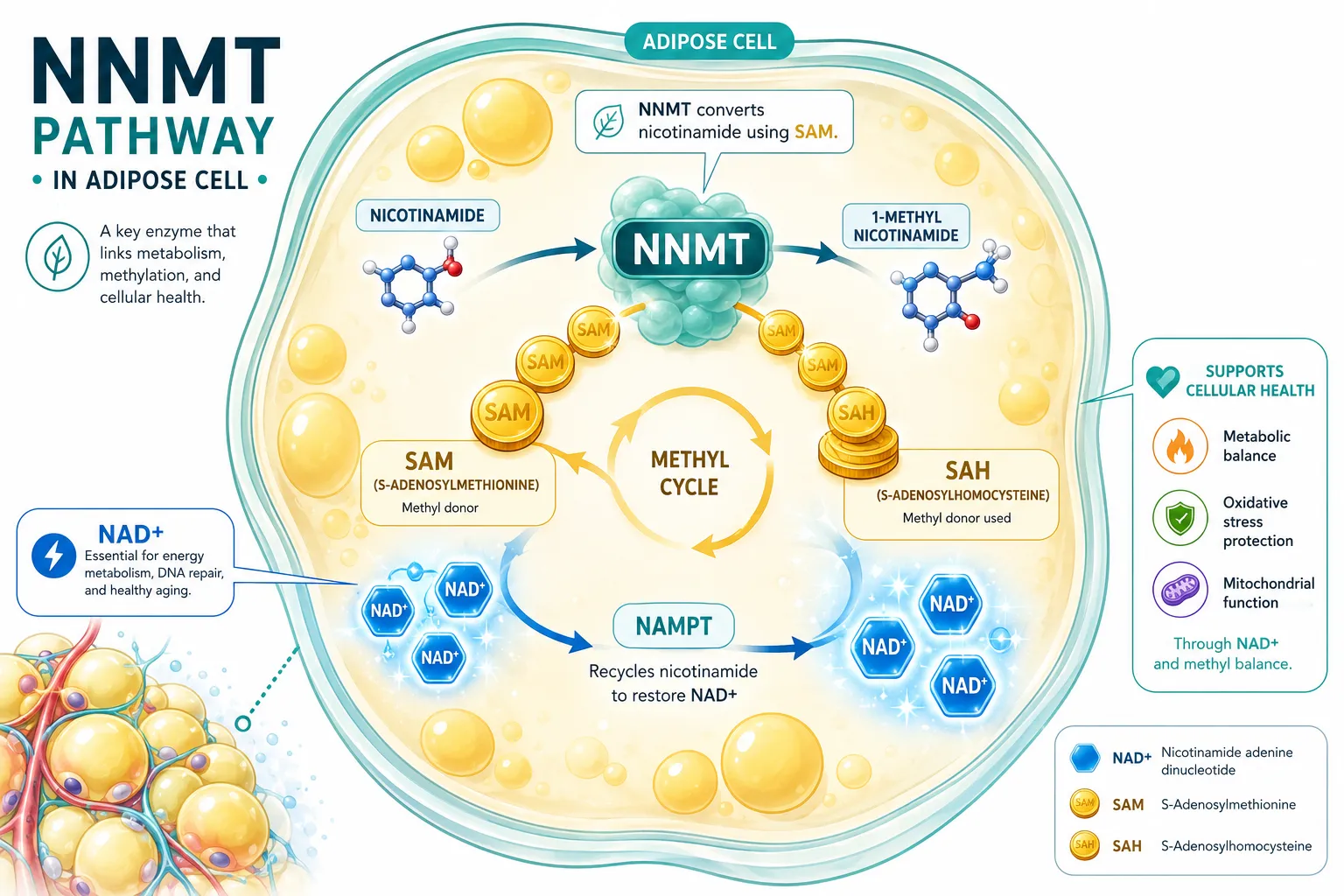
NNMT catalyzes the methylation of nicotinamide using S-adenosylmethionine (SAM) as the methyl donor. When NNMT is highly active, it consumes SAM and produces 1-methylnicotinamide, which drains the cell of two critical resources:
- SAM, the primary methyl donor for epigenetic regulation and metabolic signaling
- NAD+ precursors, molecules that feed mitochondrial energy production
In adipose tissue, this drain creates a low-energy, pro-storage environment. Fat cells become more efficient at storing lipids and less efficient at burning them. By blocking NNMT, 5-Amino-1MQ restores SAM and NAD+ availability, effectively shifting the metabolic balance toward energy expenditure. This connects directly to research themes explored in NAD+ energetics and longevity research.
5-Amino-1MQ Peptide and NNMT Inhibition: How It Compares With Statins Like Atorvastatin in Adipose and Lipid Metabolism Research

The Statin Mechanism: A Different Metabolic Target
Atorvastatin, one of the most prescribed statins globally, works by inhibiting HMG-CoA reductase, the rate-limiting enzyme in the mevalonate pathway. This reduces endogenous cholesterol synthesis in the liver, which lowers circulating LDL-cholesterol. Statins are highly effective for cardiovascular risk reduction, but their primary action is hepatic and cholesterol-focused.
| Feature | 5-Amino-1MQ (NNMT Inhibitor) | Atorvastatin (Statin) |
|---|---|---|
| Primary target | NNMT enzyme in adipose tissue | HMG-CoA reductase in liver |
| Key metabolic effect | Raises NAD+/SAM; increases fat oxidation | Reduces LDL cholesterol synthesis |
| Primary tissue site | Adipose, muscle | Hepatic |
| Lipid storage impact | Reduces triglyceride accumulation | Indirect; minimal direct fat-cell effect |
Where the Two Pathways Diverge
Statins do not meaningfully alter NNMT activity, and 5-Amino-1MQ does not inhibit cholesterol synthesis. This means the two compounds address entirely separate nodes of metabolic dysfunction:
- Atorvastatin is most relevant in research models focused on cardiovascular lipid profiles and hepatic cholesterol output.
- 5-Amino-1MQ is most relevant in models studying adipose tissue remodeling, visceral fat reduction, and NAD+ biology.
Researchers studying fat-cell metabolism may also find relevant parallels in IPA muscle and fat research themes and AOD-9604 research, both of which engage adipose biology through distinct mechanisms.
Research Implications and When Each Model Applies

Choosing the Right Model for Adipose vs. Lipid Research
The distinction between adipose metabolism and lipid metabolism is often blurred in popular science writing, but it matters enormously in research design. Adipose metabolism refers to how fat cells store, mobilize, and oxidize lipids. Lipid metabolism refers to how lipids circulate in the bloodstream and are processed by the liver.
Researchers should consider the following when selecting a model:
- For visceral fat reduction studies: 5-Amino-1MQ's NNMT inhibition offers a direct adipose-tissue mechanism, making it a stronger model candidate.
- For cardiovascular lipid profiling: Atorvastatin remains the gold-standard reference compound.
- For combined metabolic syndrome models: Both compounds may be relevant in separate experimental arms, not as direct substitutes.
Compounds like Adipotide and MOTS-c also engage adipose and mitochondrial pathways and may serve as useful comparators in multi-arm metabolic studies.
Downstream Research Considerations
Because 5-Amino-1MQ elevates NAD+ levels, it intersects with research on mitochondrial function, cellular aging, and energy sensing. This positions it alongside compounds studied in MOTS-c mitochondrial research and broader longevity peptide research. Statins, by contrast, have been studied for pleiotropic anti-inflammatory effects, but these do not overlap with the NAD+/SAM axis that makes 5-Amino-1MQ unique.
Key insight: Conflating NNMT inhibition with statin-like activity misrepresents both mechanisms and can lead to poorly designed research protocols.
Conclusion
The comparison between 5-Amino-1MQ Peptide and NNMT Inhibition: How It Compares With Statins Like Atorvastatin in Adipose and Lipid Metabolism Research reveals two non-competing, mechanistically distinct research tools. 5-Amino-1MQ targets NNMT in adipose tissue to restore NAD+ and SAM availability, shifting fat cells toward energy expenditure. Atorvastatin targets hepatic cholesterol synthesis to reduce circulating LDL. Neither replaces the other.
Actionable next steps for researchers:
- Define whether the study question centers on adipose remodeling or circulating lipid profiles before selecting a compound.
- Use 5-Amino-1MQ in models where NNMT overexpression or NAD+ depletion is a documented variable.
- Reserve statin models for cardiovascular-focused endpoints where LDL reduction is the primary outcome measure.
- Consider multi-pathway designs that include NNMT inhibitors alongside mitochondrial or GLP-1-axis compounds for broader metabolic coverage.
Understanding these distinctions ensures cleaner experimental design and more interpretable results across adipose and lipid metabolism research.
Leave a Reply
Want to join the discussion?Feel free to contribute!