

Researchers have demonstrated that certain peptides administered through the nose can reach cerebrospinal fluid in as little as ten minutes, a pharmacokinetic window that has fundamentally reshaped how scientists think about delivering neuroactive compounds. Against that backdrop, the term Klow Blend Peptide Nasal Spray: What the Formulation Is Trying to Do in Cognitive Research has surfaced in online discussions, prompting questions about its scientific basis, its ingredients, and what cognitive endpoints it might be designed to target.
This article examines the rationale behind multi-compound intranasal peptide blends, the nose-to-brain delivery pathway, and the practical challenges researchers face when designing such formulations, providing the context needed to evaluate any branded nasal spray concept in this space.
Key Takeaways
- No peer-reviewed literature, clinical trial registry, or regulatory record currently lists "Klow Blend" as an established peptide compound or research entity.
- The term likely reflects proprietary or informal naming for a multi-peptide intranasal formulation concept rather than a defined scientific product.
- Intranasal delivery is a legitimate and actively studied route for getting neuroactive peptides into brain tissue, partially bypassing the blood-brain barrier.
- Multi-compound "blend" formulations are designed to target several cognitive pathways simultaneously, but they introduce significant formulation and stability challenges.
- Researchers tracking cognitive outcomes in intranasal peptide studies typically measure memory consolidation, processing speed, neuroprotection markers, and neuroinflammation.
What "Klow Blend" Actually Refers To, and What the Record Shows
A thorough search of PubMed, ClinicalTrials.gov, the WHO International Clinical Trials Registry Platform, and major biomedical repositories returns no results for "Klow Blend" as a peptide, investigational drug, nasal spray, or research formulation. No neuropharmacology or neurodegeneration review article from any recognized institution references this name.
This absence does not mean the underlying concept is invalid. It strongly suggests one of three possibilities:
- Proprietary or internal naming, a compound or blend marketed under a trade name that does not correspond to standard scientific nomenclature
- Reformulation of existing peptides, a combination of recognized neuroactive peptides (such as those studied in nose-to-brain delivery research) packaged under a new label
- Misidentification, confusion with another intranasal peptide formulation that does appear in the scientific record
For researchers and consumers alike, this distinction matters. When evaluating any nasal peptide product, verifying whether its components correspond to compounds studied in peer-reviewed literature is the essential first step. Resources like the research blog at Pure Tested Peptides and guides on research-only peptides can help contextualize unfamiliar formulation names.
The Science Behind Intranasal Peptide Delivery for Cognition
Why the Nose-to-Brain Route Matters
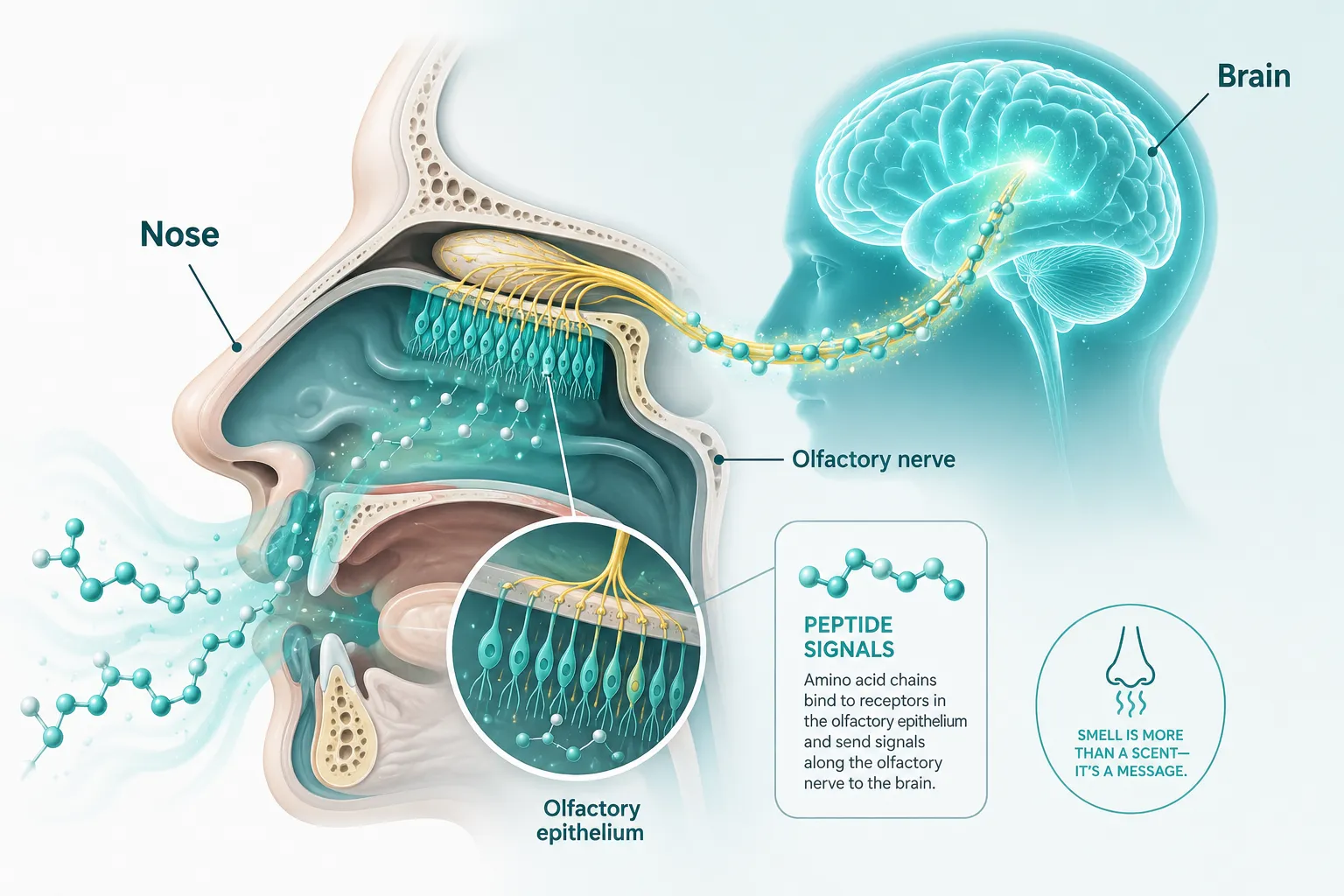
The blood-brain barrier (BBB) blocks most large molecules, including many peptides, from entering the central nervous system through conventional oral or intravenous routes. Intranasal delivery offers a partial workaround: peptides deposited on the olfactory epithelium can travel along olfactory and trigeminal nerve pathways directly into the brain and cerebrospinal fluid.
In a controlled human study with 36 healthy volunteers, intranasally administered melanocortin, vasopressin, and insulin were all detectable in CSF within 10 minutes of administration. Levels peaked between 30 and 80 minutes and remained measurably above baseline at 120 minutes. This pharmacokinetic profile is exactly what makes the nasal route attractive for cognitive research, rapid CNS access without systemic injection.
"The nose-to-brain pathway allows neuroactive peptides to reach cerebrospinal fluid within minutes, offering a non-invasive alternative to direct CNS delivery."
Proof-of-Concept in Preclinical Models
Transgenic mouse models of Alzheimer's disease have been used to test whether intranasally delivered peptides can reduce amyloid burden, improve spatial memory, and modulate neuroinflammation. These preclinical findings provide the mechanistic foundation that any nasal peptide blend aimed at cognitive decline would need to build upon.
Peptides with established neuroprotective profiles, including those studied alongside mitochondrial support compounds, are increasingly explored in combination formats. For example, research on compounds like MOTS-c and elamipretide touches on mitochondrial pathways relevant to neuronal energy metabolism, a target area in cognitive aging research.
Similarly, Epithalon peptide research has explored telomere-related aging mechanisms that intersect with neurodegeneration timelines, making it a candidate component in blends targeting brain aging.
What a Multi-Peptide Nasal Blend Is Designed to Do

The Rationale for Combining Compounds
Cognitive decline is not driven by a single pathway. Researchers designing multi-compound intranasal blends typically aim to address several mechanisms at once:
| Target Mechanism | Example Peptide Class |
|---|---|
| Neuroinflammation reduction | Melanocortin-related peptides |
| Mitochondrial support | SS-31 / elamipretide analogs |
| Neuroprotection and repair | Growth hormone secretagogues |
| Telomere and aging pathways | Epitalon-class tetrapeptides |
| Synaptic plasticity | Vasopressin analogs |
Blending these compounds into a single nasal delivery vehicle is theoretically efficient, one administration event targets multiple pathways. However, this approach introduces real formulation challenges.
Practical Challenges Researchers Must Solve
Combining peptides in a nasal spray is not straightforward. Key obstacles include:
- pH compatibility, different peptides may require different pH ranges for stability
- Mucosal absorption competition, multiple peptides competing for the same epithelial transport mechanisms
- Degradation by nasal enzymes, proteases in nasal mucosa can break down peptides before absorption occurs
- Concentration ratios, determining the optimal ratio of each compound requires independent dose-finding studies
Formulation scientists often use excipients such as cyclodextrins, absorption enhancers, or mucoadhesive polymers to address these barriers. Quality peptide sourcing and verified purity are prerequisites before any such formulation work begins, since impurities can accelerate degradation and confound research outcomes.
Cognitive Endpoints Researchers Track in Intranasal Peptide Studies

When a nasal peptide blend enters a research protocol, investigators need measurable outcomes to determine whether the formulation is doing anything meaningful. Standard cognitive endpoints include:
- Spatial memory performance, assessed via maze tasks in animal models or virtual navigation tests in humans
- Working memory and processing speed, measured through standardized neuropsychological batteries
- Biomarkers of neuroinflammation, such as IL-6, TNF-alpha, and microglial activation markers in CSF or blood
- Amyloid and tau burden, quantified via PET imaging or CSF assays in Alzheimer-focused studies
- Neuroprotection indicators, including BDNF (brain-derived neurotrophic factor) levels and synaptic density measures
Researchers also track safety endpoints: nasal mucosal irritation, systemic peptide exposure, and off-target receptor activation. Any blend formulation, whether labeled "Klow Blend" or otherwise, would need to demonstrate a clean safety profile across these measures before advancing toward human trials.
For those interested in how blend formulations are structured in practice, the ipamorelin and CJC-1295 blend offers a well-documented example of how two peptides with complementary mechanisms are combined in research settings. Similarly, the BPC-157 and TB-500 blend illustrates how synergistic peptide pairings are evaluated in preclinical research.
Conclusion
The Klow Blend Peptide Nasal Spray concept, as it appears in online searches, does not correspond to any traceable entity in the peer-reviewed scientific or regulatory record as of 2026. However, the underlying rationale, delivering a multi-peptide blend intranasally to target cognitive decline through several simultaneous mechanisms, aligns directly with a legitimate and growing area of neuropharmacology research.
Actionable next steps for researchers and informed consumers:
- Verify ingredient identity, cross-reference any named peptides in a blend against published literature using PubMed or equivalent databases.
- Confirm purity and sourcing, only compounds with documented purity certificates are suitable for research use; consult guides on where to buy peptides for sourcing standards.
- Evaluate the delivery mechanism, assess whether the nasal formulation addresses known absorption and stability challenges.
- Track the right endpoints, any cognitive research protocol should pre-specify measurable biomarker and behavioral outcomes before administration begins.
- Stay current with the literature, the nose-to-brain peptide delivery field is advancing rapidly; following current peptide research ensures decisions are based on the most recent evidence.
No formulation name, however compelling, substitutes for transparent ingredient disclosure and peer-reviewed evidence. That standard applies equally to Klow Blend and every other nasal peptide concept in the cognitive research space.
Leave a Reply
Want to join the discussion?Feel free to contribute!