

A 16-amino-acid peptide encoded not by the nuclear genome but by mitochondrial DNA is reshaping how researchers think about cellular energy regulation. MOTS-C Peptide: Unraveling Its Role in Mitochondrial Dynamics and Energy Metabolism Research has become one of the most compelling areas of metabolic science in 2026, drawing attention from investigators studying aging, insulin resistance, obesity, and physical performance. With a molecular weight of just 2,174.6 Da and a plasma half-life of roughly 30 minutes, MOTS-c punches well above its size in terms of biological impact.
Key Takeaways
- MOTS-c is a mitochondria-derived peptide that regulates energy metabolism through the Folate-AICAR-AMPK signaling pathway.
- Under metabolic stress, MOTS-c translocates to the cell nucleus to activate stress-response genes.
- Exercise significantly increases circulating MOTS-c levels, linking physical activity to mitochondrial signaling.
- MOTS-c expression declines with age, and supplementation in animal models has reversed age-related physical decline.
- Preclinical research suggests therapeutic potential in type 2 diabetes, obesity, and metabolic syndrome.
Molecular Origins and Mechanism of Action
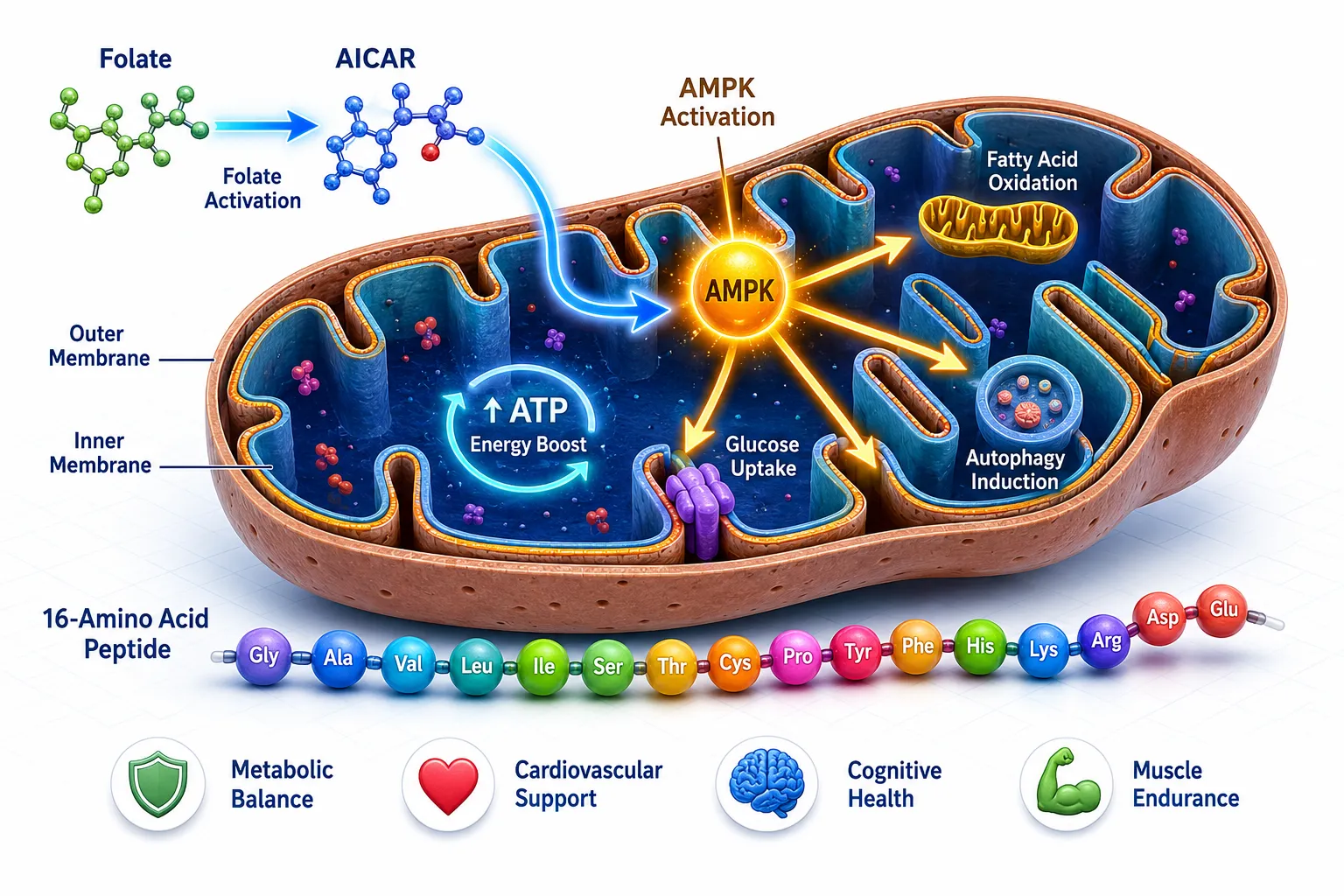
MOTS-c is encoded within the 12S ribosomal RNA gene of mitochondrial DNA, a discovery that challenged the long-held assumption that mitochondria primarily serve as passive energy producers. Instead, mitochondria appear to act as active signaling organelles, releasing peptides that communicate with the rest of the cell.
The primary mechanism through which MOTS-c exerts its effects is the Folate-AICAR-AMPK pathway. Here is a simplified breakdown of how this cascade works:
| Step | Event | Outcome |
|---|---|---|
| 1 | MOTS-c inhibits folate cycle enzymes | AICAR accumulates intracellularly |
| 2 | AICAR activates AMPK | Energy-sensing switch is turned on |
| 3 | AMPK activation | Improved glucose uptake, reduced fat synthesis |
| 4 | Nuclear translocation under stress | Gene expression reprogrammed for adaptation |
This pathway influences insulin sensitivity, inflammatory signaling, and the cellular response to metabolic stress. When energy demand rises, during exercise or caloric restriction, MOTS-c translocates from the cytoplasm into the nucleus, where it binds to stress-response transcription factors and reprograms gene expression to support cellular adaptation.
Researchers exploring MOTS-c and its mitochondrial peptide biology have noted that this nuclear translocation behavior distinguishes MOTS-c from most other peptides, which typically act at cell surface receptors rather than directly influencing transcription.
MOTS-C Peptide: Unraveling Its Role in Mitochondrial Dynamics and Energy Metabolism Research, Metabolic Applications

The metabolic implications of MOTS-c research are broad. Preclinical studies have demonstrated several consistent findings:
Obesity and Insulin Resistance
In mouse models fed high-fat diets, MOTS-c treatment prevented diet-induced obesity and significantly improved insulin sensitivity. The peptide appears to shift cellular metabolism toward more efficient glucose utilization while reducing lipid accumulation.
Type 2 Diabetes and Cardiac Function
Research published in recent years found that MOTS-c can restore mitochondrial respiration in type 2 diabetic hearts, a finding with significant implications for cardiovascular metabolic disease. Impaired mitochondrial function is a hallmark of diabetic cardiomyopathy, and MOTS-c's ability to improve respiratory chain activity positions it as a candidate for further investigation.
Inflammatory Modulation
Beyond glucose metabolism, MOTS-c appears to dampen inflammatory signaling pathways. Chronic low-grade inflammation drives insulin resistance and metabolic syndrome, making MOTS-c's anti-inflammatory properties a secondary but important area of study.
Those reviewing MOTS-c metabolic flexibility research themes will find a growing body of evidence connecting mitochondrial peptide signaling to whole-body metabolic flexibility. For context on related metabolic modulation compounds, the metabolic modulation research lines overview provides useful comparative framing.
Exercise, Aging, and the Broader Research Landscape

Two of the most actively studied dimensions of MOTS-C Peptide: Unraveling Its Role in Mitochondrial Dynamics and Energy Metabolism Research involve physical performance and the biology of aging.
Exercise-Induced Expression
Human studies confirm that exercise significantly increases circulating MOTS-c levels. This suggests the peptide acts as an exercise mimetic signal, one that tells tissues to adapt metabolically even before the body has fully recovered from physical exertion. Systemic MOTS-c administration in animal models increased exercise capacity by boosting skeletal muscle stress responses and enhancing mitochondrial adaptation.
Age-Related Decline
MOTS-c expression measurably decreases with age. In aged mouse models, exogenous MOTS-c administration reversed markers of physical decline and restored exercise performance closer to levels seen in younger animals. This positions MOTS-c alongside other longevity-focused peptides currently under investigation.
Key insight: The decline of MOTS-c with age may represent a targetable mechanism underlying the metabolic deterioration commonly associated with aging.
Researchers comparing mitochondria-targeted compounds may also find value in reviewing SS-31 peptide research considerations, as SS-31 targets cardiolipin within the inner mitochondrial membrane and represents a complementary research direction. The SS-31 mechanism and research overview further contextualizes how mitochondria-targeting peptides differ in their mechanisms.
For investigators interested in longevity-related peptide research more broadly, GHK-Cu longevity research themes and Epithalon longevity signals offer adjacent research perspectives.
Recent work examining MOTS-c and SLU-PP332 interactions explores how combining mitochondrial activators may produce synergistic metabolic effects, a direction that reflects the growing sophistication of peptide combination research.
Conclusion
MOTS-c represents a paradigm shift in understanding mitochondrial biology. Rather than viewing mitochondria solely as ATP-generating organelles, researchers now recognize them as dynamic signaling hubs capable of releasing peptides that regulate metabolism, stress adaptation, and aging across multiple tissues.
Actionable next steps for researchers in 2026:
- Review preclinical dosing protocols and half-life data before designing MOTS-c administration studies.
- Consider pairing MOTS-c investigations with mitochondria-targeted compounds like SS-31 to explore complementary mechanisms.
- Track nuclear translocation as a key biomarker of MOTS-c activity under stress conditions.
- Monitor circulating MOTS-c levels in exercise intervention studies to establish dose-response relationships.
- Evaluate MOTS-c's anti-inflammatory properties in models of metabolic syndrome alongside its direct metabolic effects.
The depth of MOTS-c's influence on mitochondrial dynamics and energy metabolism research makes it one of the most promising peptide candidates for future translational studies. As the field matures, rigorous research design and high-quality sourcing will be essential to advancing the science responsibly.
Leave a Reply
Want to join the discussion?Feel free to contribute!