

"
Metabolic dysfunction now affects more than one billion people globally, yet the molecular tools available to researchers studying its root causes have expanded dramatically in recent years. Among the most discussed pairings in preclinical metabolic research is the combination of 5-Amino-1MQ and MOTS-C, two mechanistically distinct agents that may converge on shared mitochondrial and energy-sensing pathways. Understanding the rationale behind this pairing, what the current evidence actually shows, and how to design studies that test synergy claims rigorously is essential for any researcher working in this space in 2026.
Key Takeaways
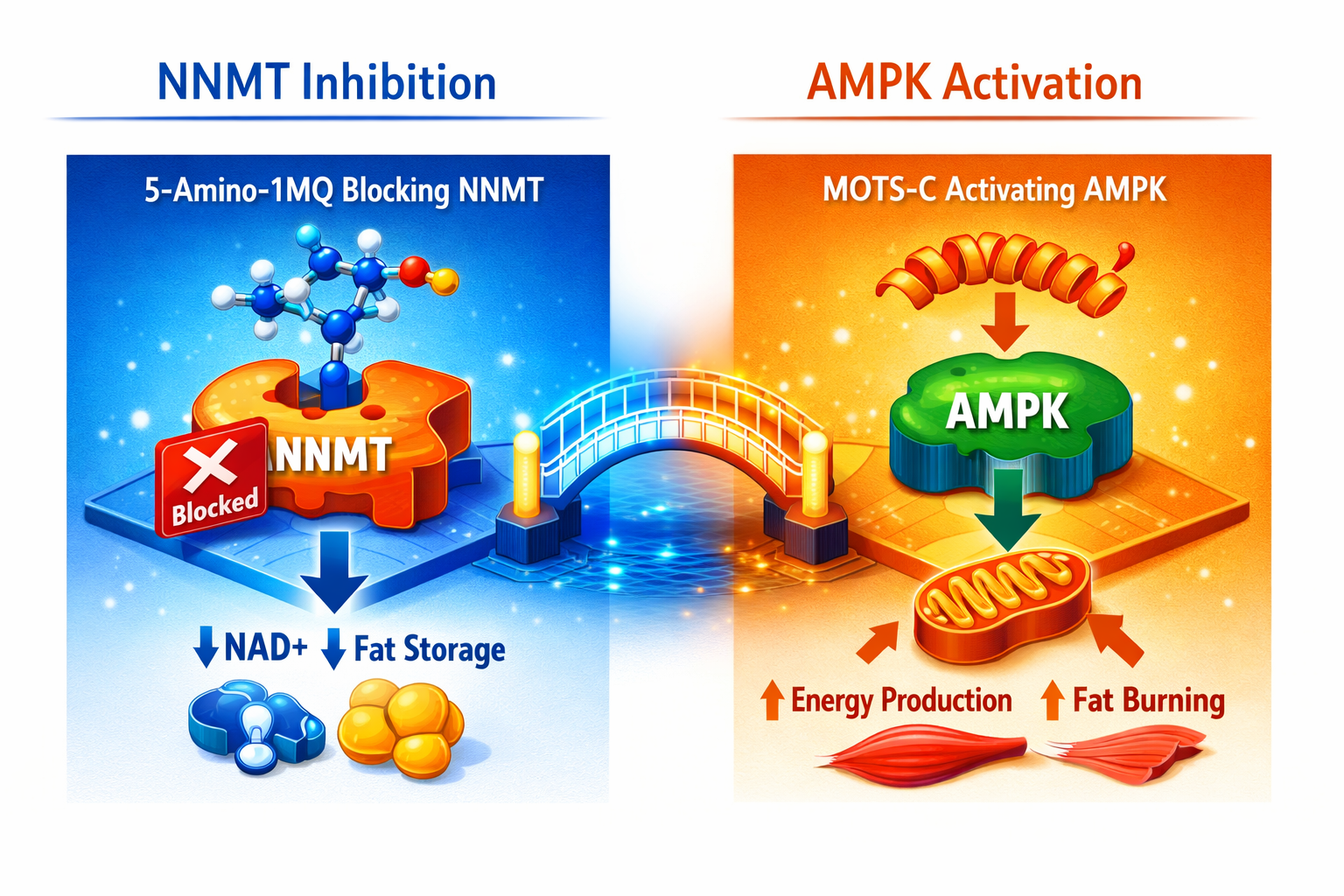
- 5-Amino-1MQ inhibits the enzyme NNMT, which plays a central role in regulating cellular NAD+ availability and fat storage.
- MOTS-C is a mitochondria-derived peptide that activates AMPK and influences glucose and lipid metabolism.
- Both agents may converge on NAD+/AMPK signaling nodes, providing a mechanistic basis for studying their combination.
- Synergy claims require carefully controlled study designs with defined endpoints and appropriate controls.
- Current evidence is largely preclinical; researchers should approach combination protocols with methodological rigor.
Understanding the Mechanistic Basis for 5-Amino-1MQ and MOTS-C Synergy in Metabolic Signaling
To evaluate whether two compounds produce synergistic effects, researchers must first map their individual mechanisms. Pairing agents without this foundation leads to uninterpretable results.
5-Amino-1MQ (5-amino-1-methylquinolinium) is a small-molecule inhibitor of nicotinamide N-methyltransferase (NNMT). NNMT consumes S-adenosylmethionine (SAM) and converts nicotinamide into 1-methylnicotinamide, effectively reducing the substrate pool available for NAD+ synthesis. By blocking NNMT, 5-Amino-1MQ increases intracellular NAD+ precursor availability, which in turn supports sirtuin activity and mitochondrial biogenesis. Preclinical studies in adipocyte models have linked NNMT inhibition to reduced lipid accumulation and improved insulin sensitivity.
MOTS-C is a 16-amino-acid peptide encoded within the mitochondrial 12S rRNA gene. It is one of a class of compounds called mitochondria-derived peptides (MDPs). MOTS-C translocates to the nucleus under metabolic stress and activates AMP-activated protein kinase (AMPK), a master regulator of cellular energy homeostasis. AMPK activation promotes glucose uptake, fatty acid oxidation, and mitochondrial function while suppressing anabolic processes that consume ATP.
"The mechanistic overlap between NNMT inhibition and AMPK activation creates a plausible framework for studying additive or synergistic metabolic effects, but plausibility is not evidence."
The convergence point is significant. Both pathways feed into the broader NAD+/AMPK energy-sensing network. Elevated NAD+ supports SIRT1 activity, which can activate AMPK indirectly through LKB1 deacetylation. MOTS-C activates AMPK directly. This dual-input model is why researchers have begun exploring 5-Amino-1MQ and MOTS-C synergy in metabolic signaling contexts, particularly in models of obesity and insulin resistance.
For researchers exploring the broader landscape of mitochondrially targeted peptides, the SS-31 mitochondrial research themes page provides useful context on how mitochondria-focused compounds are studied across different experimental frameworks.
Mitochondrial Targets and Pathway Interactions

Mitochondria sit at the center of the 5-Amino-1MQ and MOTS-C synergy story. Both agents influence mitochondrial function, but through different entry points.
NAD+ and Sirtuin Signaling
| Pathway Element | 5-Amino-1MQ Role | MOTS-C Role |
|---|---|---|
| NAD+ availability | Increases via NNMT inhibition | Indirectly supported via AMPK |
| AMPK activation | Indirect (via NAD+/SIRT1/LKB1) | Direct activation |
| Mitochondrial biogenesis | Supported via PGC-1alpha | Supported via AMPK/PGC-1alpha |
| Fatty acid oxidation | Enhanced | Enhanced |
| Glucose uptake | Improved in adipocyte models | Improved via GLUT4 translocation |
This table illustrates why the combination is mechanistically attractive. Both compounds influence PGC-1alpha, the transcriptional coactivator that drives mitochondrial biogenesis. However, they do so through different upstream signals, which means a combined protocol could theoretically produce stronger or more sustained PGC-1alpha activation than either agent alone.
Key pathway interactions to monitor in research:
- NAD+/SIRT1/LKB1/AMPK axis
- PGC-1alpha transcriptional activity
- Mitochondrial membrane potential
- Reactive oxygen species (ROS) output
- Fatty acid oxidation rates (beta-oxidation markers)
Researchers studying mitochondrial dynamics in related peptide systems may also find value in reviewing SS-31 mitochondrial dynamics research, which covers complementary mechanistic endpoints relevant to energy metabolism studies.
For those sourcing compounds for preclinical work, reviewing research-only peptides and quality peptide sourcing standards is an important step before designing any study.
Research Design Considerations for Studying 5-Amino-1MQ and MOTS-C Synergy
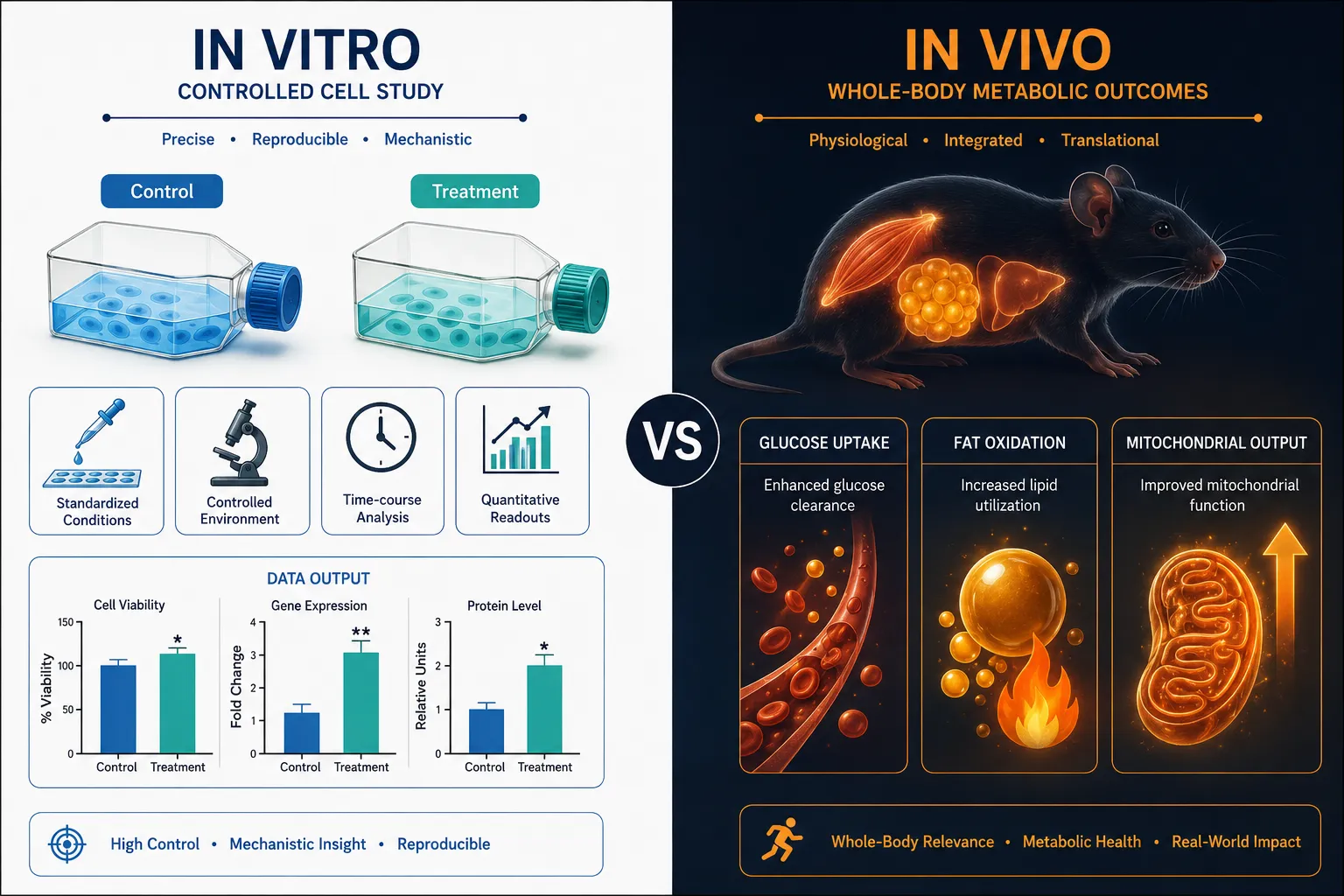
Claiming synergy between two metabolic agents requires more than observing that a combination produces a larger effect than either compound alone. Rigorous research design is non-negotiable.
Defining Synergy Quantitatively
True synergy is defined using interaction models such as the Bliss Independence model or the Loewe Additivity model. Researchers must test:
- Compound A alone across a dose range
- Compound B alone across a dose range
- Combination at fixed ratios across a dose range
- Vehicle control matched for solvent and volume
Without all four arms, distinguishing synergy from simple additivity is not possible.
Recommended Endpoints for Combination Studies
Primary metabolic endpoints:
- Oxygen consumption rate (OCR) via Seahorse XF analysis
- Extracellular acidification rate (ECAR)
- Intracellular NAD+/NADH ratio
- AMPK phosphorylation (Thr172)
- Lipid accumulation (Oil Red O staining in adipocyte models)
Secondary endpoints:
- Mitochondrial membrane potential (JC-1 assay)
- ATP production rate
- Gene expression of PGC-1alpha, TFAM, CPT1
Model Selection
In vitro models (3T3-L1 adipocytes, C2C12 myotubes) are appropriate for initial mechanistic work. In vivo models, typically diet-induced obese (DIO) mice, are needed to assess systemic metabolic effects. Researchers should note that MOTS-C has shown tissue-specific effects, with skeletal muscle being a primary target, while 5-Amino-1MQ effects have been most characterized in adipose tissue. Combination studies should therefore include both tissue types.
For broader context on how peptide combinations are approached in research settings, the research blog and articles covering peptide benchmarking standards offer relevant methodological perspective.
Researchers interested in how other metabolic peptides interact with energy-sensing pathways may also find the discussion of biochemistry-tagged research topics useful for cross-referencing related mechanisms.
Conclusion
The pairing of 5-Amino-1MQ and MOTS-C in metabolic research is grounded in a coherent mechanistic rationale. Both agents influence the NAD+/AMPK/PGC-1alpha network through distinct upstream inputs, making their combination a scientifically reasonable subject of investigation. However, the gap between mechanistic plausibility and demonstrated synergy remains wide in 2026. Most evidence is preclinical, and rigorous dose-matrix study designs with validated endpoints have not yet been widely published for this specific combination.
Actionable next steps for researchers:
- Map the dose-response curves for each compound independently before designing combination experiments.
- Select model systems that reflect the tissue targets of both agents (adipose and skeletal muscle).
- Use quantitative synergy frameworks (Bliss or Loewe) rather than informal comparisons.
- Prioritize mitochondrial function endpoints (OCR, NAD+ ratio, AMPK phosphorylation) as primary readouts.
- Source compounds from suppliers with verified purity documentation and reference standards to ensure data reproducibility.
Treating synergy as a hypothesis to be tested, rather than an assumption to be confirmed, is what separates productive metabolic research from noise.
Leave a Reply
Want to join the discussion?Feel free to contribute!