

Intranasal peptide delivery achieves bioavailability figures that oral routes simply cannot match, recent industry analyses place intranasal Semax bioavailability at roughly 60-70%, compared to less than 5% via oral administration and approximately 95% via injection. That gap is not a minor detail; it fundamentally shapes how researchers design neurocognitive and anxiolytic peptide studies. Understanding nasal spray peptides: bioavailability, administration, and Semax/Selank research applications is therefore essential for any investigator working in this space in 2026.
Key Takeaways
- Intranasal delivery bypasses first-pass hepatic metabolism, dramatically improving peptide bioavailability compared to oral routes.
- The olfactory and trigeminal nerve pathways allow certain peptides to reach the central nervous system directly, bypassing the blood-brain barrier.
- Semax and Selank are among the most well-characterized peptides for intranasal research, with distinct neurocognitive and anxiolytic profiles.
- Formulation variables, pH, tonicity, preservatives, and droplet size, critically affect absorption efficiency and mucosal tolerability.
- Purity and third-party testing of research peptides are non-negotiable factors for reproducible experimental outcomes.
Why Intranasal Delivery Changes the Peptide Research Equation
Most peptides are enzymatically degraded in the gastrointestinal tract before they reach systemic circulation. Oral bioavailability for many peptide compounds sits below 5%, making that route impractical for research protocols requiring consistent plasma or CNS concentrations. Subcutaneous or intravenous injection achieves near-complete bioavailability, but the intranasal route offers a compelling middle ground that is less invasive and, for certain peptides, nearly as effective.
The Nasal Mucosa as an Absorption Gateway
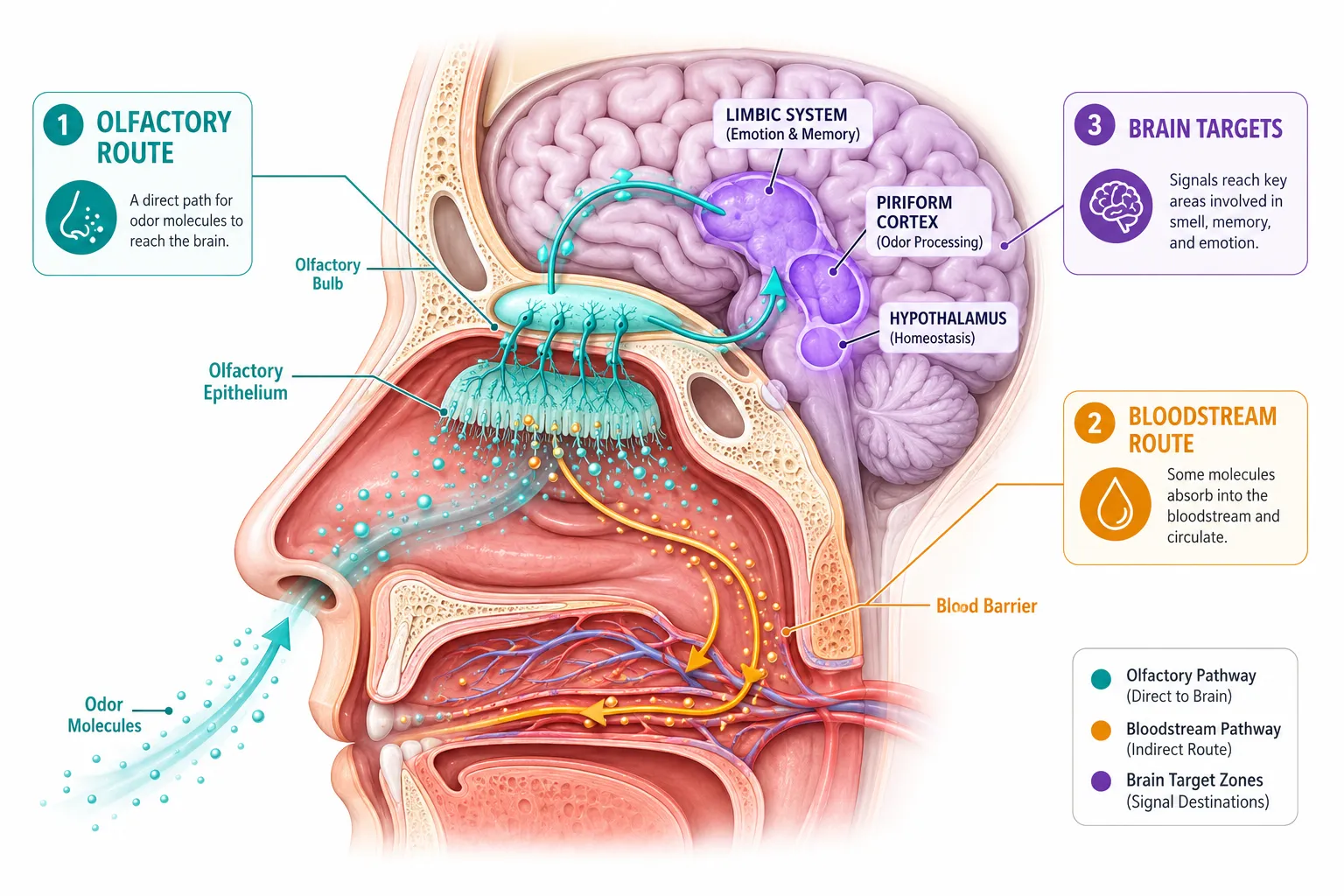
The nasal cavity presents a large surface area, approximately 150 cm² in adults, lined with highly vascularized epithelium. Peptides deposited on this surface can be absorbed through several mechanisms:
- Transcellular transport: Peptides pass directly through epithelial cells into the bloodstream.
- Paracellular transport: Smaller molecules move between tight junctions.
- Olfactory nerve pathway: Peptides travel along olfactory neurons, potentially reaching the brain directly without crossing the blood-brain barrier.
- Trigeminal nerve pathway: A secondary direct CNS route running through the nasal mucosa.
The olfactory pathway is particularly relevant for neurocognitive peptide research because it offers a direct conduit to the central nervous system. This is one reason why compounds like Semax and Selank have been studied almost exclusively via the intranasal route rather than orally.
"For peptides targeting CNS endpoints, the intranasal route is not simply a convenience, it is a mechanistically distinct delivery strategy."
Researchers interested in a broader overview of intranasal peptide formats can explore the nasal spray peptides resource for additional context on formulation and delivery considerations.
Semax and Selank: Core Research Profiles
Understanding nasal spray peptides: bioavailability, administration, and Semax/Selank research applications requires a close look at the specific pharmacological profiles of these two compounds, which represent the most extensively studied intranasal neuropeptides in the current research literature.
Semax: Structure, Mechanism, and Neurocognitive Research
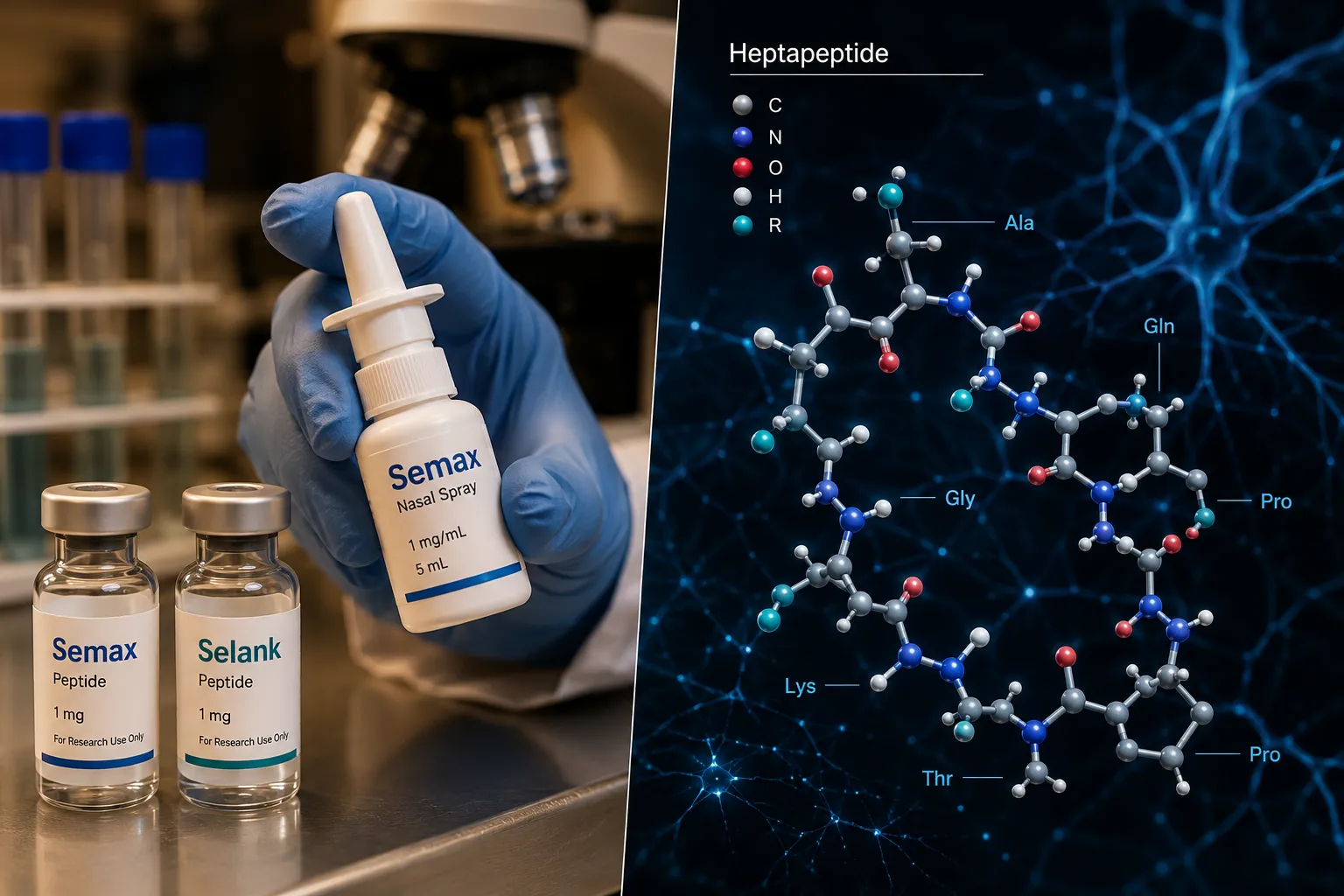
Semax is a synthetic heptapeptide derived from the ACTH(4-7) sequence, extended with a Pro-Gly-Pro fragment that confers metabolic stability. Its primary research interest centers on:
- Upregulation of brain-derived neurotrophic factor (BDNF)
- Modulation of the dopaminergic and serotonergic systems
- Neuroprotective effects under ischemic conditions
- Enhancement of memory consolidation and attention in preclinical models
Intranasal bioavailability of approximately 60-70% makes Semax a practical candidate for studies requiring reliable CNS exposure without surgical intervention. The Pro-Gly-Pro extension specifically resists enzymatic cleavage at the nasal mucosa, which helps explain why intranasal delivery is so effective for this compound compared to structurally simpler peptides.
Selank: Anxiolytic and Immunomodulatory Research
Selank is a synthetic analog of the endogenous tetrapeptide tuftsin, extended to a heptapeptide to improve stability. Research has focused on:
- Anxiolytic activity without sedation or dependence markers
- Modulation of GABA-A receptor sensitivity
- Regulation of enkephalin metabolism
- Potential immunomodulatory effects via tuftsin-related pathways
For researchers designing stress and cognition studies, the Selank stress and cognition research overview provides useful background on experimental models and observed outcomes.
| Feature | Semax | Selank |
|---|---|---|
| Base sequence | ACTH(4-7) + Pro-Gly-Pro | Tuftsin analog |
| Primary research focus | Neurocognition, neuroprotection | Anxiolytic, immunomodulation |
| Intranasal bioavailability | ~60-70% | Comparable range |
| CNS pathway | Olfactory/trigeminal | Olfactory/trigeminal |
| Metabolic stability | High (Pro-Gly-Pro extension) | High (extended analog) |
Administration Variables That Determine Research Outcomes

Even with well-characterized peptides, nasal spray peptides: bioavailability, administration, and Semax/Selank research applications depend heavily on how the formulation is prepared and delivered. Researchers who overlook these variables introduce significant confounds into their data.
Critical Formulation Parameters
pH and tonicity: The nasal mucosa tolerates a pH range of approximately 4.5-6.5. Solutions outside this range trigger mucociliary clearance, reducing contact time and absorption. Isotonic formulations (around 285-310 mOsm/kg) minimize mucosal irritation.
Preservatives: Benzalkonium chloride, a common preservative, has been shown to impair mucociliary function at higher concentrations. Research formulations should minimize preservative load or use alternatives such as sodium EDTA at low concentrations.
Droplet size: Particles in the 10-50 micron range deposit preferentially in the nasal cavity rather than the lungs. Larger droplets deposit anteriorly with faster clearance; smaller droplets risk pulmonary deposition.
Viscosity enhancers: Agents such as hydroxypropyl methylcellulose can extend mucosal contact time, improving absorption for peptides with slower transcellular transport rates.
Dosing Protocol Considerations
- Administer with the head tilted slightly forward to maximize posterior nasal deposition
- Alternate nostrils between doses to reduce local mucosal fatigue
- Allow 5-10 minutes between sequential doses if split dosing is required
- Store peptide solutions at 2-8°C; avoid freeze-thaw cycling
Researchers working with other peptide delivery formats, such as BPC-157 nasal spray and capsule evidence, will find that many of these formulation principles apply across peptide classes.
Purity as a Non-Negotiable Variable
Reproducibility in peptide research begins with compound purity. Impurities, whether residual solvents, truncated sequences, or oxidation products, can produce off-target effects that confound results. Reviewing peptide purity testing fundamentals is a practical first step for any researcher establishing a new protocol.
For studies that extend beyond neurocognitive endpoints into metabolic or regenerative domains, exploring metabolic modulation research lines can help contextualize multi-pathway experimental designs.
Conclusion
Intranasal delivery is not simply a convenient alternative to injection, for neuropeptides like Semax and Selank, it is a strategically optimal route that leverages direct CNS access through olfactory and trigeminal pathways while achieving bioavailability that oral administration cannot approach. Researchers designing studies in 2026 should treat formulation variables, pH, tonicity, droplet size, and preservative selection, as primary experimental controls rather than secondary considerations.
Actionable next steps for researchers:
- Verify peptide purity via third-party HPLC and mass spectrometry before beginning any protocol.
- Standardize formulation pH to the 4.5-6.5 range and confirm isotonicity before use.
- Document droplet size specifications for the delivery device to ensure reproducible nasal deposition.
- Review existing Semax and Selank literature to align dosing intervals with established pharmacokinetic windows.
- Consider how intranasal findings might complement or contrast with data from other administration routes when interpreting results.
Rigorous attention to these variables transforms intranasal peptide research from a loosely controlled experiment into a reproducible, publication-worthy investigation.
Leave a Reply
Want to join the discussion?Feel free to contribute!