

Human plasma levels of the tripeptide glycyl-L-histidyl-L-lysine (GHK) drop by nearly 60% between the ages of 20 and 60, a decline that closely mirrors the body's diminishing capacity for tissue repair. When bound to copper (Cu), this molecule becomes one of the most studied signaling peptides in regenerative biology. Research into GHK-Cu peptide: advanced mechanisms in extracellular matrix remodeling and wound healing research has accelerated significantly in 2026, revealing a compound that operates across multiple biological pathways simultaneously.
Key Takeaways
- GHK-Cu stimulates collagen and glycosaminoglycan synthesis in fibroblasts at picomolar to nanomolar concentrations.
- It modulates matrix metalloproteinase (MMP) activity to balance ECM breakdown and rebuilding.
- GHK-Cu influences expression of approximately 31% of human genes, including pathways for DNA repair and antioxidant defense.
- Novel hydrogel delivery systems developed in recent research significantly improve GHK-Cu biostability and wound healing outcomes.
- Plasma GHK levels decline sharply with age, making exogenous supplementation a key area of ongoing research.
Understanding GHK-Cu and Its Role in Extracellular Matrix Remodeling
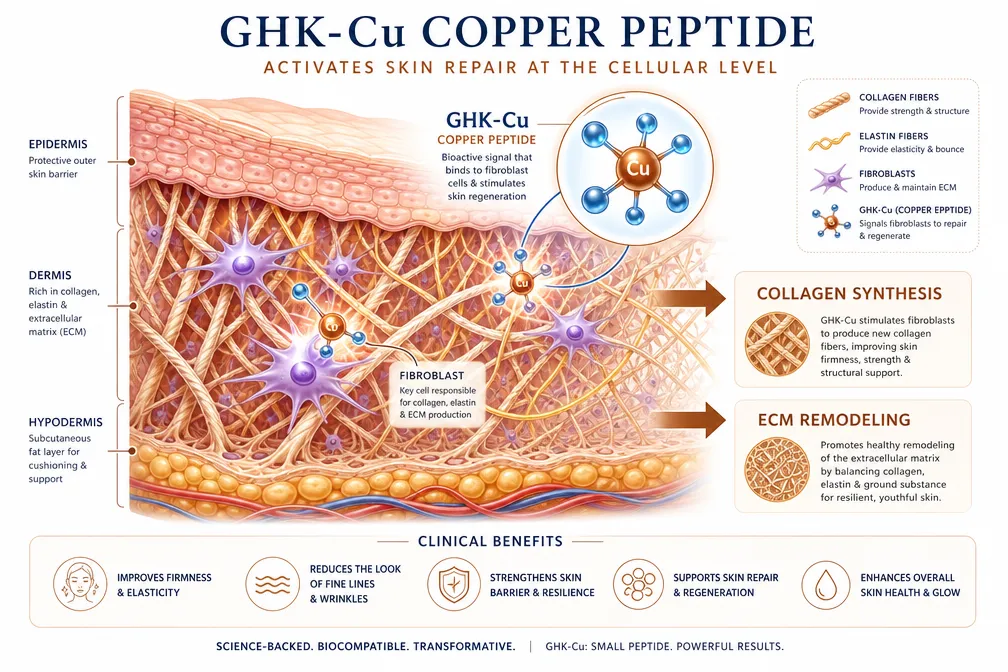
The extracellular matrix (ECM) is the structural scaffold of every tissue in the body. It is made up of collagen, elastin, proteoglycans, and glycosaminoglycans (GAGs). When tissue is damaged, the ECM must be broken down and rebuilt in a highly coordinated sequence. GHK-Cu sits at the center of this process.
Collagen synthesis is one of GHK-Cu's most documented actions. In fibroblast cultures, the peptide begins stimulating collagen production at concentrations as low as 10^-12 to 10^-11 M, with peak effects observed around 10^-9 M. This picomolar potency is remarkable and suggests a receptor-mediated signaling mechanism rather than simple substrate availability.
Beyond collagen, GHK-Cu drives a dose-dependent increase in GAG synthesis by human fibroblasts, with maximal effects between 10^-9 and 10^-8 M. GAGs such as hyaluronic acid and heparan sulfate are critical for water retention, structural integrity, and growth factor signaling within the ECM.
Key ECM components stimulated by GHK-Cu:
| Component | Role in ECM | GHK-Cu Effect |
|---|---|---|
| Collagen I & III | Structural tensile strength | Synthesis upregulated |
| Elastin | Tissue flexibility | Production increased |
| Glycosaminoglycans | Hydration and signaling | Dose-dependent increase |
| MMP-2 | ECM remodeling enzyme | Expression elevated |
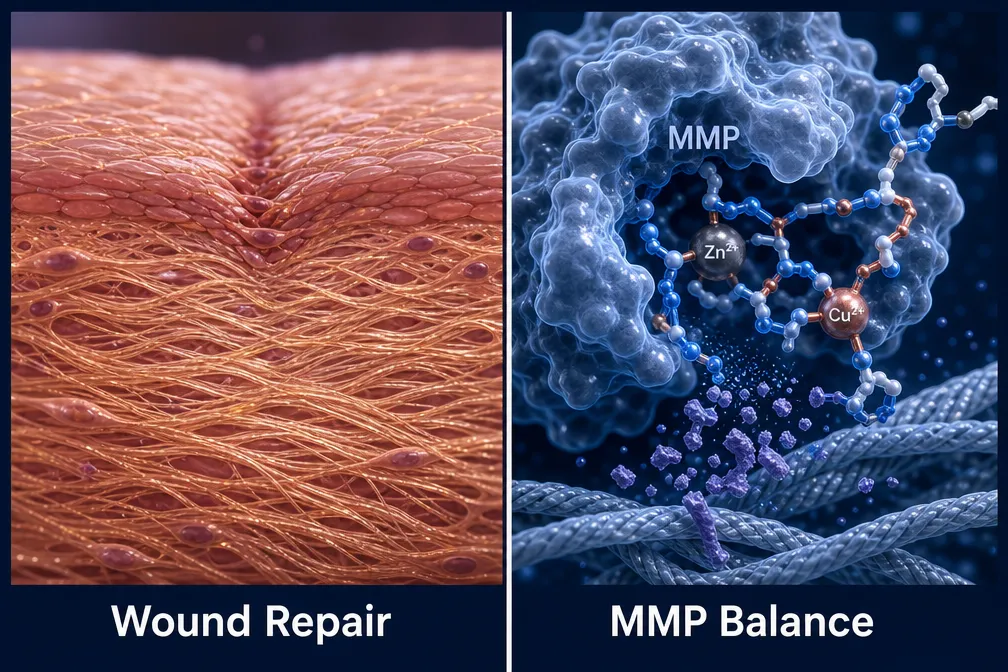
GHK-Cu also increases MMP-2 levels in fibroblast-conditioned media alongside corresponding increases in MMP-2 mRNA. This is not a destructive effect, rather, it reflects a carefully balanced remodeling signal. By upregulating specific MMPs while modulating others, GHK-Cu enables the removal of damaged matrix components and their replacement with newly synthesized, organized fibers.
Researchers exploring longevity peptide research have noted that ECM remodeling capacity is a central feature of biological aging, making GHK-Cu a molecule of significant interest in that context.
GHK-Cu Peptide in Wound Healing Research: Mechanisms and Delivery Advances
The wound healing process unfolds in four overlapping phases: hemostasis, inflammation, proliferation, and remodeling. GHK-Cu has demonstrated activity in at least three of these phases, making it a multi-stage wound repair agent.
During the proliferative phase, GHK-Cu acts as a chemoattractant for repair cells, drawing fibroblasts and keratinocytes to the wound site. It simultaneously suppresses pro-inflammatory cytokines, reducing excessive inflammation that would otherwise delay healing. This dual action, recruiting repair cells while dampening destructive inflammation, is a key reason why GHK-Cu peptide: advanced mechanisms in extracellular matrix remodeling and wound healing research continues to attract scientific attention.
"GHK-Cu functions as a natural modulator of multiple cellular pathways in skin regeneration, including collagen synthesis, anti-inflammatory responses, and antioxidant defense mechanisms."
Novel Hydrogel Delivery Systems
One of the most significant recent developments involves advanced delivery platforms designed to protect GHK-Cu's bioactivity and extend its residence time at wound sites.
A 2023 study introduced a photo-crosslinkable hyaluronic acid hydrogel embedded with GHK peptide nanofibers. This system improved bioactive wound healing by combining the structural benefits of hyaluronic acid scaffolding with the signaling properties of GHK. The nanofiber format increased surface area contact with surrounding tissue, enhancing cellular uptake.
A separate 2023 publication described a supramolecular metallopeptide hydrogel (termed Supra GHK-Cu) that self-assembles into a three-dimensional network. This structure improved biostability, a persistent challenge with peptide-based therapeutics, while maintaining the wound-healing properties of the native GHK-Cu complex.
These delivery innovations address a core limitation: free GHK-Cu in solution degrades relatively quickly in biological environments. Hydrogel encapsulation extends functional activity and enables sustained release over wound healing timescales.
For researchers interested in comparing peptide delivery and tissue repair mechanisms, TB-500 research and BPC-157 nasal and oral formulations represent related areas of investigation in regenerative peptide science.
Gene Expression Modulation and Broader Regenerative Implications
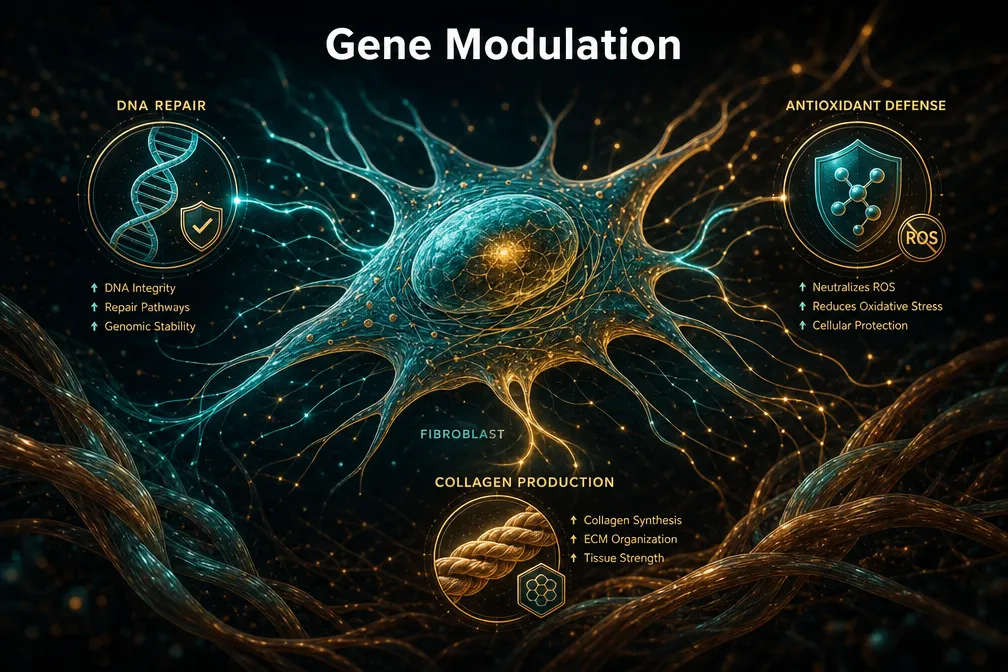
Perhaps the most striking finding in GHK-Cu research is the scale of its gene regulatory activity. Studies using gene array analysis indicate that GHK-Cu influences the expression of approximately 31.2% of human genes. This includes genes involved in:
- DNA repair mechanisms
- Antioxidant defense systems
- Anti-inflammatory signaling
- Nerve regeneration pathways
- Stem cell activation
This breadth of activity positions GHK-Cu not merely as a wound-healing agent but as a systemic tissue maintenance signal. The age-related decline in plasma GHK, from roughly 200 ng/mL at age 20 to approximately 80 ng/mL at age 60, may partially explain why tissue repair efficiency diminishes with age.
Researchers studying aging support peptides have drawn connections between this GHK decline and broader hallmarks of biological aging, including reduced ECM quality and impaired cellular stress responses.
GHK-Cu's antioxidant gene activation is particularly relevant in wound contexts, where reactive oxygen species (ROS) are produced in large quantities during the inflammatory phase. By upregulating antioxidant defenses, the peptide helps protect newly forming tissue from oxidative damage.
Those researching GHK-Cu peptide: advanced mechanisms in extracellular matrix remodeling and wound healing research alongside other regenerative compounds may also find value in reviewing Epithalon peptide research and NAD+ energetics and longevity themes, which intersect with cellular repair and gene expression regulation.
For those sourcing research-grade materials, GHK-Cu peptides for research use and additional GHK-Cu research documentation are available through specialized suppliers.
Conclusion
The science surrounding GHK-Cu peptide: advanced mechanisms in extracellular matrix remodeling and wound healing research points to a molecule of unusual biological depth. Its ability to stimulate collagen and GAG synthesis at picomolar concentrations, modulate MMP activity for balanced ECM remodeling, and influence gene expression across nearly a third of the human genome places it in a category few peptides occupy.
Actionable next steps for researchers:
- Review the 2023 hydrogel delivery literature to understand how formulation affects GHK-Cu bioavailability and wound-site retention.
- Examine gene array data to identify which specific pathways are most relevant to your research model.
- Consider age-related GHK plasma decline as a variable when designing tissue repair or longevity studies.
- Explore synergistic peptide combinations, GHK-Cu's anti-inflammatory and ECM-rebuilding actions may complement other regenerative peptides in multi-target research designs.
- Source only verified, high-purity GHK-Cu for research to ensure reproducible results.
As delivery technologies improve and gene-level data accumulates, GHK-Cu is positioned to remain a central subject in regenerative medicine, skin biology, and tissue engineering research well beyond 2026.
Leave a Reply
Want to join the discussion?Feel free to contribute!