

Fewer than 30% of published studies on selective estrogen receptor modulators clearly distinguish between a compound's free base form and its salt form, a gap that can silently invalidate experimental comparisons. For researchers working with clomiphene isomers, understanding Enclomiphene vs Enclomiphene Citrate: Formulation, Bioavailability, and Research Distinctions is not a minor technical footnote. It is a foundational requirement for designing reproducible, dose-accurate experiments.
Key Takeaways
- Enclomiphene is the trans-isomer free base; Enclomiphene Citrate is its salt form combined with citric acid.
- The two forms differ in molecular weight, meaning equal mass doses deliver different amounts of active compound.
- Bioavailability and solubility profiles vary between the free base and salt formulation.
- Research literature does not always specify which form was used, creating cross-study comparison challenges.
- Accurate experimental design requires knowing the exact form, purity, and molecular weight of the compound used.
Understanding the Chemical Identity: Free Base vs Salt Form
At the core of Enclomiphene vs Enclomiphene Citrate: Formulation, Bioavailability, and Research Distinctions is a straightforward but consequential chemical distinction.
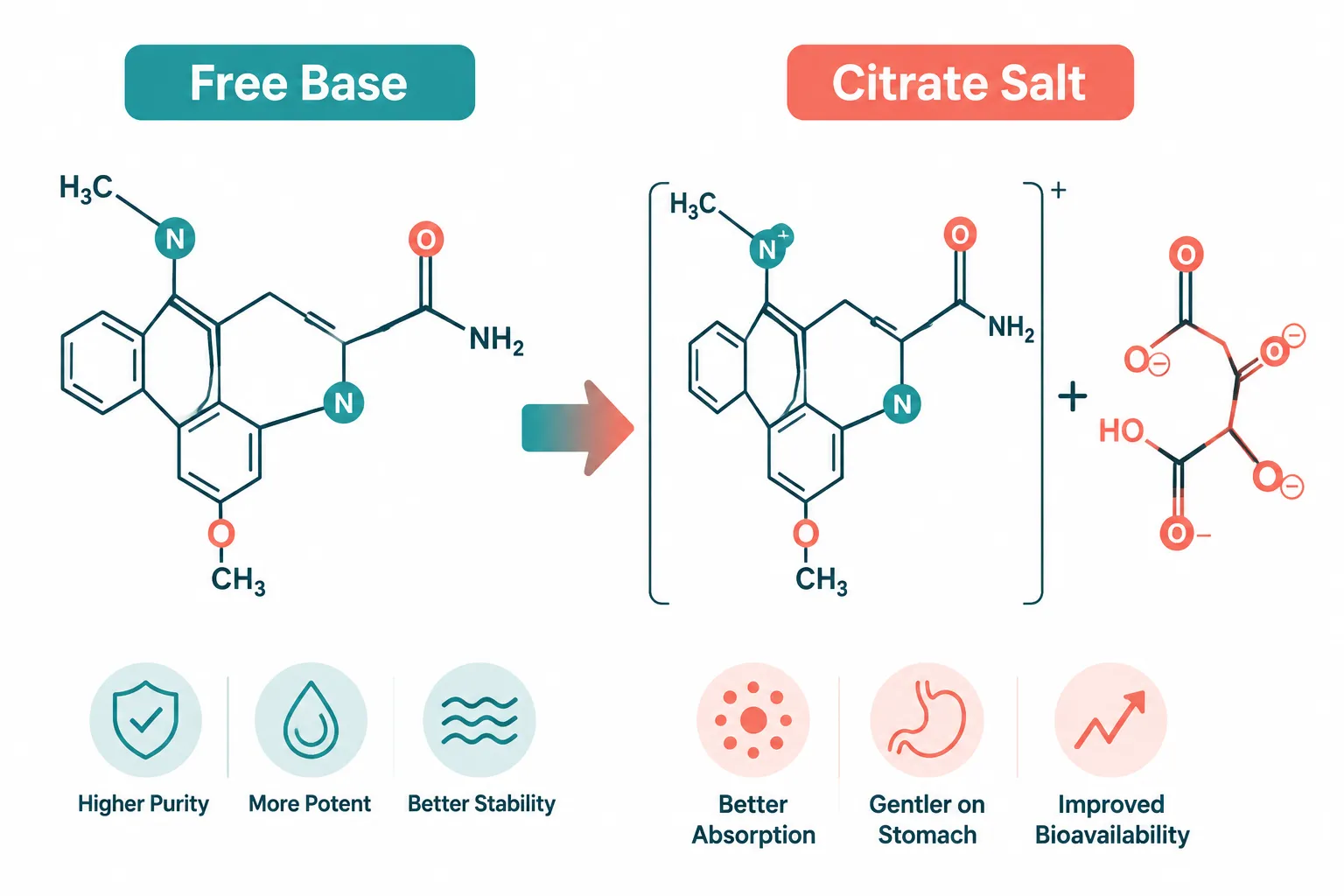
Enclomiphene is the trans-isomer of clomiphene. It is the pharmacologically active stereoisomer that functions as a selective estrogen receptor modulator (serm), binding to estrogen receptors in the hypothalamus and pituitary. In its free base form, the compound exists as a neutral molecule without any counterion.
Enclomiphene Citrate is the salt form of the same compound. It is produced by reacting enclomiphene with citric acid, forming an ionic bond between the two molecules. The citrate anion acts as a counterion that improves the compound's physical handling properties and stability.
Why the Salt Form Exists
Pharmaceutical and research-grade compounds are frequently converted to salt forms for practical reasons:
- Improved stability during storage and shipping
- Better aqueous solubility, which aids in certain formulation processes
- Easier handling as a crystalline powder compared to some free base forms
The citrate salt is the form most commonly encountered in both clinical research and commercial supply chains. However, this creates an important calculation problem for researchers.
The Molecular Weight Difference
This is the most critical practical distinction:
| Property | Enclomiphene (Free Base) | Enclomiphene Citrate |
|---|---|---|
| Molecular Formula | C26H28ClNO | C26H28ClNO + C6H8O7 |
| Approximate MW | ~405.96 g/mol | ~598.08 g/mol |
| Active Fraction | 100% | ~67.9% |
A 10 mg dose of Enclomiphene Citrate does not deliver 10 mg of active enclomiphene. It delivers approximately 6.8 mg of the active free base. Researchers who do not account for this difference will administer inconsistent effective doses, making cross-study comparisons unreliable.
Bioavailability and Formulation Implications for Research
The bioavailability dimension of Enclomiphene vs Enclomiphene Citrate: Formulation, Bioavailability, and Research Distinctions extends beyond simple dose correction.
Solubility and Absorption Profiles
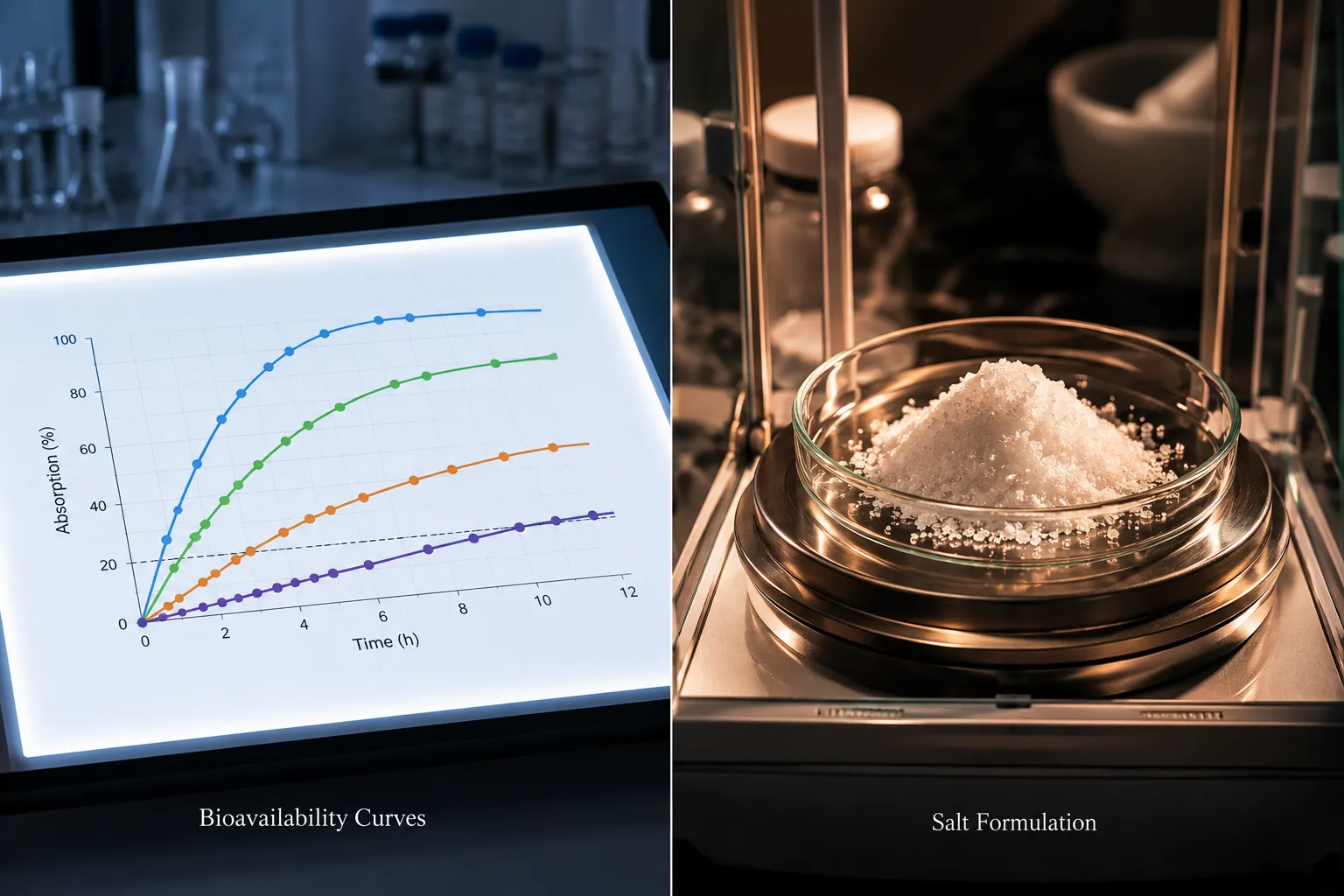
Salt forms generally exhibit higher aqueous solubility than their free base counterparts. For enclomiphene, the citrate salt dissolves more readily in aqueous media, which has implications for:
- In vitro assay preparation, stock solutions prepared in aqueous buffers will behave differently depending on the form used
- Oral bioavailability modeling, dissolution rate in gastrointestinal fluid can influence absorption kinetics
- Reconstitution protocols, researchers using peptide and serm compounds alongside agents like those explored in growth hormone secretagogue research stacks must account for each compound's solubility characteristics independently
pH Sensitivity
The citrate salt form introduces a weak acid (citric acid) into the formulation environment. In highly buffered biological systems this effect is negligible, but in unbuffered in vitro systems or specific cell culture media, the local pH shift from citrate can influence receptor binding assays. Free base enclomiphene does not carry this variable.
Stability Under Storage Conditions
"The counterion in a pharmaceutical salt is not inert, it actively participates in the compound's stability profile under heat, light, and humidity."
Enclomiphene Citrate tends to be more hygroscopic than the free base form. Improper storage can cause weight gain from moisture absorption, further distorting effective dose calculations. Research facilities storing compounds alongside metabolic modulators such as those studied in GLP-1 incretin research programs should apply the same rigorous storage standards to serm compounds.

Research Distinctions: Experimental Design and Literature Interpretation
The third pillar of Enclomiphene vs Enclomiphene Citrate: Formulation, Bioavailability, and Research Distinctions concerns how these differences affect the integrity of published research and future experimental design.
The Specification Problem in Published Literature
A recurring issue in the serm research landscape is incomplete compound characterization in methods sections. Studies may report dosing in milligrams without specifying whether the free base or citrate salt was used. When two independent research groups use different forms without disclosure, their dose-response curves become incomparable even when the reported milligram amounts are identical.
Researchers working with compounds that require precise receptor-level dosing, analogous to the precision required in mitochondrial peptide research, understand that small formulation differences produce measurable outcome divergence.
Practical Steps for Accurate Experimental Design
Researchers should apply the following standards when working with either form:
- Confirm the exact chemical form from the certificate of analysis (COA) before designing the dose protocol.
- Apply the molecular weight correction factor when converting between free base and salt form doses.
- Document the form explicitly in all methods sections and data reports.
- Verify purity independently, a compound listed as 98% pure Enclomiphene Citrate still contains approximately 32% citrate by mass.
- Standardize solvent systems based on the specific solubility profile of the form being used.
Connecting to Broader Hormonal Research Contexts
Enclomiphene research intersects with broader investigations into hypothalamic-pituitary-gonadal axis modulation. Researchers exploring hormonal signaling pathways may also find value in reviewing metabolic modulation research themes and longevity-focused peptide research, as overlapping receptor systems are frequently studied in parallel experimental frameworks.
For researchers sourcing verified serm compounds, reviewing available research-grade serm options with documented purity specifications is a necessary step before initiating any experimental protocol.
Conclusion
The distinction between enclomiphene and enclomiphene citrate is not semantic, it is quantitative, biochemical, and methodologically significant. Every milligram matters when studying receptor-level pharmacology. Researchers must confirm the exact form of their compound, apply the appropriate molecular weight correction, and document their specifications clearly in published work.
Actionable next steps for researchers in 2026:
- Request a full COA specifying free base or salt form before procurement
- Calculate effective active compound content using the molecular weight ratio
- Standardize internal protocols to specify form in all experimental records
- Cross-reference older literature with awareness that form specification may be absent
- Consult updated compound databases and peer-reviewed pharmacokinetic data when designing new dose-response studies
Precision at the formulation level is what separates reproducible science from ambiguous data.
Leave a Reply
Want to join the discussion?Feel free to contribute!