

Fewer than 1% of mitochondrial genes encode functional peptides, yet one of them, MOTS-c, has reshaped how researchers think about metabolic regulation at the cellular level. Meanwhile, 5-Amino-1MQ arrived from a completely different direction: synthetic chemistry targeting an enzyme most metabolic researchers had largely ignored. Understanding MOTS-c vs. 5-Amino-1MQ: which metabolic research questions each compound actually answers is not a matter of picking a winner. It is a matter of matching the right tool to the right experimental question.
Key Takeaways
- MOTS-c is a 16-amino-acid mitochondrial-encoded peptide; 5-Amino-1MQ is a small-molecule NNMT inhibitor, their mechanisms are fundamentally different.
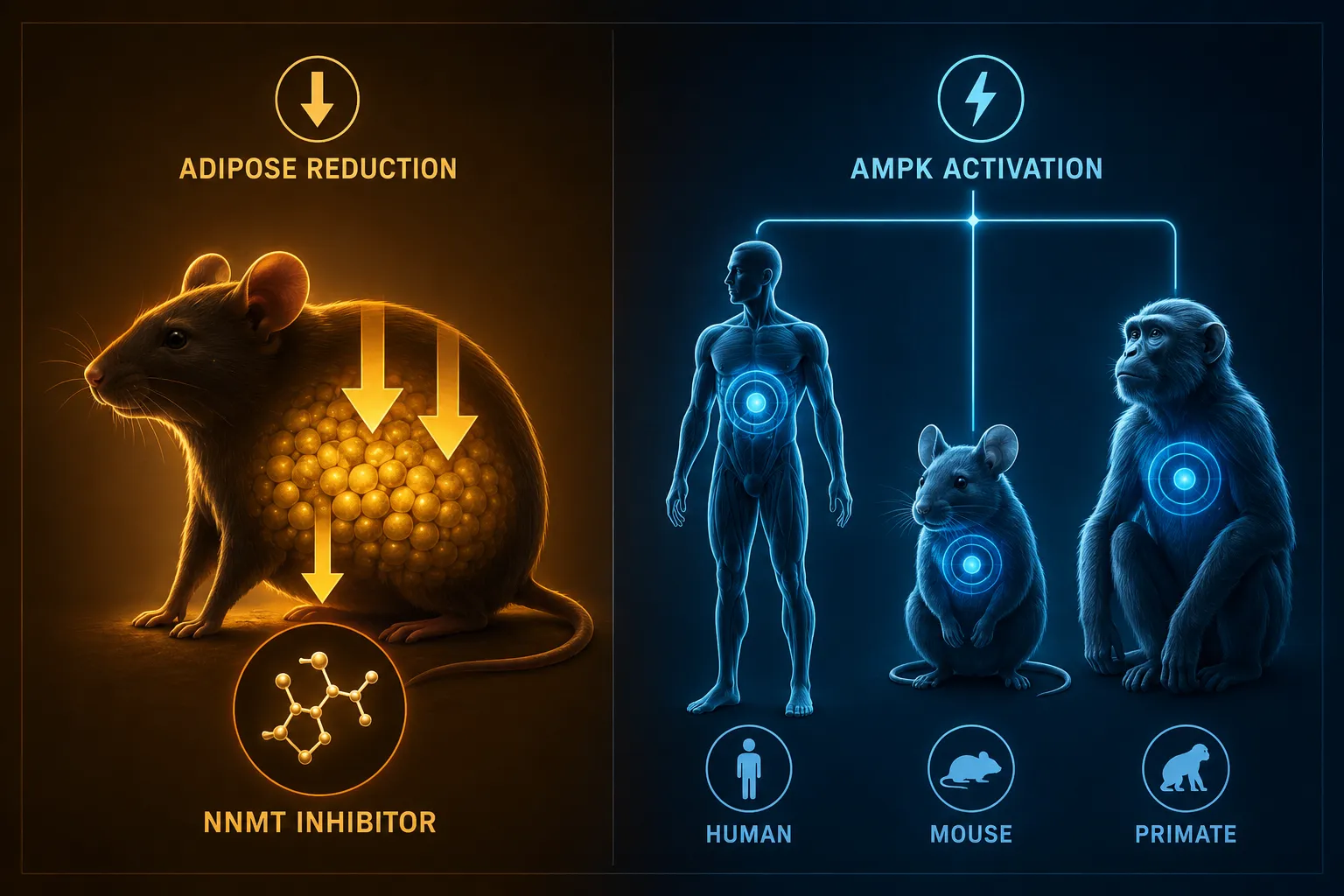
- MOTS-c activates AMPK and has multi-species, multi-endpoint data supporting its role in energy sensing and glucose metabolism.
- 5-Amino-1MQ targets nicotinamide N-methyltransferase (NNMT) and currently has efficacy data limited to mouse models.
- Researchers studying mitochondrial signaling or insulin sensitivity should look first at MOTS-c; those investigating NNMT-driven adiposity have a specific reason to reach for 5-Amino-1MQ.
- Neither compound replaces the other, they probe distinct nodes in the metabolic network.
What Each Compound Actually Is
MOTS-c: A Peptide Born Inside the Mitochondria
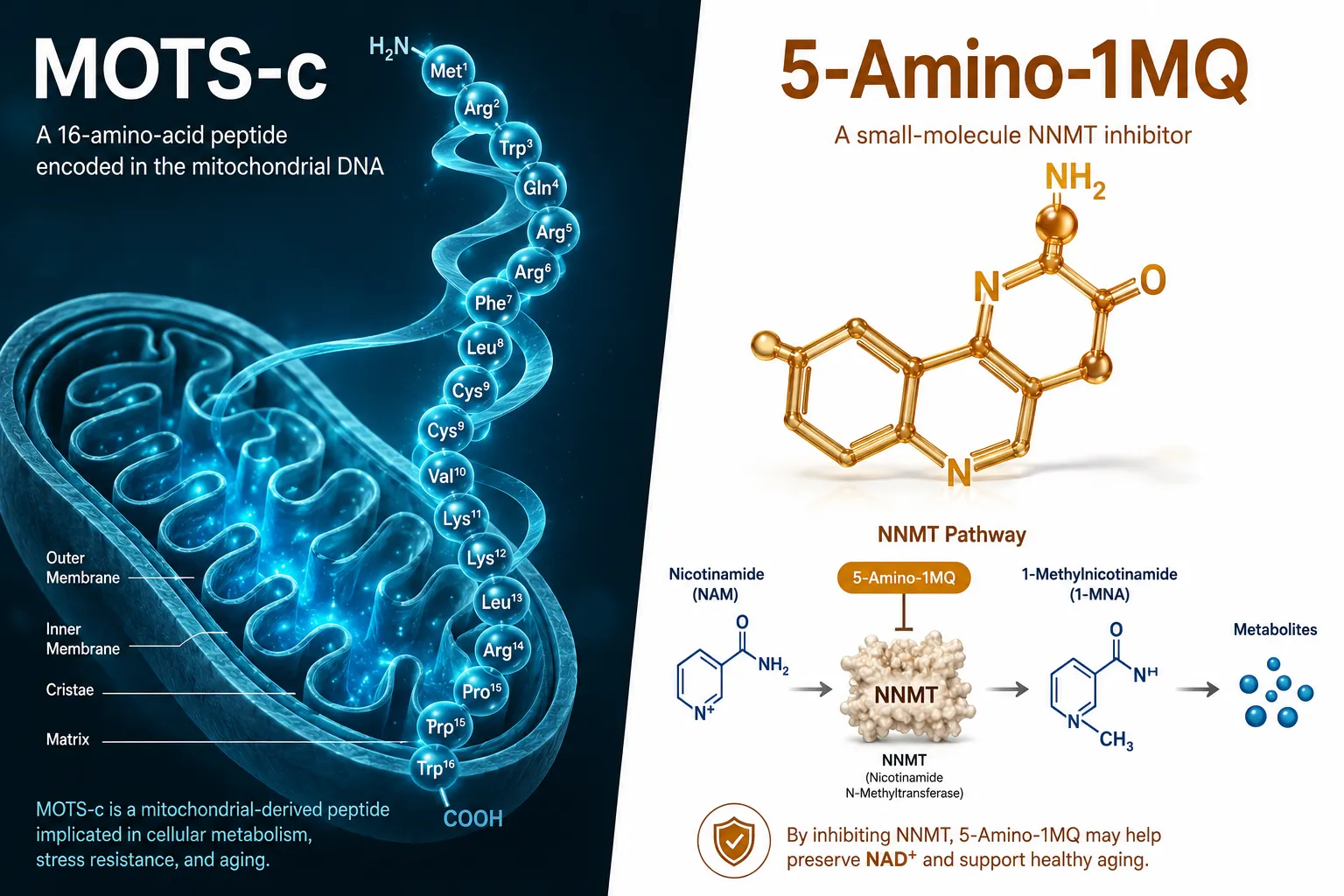
MOTS-c (Mitochondrial Open Reading Frame of the 12S rRNA type-c) is a 16-amino-acid peptide encoded not by the nuclear genome but by mitochondrial DNA. That origin is significant. It means MOTS-c functions as a retrograde signal, a message the mitochondria sends outward to the rest of the cell when metabolic stress is detected.
Its primary mechanism involves the activation of AMP-activated protein kinase (AMPK), the master energy sensor of the cell. When AMPK is activated, cells shift toward fat oxidation, reduce glucose synthesis, and improve insulin sensitivity. MOTS-c also interacts with the folate cycle and one-carbon metabolism, giving it a broader reach than a simple hormone mimic.
Researchers can explore the MOTS-c peptide research profile for a detailed look at its structural properties and documented experimental endpoints.
5-Amino-1MQ: A Small Molecule With a Narrow Target
5-Amino-1MQ (5-amino-1-methylquinolinium) is a synthetic small molecule, not a peptide. It works by inhibiting nicotinamide N-methyltransferase (NNMT), an enzyme that methylates nicotinamide and plays a direct role in regulating NAD+ precursor availability and adipocyte differentiation.
When NNMT is active at high levels, as it tends to be in obese adipose tissue, it diverts methyl groups away from pathways that support fat cell maturation. By blocking NNMT, 5-Amino-1MQ aims to reduce adipogenesis and shift energy balance in white adipose tissue.
The key distinction: MOTS-c works upstream through mitochondrial signaling; 5-Amino-1MQ works downstream in the epigenetic regulation of fat cell biology.
Mapping the Research Questions Each Compound Answers
Questions MOTS-c Is Built to Answer
MOTS-c has accumulated data across multiple species and multiple metabolic endpoints. That breadth makes it the stronger candidate for questions involving:
- Insulin resistance and glucose uptake in skeletal muscle
- AMPK-dependent energy sensing under caloric restriction or exercise mimicry
- Mitochondrial stress responses and their systemic effects
- Age-related metabolic decline, given that circulating MOTS-c levels fall with age in humans
For researchers already working with mitochondria-focused compounds, pairing MOTS-c with SS-31 (Elamipretide), a cardiolipin-targeting peptide, can help isolate whether an observed effect is driven by membrane integrity or by retrograde signaling. The SS-31 and MOTS-c research tag highlights studies that have used both compounds in complementary designs.
"MOTS-c is one of the few mitochondria-derived signals with confirmed activity in human tissue samples, giving it a translational relevance that most metabolic peptides cannot yet claim."
Questions 5-Amino-1MQ Is Built to Answer
5-Amino-1MQ is a more specialized instrument. Its current evidence base is mouse-only for efficacy, which limits but does not eliminate its research value. It is the right compound when the question specifically involves:
- NNMT inhibition as a lever for adiposity reduction
- NAD+ precursor flux in white adipose tissue
- Adipocyte differentiation and lipid storage at the epigenetic level
- Comparison of NNMT-dependent vs. NNMT-independent fat loss pathways
Researchers studying fat depot-specific metabolism may also find value in reviewing AOD-9604 research notes, since AOD-9604 targets lipolysis through a different receptor pathway entirely, providing a useful mechanistic contrast.

Evidence Tiers and Translational Readiness
The evidence gap between these two compounds is meaningful for study design.
| Dimension | MOTS-c | 5-Amino-1MQ |
|---|---|---|
| Origin | Mitochondrial peptide | Synthetic small molecule |
| Primary target | AMPK activation | NNMT inhibition |
| Species data | Multi-species including human tissue | Mouse-only (efficacy) |
| Metabolic focus | Glucose, insulin, energy sensing | Adipogenesis, NAD+ flux |
| Translational stage | More advanced | Earlier preclinical |
MOTS-c's multi-species data means researchers can design studies with greater confidence that observed effects will generalize. 5-Amino-1MQ requires more careful controls and species-specific interpretation.
For researchers building broader metabolic panels, compounds like Tesamorelin, which targets visceral fat through growth hormone-releasing hormone pathways, offer yet another mechanistic layer that neither MOTS-c nor 5-Amino-1MQ covers.
Choosing the Right Compound for Your Model
When to Choose MOTS-c
Choose MOTS-c when the research question centers on mitochondrial-nuclear communication, systemic insulin sensitivity, or AMPK-driven metabolic adaptation. Its peptide structure also makes it compatible with standard subcutaneous delivery protocols used across most rodent and primate metabolic models.
Researchers sourcing verified material should review quality peptide standards before committing to a supplier, as purity directly affects AMPK activation assay reliability.
When to Choose 5-Amino-1MQ
Choose 5-Amino-1MQ when the hypothesis specifically implicates NNMT in adipose tissue remodeling. Its small-molecule format offers oral bioavailability advantages in mouse models, which can simplify dosing protocols. However, researchers should build in appropriate controls for NAD+ pathway effects that may confound readouts unrelated to fat mass.
When to Use Both
A dual-compound design makes sense when the goal is to separate AMPK-mediated metabolic effects from NNMT-mediated adipogenic effects. Running parallel arms with each compound, and a third arm combining both, can help attribute observed changes to specific nodes in the metabolic network.
Conclusion
The question of MOTS-c vs. 5-Amino-1MQ: which metabolic research questions each compound actually answers resolves cleanly once mechanism and evidence tier are considered together. MOTS-c is the broader, more translationally mature tool for questions about mitochondrial signaling, AMPK activation, and systemic glucose metabolism. 5-Amino-1MQ is a precise instrument for NNMT-specific adipose biology, with a current evidence base that demands careful species-matched study design.
Actionable next steps for researchers:
- Define the specific metabolic node under investigation before selecting a compound.
- If studying mitochondrial retrograde signaling or insulin sensitivity, prioritize MOTS-c and consider pairing it with SS-31 for mechanistic contrast.
- If studying NNMT-driven adipogenesis in a mouse model, 5-Amino-1MQ is the appropriate primary compound.
- For visceral fat studies requiring a GH-axis comparator, review Tesamorelin dosage protocols as a parallel reference arm.
- Always verify compound purity through third-party testing before initiating any metabolic assay series.
Leave a Reply
Want to join the discussion?Feel free to contribute!