

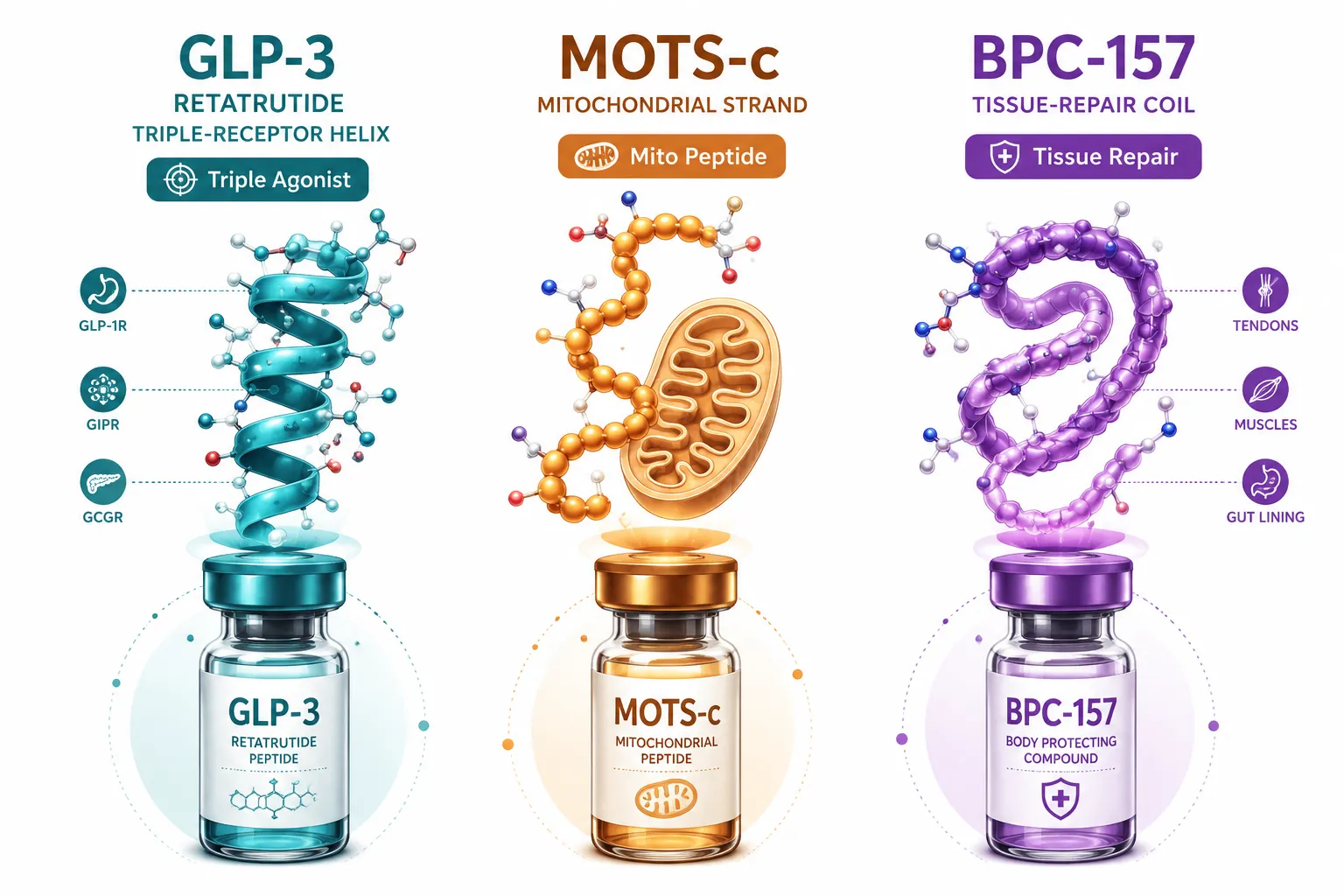
Most researchers reach for a peptide calculator when reconstituting a growth hormone secretagogue blend, then stop there. Yet the same arithmetic logic that converts a Tesamorelin vial into syringe units applies equally to metabolic triple agonists, mitochondrial peptides, and tissue-repair compounds. Peptide Calculator Use Cases Beyond Growth Hormone: Working Through GLP-3 Retatrutide, MOTS-c, and BPC-157 Research Dosing is a topic that deserves its own worked framework, because each compound carries unique concentration targets, titration schedules, and reconstitution constraints that a generic calculator must accommodate.
Key Takeaways
- Peptide calculators are not limited to GH secretagogues, they handle any lyophilized compound requiring reconstitution math.
- Retatrutide (GLP-3) uses slow titration schedules that demand week-by-week dose recalculation.
- MOTS-c reconstitution targets are typically low-volume and require precise unit conversion.
- BPC-157 research often involves both injectable and oral formats, each with different concentration logic.
- GHK-Cu and other repair peptides follow the same calculator inputs: vial mass, diluent volume, and desired dose.
Why Peptide Calculator Use Cases Extend Well Beyond Growth Hormone
Growth hormone peptides like Ipamorelin and CJC-1295 popularized the reconstitution calculator because their dosing windows are narrow and their blends are common. A Tesamorelin dosage calculator works on the same three-input model every other peptide uses:
| Input | Example Value |
|---|---|
| Vial mass (mg) | 5 mg |
| Diluent added (mL) | 2 mL bacteriostatic water |
| Desired dose (mcg) | 250 mcg |
Result: concentration = 2,500 mcg/mL; draw = 0.10 mL (10 units on a U-100 syringe).
That formula is universal. The only variable is the peptide itself, and that is where researchers working with newer metabolic and tissue-repair compounds need a more expanded mental model.
Worked Examples: Peptide Calculator Use Cases Beyond Growth Hormone for Retatrutide, MOTS-c, and BPC-157
Retatrutide (GLP-3): Titration Math Week by Week
Retatrutide is a triple receptor agonist targeting GLP-1, GIP, and glucagon receptors simultaneously. It remains investigational, with Phase 3 trials ongoing as of 2026. Because it uses a slow titration schedule, commonly starting at 2 mg per week and stepping up over several weeks, the calculator must be re-run at each dose change.
Example scenario:
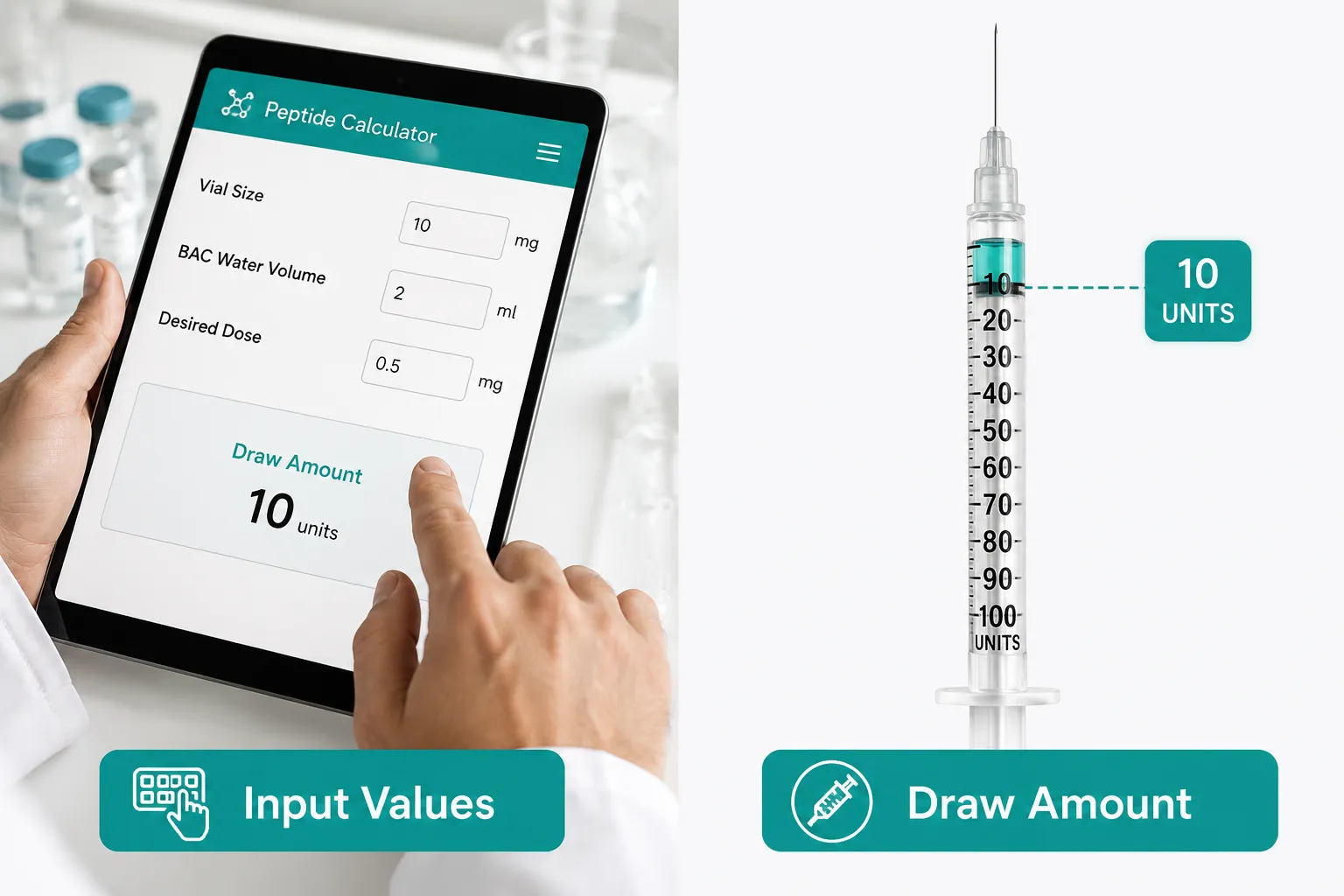
- Vial: 10 mg retatrutide
- BAC water added: 2 mL
- Concentration: 5,000 mcg/mL (5 mg/mL)
- Week 1 dose: 2 mg = draw 0.40 mL (40 units)
- Week 4 dose: 4 mg = draw 0.80 mL (80 units)
Tools like PeptiTools and PeptideDeck provide live syringe diagrams that update as the dose field changes, which is especially useful for multi-week titration. For background on the incretin research context, see the GLP-3 retatrutide incretin research themes overview, and for a broader generational comparison, the generations of GLP-1 differences resource is instructive.
"The arithmetic never changes, only the target dose does. Running the calculator fresh at each titration step prevents cumulative dosing errors."
MOTS-c: Low-Volume Precision
MOTS-c, the mitochondrial peptide, is typically studied at doses in the 5-10 mg range. Because vials are often supplied at 5 mg, researchers frequently add only 1 mL of BAC water to achieve a 5 mg/mL concentration, meaning a 5 mg dose draws a full 1 mL, while a 2.5 mg dose draws 0.50 mL (50 units).
Key consideration: At low diluent volumes, measurement error is amplified. A 0.02 mL miscalculation at 5 mg/mL equals a 100 mcg dosing error. Dedicated MOTS-c calculators, such as those offered by MOTS-c Research, handle the unit conversion explicitly, displaying results in both mL and U-100 syringe units side by side. Researchers interested in MOTS-c metabolic stress applications can explore the MOTS-c metabolic stress research page for additional context.
BPC-157: Injectable vs. Oral Concentration Logic
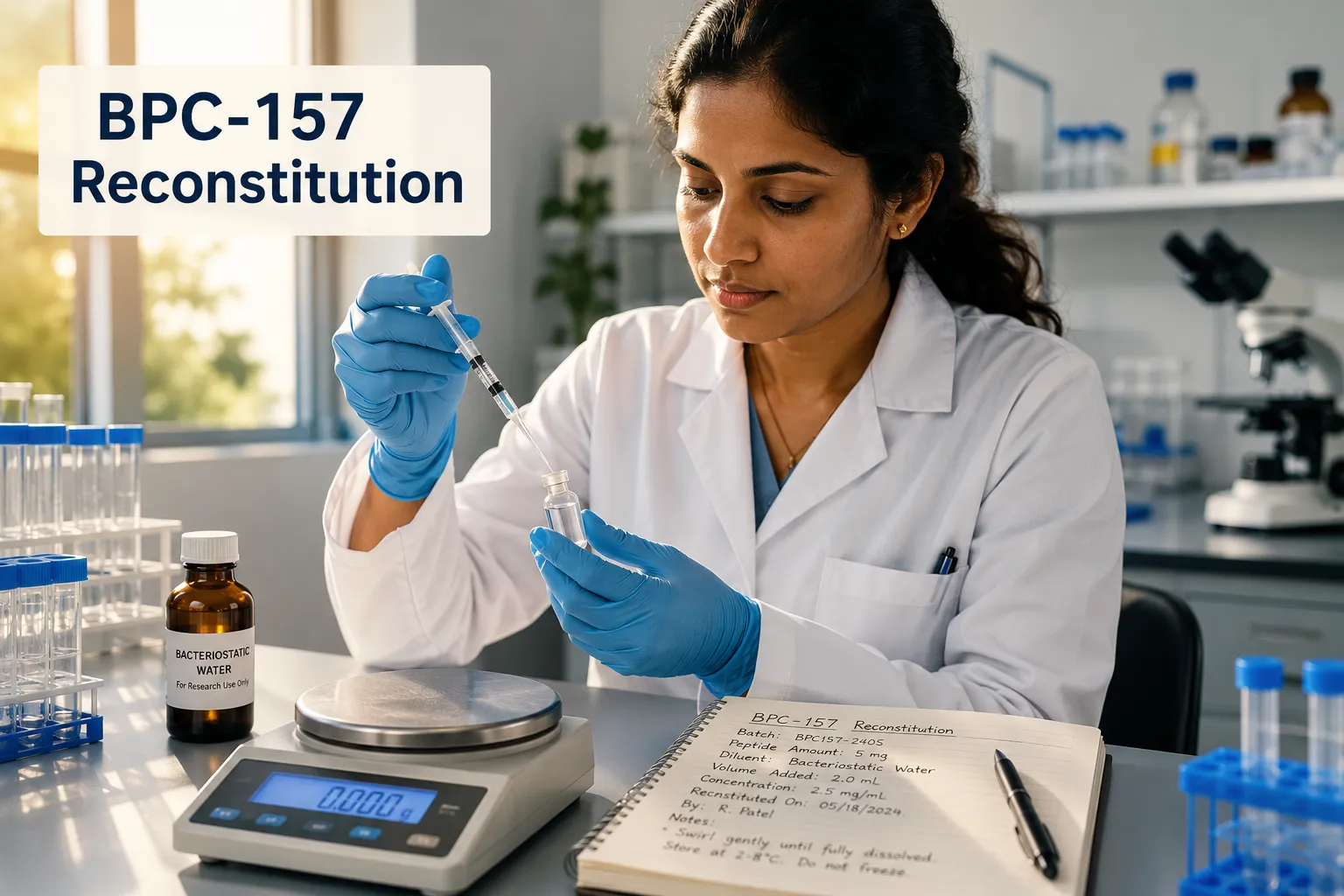
BPC-157 is unique because it appears in both injectable and oral research formats. For injectable use, a common reconstitution is 5 mg into 2.5 mL BAC water, yielding 2 mg/mL. A 250 mcg research dose then draws 0.125 mL (12.5 units).
For oral BPC-157 formats, concentration logic shifts entirely, volume is less relevant than total mass per capsule or solution. Platforms like PeptideCalcs allow researchers to toggle between injectable and oral modes, keeping the math format-appropriate. The BPC-157 10mg vial research themes page provides additional reconstitution reference points.
Applying the Same Framework to GHK-Cu and Multi-Peptide Protocols
The calculator framework extends cleanly to copper peptides and combination protocols. GHK-Cu longevity research typically involves doses of 1-2 mg, often reconstituted in 1 mL of sterile water for a 1-2 mg/mL concentration. At 1 mg/mL, a 1 mg dose draws exactly 1 mL, straightforward, but only if the researcher has confirmed the vial mass and diluent volume before calculating.
Multi-peptide protocols, for example, combining BPC-157 with a mitochondrial support compound like SS-31 elamipretide, require running the calculator independently for each compound. Shared syringes or combined vials change the concentration of both peptides and invalidate pre-calculated draw volumes. Each compound must retain its own reconstitution record.
Best practices for multi-peptide calculator use:
- Label each vial with concentration (mg/mL) and reconstitution date.
- Store calculator outputs alongside vial records, not just in memory.
- Re-run calculations if a vial is partially used and diluent volume has changed.
- Use platforms that support custom vial inputs rather than locked preset values.
Platforms such as PeptiTools, PepExact, and Blackwell BioLabs offer free, no-signup calculators that accommodate custom inputs across a wide range of peptides, including Retatrutide, BPC-157, MOTS-c, and GHK-Cu, making them practical choices for researchers managing diverse compound libraries.
Conclusion
Peptide Calculator Use Cases Beyond Growth Hormone: Working Through GLP-3 Retatrutide, MOTS-c, and BPC-157 Research Dosing confirms a straightforward principle: the reconstitution formula is universal, but each peptide demands context-specific inputs and awareness of format, titration schedule, and concentration sensitivity.
Actionable next steps for researchers in 2026:
- Identify the vial mass and intended diluent volume for each compound before touching a syringe.
- Use a calculator that displays results in both mL and U-100 syringe units simultaneously.
- For titrating compounds like Retatrutide, bookmark the calculator and re-run it at each dose step.
- Maintain a written reconstitution log per vial, do not rely on memory for concentration values.
- Consult a qualified clinician before applying any calculated dose in a research context.
The math is accessible. The discipline around it is what separates reliable research from avoidable error.
Leave a Reply
Want to join the discussion?Feel free to contribute!