

A naturally occurring tripeptide found in human plasma at concentrations that decline sharply with age — dropping from roughly 200 ng/mL in young adults to near-undetectable levels in older populations — GHK-Cu has drawn sustained scientific attention for its remarkable ability to modulate the extracellular matrix (ECM). Research into GHK-Cu Peptide: Advancing Research in Extracellular Matrix Remodeling and Tissue Regeneration has accelerated in 2026, driven by growing interest in anti-fibrotic therapies, wound healing, and connective tissue biology.
Key Takeaways
- GHK-Cu is a copper-binding tripeptide (glycyl-L-histidyl-L-lysine) that declines with age and plays a central role in ECM remodeling.
- It stimulates collagen, elastin, and glycosaminoglycan synthesis while simultaneously suppressing excessive fibrosis.
- Anti-fibrotic and stem-cell modulatory properties position it as a candidate for multi-organ regenerative research.
- Human clinical data in dermatology confirm measurable skin remodeling effects, though large-scale trials remain limited.
- Researchers sourcing GHK-Cu for preclinical work should prioritize verified purity and documented quality testing.
Understanding GHK-Cu and Its Role in Extracellular Matrix Biology
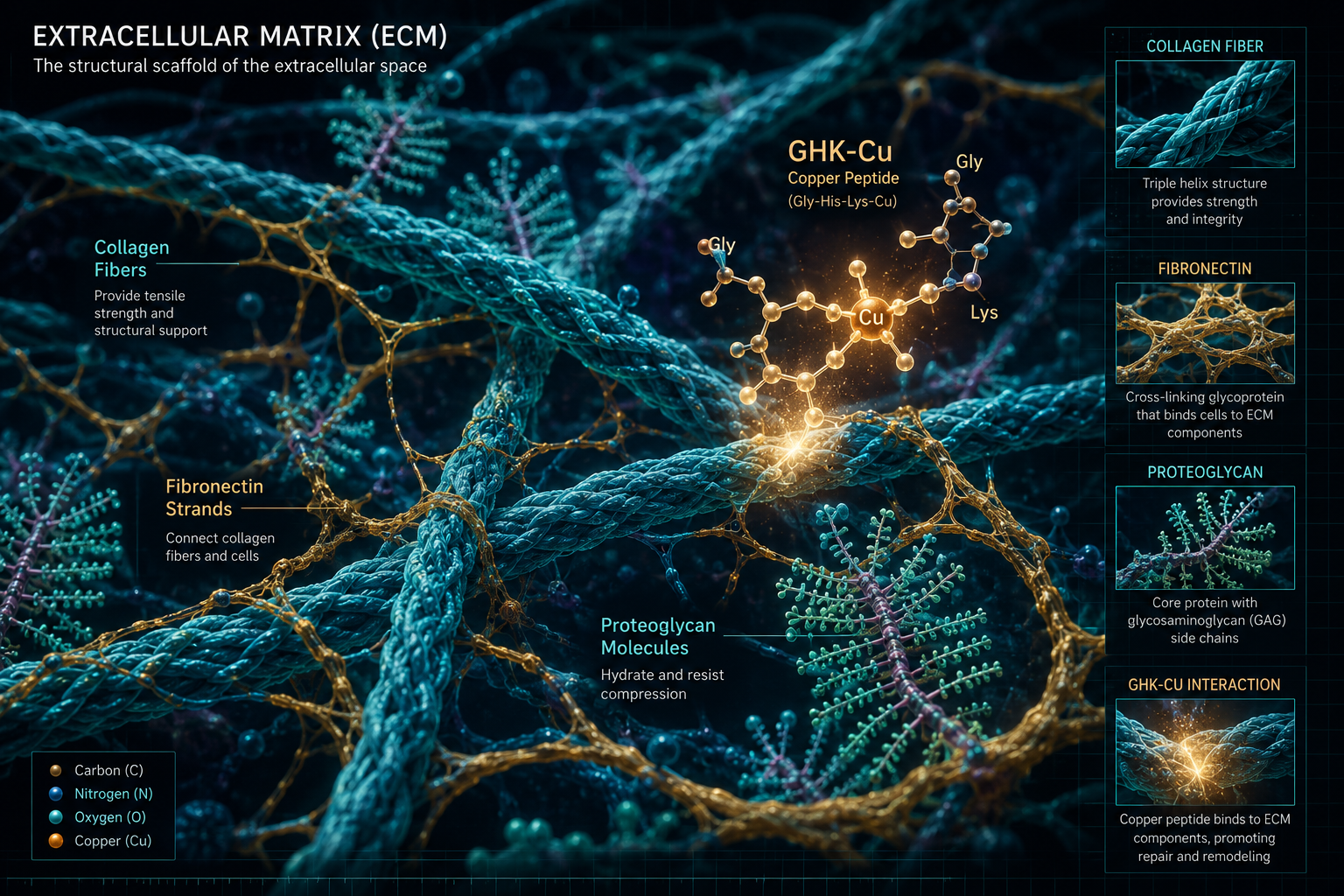
The extracellular matrix is the structural scaffold that surrounds and supports cells in virtually every tissue. It is composed of collagens, fibronectin, laminin, proteoglycans, and a range of signaling molecules that collectively govern cell behavior, tissue stiffness, and repair capacity. When this scaffold is disrupted — through injury, inflammation, or aging — the downstream consequences affect everything from wound closure to organ function.
GHK-Cu (glycyl-L-histidyl-L-lysine complexed with copper) acts at multiple points in this system. Key ECM-related mechanisms identified in preclinical and early clinical research include:
| Mechanism | Effect on ECM |
|---|---|
| Collagen synthesis stimulation | Increases type I and type III collagen deposition |
| Elastin upregulation | Restores tissue elasticity in aging models |
| Glycosaminoglycan production | Supports hydration and structural integrity |
| MMP modulation | Balances matrix metalloproteinase activity for controlled remodeling |
| Anti-fibrotic signaling | Reduces pathological collagen cross-linking |
The copper ion is not merely a carrier. It actively participates in enzymatic reactions critical to collagen cross-linking and antioxidant defense, making the intact GHK-Cu complex functionally distinct from the peptide alone.
For researchers exploring connective tissue biology, the GHK-Cu peptide research catalog provides a useful starting point for sourcing verified material.
Wound Healing, Anti-Fibrosis, and Tissue Regeneration Research
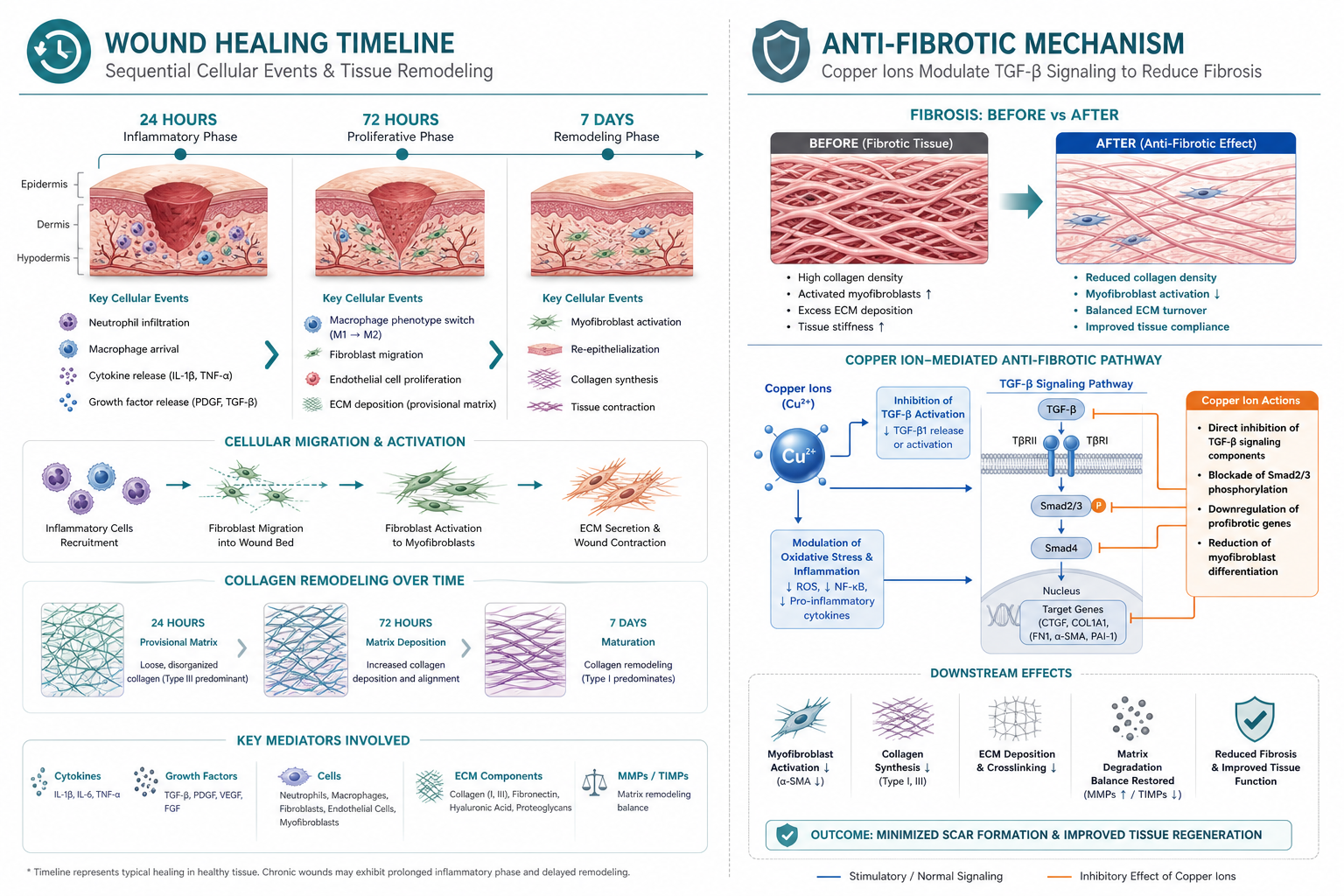
Among the most compelling themes in GHK-Cu Peptide: Advancing Research in Extracellular Matrix Remodeling and Tissue Regeneration is the compound's dual capacity to accelerate repair while simultaneously preventing the overproduction of scar tissue — a balance that has long challenged wound-healing researchers.
Wound healing phases where GHK-Cu shows activity:
- Inflammatory phase: Modulates cytokine signaling to limit excessive inflammation without halting the necessary immune response.
- Proliferative phase: Promotes fibroblast migration and differentiation, accelerating new tissue formation.
- Remodeling phase: Regulates MMP activity to ensure organized collagen fiber alignment rather than disorganized scar deposition.
The anti-fibrotic dimension is particularly significant. Pathological fibrosis — the excessive accumulation of ECM components — underlies conditions ranging from keloid scarring to pulmonary and hepatic fibrosis. GHK-Cu appears to suppress TGF-beta-driven fibrotic pathways, making it a candidate for research into age-related fibrosis reversal.
Stem-cell modulation adds another layer of interest. Preclinical data suggest GHK-Cu may influence progenitor cell activity in aging tissues, potentially restoring regenerative capacity that diminishes over time. This connects it to broader peptide research themes explored in studies of TB-500 and muscle recovery and BPC-157 tissue repair models.
Researchers interested in comparative peptide profiles may also find value in reviewing LL-37 versus SS-31 mechanistic differences, as these compounds share overlapping tissue-protective themes.
Sourcing and Research Considerations for GHK-Cu in 2026
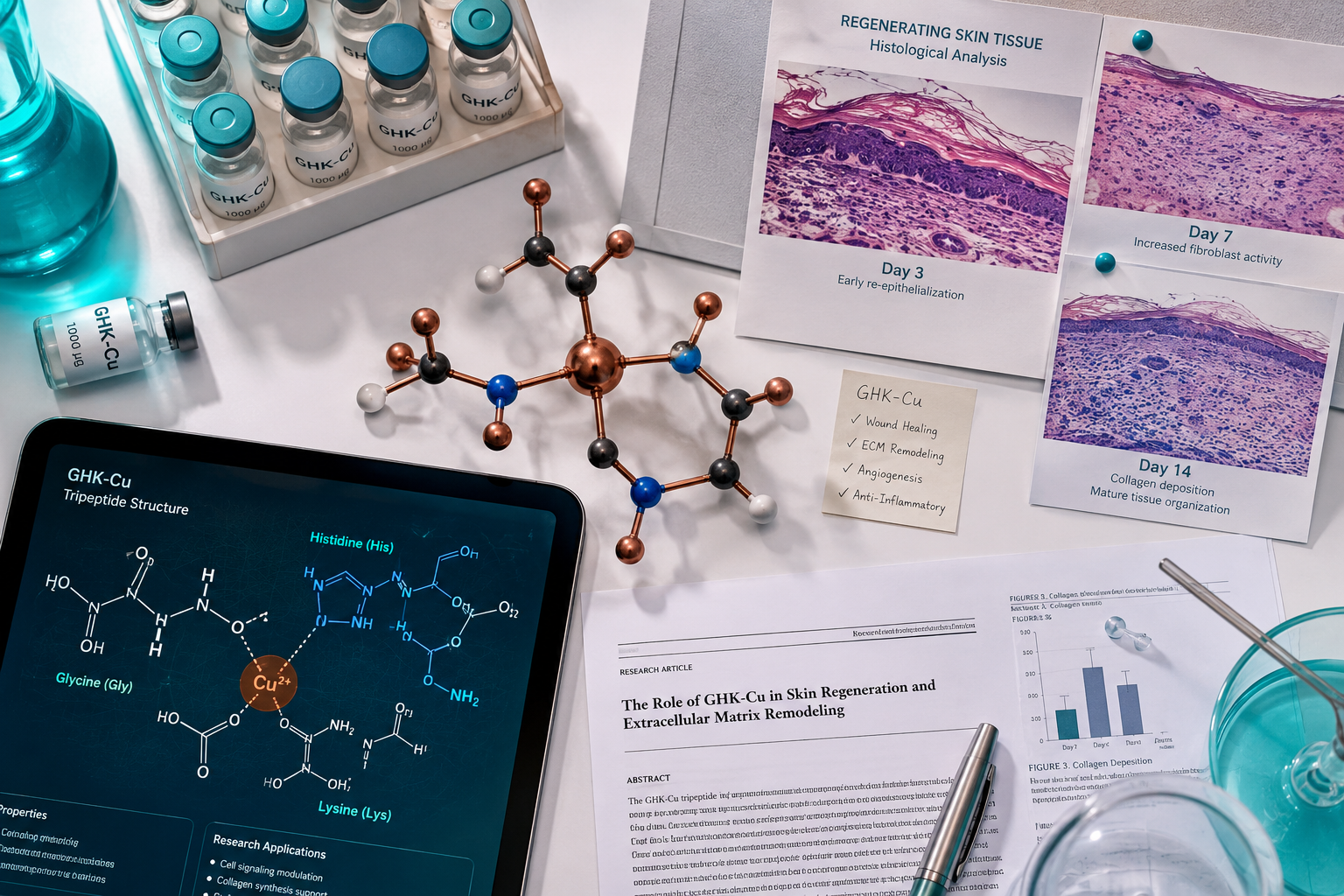
Translating mechanistic findings into reliable preclinical data depends heavily on compound quality. Peptide purity, copper chelation integrity, and storage stability all affect experimental reproducibility. Researchers should confirm that any GHK-Cu source undergoes third-party analytical testing, including HPLC purity assessment and mass spectrometry verification.
"Reproducibility in peptide research begins with sourcing — a compound that degrades before use or contains impurities will produce data that cannot be trusted."
For teams building broader ECM-focused research programs, complementary peptides worth examining include Cartalax for cartilage and connective tissue research and GLOW and KLOW peptide blends that incorporate skin matrix-active compounds. Those managing larger research programs can explore wholesale peptide sourcing options to ensure consistent supply.
For a broader view of the supplier's quality standards, the quality testing protocols overview details the verification processes applied to catalog compounds.
Conclusion
GHK-Cu Peptide: Advancing Research in Extracellular Matrix Remodeling and Tissue Regeneration remains one of the most mechanistically rich areas in peptide science as of 2026. The compound's ability to simultaneously stimulate constructive ECM synthesis, suppress pathological fibrosis, and potentially modulate stem-cell activity positions it as a high-value tool for researchers in dermatology, wound healing, and connective tissue biology.
Actionable next steps for research teams:
- Review the current GHK-Cu preclinical literature with a focus on TGF-beta pathway studies and fibrosis models.
- Source only analytically verified GHK-Cu with documented HPLC purity above 98%.
- Design assays that distinguish ECM-stimulatory effects from anti-fibrotic effects, as these may operate through separate signaling nodes.
- Consider comparative study designs that include complementary ECM-active peptides to establish relative potency benchmarks.
Leave a Reply
Want to join the discussion?Feel free to contribute!